Acid test poet: Aram Saroyan (1943- )

My first encounter with concrete and minimalist poetry came as an art exhibit in the late ‘60s. Maybe I already knew of otherwise traditional verse presented typographically to represent a visual image on a page – a vase or bird, perchance – but this time, the words themselves took on an independent visual wonder. Think of Robert Indiana’s famous LOVE as a cube of giant building blocks.

The writer I most appreciate in this field is Aram Saroyan, the son of a famed Depression-era novelist. Aram came to fame at age 20 with a one-word poem:

lighght

which became a source for right-wing scandal when it won a $750 award from the National Endowment of the Arts. As conservatives charged, it wasn’t spelled right and it wasn’t a real poem anyway. Things got ugly.

Others, me included, find it a vibrating both in the thought and the image. If that silent “gh” adds something to the sense of the word, either as illumination or as featherweight or even carefree, why shouldn’t two intensify the sensation?

It revives that wonder and puzzlement we’ve all felt, but many writers, I think, more keenly, when we first encounter many quirks of the English language but then later glaze past.

In this vein, Saroyan also has a playful

aaple

as another entry.

His small collection, Pages, has traveled from one side of the continent to another with me. A downside of these works is that they don’t work at an open mic or featured reading. They really do belong to the page.

For my own ventures along these lines, check out Sun Spots and Drumming at my Thistle Finch blog as well as the weekly Kinisi entries here at the Red Barn.
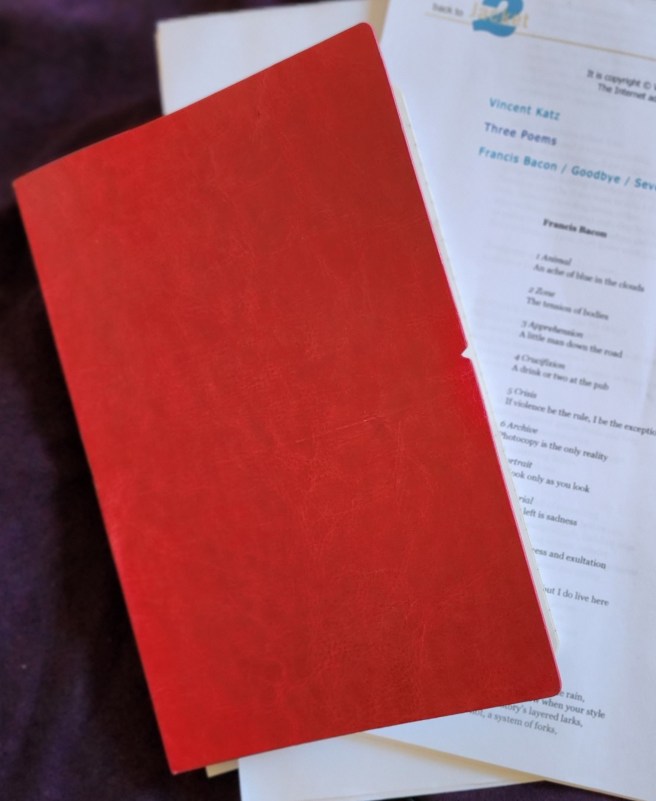
Vincent Katz and my little red journal

When I set about planning and packing for a week on the water last year, I knew I wouldn’t be bringing my laptop. The electrical power on the schooner was mostly from some powerful batteries and two small solar panels. We could charge our cell phones and had small lights in our cabins, but that was about it.

I did pack a Paris Review and a Harper’s magazine, should I feel like indulging in reading, but the heart of my “literary” life focused on a small red journal I had picked up a year or so earlier plus a few printouts of Vincent Katz poems that set a direction that has intrigued me.

Katz, like his father, the American painter Alex Katz, can look at mundane things in a seemingly flat tone that feels seminal.

Consider the line, “I wish I lived here but I do live here,” from “Francis Bacon.” It’s a feeling I know.

As he says in “Back on 8th Ave.”:

The job of the poet is not easy:
be utterly observant, tracking,
and to note down, in plain language,
with minimal emotional distortion,
what s/he sees.


For me, it had been ages since I’d sat down before a blank page and started off without any idea of where the words would be going. My usual journaling at least has a calendar full of events to catch up on, plus notes I’ve scribbled out, maybe even emails. And my more public writing has been things like this, with a purpose.

My goal was to fill the little notebook in a week. Quality or substance was not the measure. Just look and listen and try to be very much in the present moment.

It was a harder assignment than you might think. But it did provide much of the text for many of the posts you’ll be seeing this year.

Here are a few samples of what I entered:

looking for the obvious can be a challenge

 ~*~

Yellow house
behind a brown one
on a hill
flagpole and staircase
down to a wharf

the dreadful verses
you attempted
page after page
of aspiring youth
reached and fell

that stuff now is flatter
but more secure

likely no more profound
or less

don’t worry, Jnana, nothing’s happening
you’d think I could fill this small notebook with drivel in a week
but I’m halfway short

I did end the entries

[to be continued]

Hopefully, on an upcoming cruise in late summer.

Acid test poet: Anne Waldman (1945- )

Perhaps best known as a cofounder of the Poetry Project at St. Mark’s Church in Manhattan as well as the Jack Kerouac School of Disembodied Poetics each summer at the Tibetan Buddhist Naropa Institute in Boulder Colorado, Waldman has worked with many of the famed Beat poets a generation older in a life of experimental writing and social activism.

In preparing this post, I was surprised to find she’s only a few years old than me. She’s often seemed to be that much further ahead in the history of contemporary literature.

She first impressed me with a few poems in Disembodied Poetics, an annual review she co-edited. I liked the way the disparate elements danced, something in common with much of what I’ve written. Later, in her collected works, I was taken with the ways she employed repetition, something I had avoided as, well, redundant. My Preludes & Fugues, especially, are beholden to her on that front.

Acid test short-story master: Andre Dubus (1936-1999)

Short fiction is something of stepchild when it comes to literary respect in America. Novels get the serious attention, and the bigger royalties, yet as I discovered once I opened a collection by Andre Dubus, “Finding a Girl in America,” a short story can deliver much more than a rambling bigger tale. I quickly devoured two more of his compilations.

I came across his work too late for it to influence the early versions of my novels, but I deeply appreciated his craftsmanship and freshness. Though I’m far from the no bullshit, Cajun/Irish Catholic in a wheelchair in a dilapidated New England mill town character he was, the directness of his writing and his first-hand knowledge of blue-collar life in the Merrimack Valley resonated with me. I lived upstream of Dubus for 13 years and then just to the north, and there’s nothing fictional in his stories, from my perspective.

Before I had read any of his tales, bits of quirky encounters others had with the author, including the sharpness of his teaching had floated my way. Especially telling were the free weekly sessions in his home after an errant car had left him, in his words, a cripple sound much livelier than anything he had probably been doing at the now defunct Bradford College across the street from a friend of mine.

After I started blogging, one follower, an English professor, commented that he liked how much my posts reminded him of Dubus. I won’t go that far but did feel honored, all the same.

I do need to add his son, Andre Dubus III, to my TBR pile.

Acid test poet: Allen Ginsberg (1926-1997)

How curious that he should lead the parade. When my own poetry practice was taking root, back in the early ‘70s, I was largely unimpressed compared, say, to Bob Dylan. I didn’t pick up on the gay dimensions, either, only the rage of Howl. In fact, though I had some poetry courses, I wasn’t blown away by much of anything until I encountered Anne Sexton and Sylvia Plath’s searing despair. Everything was essentially head, not heart.

Over the years, my opinion of Ginsberg changed. I came to appreciate his lines that stayed close to their source of inspiration and the ways his poems faced current events. While much of his artistic voice is seen as an homage to Walt Whitman, I find his work is much more in the stream of the lives of the prophets in the Bible. I’ve come to love a masterful, righteous rant for justice, which his poems often are. (Just see my Trumpets of the Storm series, starting with Primary Care at my ThistleFinch blog).

I’ve also come to admire the seeming ease with which he presents an observation – his definition of New England as famed for red leaves comes to mind.

His 1973 collection, The Fall of America: Poems of These States, has been the volume I’ve returned to the most.

Despite his role as an avatar of drug highs or gay rights, he strikes me increasingly in his native Jewish robes more than in those of the Tibetan Buddhism he avowed. Maybe for that, you should read the book The Jew in the Lotus by Rodger Kamenetz.

Yeah, here we are already, with one author leading to another. But first, where is my set of Whitman?

Write about what you know, but best if it leads into what you don’t know

I’ve spent a lifetime writing – well, from my senior year in high school on.

I rather fell into a career as a newspaper journalist who worked mostly on the copy desk or a few steps beyond, with titles like news editor, lifestyles editor, makeup man (working closely with the production crew in what was called the back shop or, more politely, composing room).

My real dream was to have something more permanent as my legacy – books with my name on the cover and the spine. The fact was that as much as journalism engaged me, I yearned for a bigger picture than the daily deadlines usually reflected.

And so I spent much of my “free time” writing things that would never appear in a newspaper – poetry and fiction, especially, or even lengthy letters to friends and other writers. And, more recently, there’s been the blogging, which I hope you’ve been following.

Many of those years I despaired that my “serious” work would never appear as printed books, especially once I discovered how much effort was required to land even one poem in a small-press literary journal.

The persistence has resulted in eight books of fiction to my credit plus more than a thousand published poems and a few chapbooks.

The most successful entry has been Quaking Dover, a history of one of the oldest Quaker congregations in the New World.

~*~

As my diamond jubilee year wraps up, I’m reflecting especially on those eight books of fiction and the life that’s produced them.

You’ve heard the adage, of course, “Write about what you know.” But I’ve come to see how important it is to also write about what you don’t know, especially where it’s at the edge of your existing knowledge. I am among those who write as an attempt to make sense of something personal, which means being something of an explorer or discoverer or laboratory technician. A good writer, I’m thinking, wears many hats, at least of the proverbial kind. Let me confess I rarely wear a hat of any kind, though I should, considering the balding and sunlight and many skin cancers.

Drafting a story is work, even on those rare and exhilarating flashes when it seems to write itself and you’re flying too fast to worry about spelling or grammar or other details. But it’s not the most difficult part of the practice.

Revisions, I should emphasize, are everything. Or at least the hardest part, and the more essential part of writing in the hope of a readership. I find that in hard revisions I discover more of what I’m coming to know.

With my focus on Quaking Dover for the past three years, I’ve neglected my earlier books. Returning to them this year feels like a good exercise, for you, dear reader, and for me.

One of the regular weekly features here will be on things behind my books. The stories themselves already speak on their own.

Please stay tuned and tune in.

Get ready to meet some crucial writers along my journey

You’ve no doubt heard more than one person boast that their life could be a book, perhaps even adding that it would make a fortune and lead to fame. Perhaps you even shuddered because this was somebody who doesn’t read books, somebody essentially uninterested that way. As a fellow writer once quipped, he could simply look at a page and tell immediately if the creator was a reader.

The fact is that good writers are also devoted readers. We are inspired by good models, informed by their content, and strengthened by their style and structure. They give us standards to measure up to, excellence to aspire toward, and frontiers to explore. They caution us against getting lazy or complacent.

As my diamond jubilee winds down, I find myself reflecting on novelists and poets and a few others who have accompanied me at some crucial stretch in my writing and editing practice. I’ve come up with a list of 50 plus one.

It’s a quirky list, with an emphasis on those who have been influences at one point or another. Sometimes just one book is enough to leave an impact. I’m not calling these “favorites” – much of my pleasure reading isn’t necessarily that original or elicit that spontaneous “Oh, wow!” reaction. Think of what I’m presenting as godfathers and godmothers of a work. These have served as touchstones or charm stones, elders, wilderness guides, guardian angels. They weren’t there to be imitated or copied but to provoke, definitely, and sometimes comfort.

Over the coming year, I’ll present one a week. They’ll run alphabetically – by first name, just to shake up expectations.

Feel free to name your own personal top writers in the comments as we go. If you’re a reader, one name will lead to another.

Onward!

Looking forward while looking back

Somehow, each year here at the Red Barn has taken on a special spin, despite the merry-go-round sequence of postings, categories, themes, and tags. Or maybe because of that.

While I keep looking forward to “retirement” of some kind, new material for this blog hasn’t let up.

Last year, many of my recorded dreams became a regular presentation, but I’ve run out of those. Previously, prose-poems had their run. Newspaper Traditions are now far in antiquity. And many of my poems are available at my Thistle Finch blog for reading or download. Yet I’m living in a newer, much different, world, lucky me.

Many of this coming year’s postings are shaping up as once-a-week series.

Now that the house renovations are actually happening (Huzzah! Huzzah!), you’ll be seeing that progression on Saturdays. I mean, how many times do you get to watch an old house be torn apart and rebuilt while the residents are still within it? As we were or let me say are.

My week out on Penobscot Bay in a historic schooner provided enough text and photos for a series on Sunday mornings. For me, it’s still dreamy. Hope you see it that way, too.

With a presidential election coming up, I’m returning to a clearer understanding of what’s at stake based on the Federalist papers through excerpts you’ll be seeing on Thursdays. It was that or some childish and more current quips of my own. I see this as more principled.

As a break in my Quaking Dover book reflections, I’m turning to a series looking at what’s behind my published novels. See that in contrast to “what they’re about.” That series of posts is set for Fridays.

Add to that is a series on Mondays, looking at authors who have influenced me one way or another. They’re not necessarily my “favorites,” but definitely ones I want to revisit in my years ahead.

Meanwhile, the Tuesday Tendrils, ten items about whatever strikes my fancy, will continue, as will the Sunday night Kinisi.

I promise you these posts will encompass another full year. Please stop by often, and leave comments, especially. I still think your contributions are the best part.

Happy New Year, dear readers.