To add the word ‘island’ to Grand Manan would be redundant

Despite our many trips to Cape Cod back when I lived not that far away in New Hampshire, I never got around to visiting tony and history-laden Martha’s Vineyard or neighboring Nantucket. It’s an oversight I don’t want to repeat when it comes to Grand Manan, an impressive Canadian island we can see from some points here in Eastport, Maine.

I am hoping to get there this year. Even if I don’t, here are some high points:

  1. Its closest point on the mainland is the town of Lubec Maine, nine miles across the Grand Manan Channel. For mainland New Brunswick, it’s Blacks Harbor, 20 miles over the Bay of Fundy. Yet if you look at most maps of Maine, it doesn’t show up at all, despite its proximity. That part
  2. As the largest of the 25-plus Fundy Islands, Grand Manan is 21 miles long and has a maximum width of 11 miles, covering 53 square miles in all. (Campobello and Deer Island, which border Eastport, are the second and third largest, respectfully.) It’s home to 2,595 year-round residents.
  3. The principal way of getting there is by a 90-minute ferry ride from Blacks Harbour. Reservations are recommended, both ways.
  4. For comparison, Martha’s Vineyard is 20.5 miles long, covers 96 square miles, takes a 45-minute ferry jaunt, and has 20,530 full-timers; Nantucket covers 45 square miles, is a 2¼-hour commute by traditional ferry, and has 14,444 residents. Both of the Massachusetts towns are much wealthier than Grand Manon, where most folks eke out their living “on the water.”
  5. The economy is based primarily upon commercial fishing – lobster, herring, scallops, and crab – plus ocean salmon farms and clam digging.
  6. For the traveler, the island is largely a step back in time, with a single highway along the eastern half, where most of the modest residents live. That leads to the rest of the Grand Manan archipelago of nearby smaller islands such as popular White Head (reachable by a second ferry ride), Ross Cheney, and the Wood islands, plus countless surrounding shoaling rocks. Meanwhile, the rugged and forested western side, with 300-foot-high cliffs, high winds, numerous passages, coves, and rocky reefs, incorporates wildlife-rich preserves.
  7. Tourism, the second source of income, provides unspoiled ocean views, whale-watch cruises – rare right whale breeding grounds adjoin its waters – as well as kayaking, hiking, camping, photography, painting, and bird-watching with more than 240 species, including nesting puffins in season.
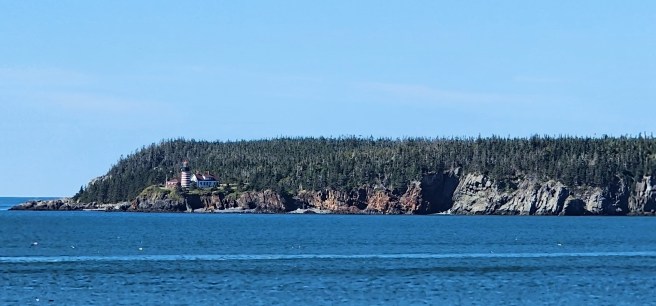
  8. Among the lighthouses to check out are Gannet Rock, Swallowtail, Southwest Head, Long Eddy Point, Long Point, and Great Duck Island. Not all of them are what you would call picturesque or prime condition. Not to slight them.
  9. Linguistically, “Manan” is a corruption of mun-an-ook or man-an-ook, meaning “island place” or “the island” in the local First Nations’ language. The suffix ook, meanwhile, means “people of.” French explorer Samuel de Champlain recorded the place as Manthane on a 1606 map and later changed it to Menane or Menasne – close enough in sound. So if Manan already means “island,” why be redundant? You don’t need to add “island” to the Vineyard or Nantucket, either – everybody knows what you mean without it.
  10. Grand Manan’s not for everyone. As one review said, “A long way to travel for nothing. Nice rocks but you can see those in Maine. Sea glass was hard to find and sparse. Very poor, depressed area. Lighthouses are ugly and there is nothing to really do other than hiking, which you can also do in Maine. Ferry stunk and was disgusting. Never saw any whales or seals. Nothing on the island except rundown shacks. All the online promotions are just hype. Waste of a day. … Go to Campobello island, it’s 100% better.” In short, sounds right up my alley for adventure.

The first permanent settlement, by the way, was in 1784 by Loyalists fleeing the U.S. at the close of the American Revolutionary War, a common occurrence across New Brunswick.

If you’re dreaming of  a vacation in Maine, please consider …

The weather can be iffy, even in summer. Your week by the beach may be mostly rain and or fog. Plan accordingly. There’s nothing wrong with hunkering down with a good novel when you’re away from everyday distractions.

Where I live the ocean is too cold for swimming. Period. Even before factoring for the currents. Further south and west, this can be iffy.

Black flies. They’re early summer, to mid-July. Inland, especially. You’ve been warned. They’re even worse than swarms of mosquitoes.

As for your expectations? A more laid-back lifestyle perhaps with antiquing is one thing. If you have kids in tow? That’s another. Hope they enjoy the outdoors.

If you go for a whale-watch anywhere, what you wind up seeing is what you are given that day. The best part may be simply the cruise out and back from the prime ocean. There are no other guarantees.

In many destination locations, retailers are faced with a six-week business model. Restaurants, lodgings,  and stores have to cover most of their year’s expenses in those few intense weeks and then hold on through the rest of the year, if they stay open at all. Prices will be higher than you might like.

Nightlife may very well mean looking at stars.

A feel for the water and wind

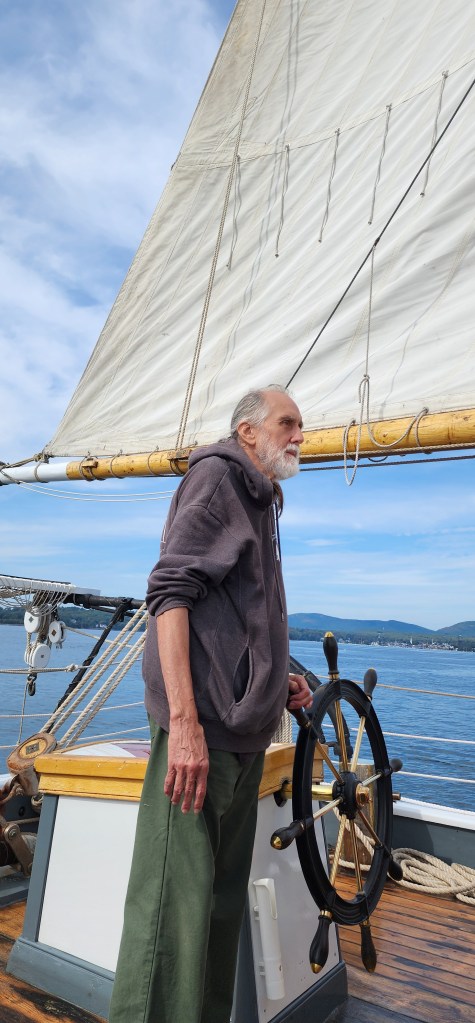
On cruises aboard the historic schooner Louis R. French, passengers get opportunities to pitch in with the work. We help raise the anchor and the sails in the morning and we wash our own dishes. Sometimes, when the water’s calm, we even get a spell at the wheel, where you do get a feel for the interaction of the wind and water as well as the delay in the boat’s response to a change in the course. Here I am at the end of last summer.

For poems related to the sea, check out my collection Ocean Motion at Smashwords.com.

Looking at mainland New Brunswick

Americans, in general, know little about their “neighbor to the north,” meaning Canada, though where I live it’s actually closer to the east.

That said, I’ve been learning principally about its province of New Brunswick, with its border coming about a mile from our home.

Here are ten highlights.

  1. It’s one of the three Maritime provinces – the other two being Nova Scotia and Prince Edward Island – and one of the four Atlantic provinces when Newfoundland, which includes Labrador, is added in.
  2. It was set off from Nova Scotia in 1784 when 10,000 Loyalists arrived in exile from the new United States at the conclusion of the American Revolution. They established communities like St. John, St. Andrews, St. George, St. Stephen, and Fredericton. Some of them had even dismantled their homes in New England, shipped them, and erected them anew.
  3. Half of today’s population of 850,000 lives in three urban areas: Moncton, St. John, and Fredericton. As a result, New Brunswick, rather than say Manitoba or Saskatchewan, is proportionally the most heavily rural province in Canada.
  4. Although the first attempted French settlement in the New World was on St. Croix River, 1607-1608, on today’s border with Maine, it was abandoned. Later French colonists, from 1629 on, created a unique society based on dyke-based cultivation of tidal marshes along the Bay of Fundy. French authorities referred to the region as Acadia.
  5. The Treaty of Paris in 1763 not only ended the French and Indian wars with the English colonies but also gave England unchallenged rule of the region, leading to the forceful deportation of 12,000 Acadians. Those who emerged in Louisiana became known as Cajuns. Enough remained in New Brunswick to make it officially bilingual today – the only Canadian province so designated.
  6. About 8.5 percent of the population speaks French only. It’s a dialect stemming from southwestern France and is distinct from Quebecois elsewhere in Canada.
  7. Two-fifths of the city of St. John was destroyed by a fire that broke out in June 20, 1877. Among the 1,612 structures lost were eight churches, six banks, 14 hotels, and 11 schooners. Nineteen people were left dead and about 13,000 people became homeless.
  8. Today the city is home to the powerful Irving Group of Companies, including the gas station chain.
  9. Tourism is also a major economic factor, with the Bay of Fundy and its world’s highest tides as a central attraction. The province also has 58 covered bridges, including the world’s longest, and about 100 lighthouses, not all of them active.
  10. Four-fifths of the province is covered by forest. The Appalachian range extends across the northern half of the province.