UNDER THE SEA


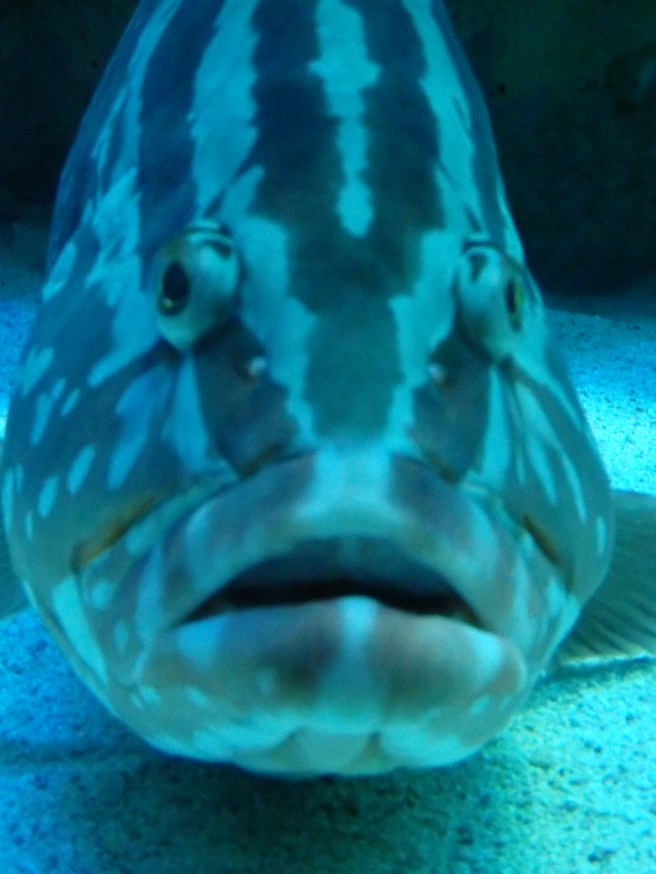
Looking at you, too ...
Looking at you, too …

The big tank at the New England Aquarium provides close-up views of oceanic stars.

Boston is a rich and varied destination – the Hub of New England, or the Universe, as they used to say. Living a little more than an hour to the north, we’re well within its orb.

Somehow, I'm reminded of a butterfly.
Somehow, I’m reminded of a butterfly.

LIBERTY

Few people move to desert out of any desire for its peculiar landscape. True, there are those who hope its dry air will alleviate some health problem, yet even they typically install green lawns and shrubs requiring frequent irrigation. There is the prospector expecting to strike riches to squander elsewhere, or the cowboy or shepherd accompanying the herd or the flock, or a refugee or smuggler moving across the opening as a place of the least likelihood of detection or the least resistance in the border. Admittedly, some come to a particular job or to retire. Some come for opportunities of outdoors recreation — proximity to forested mountains or snow-fed rivers rather than the tawny dry ground itself. Almost all, however, have taken flight from something back there — whatever their birthplace or last residence — more than any deep conviction that this horizon embraces their Promised Land. They arrive with boxes and garments, with reminders of conflict or distance. Moreover, they cling to the desert fringe — settling in oasis towns or cities where irrigation water rushes along cement ditches — rather than miles beyond their next neighbor, with only buff surroundings.

My wife and I are no exception.

At the office, I’m asked, Where were you born? What brought you here? Where are your parents? I calculate: few children live within a day’s drive of grandparents, aunts, or uncles. Compared to my birthplace, cemeteries are rare. Nobody admits fleeing family, which is a fact of life. The trout fishing, they say, is unsurpassed. There is salmon. If you have water, you can garden nearly anything to perfection. You can hunt elk in the mountains or various quail in the foothills. You can raft on the river. There’s no rain to speak of, and overcast days are infrequent, excepting the winter.

I explain my reasons were professional. I’m establishing a career and am something of a specialist whose last job was eliminated by sharp, painful budget cutbacks. Here, at least, I have opportunities to advance as a manager, working under a progressive-minded mentor. I accept this move as a shortcut before moving on, to bigger things beyond that horizon. Besides, I’ve promised my wife that somehow we’d relocate to this corner of the nation, a place she fondly remembers from four years of childhood. Following me in this move, she’s distraught to find desert where she anticipated rainforest. In short, both of us suffer dislocation.

Here, then, a rewiring begins. Some of it connects the person to the place. Some of it, the two people to each other. Some of it, the individuals to their dreams.

Horses preserve a way of desert life. Consider rodeo. Agriculture is spelled rancher, not farmer: Even fifteen acres becomes a ranch. There’s great distance nearly anywhere you’d want to go. Religion polarizes into New Age, on one hand, and fundamentalist, on the other, with little in between; this condition is as true within denominations as across the diverse range of religions themselves. There’s a different spectrum of ethnicity to contend with, too — Native-American, Hispanic, and Asian. More, too, than the Eurocentric nationalities and African consciousness he had seen Back East — to say nothing of rearranged economic strata. Within and without. The bum on the corner turns out to be a multi-millionaire who owns a thousand acres. Here cattle are not cows; it’s beef rather than dairy. Federal government agencies are omnipresent: the Bureau of Reclamation manages hydroelectric generation and irrigation; beyond, there are military bases, national forests, tribal reservations, high country meadows, famed parks, Corps of Engineers reservoirs, state-owned sporting grounds, horticultural boards, Extension Service projects. People apply to the Feds when they file for grazing rights or mineral mining stakes supposedly there for the taking. You’ll observe unspoken contradictions, beginning with the right-wing rhetoric common within these federally subsidized communities. As for the Bureau of Reclamation: how dare we say we’re reclaiming when we’re merely putting our human stamp on a piece of soil by diverting water and planting? Maybe we’re declaiming or proclaiming instead. The Bureau of Indian Affairs appeared even more unsettling. Chiefly …

I am learning. There’s good reason the rattlesnake-infested, corrugated humps encircling the orchard valley are pale brown: they receive none of the snowmelt impounded from late March into July in the high mountains. Agencies release and distribute that water through blazing summer into October. Green agriculture parallels the river and irrigation canals, defying the tough, roasted inclines above, where sagebrush and bunchgrass stroke tawny eternity. In this compass, wind rarely precedes rain. Beyond lucrative strips of orchards, the principal agriculture involves herds or hay; because of irrigation and unfettered sunlight, five mowings a year are common; bales are trucked to dairy cows and pleasure horses on the rainy side of the tall mountains. Desert has few chickens — and no pigs to speak of. Somewhere out there, Basque shepherds elude the heat. Forests begin at the top of high ridges observed fifty miles distant.

In the Far West, most men hunt and fish. Their goal is big game: deer and elk, especially. Big trout and salmon, too. Everything else remains “Back East” or target practice. Its vastness hammers the imagination.

On our journey westward, we notice that Custer National Forest flanks the barren holdings of the Crow and Northern Cheyenne reservations. Somehow that summarizes a Far West polity in what I thought would be a classless society.

For more insights from the American Far West and Kokopelli, click here.

IN SEARCH OF DEEPER EXISTENCE

We made a leap, heading off nearly stiff-necked to find ourselves, as some diners proclaim, “served where quality counts.” Over steak dinners, this quaking closet monk is surprised by how much change can happen when I think nothing is moving. Just pass the salt, sugar, coffee, cream — thunder, please — in what they call the Brand Room surrounded by “Western art,” supposedly realistic styling of cowboys, Indians, and wildlife in dramatized poses. People from all over the world come to a few tiny rodeo towns like this to collect such canvases. Examine the pieces closely, though, and you perceive the false notes. The clothing, poses, landscapes distort. The artists react against the very masters they wish to emulate. Much of it is cranked out without looking acutely at the things being portrayed. Some may be driven by a worship of a past that never was quite that way; some, by a retreat from current events. Most viewers merely acknowledge symbol and go on as though sleepwalking, an act that continues misunderstanding. The rifle, saddle, spurs, and cougar evoke no real emotion: they are foreign to the touch and nose. But I desire to perceive this territory afresh — no matter how startling my findings deviate from convention. When I meet a bear or a buffalo, it won’t be like the dilated scoundrels in these paintings. My horse won’t rear behind me. He’ll simply center in his tracks — quiet, aware, efficient. He knows how it will be.

The Dedicated Laborious Quest begins with sustained exercise of a specific activity: a sport, an art, a science. Anything that requires years of individual exertion, even solitude, drawing upon many facets of the practitioner’s being — heart, mind, soul, and might.

Somehow, the novice begins dancing, if only in his head. Something simple, at first, until familiarity gains ground. Feet, legs, torso, arms, and hands eventually follow. A reel leads into a jig. Thought and emotions balance. Head and heart dialogue. With confidence comes freedom. More and more, the aspirant concentrates on partners or the group or motion itself, rather than his own next step or position. The music becomes more textured, until the hornpipe stands as the liveliest structure. So it’s been in this landscape. This is not just any desert, for there’s nothing generic about any detail encountered closely. With both people and places you come to know dearly, you find nuances and subtle contradictions will blur any sharp image. It’s easier to describe someone or something you meet briefly than what you know intimately. To say desert is dry and sunny misses the point, especially if you arrive in winter. At first, like so many others, we didn’t even consider this valley as desert, for it has no camel caravans or mounds of shifting sands with Great Pyramids on the horizon. One word or phrase can be misleading. Even the Evil Stepmother from folklore and fairy tales must have possessed some redeeming qualities. Could we be more specific than “evil”? Simply selfish? Or was she mean, jealous, domineering, afraid of whatever, from the wrong party? Suppose she was really a victim of some deep abuse? The portrait changes. Has anyone detailed how she dances? In the end, it’s either entertainment or worship, depending on the individual’s orientation. An authentic spiritual discipline teaches, through experience, we are not gods. Choose, then, good or evil, flowing or hoarding, living or dying.

Matching maps to the landscape, I look vainly for towns that do not exist or discover attractions placed on the wrong side of the road. Admit that everything is moving and transitory, even the mountains. Mariners, too, will speak of shifting sandbars as only one hazard of sailing on charts. Pay attention, then, but never toss your maps overboard. Are they all that different from Holy Scripture?

In a multitude of ways, people fear religion will lead them not just into wilderness but a desert. Demand, in fact, they leave everything behind. The description will vary by tradition. Entering the Void or emptiness, becoming selfless or egoless, abandoning the Little Self for the Big Self, achieving annihilation and sacrifice, attaining renunciation (Sannyasa), taking up your own Cross — these are a few of its names. Marriage adds its own complications.

Having come to the desert, we now know the fuller value of water. Something simple, essential. No one can live without it. The list of necessities is a short one; the possibilities of embellishment, endless.

There are rivers on every map you rely on. Sometimes when I walk out into the expanse, I encounter one. Sometimes, one deep enough to block my way. And then I turn to the page for a bridge.

Or, better yet, call out for my buddy, Kokopelli.

For more insights from the American Far West and Kokopelli, click here.
PARADING THROUGH THE PUBLIC GARDEN

Happy birthday, Mr. President!

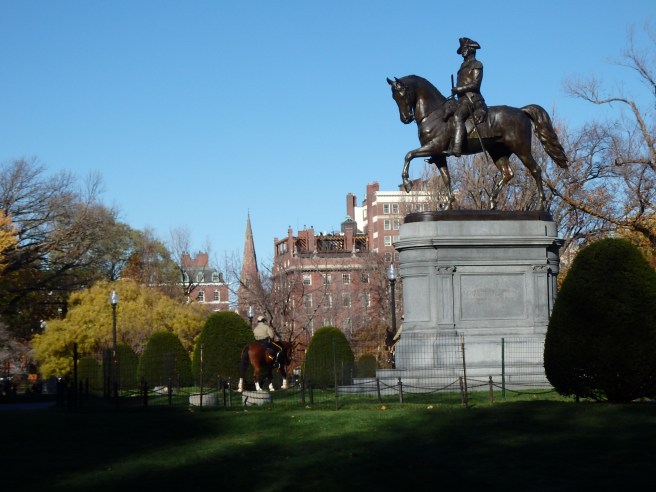
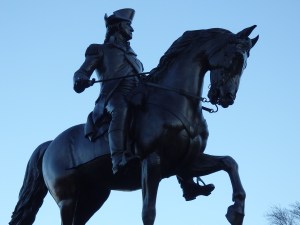
George Washington rides in full splendor at an entrance to the Public Garden. Sometimes he’s not alone, no matter how much he overshadows mere human equestrians.

Boston is a rich and varied destination – the Hub of New England, or the Universe, as they used to say. Living a little more than an hour to the north, we’re well within its orb.

The horse really adds to the impression.

THE INTERIOR SURPRISES

When the Pacific Northwest is mentioned, most people envision lush evergreen rainforests amid glacial mountains; few consider the desert that occupies most of Washington State, Oregon, and Idaho. I now explore the western end of the largely treeless expanse beginning within the Dakotas, Nebraska, Kansas, and Texas and extending almost to the Pacific Rim itself. Remember, a leafy tree requires thirty inches of rainfall a year to survive; an evergreen, somewhat less. My valley received an average of a little more than seven inches a year. Having grown up adjusting to muggy summers, I find a desert can affect my spirit in more ways than I ever would have imagined.

But you can choose, too, not to call everything by the names on maps. As geographies are being transformed ever more rapidly, few outward specifics hold long. Seek instead the vibrations of a site, sense its unseen roots and unexpressed timeless potential. In that vein, another depth appears. Perhaps each human inhabitant will go beyond basic misunderstandings. As I still hope.

Some maps are even jigsaw puzzles. And you think they’re for children?

Returning from that first trip to India, my spiritual mentor remarked that each village had felt different. “It’s more than appearances. The difference is the distinct vibration of a site. Many of their deities belong to a specific locality. One village will worship one god; another will enshrine another.” That’s how they identified the unique quality of a spot, just as Westerners have chemical elements to define physical qualities of a substance.

Even though I wasn’t quite certain of their origin or all of their psychic flavors, I sensed such subtleties. There are spiritual fingerprints certain people leave behind: a Quaker or Dunker neighborhood, for instance, may have a distinctive feel even a century after those worshipers depart. The same seems to be true for American Indian sites.

For more insights from the American Far West and Kokopelli, click here.

LEVIATHAN, AS AN EMBLEM

1

now to see
North Atlantic
in my sphere

landlocked
till twenty-eight

that week, camping tide-to-tide
beside North Pacific

and you speak of turning to Christ?

2

who found the eagle in the desert canyon
and high mountains
before the Upper Mississippi
or Great Falls of the Potomac?

still, moose fail to inspire me
as elk did

3

whales, then
rather than moose
in contrast to elk of the Yakima Valley

this mirror of historic economy

besides, moose and whales do not leave tracks
everywhere we trek here,
unlike the elk out west

to say nothing of ticks

4

water, defining land
defining water
and the overlap

I want to know what the ocean voices
in its repetition
addressing the absent moon
or distance, even in the erasure

bank of fog
curtain of resounding
fog horn or bell

or vast silence
before

the hundred thousand variations of nor’easter
just off this point

no need to circle the planet

we have our fill of floundering
agents of change

Poem copyright 2016 by Jnana Hodson
To see the full set of seacoast poems,
click here.

INDUSTRIAL AGE BIRTHPLACE

This is where it began.
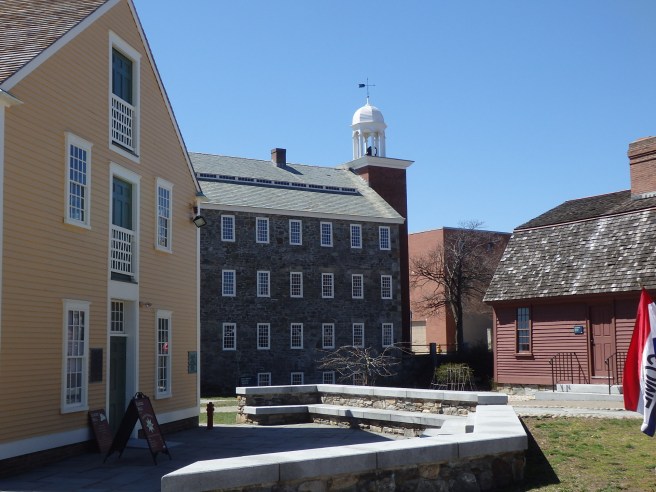
This is where it began, starting with the Slater Mill on the left and building into the Wilkinson Mill, center.

The modest Slater Mill complex in Pawtucket, Rhode Island, is honored as the birthplace of the American Industrial Revolution.

The operation originated when apprentice Samuel Slater slipped through British security with secrets for textiles manufacturing and was hired by Moses Brown to replicate them in America, with the mill opening in 1793.

The fact that Brown, a Quaker, and his partners advertised for what was essentially stolen information troubles me – I do wonder how they justified their actions when questioned by their Friends meetings. The English, meanwhile, had long before enacted barriers that penalized fellow citizens in Ireland and America. Perhaps that was sufficient inspiration, even before the American Revolutionary War. Perhaps one action apologized for the other.

I was resting my finguers on this waterpowered lathe when I realized it was the origin of mass-production.
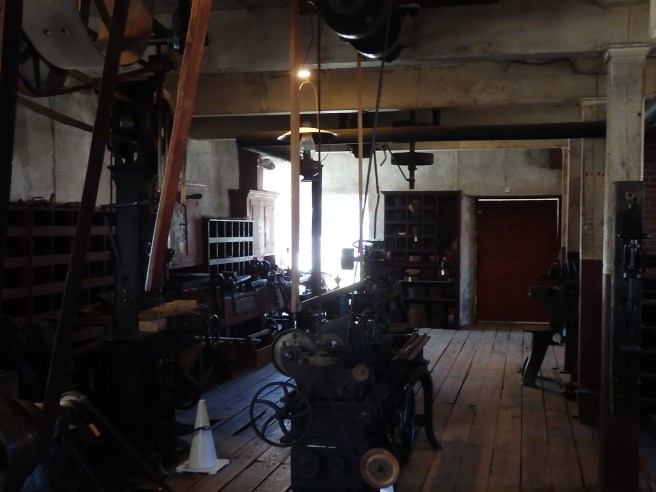
I was resting my fingers on this water-powered lathe when I realized it was the origin of mass-production. Without uniform parts, each item would have to be handcrafted from scratch.


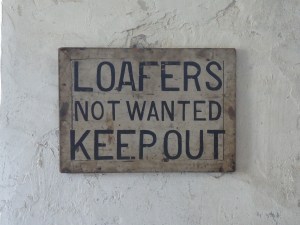
There were differences between the Quaker Work Ethic and the Puritan Work Ethic, but they would have agreed on this sign.

More remarkably, though, Slater’s assistant, David Wilkinson, then provided the next leap – a lathe that produced large screws that were far more uniform than those painstakingly made by hand. Whether he or Henry Maudslay in England was the first to produce such precise work can be argued, but the results were the foundation for the innovative precision toolmakers who would transform industry. This was, in effect, the foundation for mass production. The thinking behind Wilkinson’s model inspired a league of New Englanders to advance the technology in applications across the region.

I doubt this was the origin of the phrase “Yankee ingenuity,” though it certainly fits.

My fondness for old mills, by the way, did prompt a novel, Big Inca.

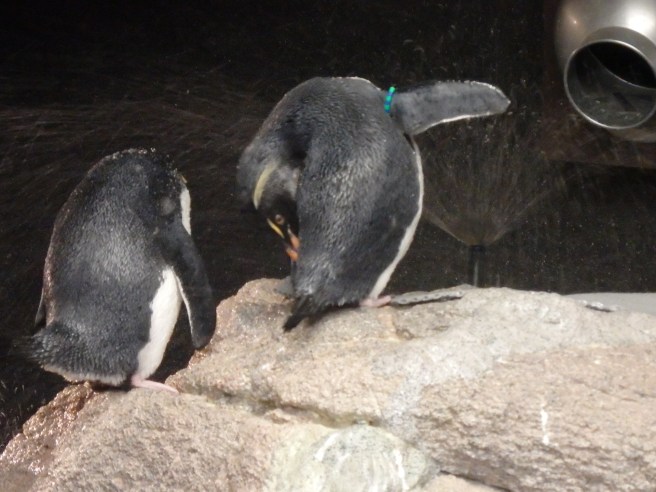
OH, SUCH PLEASURE IN THE SPRAY!

Penguins at the New England Aquarium take utter delight in the periodic rounds of spray around their pool.

The New England Aquarium at the edge of Boston Harbor is a fascinating destination. And penguins can be endlessly amusing.

Boston is a rich and varied destination – the Hub of New England, or the Universe, as they used to say. Living a little more than an hour to the north, we’re well within its orb.


MAPPING MORE THAN GEOGRAPHY

I had no knowledge of the streams of quiet rebels who experience divinity directly, thanks, in part, to the map of their heritage as they work with the soil and their own bodies. These days, they resist as best they can the manufactured desires beaming from satellites or television airwaves, even while they watch many of their children succumb to these temptations. They could tell us about Elijah or Jeremiah, the Babylonian captivity, or the Maccabees’ war of independence, in addition to my own ancestors’ sufferings recorded in The Bloody Theater or Martyrs Mirror of the Defenseless Christians or Joseph Besse’s A Collection of the Sufferings of the People Called Quakers, for the Testimony of a Good Conscience. When, at last, I reclaim this legacy, piecemeal, I ask, “So whose story are you telling, anyhow? Which grandparents are yours?” Opening their maps, I follow their footsteps, even in a strange land. Well made cartography includes supplications and blessings, as well as warnings.

My own homeland once included many woodlands well into my grandfather’s childhood. A balance of forest, with its firewood and construction timber, and farm fields and pastures. So much so, in fact, that people could travel dozens of miles on roads that never left forest between cities. By my own childhood, however, most of the trees had been leveled, and even the woodlot on an uncle’s farm doubled as pasture for hogs and cattle. In winter, the countryside was a stubble wasteland.

Similarly, a prairie denuded of buffalo is impoverished. How much poorer is a suburban lot occupied by restless greed? Here I am, dwelling in desert I consider healthier and more vibrant than the construction I see overrunning the lands around cities and towns. “Rebuild at the core,” I urge the wind. “Repent!” Turn about! Bring back the buffalo and the buffalo nickel, as well as amicable urban neighborhoods. There are all kinds of communities, and humans are only part of the equation. There is land, there is sky, there is water and flowing. To say nothing of what exists beneath them.

A person who comprehends maps will appreciate history as well. Perhaps even musical scores, as another kind of map with a dimension of time.

I listen to my wife and learn of the mental maps many women carry. The ones of kitchens or gardens. Others leading to childbirth and parenting, or even away.

I, meanwhile, come here for a taste of primeval wilderness — a hope to experience a timeless reality that holds humanity in a state of awe rather than arrogance. Just look to the mountains for salvation. Look as well to dreams, each one having one foot in your past and the other in your present.

Carried to an intelligence that daylight conceals, I sense that within many rapidly fading distinctions I’ve scorned are important markers; these ranged from where to harvest wild berries and their uses as food and medicine to my own ancestors’ hymns and religious teachings. To be creative means building on what’s come before, rather than entering a new universe. The path on the map goes from one place to another. Respect is essential — another way of honoring one’s fathers and mothers. There’s still time to cultivate individuality and character in the field. Sometimes, even where homogeneity is perceived, a people can differ as sharply among themselves as they do from others. Ponder Polish Catholics in Chicago, Congregationalists in Ohio’s once-Yankee Western Reserve, and fire-breathing Baptists and Pentecostals in Detroit and what they might do to enhance each other’s heritage, rather than striving for some common denominator. That’s another way of lifting up mountains, rather than leveling. Even on flat land, each body leaves a hidden stamp on its soil. Learn to read vibrations of an environment, and you identify communities dwelling therein, sometimes a century or two after their departure. Through the news and entertainment media, I grew up knowing more of Manhattan and Capitol Hill, though they were only incidentally closer geographically than Kansas City or Minneapolis, supposedly within my Midwestern realm. I knew more, too, of Hollywood back lots and Beverly Hills. Indeed, not until much later had I recognized the Midwest I’d considered so conservative and culturally backward was, at the beginning of the twentieth century, a hotbed of radical politics and organized labor. Many of its cities elected Socialist mayors only to replace them with Ku Klux Klan within the decade. Talk about upheaval! In the front parlors of homes in many small towns across the Plains, the latest wave of European high culture was performed; three of the nation’s oldest handful of symphony orchestras were organized (St. Louis, Chicago, Cincinnati). In the machine shops of isolated barns and backyard stables of small-town entrepreneurs, curious Midwestern farm boys tinkered perfecting the automobile and a thousand other industrial marvels. Kite-flying bicycle-building brothers put men in the air.

Much of this I did not understand or appreciate when dreaming only of escape. Only now did I come to see what remains of a once rich and varied heritage. In those days I looked off to the limits of a world; fixes like Boston and Seattle as strands of Utopia. What I encountered instead was a step beyond the anticipated. Of the neighborhoods I would come to call home, none quite fit what people expect of East Coast, Midwest, or Pacific Northwest, either.

For more insights from the American Far West and Kokopelli, click here.