YANKEE

1

don’t presume the ocean is smiling
or the gulls enchant
the spire warns you

especially in New England

to step
back from the wreckage
or unexpected nor’easter

2

gales and furies
sweep up and disappear within hours
behind placid indifference

raise public duty

expense and craftsmanship
defining coastline
signatures, on the dotted line
in the clearest conditions

3

pointer / referent / rhythm of light / solitude or
loneliness / romantic illusion / high-maintenance history
lightening bolt / flicker / flare / discharge
beer can or wine bottle uncorking or blowing its cork
tourist magnet / spike / whistle, horn, upturned bell
observatory / night madness / memorial / first end of the sea
fist of defiance / ordered rock on rocks / spiral staircase to sky
to the horizon / a hollow tube / a composition of lenses
slivers of glass / slivers of crystal / a glass circle carousel
a hermitage / pigeon roost / billboard / thumbtack
anchored ship’s bridge / silver cup tilting / upraised finger

4

Boon Island, flashing white every five seconds
projects nineteen miles out to sea

Goat, faintly to the north

to the south
White Island, out in the Shoals

and Whaleback, would be double white flashes every ten seconds
just over the trees

way off, Thacher Island Twin Lights
(aka Cape Ann Lights or Rockport, Mass.)
project seventeen, but viewed from up on rock

at Nubble, some extra distance
on a rare night

of calm
antiquity

joining the squat red beam
and strobe flash
each one
proclaiming liberty
over any face of oppression

the tyrant sea offers

Poem copyright 2016 by Jnana Hodson
To see the full set of seacoast poems,
click here.

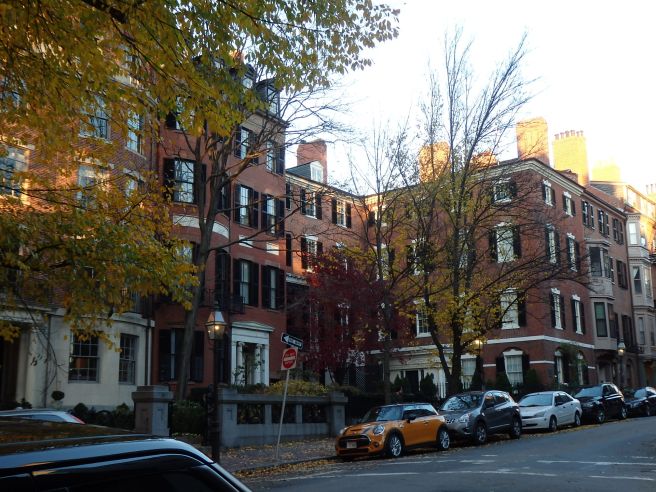
HIGH VICTORIAN

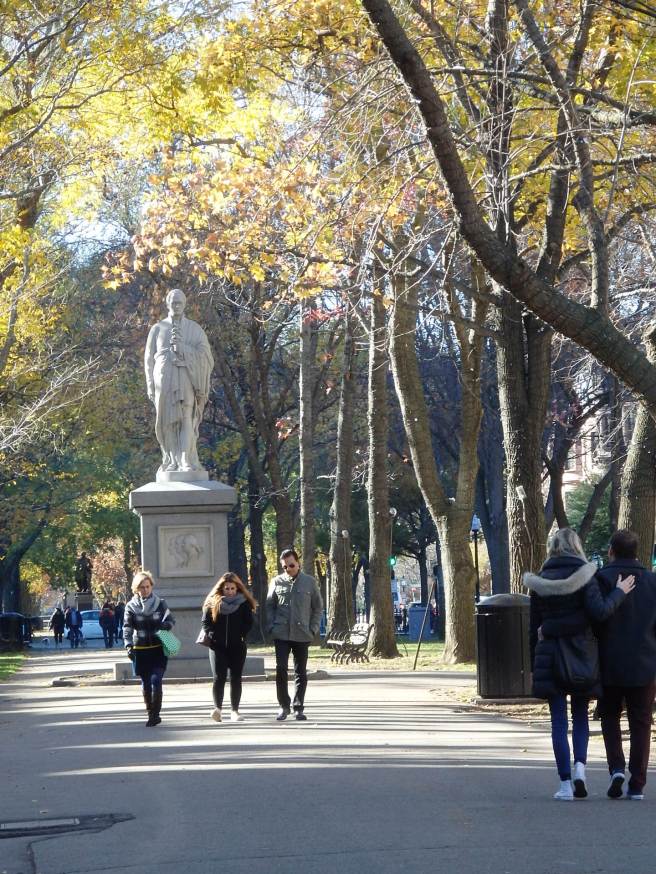
Strolling through the neighborhood.

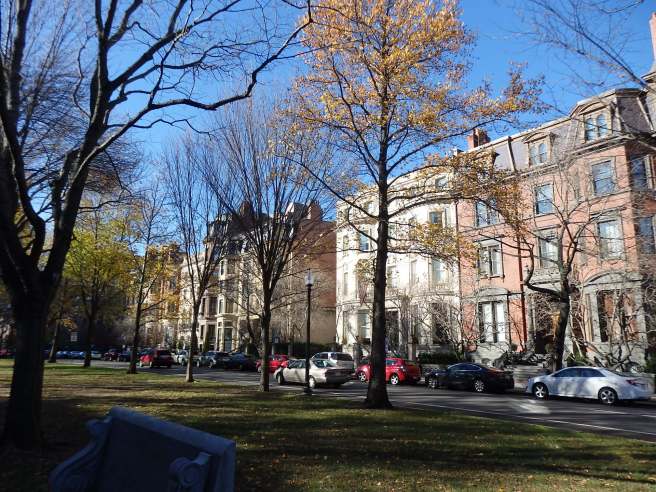
Boston’s Back Bay boulevards reflect the rising wealth of the city in the aftermath of the Civil War.

Boston is a rich and varied destination – the Hub of New England, or the Universe, as they used to say. Living a little more than an hour to the north, we’re well within its orb.

Boulevards lined with housing like this.


IN A WHIMSICAL VEIN

Atop Fanueil Hall.
Atop Fanueil Hall.

The cricket design of the weather vane atop Faneuil Hall always delights me. Or, as I long wondered from the ground, could it be a grasshopper?

Whichever, the craftsman and the client both demonstrate a lasting sense of delight in the realms of nature. Turns out to be a cricket after all, crafted in 1742 by Deacon Shem Drowne, perhaps inspired by similar weather vanes on London’s Royal Exchange building. The cricket, by the way, is the only part of the historic building to remain unchanged from the 1742 original. A 1761 fire gutted merchant Peter Faneuil’s original structure, and in 1805 architect Charles Bulfinch designed additions that doubled the width and length of the building while keeping the basic style to produce what we see today.

Boston is a rich and varied destination – the Hub of New England, or the Universe, as they used to say. Living a little more than an hour to the north, we’re well within its orb.

RIDGES AND RIVERS

Someday I’ll learn the identities of clouds. Buy the chart, memorize their qualities and forms, and then watch the flowing sky afresh. This is, after all, yet another strand of mapping.

From childhood, I’ve absorbed maps. Mind travel. Concepts augmented by photographs and writings, which have often furnished a sense a such familiarity that when I arrive in a new place, strangers stop me to ask directions, even on my inaugural visit. Foliage, waters, buildings, and people fill in the lines of his maps as they stretch toward some new border. But this move, with its desert, has been an exception. Nothing’s been predictable or particularly comforting. Besides, I experience a vague agitation when venturing to the edge of my known universe. If possible, when visiting new locale, I push out a few miles further, to determine what’s over the next ridge or river — or at least down the road — as if to anchor myself within some context, rather than remain at its periphery. Curiously, I feel more secure when placing that border at some shoreline or rise — countryside, at the least — rather than within seemingly endless tracts of housing, factories, stores, and pavement. Even a round earth has places where monsters may lurk. Gaps exist in any map. Consider the clouds. Everything is, after all, changing. Even that rock, where Kokopelli is sitting.

For more insights from the American Far West and Kokopelli, click here.
RELICS, IN TIME

1

along the edge
where river after river, cove and forking
confuse and disguise without end
each minaret has a name, often two

a badge
capped by a dome
a green-copper half-moon
above glass and the flash
or a triangular
arrowhead pointing to Heaven

the occasional towers standing in pairs
are to be read as eleven, rather than two
in the mathematics of waves

along Cape Cod, Cape Ann, Cape Elizabeth

2

token of peril
crag and sandbar

a warning
to welcome
a warning

acknowledging most shipwrecks
occurred within sight of shore

however deceptive the calm

3

a preference for lighthouses on craggy sites
to those on lawns or hillocks

still all stand

arrayed as white prayer flags along the coast
these relics, in time

all fall away

as we journey

Poem copyright 2016 by Jnana Hodson
To see the full set of seacoast poems,
click here.

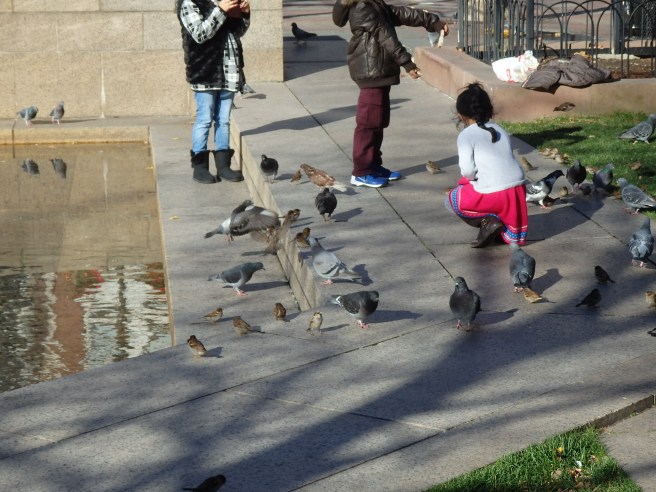
OF COURSE IT’S A CITY

A moment at the reflecting pool in Copley Square in Boston's Back Bay neighborhood.
A moment at the reflecting pool in Copley Square in Boston’s Back Bay neighborhood.

They’re the national bird of many cities.

Boston is a rich and varied destination – the Hub of New England, or the Universe, as they used to say. Living a little more than an hour to the north, we’re well within its orb.


IN THE DIMENSIONS OF DAILY EMPLOYMENT

Any workplace holds confidences you can never reveal. Not that you don’t want to expose company secrets. Then, considering the office computers, fax machines, and photocopiers, you realize they’re incapable of guilt. They simply do their job — and you might find that unsettling.

Whenever I do manage to tap genuine emotions regarding this employment, no one’s more shocked than myself. Take something as simple as a pane of glass between my desk and the trees outdoors. Even on my job in Appalachian mountains, I wanted a window. One the size of a book would suffice, although a picture view would be preferred. I’ve always appreciated a panorama, a sense of precisely where I fit into the weather of a particular day. Instead, I feel trapped underground, half-buried in regulations and routine. Only a band of natural light at the far end of the fluorescent-and-steel expanse hints of sun, moon, sky, or clouds — and even that aperture is tinted. Why are my hours on the job so cut off from the rest of life? “We may as well be coal miners in carbonized veins or muscular razorbacks sweltering in midnight foundries. Is it only the sun we miss? Examine the calendar. Check on the moon’s phase.”

I could just plot my escape. I am surrounded by desert. Trek there alone. Right to the heart.

He recall the words of another friend who spoke of the paradox of Zen Buddhist freedom: the very limitations the practice imposes also lead to an extraordinary freedom. An individual who’s free in the Spirit can be placed in prison and yet not be captive — persecuted and yet unbowed — denounced and still spotless.

The Dedicated Laborious Quest, as my Teacher taught, is a truly free way.

Free, yes, with the labor.

I pick up the phone and hear Kokopelli’s whistle. He wants us to get going. Then tells me of the dance where we’ll be playing.

For more insights from the American Far West and Kokopelli, click here.
REST IN THE AGES

Tucked away in a corner of the park, this gate.

The burial ground in Boston Common is the resting place of early patriots, among them the composer William Billings – the latter, by assumption rather than documentation. Historians will note that the headstones in the city’s oldest graveyards no longer stand over their intended bodies, but were moved around by convenience.

Boston is a rich and varied destination – the Hub of New England, or the Universe, as they used to say. Living a little more than an hour to the north, we’re well within its orb.

It's a classic New England scene, in cities, towns, and isolated countryside.
It’s a classic New England scene, in cities, towns, and isolated countryside.


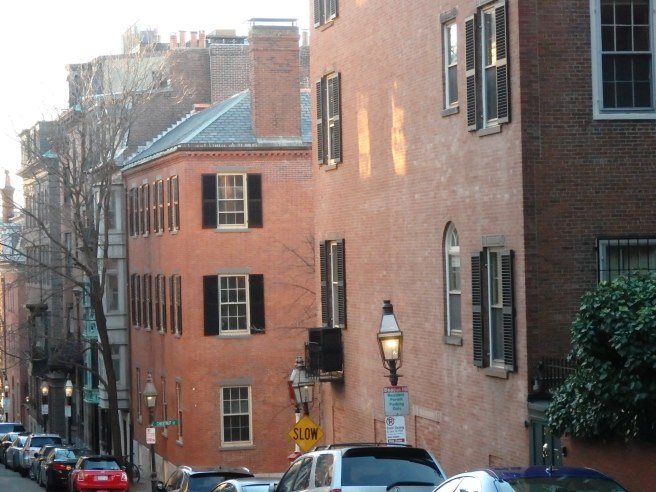
HOME TO ENLIGHTENMENT STYLE

A prime location in the big city.

Beacon Hill’s narrow streets and closely set homes invite pedestrians to enter a timeless order and grace. It’s hard for us not to imagine living here early in the 19th century as American ideas took hold.

Boston is a rich and varied destination – the Hub of New England, or the Universe, as they used to say. Living a little more than an hour to the north, we’re well within its orb.

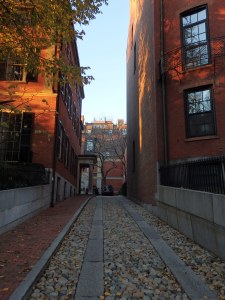
A quiet break in a crowded neighborhood.


Beacon Hill is, after all, hilly.

MOUNTAINS AS A RELATIVE MEASURE

As I listen, I realize the locals don’t consider the surrounding ridges to be mountains. Although these “foothills” or just plain “hills” are as tall as Pennsylvania’s Alleghenies, shorn of trees, to speak of “mountains” signifies that one must drive away into forest. The time comes to hike in unfamiliar high country.

I drive west, into a mountain pass, and park at the trail head.

Climbing through clouds on Sheep Lake Trail, I identify snow lilies, phlox, two whistling marmots I mistake for groundhogs, and a ptarmigan. In these topless mountains, snow and rocks glimmer atop jagged white threads that twist, plunge, and roar over miles. In this clarity I recount a friend’s determination to perceive the important task to perform each day — a focus she achieved in the sunset of her young death. Go on.

The next outing, I follow another friend’s favorite trail. My valley of orchards and meadows stretches behind in a twilight of small-city lights and barren blue ridges. In golden splay dusk, I learn to fear glaciers atop volcanic spines and in their grooved depths, too. So much depends on which way you turn. Clouds, one moment pink, shift into slate-blue. Think of a great-uncle’s farm in Ohio flatlands when green-wood ringed the fields and autos were novelties; and how, when the United Brethren in Christ build their new sanctuary, one tree furnishes enough lumber for all the pews. Such timber is long gone from most of the Midwest, and nearly gone here, as well.

Strangely, adjusting to such disorientation can allow one to see more than the landscape with fresh eyes. I begin reckoning my birthplace afresh, too. I perceive a native poetry now vanished: in flat terrain they coined Sweet Potato Ridge Road when they became sensitive to what had been called Nigger Pike, after work crews that came out from the workhouse jail in the city; Diamond Mill Road was made of limestone gravel flecked with quartz or mica, but named for the distillery beside the rails. What could be in those rural lanes I had sped along on the way to the farm to cause their ghosts to arise out here? I think, too, of the hayloft I had delighted climbing in, even though the old folks feared I’d fall through and be trampled by cattle; more ominously, some shed rafters I walked like a high-wire artist had hogs rummaging below, with razor snouts and teeth and a latent taste for blood. That farm acreage is scarcely like these Western orchards or open ranges, yet something echoes. It’s earth and air. Sunshine and clouds. My days in the mountains are airy conifers. I could be a pioneer, in spirit, at least. My ancestors settled those Ohio tracts. Another line, a bit earlier, settled North Carolina Piedmont. Here, I find unspoiled corners.

Perhaps bears do drink beer. Rocks, leap from mountaintops into oceans. Naked breasts, swell from snowmelt pool to sky.

Against this wall, between his desert and the frigid sea current, I declare my vast ignorance: left to myself, I’d likely starve, soon sicken of berries, and have never caught fish properly or gutted a rabbit. Somehow, I wait to be fed. Thus, one point of my Dedicated Laborious Quest involves learning to be wholly myself — embracing flaws as well as talents, as I search out my own boundaries.

Away from the office and encircled by an ever-renewing earth — even an apparently lifeless desert that restores his sanity and a brand of insanity, too — you may find that every trail you follow brings you closer to your own attainment, your emerging sense of place and mission within the universe. As for looniness — ah, loco! — you soon appreciate how all are in some way at least un poco, indeed.

For more insights from the American Far West and Kokopelli, click here.