HOT AND SOUR

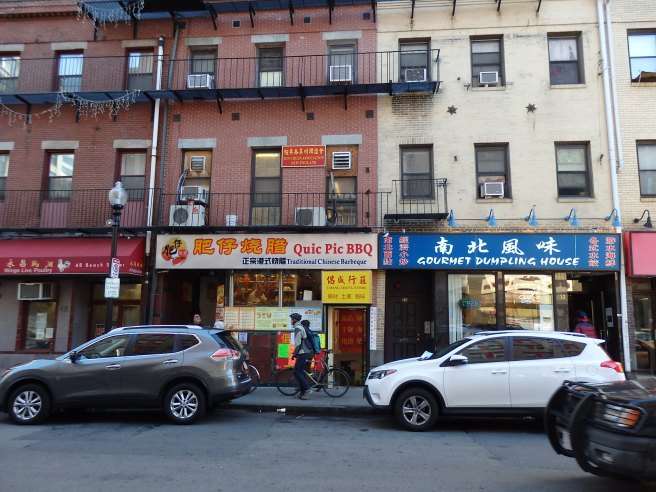
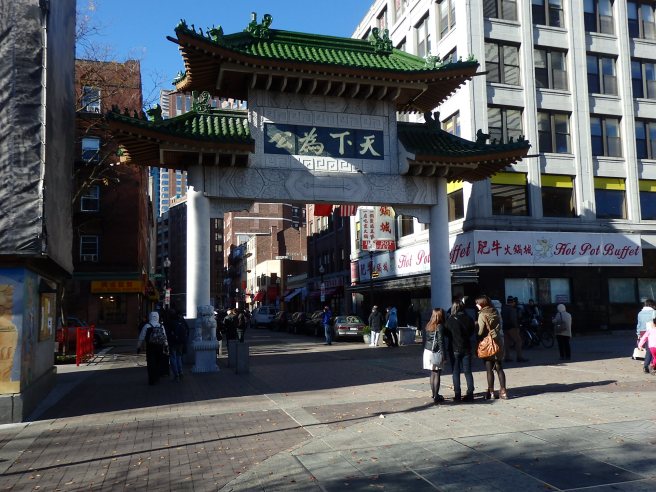
The gateway is just blocks from South Station.

Chinatown is a delightful contrast to much of Boston’s more Yankee reserved style. We recommend feasting on dim sum on a Saturday or Sunday morning, but be sure to arrive early – the restaurants are soon packed for the inexpensive rounds of adventurous platters.

You never know quite what to find in its shops, either. A resourceful puppeteer I know discovered the perfect fabric in one of its retailers aimed at, shall we say, exotic dancers? She was hardly the type, and the owners were amused.

The city is a rich and varied destination – the Hub of New England, or the Universe, as they used to say. Living a little more than an hour to the north, we’re well within its orb.

It's streets are narrow and busy.
It’s streets are narrow and busy.

TOWN AND COUNTRY

Our landlord explains his own decision to relocate in the valley: “Cities embody man’s attempt to be supreme over all. You tire of the power games, the competition rather than harmony. The back country I love emphasizes what’s greater than man. There I’ll endure avalanches, sliding roadways in mountain passes, storms, grizzlies, even cougars. The city relies on institutional religion, second-hand versions of Great Spirit codified to support the System. No, that’s not for me. My back country upholds individual revelation. Wilderness raises fresh opposition against everything that binds artificially. The back country leads me closer to basic understanding. You need to accept whatever Absolute there is, whatever portion of the Mystery you can chew off at the moment. It makes me recognize how much more there always is. The city’s linear, controlled. But back country is circular, like wave motions. It’s feminine, robust and soft all at once. Its give-and-take reminds me of Emma.”

And, as I also knew, the land can be as hard and unforgiving as rock.

For more insights from the American Far West and Kokopelli, click here.

WORKING THE LATE SHIFT

Approaching thirty years of Aquarius, I consider what happens when the office finally hushes. Despite the line bells and the whine of an engraving machine in adjoining rooms, I’m the only one at a keyboard while the police dispatcher mumbles about deranged prowlers, unwanted guests, a prostitute overdosing with the hypo still in her arm (though she later claims she never uses the stuff, as they all say). Sometimes, pretending I no longer care, I sit and read as blue smoke swirls toward fluorescent tubes.

I wish Kokopelli were here, even with one of his stinky cigars. Or the pipe, the one he plays for music or the one he fills with leaf, either one.

Instead, I ponder ways this place differs from Long Pond and its Mafia hit men out of New York and Philadelphia visit to drop a corpse in icy brambles. A nearby restaurant serves poached venison year-around. Another hit happens near a stone mason’s hunting cabin above Devil’s Hole, on mountainside still fire-scarred where his father had built it like a dock. I’ve been both places. Two hits in one place out of many.

When I step outside for my dinner break, I observe a doll holding a cigarette at nose level, as if waiting for some night bird to perch. While she stares through smoke as if she desires me, I wondered how many have fallen for her tricks. I scan her hand and fingers and spot the glittering emblem. I buy a cheap cigar — for later, whether Kokopelli shows up or skips.

At heart, though, I sing for a restoration of America. A healing of fields, of fish, of human integrity, of Eden’s ideal. I want to live free in the Holy Spirit. “May we turn it,” I pray silently. Be it so!  Genuine repentance. Turning. Always turning toward what’s holy.

At breakfast, I begin: “Praise the hunger that brings us together.”

Kokopelli takes a second helping.

I meditate as befits a stone sitting in water.

I gain bearings in addition to the mountain. Some are also barriers. Nuclear reactors, to the southeast. To the north, Army maneuvers. To our west, the Indian reservation. All posted: DO NOT ENTER.

For more insights from the American Far West and Kokopelli, click here.

FANCIFUL CRITTERS

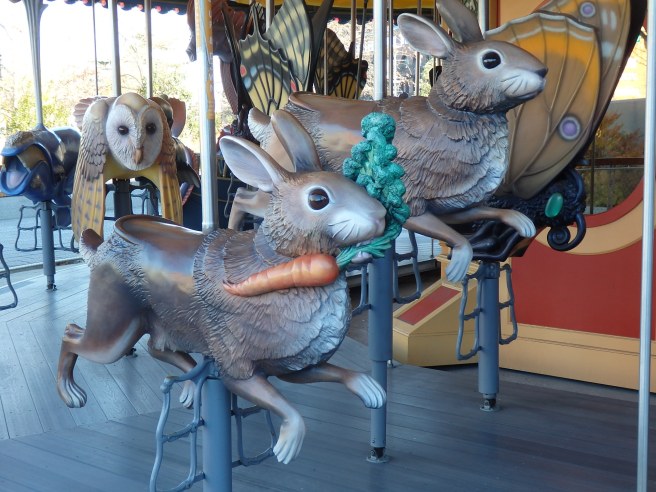
Rabbit,run!
Rabbit,run!

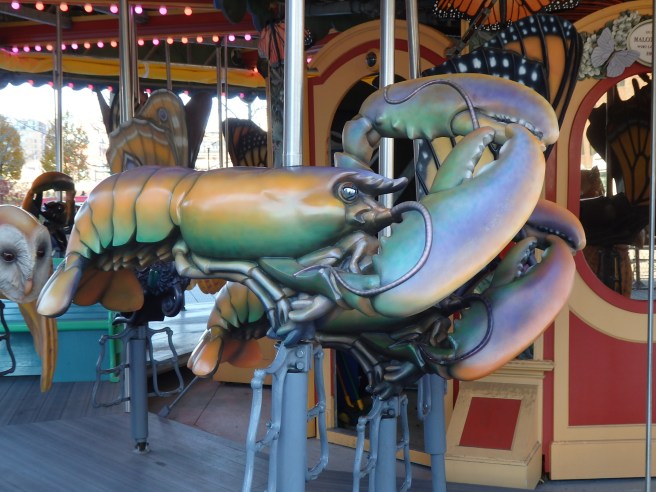
The animals circling on the carousel in the Rose Kennedy Garden atop the Big Dig are a vast improvement over the days when the Expressway overhead was jammed.

Boston is a rich and varied destination – the Hub of New England, or the Universe, as they used to say. Living a little more than an hour to the north, we’re well within its orb.

Yes, we have lobster.


ALL POSTED

On the late-night swing at the office — the one my coworkers call the “presidential death watch,” standing by just in case something major develops — I wait for the product to churn. When it does, I hear once more the locomotives rolling into Union Station overhead, their rumbling through concrete walls as my grandmother returns from Detroit or Fort Wayne. It’s the same rolling thunder I hear later in Manhattan, in the pavement of Lexington Avenue, under the taxis and human footsteps. Tonight these trains roll along spider webbing.

Although I now live in desert, my office resembles offices everywhere. In the morning, chubby wheeler-dealers strut into the room and bark orders. In this case, they’re Texans clad in polyester and strings ties. More gyrating rolls spit out headlines under the ceaseless deadline.

At times I long for an appointment as serene as a winter pond. Make an offer. The owners want more. They grin and demand, boy. Watch the shit.

I ask Kokopelli, “Why do people avoid bare truth? What virtue is found in complication? Why can’t I simply stick to the steps of the Way? How much opportunity slips away when entanglements dim my view of my Guide? What will be my first big break? Or three?”

“How the hell should I know,” he grins.

He knows, all right. No doubt about it.

~*~

When I arrive home, she greets me with a mischievous grin: “I’ve only lied once or twice in my life and this is the third time. Welcome to the split-pea patch of my existence.”

For more insights from the American Far West and Kokopelli, click here.

GIDEON

1

in a beachside motel lacking
a Gideon’s Bible beside its saggy beds

it’s a mystery
just what else might be missing

I, for one, wouldn’t go looking
under the mattress

even at these off-season rates

2

off-season, an indolent tourist village
still awakens with Boston newspapers

rolled up on narrow sidewalks only
now most stores open about noon if at all

and workmen pound new yellow shakes
between weathered gray before the dew lifts

their rounds of hammering and rolling surf
repeat a brazen dance figure in a limited palette

of blue and nearly beige you could render
the clouded and sandy past overcut
and overgrazed
excepting the stooped plumes of wild grasses

3

an earlier Quaker dove pigment might
whet the salt-air and pepper mercies

appearing now

as two couples gleaning the beach
precisely as four aging women

once the gulls raise their aprons

4

tan sand, deep blue water
deep blue sky, touch of green
against the cliffs
gray houses or driftwood

deceptively peaceful
the lulling surf

surfcasters at dawn
wary of ferocity just below the horizon
or water’s surface
approaching the realms of Jezebel and Baal

Sunday dawn or sunset
matching the moon
(heart) breakers

Poem copyright 2016 by Jnana Hodson
To see the full set of seacoast poems,
click here.

POWERING MANUFACTURING

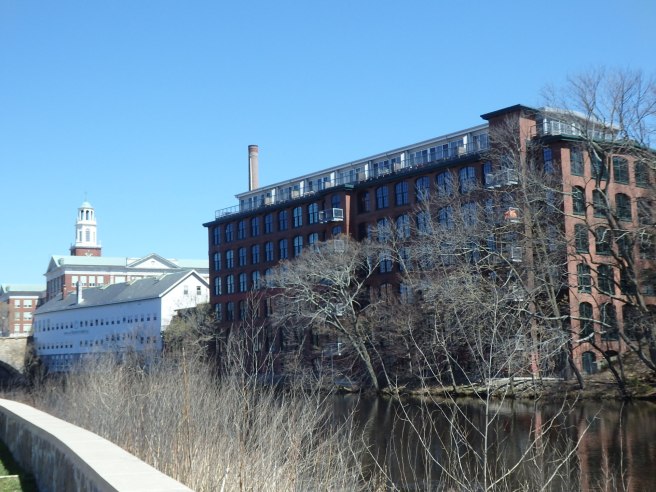
At the Slater Mill ...
At the Slater Mill …

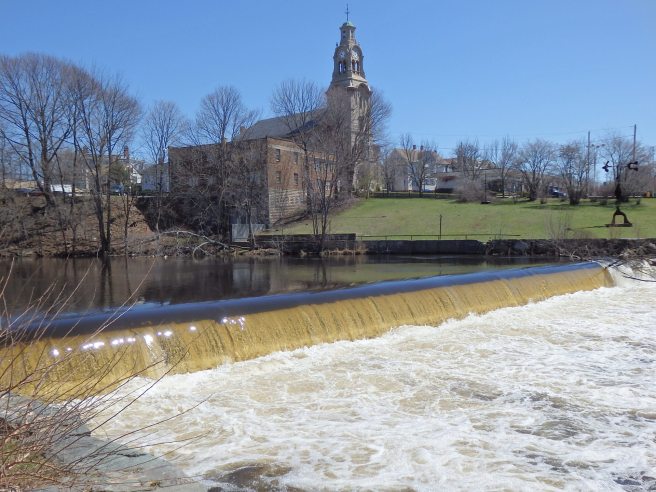
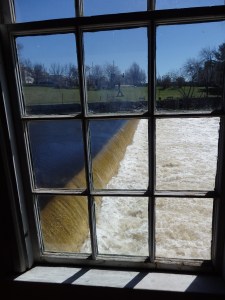
The modest Blackstone River flows through Pawtucket, Rhode Island, where it powered the birth of America’s industrial revolution.

The stream reaches to Worcester, Massachusetts, the second-largest city in New England, and once ran many factories along its way.

My fondness for old mills, by the way, did prompt a novel, Big Inca.

Just upstream ...
Just upstream …


Viewed from inside the Slater Mill ...
Viewed from inside the Slater Mill …


THE MOODIEST FEATURE

Initially, I regard the mountain as another slumber-induced fantasy. Its climax appears pristine, boundless, haughty, mesmerizing, even eerie. Over time I behold its hideousness and terror as well. Such beauty may suddenly turn fatal. Timberlands netted with trails and campsites, plus unfettered wildlife, extend from its ivory helix. These opportunities are my primary rationale for migrating to this corner of the nation. But these woodlands border desert, and none of my maps alert me to the consequences. Not even Georgia O’Keeffe’s brilliant renderings of New Mexico, artwork I long admired, hint at its harsh thirst. Rather, the paintings emerge as another kind of dream to be savored, confined to a gallery or oversized pages. Besides, my definition of desert would have required camels, or at least organ barrel cactus, neither of them found in the cheat grass and sagebrush foothills surrounding my new home and workplace.

A glacier-glad mountain resembles a foaming waterfall. It is, after all, an endlessly frozen cataract. Below it, in late spring or early summer, breastworks are laced with plummeting streams racing toward September irrigation in desert to the east. On the clearest days, Rainier’s ice sparkles; its beacon flashes sixty miles to the orchard where we dwelled. At sunset the inactive volcano’s shadow is a finger reaching toward the rising full moon. It points as well to places we’ve abandoned.

The predominant mountain is also the moodiest feature of the vista. Everything’s arrayed in reference to this pillar. To observe it over time is akin to regarding one’s beloved. Neither the zenith nor one’s honey is as immovable as one presumes. They are not the divinity. They’re more accurately repeated dreams, where some episodes fade out over the years while others intensify. Sleep visions of the soul, having one foot in the dreamer’s past and the other in the present, dance on water. Sometimes they drown. Even a mountain.

You should see the way Kokopelli makes it dance before sunrise.

For more insights from the American Far West and Kokopelli, click here.

SUMMONS AND SORROW

On scattered reservations, a few elders rise before dawn each day and summon the sun to return. Don’t scoff. When I, too, get up in the dark and meditate, I feel my own self-confidence rising. Watch the world awaken. Light a wood fire, something I sit beside and watch for hours, its flames more imaginative than television. Bask in the radiant warmth.

Kokopelli, night owl that he is, still slumbers.

My wife, in another room, rolls toward the wall and finally rises to join me.

There’s a science, and then there’s an art. In the pyre, paper first chars, then shrinks, and finally explodes. Only then do flames engulf it. “Consider the bomb a ream would create,” I grin at her.

“Now who would you want to bomb, Buzzard?”

But I also know how difficult igniting that ream would be, and how difficult to keep it burning. Watch carefully and misconceptions turn to ash.

In the continuing drought of that fall and winter, I explore national forest well into February. Areas that should be buried in a half-dozen feet of snow are instead bare. Atop one mountain, I look over a cliff. “I think it’s dolomite.” Maybe it isn’t. Maybe the identification isn’t earth-shaking important, but learning the names of places and their minerals, fauna, and flora adds dimensions to a place. Improves your chances of survival, too, if put to the test. For now, I scramble on the scree and realize that white painted stones at the cliff’s edge marked out a heliport. Far below my feet, a table of forest spreads into basins that are invisible from my vantage, and other places I’ve already been. I trace Forest Service roads, such as they are — 1707 from Raganunda to the top or 601 down to Willy Dick’s. “Keep elk gate closed,” the sign reads when I came out, passing a few back country ranches to the highway’s rush and debris. Far above all that, I sing out: “God bless a bloody rib cage above gray fuzz. Perhaps we’ll have rain in the morning! We shouldn’t be kicking this dust.”

In a zero-degree fog, the sun rises as white as the moon.

“Let our liquid flow again despite this desiccation!” I cry in my dreams. “Why is it so difficult to recall the thoughts rainstorms instilled?”

“You put too much value on sorrow,” Kokopelli tells me. Even in my sleep, that old guide’s still at work.

For more insights from the American Far West and Kokopelli, click here.
SPIRE OF INSPIRATION

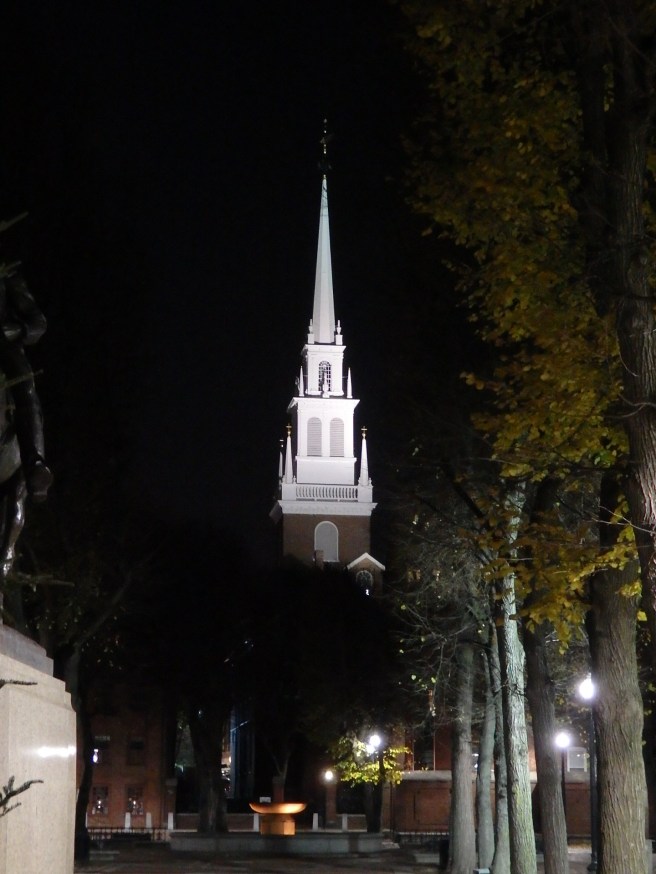
Old North Church, in Boston's North End.
Old North Church, in Boston’s North End.

Lanterns in the spire of North Church signaled directions to Paul Revere and other riders at the outbreak of the American Revolution. The race to Lexington and Concord was on.

Boston is a rich and varied destination – the Hub of New England, or the Universe, as they used to say. Living a little more than an hour to the north, we’re well within its orb.