COLONIAL LINES

Facing the street ...
Facing the street …

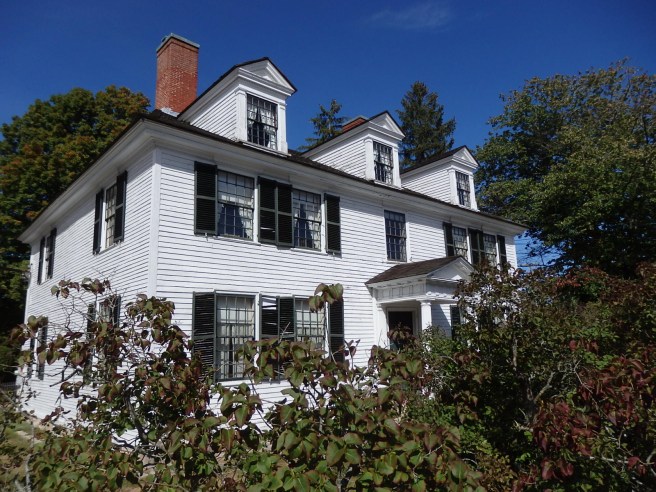
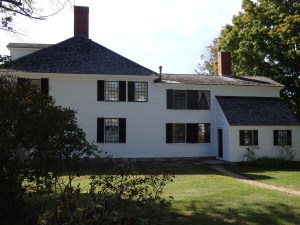
Novelist Sarah Orne Jewett (1849-1909) was born in this 1774 house owned by her grandparents, which she would inherit from them. The site, sitting in the heart of South Berwick, Maine, just a few miles from us, is now owned by Historic New England and open to the public.

Like many New England houses, additions have kept growing to the original structure.

GAME TIME

Late each autumn, hunters sip Wild Turkey. Stovepipes stick out through canvas walls. Cardboard surrounds their campfires. Nearly sullen, they hunker down in numbing wind. So much has been protected for their harvest. It’s crazy, this unreleased male desire to sing deep and loud. Call for your honey. Bellow again. With a measure of self-despair, the men admire the bulls they stalk.

In these parts, elk management thrives. Bureaucratic neckwear is a moth collection worn in a smoky room. With books resembling bear traps, Fish and Game as well as Forest Service authorities gather in what appears to be a poker party; it could as easily be city council or a gathering of the Committee of Economic Development, maybe even the Federal Reserve Board. Nobody speaks directly of the field or on behalf of its inhabitants. Each player represents a particular constituency, even though nobody represents the elk themselves. Everybody, it seems, wants a piece of action, connoting elk harvest.

Kokopelli’s prescription: Around the office, snort loudly. If there are windows, pop ’em, even when snow falls.

Better yet, leave the room. Go to the site, meet the subjects on their own ground. If they trek off too soon, it’s the regulations need adjustment.

Take note. In open country a snow-driven bull breaks trail to lead clusters of cows and calves single-file through winter range. Elsewhere a train of two hundred passes before I lose count. From these huffing creatures come vapor trails — some float parallel to a freeway that avalanche will soon block. Truck hoods and beds await them in hunting season. Through deep winter, though, elk come down to the canyon station. Feeding time’s 1 p.m.

I wonder which grandparents or great-great-grandparents witnessed the disappearance of elk across the continent, save for a few spots. I meet old-timers who recall the elks’ return in two boxcars sent from Montana, the ones that repopulated Washington State. That’s how close they skirted extinction.

Bulls, cows, and calves graze between conifer species. In any journey a name may encompass far more than anyone suspects.

Winning the state’s autumn lottery comes down to two hunters for every elk. Victors’ identities are repeated on the airwaves. Encampments arise between snowy boulders. Not every elk license winner succeeds in bagging his prey, though an elk tag will exempt him from jury duty. Any judge understands how a man on a ledge feels unexpectedly face-to-face with a stag. What thunder breaks heart and horns! Hallowed be tumbling water, on the homeward trek.

“You never forget the bull’s song,” Kokopelli says. “It curdles your blood.”

Men relate time-honored tricks of the trade. It’s the Fall of Cards. Cut the Deck. Deal Me In.

Imagine joining the Elks lodge. When buzzed in through the door, follow a red carpet hallway to the bar where barley-skinned salesmen compared their ex-wives. If a herd of real elk prances past, scouts the room, and bellies up to red vinyl barstools, take a dive. Wait for the blowhards to readjust themselves in front of the mirrored collection of liquor bottles resembling a carnival shooting gallery. Here and at Eagles and Moose dances, as well, there’s too much drunken groping for Beaver, as Kokopelli and I have observed. The game takes revenge. A shot’s a shot. Glasses and reflections shatter. Under glazed eyes, unfit individuals collapse. Their blood reaches out across the carpet. Red on red. Real animals unmask and sniff a fallen Jack of Diamonds. They paw an expiring Queen of Clubs.

When individuals participate in governing themselves, the whole business returns to the right track. All elk ask is a fair shake. Kokopelli knows many by name.

First, he says, ban all guns, motor transport, and steel traps. To be wild’s hardly enough. Before going afield, hunters must fast and enter a sacred sweat lodge. They must flake their own sharp tips and cross range on hoof.

Back at the bar, the ex-wives and widows gather. Who knows where their children are. When they understand the new rules, there’s NO BULL. The whole tribe and herd are in this together.

Simultaneously in Iowa, a man sheepishly hugs his rifle and emerges from woods with a gray pelt the size of a rat hanging at his waist. He could have been shooting beer bottles. A macho urge is not the same as hunting, my boss repeats after taking his adopted seven-year-old hunting the first time.

“Daddy, that man just said fuck.”

“That’s all right, son, that’s all right,” comes the reply. Their dove-hunting companion sips McNaughton’s; the son, a soda. The boy sticks close, raising the same questions they, too, asked as lads. The cycle repeats.

Later, the game soaks in onion before roasting in garlic or being sauteed in wine. This terrain demands many rituals.

Where desert and timberland interlace, foothills run braided above your hat brim. Tufts of grass punch through light snow. Like red mites on paper, elk advance through fog-wisps overhead. Standing beside half-iced rapids, I raise my binoculars and lose count again.

On the eve of the season’s premiere, cities of tents, camping trailers, and vans crowd into wild wood. In a state of sixty thousand elk and one hundred and twenty thousand licensed elk hunters, expect free-fire.

Opening day, an office pool bets on the quarter hour the first hunter will be hit. 9:15 it’s BINGO.

Look out. Glazed heads festoon truck prows. Multi-sail frigates careen through mountains with skinned carcasses stretched across their decks. Give the victors their trophy, even as a hood ornament.

“Many of these guys get so plastered, if anything moves, it’s open-fire,” Kokopelli says. “In the shootout, each heatedly claims the kill. Then the fun begins.”

That is, there are more intriguing animals than elk to hunt. Other armed hunters move in.

By evening, poker-faced herds pressed my rear-view mirror. They steer vans, pickups, and sedans. Slow down, and you discover their horns.

I vow never to dwell where I can’t see premonitions of seasons advancing clearly in dawn. “Watch the Milky Way turn through silence, you assume a point within millions of years of light,” as Kokopelli says. Even hunting can be timeless. Eventually, I see the Dedicated Laborious Quest as a specialized form of hunting.

In a slow drizzle across back roads in the valley, shacks and sheds occasionally relocate themselves to Wisconsin or Maryland. The green growth, scudded sky, lush shrubs, and running fields send memories tearfully home. Was I really, completely Out West?

For more insights from the American Far West and Kokopelli, click here.
BUT TO KNOW OTHERWISE

In this environment I encounter many birds I can’t yet identify: stellar and Clark jays in addition to magpies, much less the common raven I’d thought a crow. Meanwhile, the cardinals, warblers, and finches I knew back east are memories. Even this landscape contradicts my usual referents.

The mailman delivers a long letter from a friend who confesses that sometimes an hour passes before he puts his first word down on paper — something I’d never guess, for his lines flow so naturally. I assumed they originated effortlessly. But to know otherwise?

Don’t force it, as Kokopelli cautions. Wait for the energy to gather.

Keep the pathway clear.

For more insights from the American Far West and Kokopelli, click here.
TOPOLOGICAL DISPARITY

1

any stretch of shoreline
is not two sides of the same coin
viewed from water or land

even assuming you know the twisting roads
or clusters of housing and wharves
or white steeples and beacons
the familiar melts unevenly

even the maritime charts and roadmaps
conflict
one measured in knots
and the other, miles

for many good reasons
the pieces rarely fit

even if you could walk on water
and still the rough waves

2

land is a kind of insurance
if you don’t crash

any grounding and the atmosphere
both move, often in contrary
currents, you navigate a facade

blue is never the ocean’s true nature
even on a summer day
unnoticed red or yellow modulate

when rain comes up
the beacon vanishes
in fear or arrogance

3

no matter how similar
they initially appear

waterfowl bridge this disparity
moving, air

Poem copyright 2016 by Jnana Hodson
To see the full set of seacoast poems,
click here.

ON THE GREAT WORKS RIVER

OLYMPUS DIGITAL CAMERA
Standing proud today …


Seen from the far side ..
Seen from the far side …


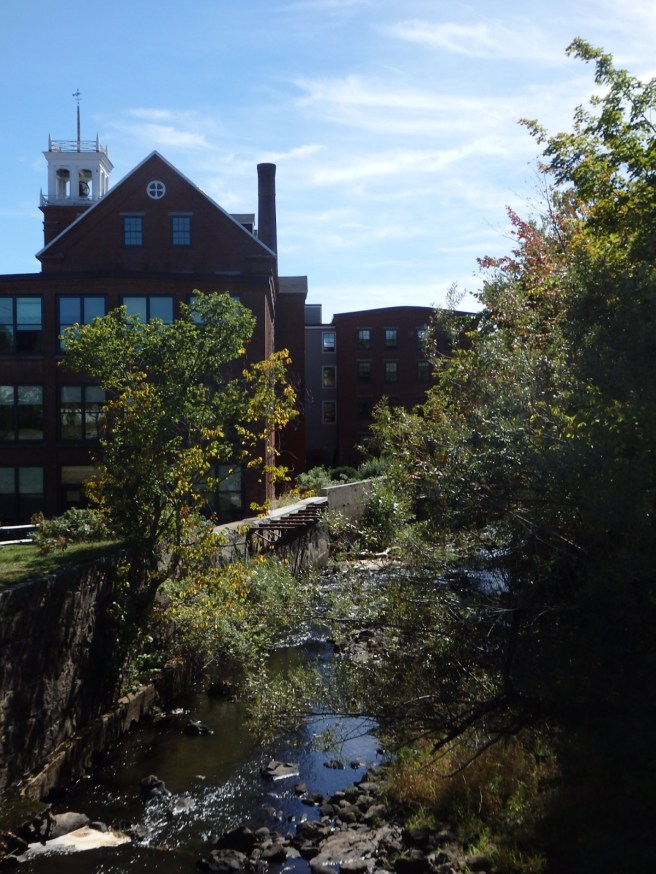
Even a small stream could be put to work.

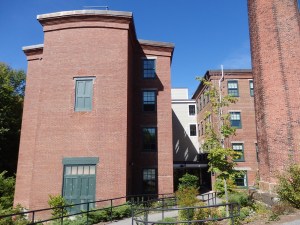
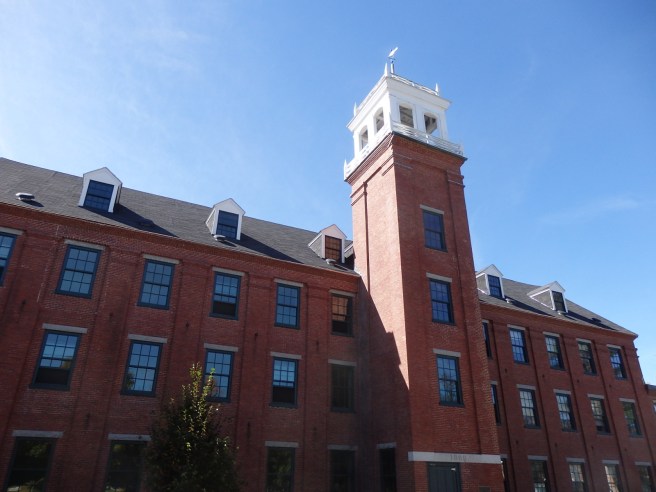
Not all of New England’s water-powered mills sat along major rivers. This woolen mill in North Berwick, Maine, was founded by Quaker William Hill, beginning in 1862, and made blankets for Union soldiers. The Great Works River itself had been named by earlier Quakers.

The mill has been renovated into residences and offices.

My fondness for old mills, by the way, did prompt a novel, Big Inca.

UPDRAFT

This is desert. And logging country, too, where the best place to find loggers is in a bar, any bar. Just listen.

“When I’m real loose, I like t’dance t’country-westron music. Out seven nights a week, then a month without any. Can’t work anyplace but woods. Done everything but hemlock. Started skidding horses in Colorado. Now driving a diesel Ford. Not much time for thinking. Slick roads, sharp corners, dumb ladies in the way.”

Here’s how it works, as Kokopelli and I play along.

“Aim a load down logging roads and then highway t’ the mills. A thirty-, fifty-mile stretch each way, four to six times a day while the CB chatters.

“Every spring when the ground’s too wet, the Forest Circus shuts ya down, the heavy equipment breaks the roads.

“That’s our vacation, three months off, taking unemployment.

“Head for Hawaii, Reno, or Vegas. There’s no money in mud. So ya take care of yard work, fix the house, prune the orchards.

“Successful loggers have expensive hobbies like race cars or airplanes. Mechanics, anyway.

“The drought will cut our pay in half. They’ll keep us out. Fire hazard.”

As they say.

Kokopelli tells me doors define a room, more than walls and roofs. Tells me to see their potential. An opportunity to spy or exit at will. Or interrupt. Doors with keys invoke power. Ownership. Think of all the doors in Versailles.

For me, the greatest freedom comes outdoors or while playing a dance with Kokopelli. Now the cat wants out.

Decisions are doors, too. Take style and size. Standardization leads toward smallness. Once, they were French-doubled or twelve-feet tall. Bronze portals to cathedrals. Red doors and oak doors. Lacy castings for an office. Frosted glass at the bank. Now they’re internationally uniform. The small millwright goes under, as well as local characteristics.

When the cat went out, my wife came in. Everybody seems to like her. But I see her other side, when she’s really destructive. I want to scream.

Instead, I blurt out, “To hell with the dark stupidity of their Christian indoctrination! Bring on wild goats! Pan pipes! My roaring conch will shake the walls of this slumber!” I have no idea what prompts that thought. Why Christian, other than the fact it’s the predominant religion in this country? Just where would a person start without any teaching? Most likely, I meant dogma, which I see repeated with only a superficial understanding. But that could apply to any faith tradition, couldn’t it? So just what am I fleeing? And what do I really hope to find?

Maybe it’s a door. Or a corridor. A cavern. A current of water. A trail. A strait gate with a narrow way.

Choose one. And then enter.

I want full awareness. Experience, rather than theory. Ecstasy, especially. For whatever reasons, I veer away from the Judeo-Christian prophetic stream and toward the shamanic traditions, wondering whether the Siberian word shaman arises from the Pali samana, for holy man. I accept the argument that meditation grew out of primitive hunting, the waiting for the game, the belief that game is supernatural, requiring supernatural aid. I must remember to thank the trapped bear, if the time comes. “Boy, do the local elk hunters have a lot to learn,” I whistle — me, who’s never gone hunting.

Kokopelli raises one arm as if he’s holding a rifle. Then, with his other hand, he pulls a trigger. I think he felled what he wanted.

“Yes, hunting antedates farming,” I whisper to no one but him. “See that, Cain and Abel!”

Maybe that’s why I’ve come so far west, just to see the sunrise.

But just as there’s light, there’s also darkness. Trust and distrust.

List the names of deities. As for a supernatural trickster, Mara or Maya seems to relate to Satan, who in turn relates to Coyote. Now for Pan!

Arcane teachings. I consider delving into palmistry, followed by astrology, Tibetan texts, more deeply into Tantra, and back through meditation. If only my paying job didn’t requiring more and more of my time, I might pick up the thread from hunting, tracking holiness through food traditions. The balance of feasting and fasting. The importance of prohibitions as strengthening the ability to say NO as well as reinforcing a group identity. “So what kind of vegetarian are you?”

Kokopelli reminds them this is desert. If it weren’t for irrigation or berry-picking trips to the high mountains, you’d starve.

For more insights from the American Far West and Kokopelli, click here.
COMMITMENT TO LIBERTY

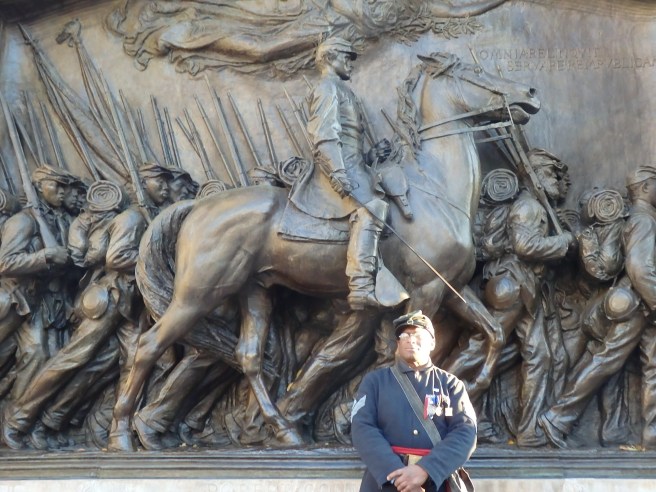
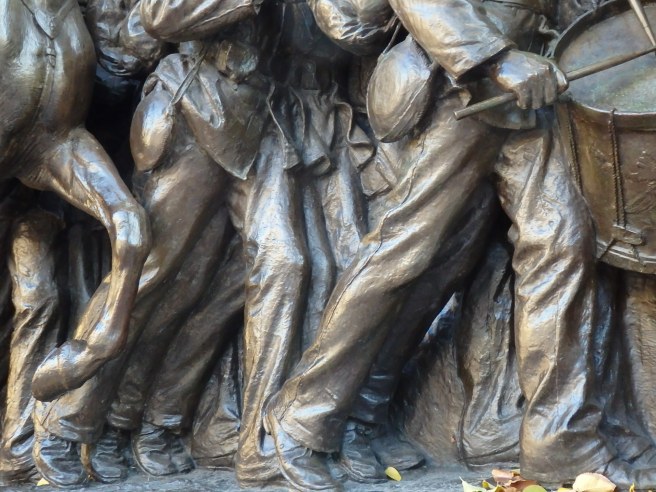
I didn't ask the name of the reenactor, lower right. He was proud of his unit, and now stands representing all of them.
I didn’t ask the name of the reenactor, lower right. He was proud of his unit, and now stands representing all of them.

Public sculpture typically celebrates famed men or mythological figures, but the Memorial to Robert Gould Shaw Memorial and the Massachusetts 54th Regiment, which sits across from the State House, is in a league of its own.

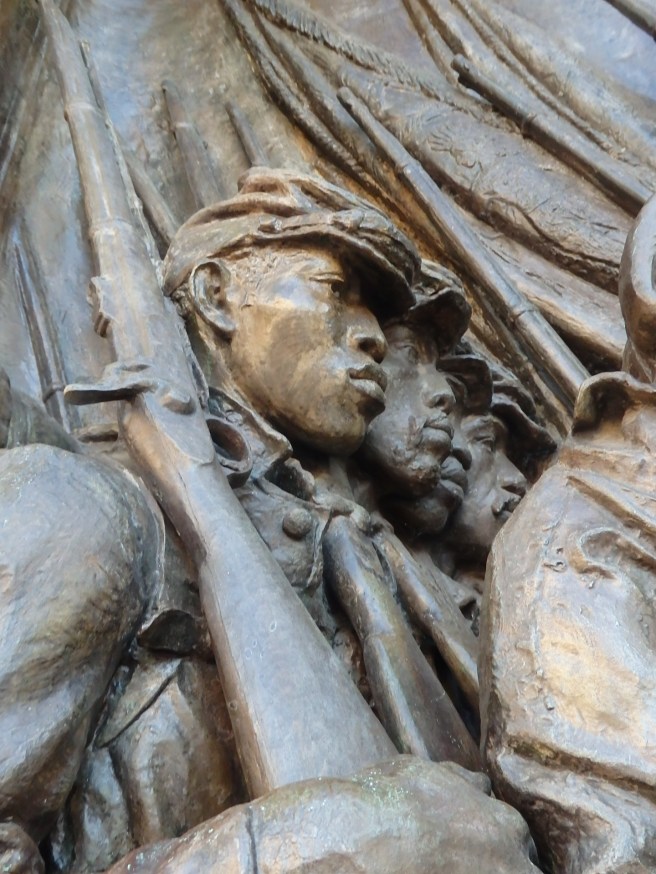
Within its unified design, the focus turns to each of the enlisted black soldiers as they resolutely march to battle to free slaves. Every face is unique, sympathetic, tragic, and each body moves with muscle, even anger and justice. If August Saint-Gaudens had created no other work, this masterpiece would have sealed his reputation.

Each face is unique and distinctive.


The ugency and motion compressed into the relatively narrow sculpture is amazing. By the way, as the reenactor pointed out, the artist knew he was placing the canteens on the wrong side of the soldiers. It was a matter of artistic license.
The urgency and motion compressed into the relatively narrow sculpture is amazing. By the way, as the reenactor pointed out, the artist knew he was placing the canteens on the wrong side of the soldiers. It was a matter of artistic license.

Boston is a rich and varied destination – the Hub of New England, or the Universe, as they used to say. Living a little more than an hour to the north, we’re well within its orb.


THE ISLES

1

the cluster of eight small rugged islands
(or more, depending on the tide
and how one’s counting)
ten miles out from New Hampshire
and Maine

Appledore, Star, White, Smuttynose
among them – the landing at Gosport
ornithological laboratory, conference hotel
lighthouse and keeper’s housing

2

distinctly hot, hazy ashore
a threat of afternoon fogging
obstructing the islands

board the M/V Thomas Laighton, named
for Celia’s brother, HARBOR CRUISE & TOUR
and it’s twenty degrees cooler offshore
windy, nine-foot tide normal

far from anything, a kite flies, wagging a long tail
gulls flock a fishing boat
“whistlebones, cricket sticks”
a young woman sings

approaching the unfamiliar light of an afternoon squall

“everyone on the deck, down under – now!”

quickly enwrapped

in a darker fog, a gray luminescence
viewed from the inside
of a pearl
all passing in minutes

3

you could volunteer for the trip
to thin hop vines overrunning her garden

bring home rootlets
for a memorial planting

to stabilize and flavor
your own bottles

fermented in late fall and deep winter

Poem copyright 2016 by Jnana Hodson
To see the full set of seacoast poems,
click here.

OVERLOOKING THE REMAINING MILLS

In the heart of downtown ...
In the heart of downtown …
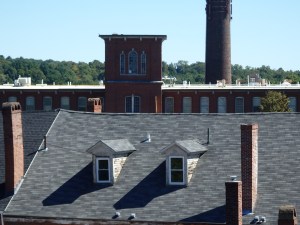
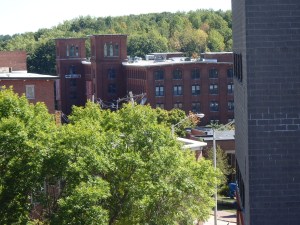
The Cocheco Millworks stretch through downtown Dover.
The Washington Mill complex picks up on the other side of the Cocheco River.

Hard as it is to imagine, Dover once had twice as many mills along the river, plus tanneries and other supporting enterprises.

My fondness for old mills, by the way, did prompt a novel, Big Inca.

LOOKING FOR WIDER CONNECTIONS

My wife, meanwhile, has her own perspective. “Many people think this valley can prosper in isolation, but let me tell you, the local museum indicates otherwise. It’s filled with Pennsylvania long rifles, Ohio flint, a New Hampshire stagecoach, antique cars from Michigan, pianos made in Indiana, Connecticut pistols, even Illinois farm implements. Everybody came from somewhere.” In her case, South Carolina.

Taking her up on the invitation to tour the exhibits, my wife paid special attention to local Indian basketry and beadwork. “Over time, their artistry was pathetically stripped down to resemble coloring books,” she told me afterward. “The gift shop sells greeting cards from Iowa and crafts from what the sales clerk said was ‘Berea, Virginia.’

“Virginia? I replied.”

“The college there.”

“Oh, you mean Kentucky!”

“‘Kentucky, then,’ she said, as if it’s all the same.”

I understand the scowl. “I notice, around here ‘Easterners’ seem to come from such ‘seaboard’ states as landlocked Nebraska, Kansas, and Illinois.”

“That’ll be news to them,” she grins. “Bet they never thought of themselves as Easterners, either!”

Infinite misunderstandings continue, tit for tat.

“Even so,” I say, “this is big sky and cowboy spreads. Even these treeless foothills ignite something in my airy nature. I hope this elation never ends.”

An elation, at least, when I’m out of the office.

I look forward to tonight’s gig with Kokopelli.

For more insights from the American Far West and Kokopelli, click here.