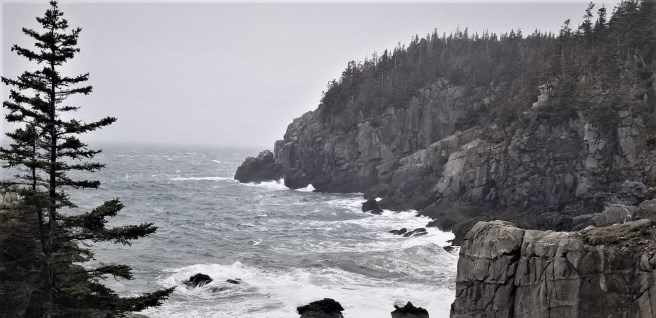
Cheers! They’re officially opening today

We’ve been watching the renovation of a former bakery downtown, including the clues it was going to be a brewpub. Everyplace seems to have one, except Eastport, until now.

Only a month ago.

The work felt like it was taking forever, but then, to our surprise, the one storefront had some “soft openings,” 2 to 7 or so over the past couple of weeks, ironing any kinks out. It was announced only by a small chalkboard on the sidewalk. I’ll just say they’ve been lovely, low-key, and fun. The Horn Run’s brew’s excellent, too. From all signs, Lisa and Jeff know what they’re doing. They already have a loyal following.

The interior is cozy with an English pub feel, with a view that would be hard to beat. It’s become a place where it’s easy to make introductions.

The choice for the official opening matched many of the downtown stores and galleries, which already planned to reopen for the season today. We’ve definitely felt something building in the air.
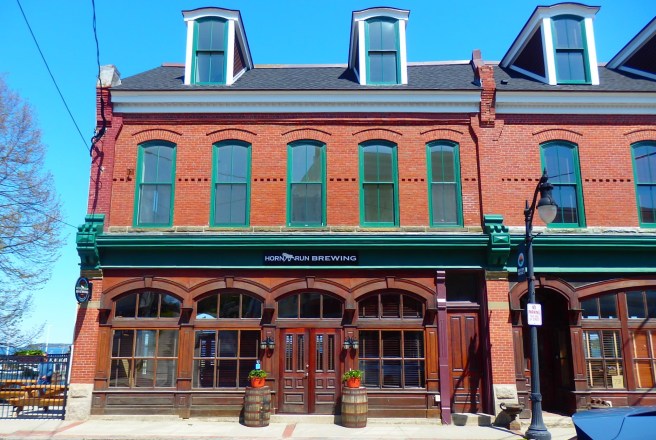
But look now. And, yes, there’s an outdoor deck to our left.

Horn Run? Well, for baseball fans, it’s a kind of pun, with a moose as the runner. But it’s also an inside joke, based on the nearby Moosehorn National Wildlife Refuge. Seems that when the pub’s owners were younger and wanted to go for a drive, they’d say, “Let’s take a run around the ‘Horn.” Which then introduces a second inside joke. Moose don’t have horns – they have antlers.
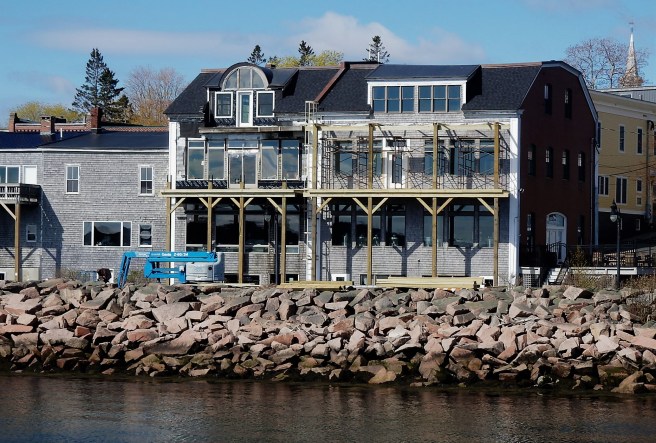
Overlooking the harbor, once the porches are finished.

Work on the apartment porches overlooking the harbor continues. I have seen some of the daring residents already having their morning coffee on the deck, enjoying the ocean air and the view.

The hope is that Horn Run will spark renewed vitality downtown as we come out of Covid. It definitely has appeal for summer visitors as well as younger residents looking for a suitable social center.
Distances from Seattle to … it really is a world apart

In my novel Nearly Canaan, Joshua and Jaya settle into a place unlike anything they would have imagined. It’s desert, for one thing, where nearly everything has to be irrigated, for another. Quite simply, it’s a lot like Yakima, in the middle of Washington state. The closest big city was Seattle, three or four hours away. And that, too, was far from much else.

Just consider these in miles, apart from flying time, even when you could fly direct.

  1. Anchorage: 1,448 miles. Alaska has a spiritual affinity in the Pacific Northwest, like it’s just up the road, more or less. Plus, it had good summer jobs on the crab boats, forget the riskiness.  
  2. Honolulu: 2,680. Naturally, driving isn’t an option. As a vacation destination, though, this was a highly popular option, especially considering the sunshine.
  3. San Francisco: 679. Like this was the next town south, and like a grown-up version of Seattle, a few decades back. It’s still a long way to drive.
  4. Las Vegas: 871. Seemed close, especially in winter. Say a weekend getaway. Again, factor in the sunshine, if you ever left your hotel/casino.
  5. Denver: 1,024. While many think of the Mile High City as Western, we thought of it as Out East. Our awareness largely skipped right over it. See next item.
  6. Chicago: 1,737. Alaska was closer, and more of a kindred nature.
  7. New York: 2,408. Largely didn’t matter in our eyes.
  8. Washington: 2,306. Ditto.
  9. Tokyo: 4,792. Psychologically, it felt as close as the East Coast of the U.S. and about as influential. We shared an ocean, after all.
  10. Atlanta: 2,182. And you still had to get to Florida, which didn’t matter since we had Hawaii when you added it all up. Blah! 

Real Maine


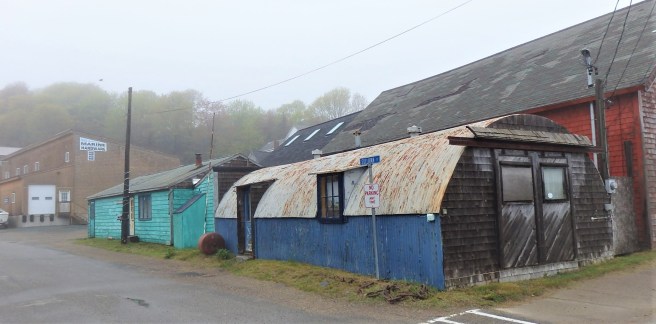
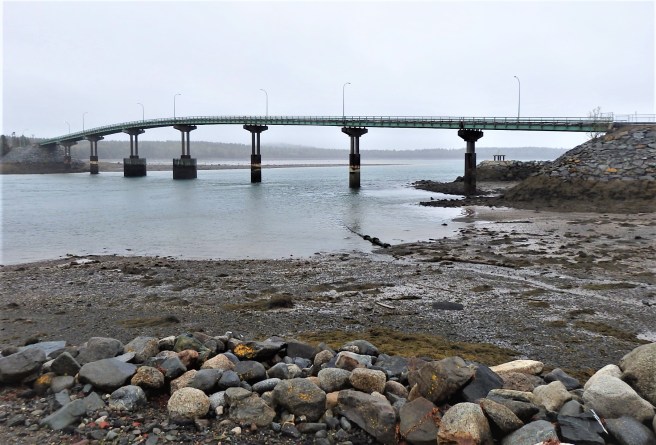
This year the Red Barn has featured a lot of photos from Downeast Maine, many of them taken about a five-hour drive from our home in coastal New Hampshire. (Driving the other direction would put us in Manhattan in the same amount of time.) It’s easy to imagine the remote coastline as idyllic, but the reality is that much is also economically challenged and impoverished. Here’s an example from downtown Eastport.

Ever been out on the Plains?

My novel Nearly Canaan starts off in a railroad crossing called Prairie Depot, and my story The Secret Side of Jaya returns there.

Prairie can be found as far east as Ohio, but it’s more extensive out on the Great Plains.

Here are some tidbits about the landscape.

~*~

  1. It’s bigger than I thought. The region runs from the Rio Grande river bordering Mexico all the way to the Arctic Ocean in Canada, and along the Rocky Mountains to the west. Its width is about 500 miles and it covers about a seventh of the continental U.S.
  2. Rainfall ranges between 13 and 20 inches a year, too little to sustain trees.
  3. Its natural vegetation is a variety of grasslands. And it’s flat or gently rolling.
  4. It had immense herds of bison as well as pronghorn. Prairie dogs, coyotes, prairie chicken, and rattlesnakes remain prominent.
  5. Native American tribes included Blackfoot, Crow, Sioux, Cheyenne, Arapaho, and Comanche. The nomadic tribes followed the bison migration through the year.
  6. The introduction of the horse from Europe dramatically changed the Native culture.
  7. The rural Plains have lost a third of their population since 1920. Ghost towns, which have lost so much population they’re considered extinct, are the most common category of towns.
  8. The climate includes cold, harsh winters and very hot, humid summers.
  9. Without natural trees, hills, or mountains, there’s no protection against wind and erosion.
  10. The region includes Tornado Alley, based on the frequency and intensity of the twisters generated in its open spaces.

~*~

What surprises you here?

Out west, it can be a long drive to anywhere

When Joshua and Jaya finally arrive in their Promised Land in my novel Nearly Canaan, they discover how far they are from other destinations.

As I recall, some people would drive hours for a fine dinner, and hours going back.

Here are some drive times from Yakima, Washington, to other Western locales.

~*~

  1. Seattle, 2 hours, 16 minutes. I remember it taking more like three or more.
  2. Spokane, 3 hours, 9 minutes.
  3. Walla Walla, Washington, 2 hours, 6 minutes. Having the Interstate down the valley has certainly cut the time here.
  4. Wenatchee, Washington, 2 hours.
  5. Portland, Oregon, 3 hours, 6 minutes.
  6. San Francisco, 12 hours, 6 minutes.
  7. Boise, Idaho, 5 hours, 33 minutes.
  8. Salt Lake City, 10 hours, 11 minutes.
  9. Denver, 17 hours, 19 minutes.
  10. Missoula, Montana, 6 hours, 9 minutes.

~*~

And that’s not stopping for fuel, food, or comfort.

How long does it take you to get to a favorite daytrip destination?


Facts about the mills in Dover

  1. The Cocheco Manufacturing Company had the largest overshot flywheel in the world. It powered the looms and shuttles inside the long five- and six-story building.
  2. It was the scene of the first all-women’s strike in U.S. back in 1828.
  3. The mills once had 1,200 workers.
  4. There were more than 100 company-owned boarding houses.
  5. The town itself wrapped around the mills rather than to one side.
  6. Less than half of the mill complex remains.
  7. The printworks produced 1,000 new patterns a year.
  8. Mill workers received free milk from the company’s herd on Milk Street. Urine from the cows was essential as the fix (stabilizer) for dyes in the fabrics.
  9. Calico, sateen, velvet, and seersucker were the principal textiles produced.
  10. Fire was a constant threat, on occasion erupting spectacularly.


What is it about Memphis?

In my novel Yoga Bootcamp, Jaya’s guru is a native of Memphis, there on the Mississippi River.

And much of the action in my novels Nearly Canaan and The Secret Side of Jaya takes place in Arkansas, right across the river.

It’s more influential than I’d thought.

Here are ten tidbits.

~*~

  1. It’s populous. With a metro population of more than 1.3 million, Greater Memphis is the most populous locality in Tennessee. However, the city itself has 650,000 residents, making it second behind Nashville.  
  2. FedEx headquarters. The airport is the world’s second-biggest cargo operation.
  3. The river. The busy shipping port moves 11 million tons of cargo a year, much of it arriving by train or truck.
  4. King Cotton. Half of the nation’s cotton is traded at the Cotton Exchange on the riverfront.
  5. Music. Sun Records (founded in 1950) became the birthplace of rock ‘n’ roll in the 1950s. It was the first label to record Elvis Presley, Roy Orbison, Jerry Lee Lewis, and Johnny Cash. It was sold in 1969 and eventually moved to Nashville. Meanwhile, Stax Records (1959-1976) was a fountain of the Memphis Sound, mixing blues, rhythm and blues, and soul.
  6. Graceland. Presley’s mansion is visited by 600,000 tourists each year. In America, only the White House attracts more.
  7. Civil rights. The motel where Martin Luther King Jr. was gunned down in 1968 now houses the National Civil Rights Museum, a Smithsonian Institution affiliate.
  8. Edible flesh: The city is the largest livestock and meatpacking center in the South.
  9. Fire up: The World Championship Barbecue Cooking Contest each May offers $110,000 in prizes.
  10. Namesake: It’s named for the city on the Nile in Egypt.

~*~

Ever been there? What struck your fancy?