Cruise ships on way

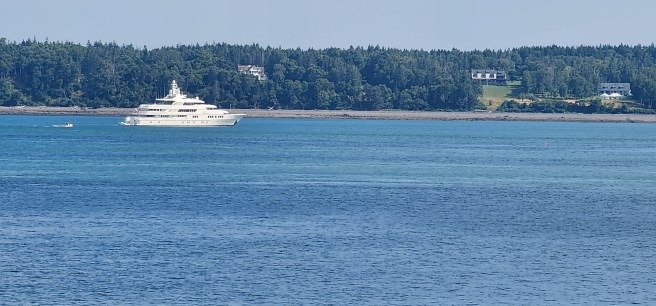
Eastport is preparing to welcome eight cruise ships for visits after Labor Day. That’s about half as many as last year’s record but could top it in the number of passengers. Four others were slated to visit but had to change plans when Customs could not provide agents to clear passengers and crews into the United States.

So far, I’ve found seven of the expected ships.

  • September 3: Enchanted Princess, 1,083 feet length, 18 decks, 4,500 maximum passengers, 1,346 crew.
  • September 17: Roald Amundsen, 459 feet, 530 maximum passengers, 160 crew.
  • October 5: Zuiderdam, 936 feet, 1,964 maximum passengers, 817 crew.
  • October 13: Volendam, 778 feet, 1,718 maximum passengers, 647 crew.
  • October 14: Azamara Journey, 594 feet, 781 maximum passengers, 408 crew.
  • October 15: Viking Mars, 748 feet, 938 maximum passengers, 465 crew.
  • October 27: Le Champlain, 430 feet, 264 maximum passengers, 112 crew.
  • Next year is already shaping up to be more active.

The visits have boosted the local retail season for many merchants, especially after the Summer People have retreated to their usual haunts.


Memories of places in the town I grew up in

I’ve mentioned a few others, such as the art museum, in other posts here. Now, to add a few more, in no particular order. Again, I’m looking at Greater Dayton rather than strictly inside the city limits.

  1. NCR: The National Cash Register Company’s world headquarters looked more like an open college campus with linden trees and pristine lawns than an industrial jumble behind barbed wire and hurricane fencing. It even had a fine auditorium and pipe organ, used for its gatherings of salesmen but also the concerts of the Civic Music Association – I heard a number of famed musicians there. And I was awarded my Eagle Scout badge and later my high school diploma on its stage. And, oh yes, I can’t overlook Old River, the employee park with the lagoon and boating, a fine miniature golf course, and a huge outdoor swimming pool – when one of my buddies whose father worked at NCR and thus had a pass to the park asked if I wanted to go, there was only one possible answer. Please!
  2. The corner display windows at Rikes department store: The pioneering retailer was the place to shop in town, and anytime we took the bus, say to the library or a movie, we’d wind up checking the latest display – especially at Christmas. During my senior year, some of my art work was used in the background of the featured fashion.
  3. The YMCA: I learned to swim at the indoor pool and sometimes applied my allowance to a grilled cheese sandwich later, over on the men’s side. And then, little kid that I was, I enjoyed the freedom of taking the bus home on my own.
  4. Frigidaire employee park: Thanks to my best friend’s father’s employee pass, we spent many summer nights enjoying free Starlight movies. My dad worked for another General Motors division in town, one that had no such benefits.
  5. Troop trails: My Boy Scout troop had a long hike one Sunday a month, in addition to a primitive camping weekend. Our routes often followed a river or crossed farmlands or even trekked along railroad tracks. I remember especially a few that traced the abandoned Miami-Erie Canal with its mule bank and its eerie remains of limestone locks left in vines and trees.
  6. Suicide Hill: A decent snowfall (quite modest by what I’ve experienced since) meant sledding at Hills and Dales Park. How insignificant the slope looks now, but there were some serious injuries. I had a near call.
  7. Memorial Hall: It really wasn’t designed for concerts, but it’s where the Philharmonic performed, and since my dad had access to tickets, I heard many top soloists. Hard to believe now, actually.
  8. Our big ugly high school: built in the 1960s and long since torn down. In my memory, I recall it more than the older but equally ugly elementary school.
  9. Yellow Springs: Once I got my driver’s license, the bohemian town in Greene County, home of Antioch College, became a welcome retreat. Its funky stores, before funky was a word in my consciousness, were mind-expanding. Nowhere else could we find Earl Grey or gunpowder tea or sticks of incense or perfumed soaps. Then there was the professional summer theater series at the amphitheater, itself a revelation. By that time, I was in love, at last. And that leads to mention of a covered bridge by moonlight: Yes, making out afterward in the moonlight at a covered bridge that’s no longer existent down an unpaved road.
  10. The Art Theater: Where I first saw foreign films, black-and-white alternatives to Hollywood’s commercial concoctions. And then there was the Lemon Tree coffee house next door with its folk music and blues.

My, all that was a world ago in my life.


‘This is not New York’

was so surprised
in rush between breakfast
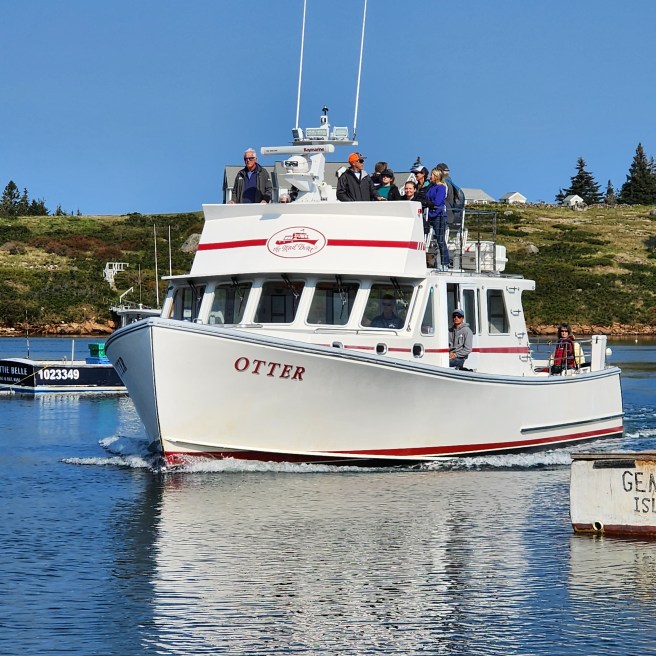
and boarding the Peapod for shore trip
to find in my pillbox this wasn’t Tuesday but Wednesday

when did I lose a day?

On Isle au Haut pier

I salute the shopkeeper for thanking
Justice Roberts for Obamacare
and explaining to him
why it was so important to her

to us

ATVs all around

My introduction came back in the late ‘70s when our landlord acquired a three-wheeler to get him easily from one end of his orchards to the other, and even up to the hill ranch and back. It was certainly easier to navigate through the trees than a tractor was.

These days, though, I see them everywhere.

Even though they’re not my cup of tea, here are some reasons.

  1. The machines themselves: More properly known as all-terrain vehicles, these small open motorized conveyances are either buggies (“quads” or “four-wheelers”) or tricycles (“three-wheelers” or “trikes”) with big, low-pressure tires and a seat that is straddled by a driver who steers with handlebars. So they’re not quite a motorcycle, OK? They are intended for off-road use, but commonly show up running on highway shoulders.
  2. Popularity: Honda introduced the three-wheeler in 1970, followed by the four-wheeler from Suzuki in 1982. They originally appealed to hunters and then sporting trail riders.  Yamaha entered the market in 1987 with the Banshee, which added sand dune riders as fans. By the early 1990s, ATVs had also become a part of the American workplace.
  3. Pure fun: There’s a good reason for the big club down in Dennysville, as well as the recreational riders at the trailhead in Machias during their summer vacations. The activity is seen as a major tourism opportunity. You can zip along and bounce, feeling free. I think of them as a kind of three-season snowmobile.
  4. Ease of getting around: On the Passamaquoddy reservation just to our north, they’re a common way to get from one part of the village to another, no matter the rider’s age. Here in town, they’re still pretty much banned, with some folks complaining of the noise or potential trespassing. The controversy is a hot topic in many localities.
  5. Regulations: Few states require a license to operate an ATV. In Maine, where I live, there is an annual registration fee for an ATV. In addition, no one under age 10 is permitted to operate an ATM, and youths 10 to 16 are required to have completed a safety course and be accompanied by an adult. The rules don’t apply to land where the operator lives or on land owned by the operator’s parent or guardian.
  6. As for kids: Youths can drive them, although children under age 12 are advised not to ride machines having more than 90 cc engines or, under stricter guidelines, no one under 16 should be driving, period. In practice, though, parents do send the kids to the grocery and hear no complaints. In addition, smaller models designed for young riders are available. Engine limiters are among the safety features. Still, an estimated 22 percent of the deaths involved children under 16, as well 26 percent of the reported emergency room injuries.
  7. Safety: From the beginning, deaths and serious injuries occurred, most of them blamed on reckless operation and failure to wear safety gear such as helmets and goggles. Tipping and rollovers accounted for a majority of the accidents. In 1987 a moratorium on the production of three-wheelers went into effect, shifting the market entirely to four-wheelers. In 2021, there were 293 deaths on public roads – 59 of them riders age 29 or less. Texas, West Virginia, and Pennsylvania have the highest fatality rates, followed by Kentucky and California.
  8. Environmental impacts: They’re largely negative. Off-road use contributes to soil erosion, damages vegetation, and disturbs wildlife habitats. All uses increase noise pollution, greenhouse gas emissions, and air pollutants. On the other hand, they’re not as bad as a pickup.
  9. Cost: Roughly $4,000 to $12,000 for a new one, though customization can really up the total.
  10. Annual sales: North America recorded $2.2 billion in sales in 2022, nearly two-thirds of the global market, and it’s growing.

The Appalachian Trail is the grandaddy of a hiking marathon

Other parts of the world have long had their pilgrimages, but in the United States, when it comes to doing that on foot rather than by car, I’d say the Appalachian Trail tops the list.

The public pathway was conceived in 1921, built by private citizens, and competed in 1937. It officially became the Appalachian National Scenic Trail in 1968.

Here are some other perspectives.

  1. Length: Almost 2,200 miles involving 14 states from Georgia to Maine. Parts of the path get rerouted over time, a consequence of urban development pressures, loss of access across private lands, or other factors. It’s touted as the longest hiker-only trail in the world. Pack animals and wheeled things are shunted to other options.
  2. Heavenly heights: The trail ascends many of the tallest peaks in the Appalachian Mountain system, including the Great Smokeys of North Carolina and Tennessee, the Green Mountains of Vermont, the Presidentials of New Hampshire, and Maine’s Longfellows, many of them rising above the tree line. Most of the trail is forests or other wildlands, although some sections, especially in the valleys, pass farmlands, follow roadways, cross bridges, or run into small towns.
  3. Backpackers: Sections traversing roadways often have trailheads that give day hikers or overnighters access for short treks, the AT is celebrated for its backpackers, carrying all of their food, clothing, and gear and camping each night somewhere in the wilds. Some, like my Boy Scout troop when I was 12, venture out for a week or two, but the truly serious folks are the ones who trek from one end to the other in a single season. They’re known as thru-hikers, and those who return to hike the AT from the other direction the next year are considered a “yo-yo.” An estimated 3,000 people set out each year to hike the entire length, with a fourth of them actually succeeding. In 2017, 715 northbound and 133 southbound thru-hikers were recorded.
  4. Weather factors: Winter weather in effect shuts down many sections of the AT, at least for thru-hikers. Since the weather warms earlier in Georgia than in Maine is the reason most of the thru-hikers start at the south end and head north, hoping the snow and ice have melted from northern New England sections by the time they arrive that far. Some veterans argue that the trail is easier in that direction, too.
  5. Self-discovery: As one gets a distance away from a road or peopled location, the terrain becomes more pristine. There’s less litter and debris and less noise, too. The hiker encounters not only nature, on gorgeous days and raw ones, but also personal challenges and inner resources.
  6. Dedicated organization: The AT is maintained by 31 trail clubs of volunteers and other partnerships and managed jointly by the National Park Service, U.S. Forest Service, and nonprofit Appalachian Trail Conservancy.
  7. Angels along the way: Thru-hikers tell of remarkable locals who routinely come to the aid of the travelers. Need a bath or shower? A lift into town for groceries? A phone call, back in the day before cell phones? (Maybe today that’s a recharge?) They’re there.
  8. Memories: Many of the experiences are unforgettable. The scenery, especially. But there can also be downsides: Rattlesnakes, copperheads, bears, as well as ticks, mosquitoes, and black flies. Or some brutal weather, even in the height of summer.
  9. Mostly protected now: Passage of the National Trails System Act of 1968 allowed the Park System to purchase most of the lands still in private hands, assuring the AT of a permanent route.
  10. It’s not necessarily free: Portions of the trail require payment for backcountry permits or park entry as well as for shelters and campsites. Otherwise, access it free. Your gear, foodstuffs, and getting there are, of course, expenses to consider.  

 The AT is no longer the only long trail system in America, but it’s still the oldest. To achieve its length combined with Continental Divide Trail (2,700 to 3,150 miles, depending) and Pacific Crest Trail (2,653 miles) is considered the Triple Crown of Hiking in the United States.