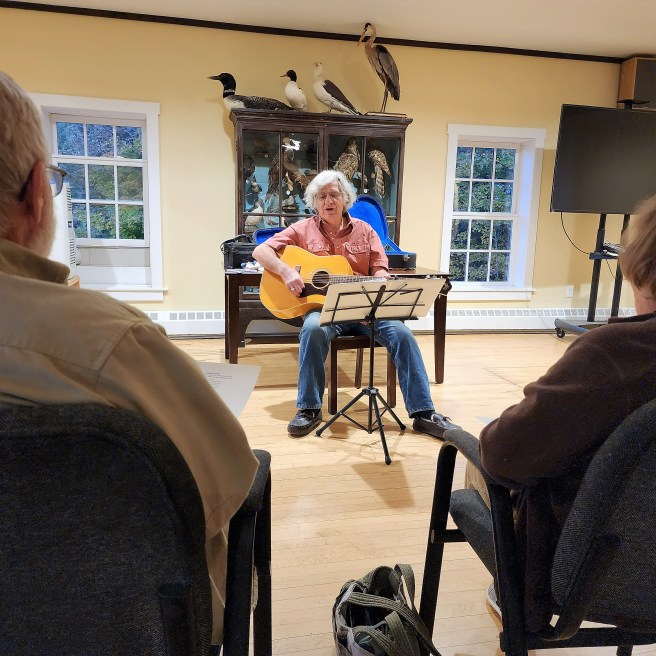
As you can see, Stephen Sanfilippo is more than a maritime historian. He can sing his research findings. Small concerts like this one upstairs at the Pembroke public library are one of the delights of living Way Downeast.
You never know what we'll churn up in cleaning a stall
As you can see, Stephen Sanfilippo is more than a maritime historian. He can sing his research findings. Small concerts like this one upstairs at the Pembroke public library are one of the delights of living Way Downeast.
One of the benefits of donating even a modest amount to the Metropolitan Opera’s broadcast fund is that you receive an annual schedule booklet, 36 colorful, glossy pages with the casts, broadcast times and estimated lengths, and summaries of the plots. The booklet arrives a month or two before the next season begins, and I keep mine as wonderful future references.
The upcoming Saturday matinee broadcasts, which start airing on Dec. 9, have already been controversial, due to the company’s shifting focus toward increased contemporary and sometimes realistically gritty works. The first presentation of the season, in fact, is Florencia en el Amazonas, inspired by the writings of Gabriel Garcia Marquez and only the third Spanish-language opera to be performed at the Met. (Carmen, after all, is in French and will be heard on Jan. 27.) Other works from our own era are Dead Man Walking (Jan. 20), X: The Life and Times of Malcolm X (Feb. 3), Fire Shut Up in My Bones (April 27), John Adams’ opera-oratorio El Nino (May 4), and The Hours (May 18).
That unprecedented string of operas by living composers doesn’t mean the usual masters aren’t on the menu. Mozart (3), Wagner, Verdi (4), Puccini (3), Bizet, Gounod, Donizetti, Johann Strauss Jr., and Gluck are all in the lineup, with two of the dates yet to be announced. Conspicuously absent is Richard Strauss.
Two of the archived presentations feature my favorite-ever conductor, Max Rudolf: Mozart’s Le Nozze di Figaro on Dec. 30, with Victoria de los Angeles and Cesare Siepi, and Donizetti’s L’Elisir d’Amore on April 6, with Luciano Pavarotti, Judith Blegen, and Ezio Flagello. As one conductor once told me, Rudolf could have been famous, if he had wanted that. At the Met, he worked largely behind the scenes as Rudolf Bing’s artistic administrator before going to Cincinnati and rebuilding that city’s great orchestra.
Also of note is that the long-running broadcast series has a new sponsor, the Robert K. Johnson Foundation, only the third in its history. The series was underwritten by Texaco from 1940 to 2003, followed by Toll Brothers luxury homebuilders (2005 to 2023).
Gee, have Texaco’s red-star gas stations been gone from the landscape 20 years already?
Even tradition changes.
The label does have a range of applications, from residents of the six-state New England region or Connecticut in particular to a Manhattan professional baseball team to anyone north of Dixie (often prefaced with “damn”) to anyone from the USA who lands in a foreign country.
Along with the shortened “Yank.” Or its many uses as an adjective.
The word’s origins, though, are contested.
None of these quite convince me, but I feel Scottish, Swedish, and even Persian roots are even less likely.


Diminutives, yes, but nothing like Sonny or Bunny.
I don’t know what that means, other than perhaps a lack of imagination.
~*~
Well, Dad was known as Sandy, but only at the office. Guess it was because of the time he was stationed in Florida during the Second World War.
As long as we’re at the Common Ground Fair in Unity, Maine, let me mention a few presentations today that go beyond the solid fare of food, forestry, livestock, fleece and fiber.
For instance, a home funeral demo is followed by discussions on green cemeteries and community death care teams for those interested in alternatives to costly funeral traditions. There’s also a blacksmithing demo and a hands-on assembly of a ¼ scale timber barn. Chicken first aid could be amusing, as could the basic of breeding your own pigs.
Of special interest to me are the two contradances, a traditional shape-note sing (hope I remembered to pack my Sacred Harp hymnal) alas at the same time as an Indigenous storytelling session, and three Maine legends appearing together: folksinger Noel Paul Stookey, comedian Tim Sample, and guitarist David Mallett.
I’ve sung in the choir behind Stookey twice and can say he’s an amazing person and musician.
Many of the presentations at the annual Common Ground Fair in Unity, Maine, focus on healthy garden and kitchen practices.
Today’s workshops and discussions include seed saving for the home gardener, my love affair with garlic, stories of climbing fruit trees, weird and whacky wire weeders you can make, beekeeping, honey harvesting and winter preparation, cider apple tasting, growing curcubits, unusual edible plants in the landscape, three-season gardening, year-round vegetable production, building and maintaining healthy soil, green manures, heritage tomatoes, and running a “from scratch” kitchen. There’s also canning, cooking your way to health with mushrooms, health and healing with products from the hive, medicinal uses of tannins, a panel answering your questions about herbs, a solar cooking demonstration, a children’s apple pie contest, and judging of baked goods and dairy and cheese entries. Remember, that’s just one day out of the three and there are plenty of other things happening at the same time.
Among the specialties being offered by the 43 food vendors you’ll find maple fried dough, Zylabi fried dough, sausage and chicken gumbo, jambalaya, red beans and rice, chai tea, traditional empanadas, Maine fish tacos, hummus and falafel pita sandwiches, spiced beef and lamb bowls, bialys, sourdough bruschetta, tofu fries, seaweed salad, sambusas, oysters on the half shell, eggplant and hummus sandwiches, pad Thai, Asian rice bowls, festival sweet dumplings, lamb shawarma, elote (street corn), switchel, fried shitake mushrooms, chicken tikka, aloo palak, chicken and lamb flatbreads, vegan egg rolls, and wild blueberry crisp. Maybe there’s only one way to find out what some of those are.
The lamb and oysters definitely have my attention.
For more conventional tastes, there are Italian sausages, burgers, smoothies, French fries, lemonade, cheesecake, thin crust pizza, soft pretzels, Belgian waffles, popsicles, and coffee and tea.
If that’s not enough, tomorrow includes growing rice in Maine(!) and yesterday had a future of psilocybin in Maine (21+ must have ID).
I think it’s a good example of ways America’s cuisine has expanded in the past 50 years. Back in my youth, mushrooms were an exotic item that came out of cans.
How about you?
There’s no Ferris wheel, no cotton candy, no neon lighting, no celebrity performers – for years there wasn’t even coffee, until fair-trade organic became an option – but the three-day event still draws roughly 60,000 folks to a two-lane road toward its grounds in the rolling farmland of central Maine.
For the first dozen years I lived in New Hampshire, I heard about the most recent gathering and spotted its current T-shirts at contradances and farm markets afterward, but my work schedule didn’t fit attending.
And then, newly remarried, I took some precious vacation time that gave me a first-hand experience – including the now legendary traffic jam that rivaled any big city. Once there, we encountered a number of people we already knew, even though we lived three hours away.
Another dozen years passed before we returned, from the other direction, and this year’s an encore.
It’s the Common Ground Fair, a three-day weekend affair held a few weeks after Labor Day – more or less an equinox celebration held by the Maine Organic Farmers and Gardeners Association, or MOFGA, the nation’s oldest and largest statewide organic organization in America.
It’s like a Whole Earth Catalog come to life. Of, if you’ve ever wondered where the hippies went, a good place to see places the movement has evolved and continues in practical ways.
Not all of it’s back-to-the-earth, either. Sustainable living, local economies, and spirituality augment the emphasis on organic agriculture and food use. There’s even a workshop on organizing a labor union.
Here’s hoping for some prime fall weather.
It’s a big deal, I’m told, and will bring a flock of bigwigs to our tiny but fair city. We got a taste of U.S. Navy presence over July 4th, but this is more uppity.
A state-of-the-art trimaran hulled stealth vessel of war, the USS Augusta (LCS-34), will ceremonially go into service. I guess it’s like a grand opening celebration.

Since the independence-class littoral combat ship is named for the city in Maine, the second vessel to carry that distinction, the Navy wanted to uphold a tradition of performing the ritual within the state being honored.
The event’s not to be confused with the christening, which happened with a shattering champagne bottle across the bow or some equivalent in December last year in Mobile, Alabama. Nor is it to be confused with the launching, May 23 last year.
So instead of witnessing the infusion of three thousand guests to Eastport for the day, I’ll be out on the waters of Penobscot Bay, two-plus hours to our west, sailing and sleeping in the oldest active two-masted schooner. Definitely more my speed.
Given the two first-time experiences before me, I think I’ve made the right choice, not that the other was an option at the time I made my reservation.
Isn’t that so emblematic of life?
It was a favorite breakfast when I was growing up in Ohio, but not an everyday offering.
First, it would be served as a hot cereal, and afterward, after hardening in bread pans, it would be fried in slices and served in melted butter and syrup.
I still remember the reaction when I was head chef (briefly) at the ashram and served it for brunch. It was vegetarian and fit into that part of our yoga practice. But half of the staff and guests were openly baffled. What is this stuff? It wasn’t anything like the buckwheat kasha they’d introduced me to. The other half, though, delighted in it.
It’s still not an everyday dish in my household, but I still relish the moments when it comes up.
My wife, of Southern roots, is more familiar with grits – a variant – and also the Italian polenta, which is much more expensive for no understandable reason.
The one place I’ve seen it on the menu is at the Bob Evans restaurants, where it’s deep fried and typically sells out early in the day.
Cornmeal does show up in my novel The Secret Side of Jaya and on many supermarket shelves, especially under the Hodgson Mill label, reflecting some distant relations of mine who went back to inserting the “g” into our surname.
So where, if at all, do you use or eat cornmeal? It was a basic foodstuff of much of early America.

