Some road names have a poetic twist

Country roads sometimes carry imaginative monikers.

Here are some ones that stand out in my encounters:

  1. Bellsqueeze (Maine)
  2. Cat Mousam (Maine, named for Catherine Mousam)
  3. Clay Lick (Indiana)
  4. Diamond Mill (Ohio, named for the pattern on the mill’s label rather than little gems sparkling in the pavement)
  5. Feedwire (Ohio)
  6. Indian Ripple (Ohio)
  7. Labor in Vain (Massachusetts)
  8. Needmore (Ohio)
  9. Snakeroot (Maine)
  10. Sweet Potato Ridge (Ohio, in some truly flat terrain)

Charles Ives saw music ‘as the lens through which we can glimpse the divine’

For him, that also shook up the universe.

The 150th anniversary of the birth of the American maverick takes place Sunday, the 20th, and despite his relative obscurity, he was a giant as an uncompromising modernist classical composer and as an innovative executive in the insurance industry.

Born in Connecticut and a graduate of Yale, Charles Ives’ musical transformation was certainly one of the most extraordinary cases in history, made all the more remarkable by the fact that he was forced to compose largely without hearing many of his adventurous works played by an orchestra or soloists until a half-century or more after their composition. Even the sonatas, songs, and chamber music suffered from widespread neglect.

As a matter of confession, I am quite fond of his music, from the wonderfully rich late-Romantic scores of his youth to the craggy, thorny modernist fireworks of only a few years later. I am among those who feel scandalized by the fact that this season orchestras aren’t playing even one of his symphonies in celebration, much less all four. Two of them did win Pulitzers, by the way, once they were finally aired, and riotous cheers often break out at the conclusion when the works are performed.

For a biographical overview of this American original, turn to my post, “Thoughts while listening to Charles Ives,” of November 5, 2013, at my blog, Chicken Farmer I still love you.

Today, I’m offering a Double Tendrils. Let’s start with ten quotations about music.

  1. You goddamn sissy… when you hear strong masculine music like this, get up and use your ears like a man.
  2. It is more important to keep the horse going hard than to always play the exact notes.
  3. Please don’t try to make things nice! All the wrong notes are right. Just copy as I have – I want it that way.
  4. In “thinking up” music, I usually have some kind of a brass band with wings on it in back of my mind.
  5. The possibilities of percussion sounds, I believe, have never been fully realized.
  6. There is more to a piece of music than meets the ear.
  7. Music is the art of thinking with sounds.
  8. Beauty in music is too often confused with something that lets the ears lie back in an easy chair. Many sounds that we are used to do not bother us, and for that reason we are inclined to call them beautiful. Frequently, when a new or unfamiliar work is accepted as beautiful on its first hearing, its fundamental quality is one that tends to put the mind to sleep.
  9. The beauty of music is that it can touch the depths of our souls without saying a single word.
  10. Good music is not just heard; it is felt with every fiber of our being.

~*~

And here are ten Ives quotes about life itself.

  1. The word “beauty” is as easy to use as the word “degenerate.” Both come in handy when one does or does not agree with you.
  2. An apparent confusion, if lived with long enough, may become orderly … A rare experience of a moment at daybreak, when something in nature seems to reveal all consciousness, cannot be explained at noon. Yet it is part of the day’s unity.
  3. Awards are merely the badges of mediocrity.
  4. Every great inspiration is but an experiment – though every experiment, we know, is not a great inspiration.
  5. Expression, to a great extent, is a matter of terms, and terms are anyone’s. The meaning of “God” may have a billion interpretations if there be that many souls in the world.
  6. You cannot set art off in a corner and hope for it to have vitality, reality, and substance.
  7. The fabric of existence weaves itself whole.
  8. Vagueness is at times an indication of nearness to a perfect truth.
  9. The humblest artist will not find true humility in aiming low — he must never be timid or afraid of trying to express that which he feels is far above his power to express, any more than he should be in breaking away, when necessary, from easy first sounds, or afraid of admitting that those half-truths the come to him at rare intervals, are half-true; for instance, that all art galleries contain masterpieces, which are nothing more than a history of art’s beautiful mistakes.
  10. Most of the forward movements of life in general … have been the work of essentially religiously-minded people.

Reclaiming Passamaquoddy

Living adjacent to the tribe’s Sipayik reservation opens new perspectives in my awareness. It’s not quite osmosis, but perhaps a willingness to listen.

One of the big breakthroughs for the tribe has involved access to 36 wax cylinders from 1890, the first field recordings ever made, when anthropologist Walter Jesse Fewkes came to Maine to test the Edison equipment before he headed off to Navajo and Hopi lands.

For decades, the recordings were kept in museum vaults, unknown to the tribe. And then, slowly, they came into consciousness, first through taped copies full of scratchy static and more recently cleaned up into digitalized files that tribe historians are carefully gleaning.

As a writer, I believe in the power of stories and the importance of language itself.

Here are some of the insights I’m hearing from my neighbors.

  1. Dwayne Tomah’s reaction on hearing the recordings the first time: “I wept. These were my ancestors speaking and singing to me.”
  2. The language has only two genders – animate and inanimate.
  3. Its wider family, Algonquian, features prenouns, a form shared only with Japanese and Korean.
  4. Translations from a tribal side, rather than a nontribal institution, can be revealing. For instance, rather than “Trading Song,” it’s more accurately “Let’s Trade.”
  5. The recordings preserve more than the language itself. There are also the stories, songs, and advices, sometimes with context.
  6. The Tides Institute’s latest map of our region portion of Maine and New Brunswick includes the Passamaquoddy place names. Tribal historian Donald Soctomah has used that to explain hard-to-translate subtleties, such as those describing qualities of water encountered in canoeing in a specific location.
  7. A Passamaquoddy-English dictionary, still growing, is available online. It has a range of expressions for anger that are totally missing in English.
  8. The language is being taught in elementary schools. (For generations, it was banned, even in homes.)
  9. The recordings are helping the tribe’s branch in neighboring Canada in its quest to gain First Nations status. One song, for instance, refers to what’s now the location of Saint Andrews.
  10. Even a few commonly understood words spoken among the tribe are rebuilding identity and pride, even when the rest of us watch on.

How to tell if you’re becoming a gnome

Ever have one of those days? You may have some serious reasons for concern if it includes the following symptoms.

  1. Feel like you’re shrinking in size? Down to two spans high?
  2. Suffer deep embarrassment or shame?
  3. Have a desire to retreat underground?
  4. Get hot-tempered? Irritable?
  5. Find gold-diggers offensive?
  6. Sense a reluctance to interact with humans?
  7. Sympathize with prudish women?
  8. Have flashes of innovation or cunning?
  9. Wild hair?
  10. Ugly?

And here I had thought these were simply symptoms of aging.

Not to be confused, geographically speaking

Living in Down East (aka Downeast) Maine is confusing enough, considering that it’s mostly north. How about some other place locations?

  1. Upper Cape versus Lower Cape Cod as well as the Inner Cape and Outer Cape, meaning Cape Cod, Massachusetts, not what you’d usually think
  2. Deer Isle (Penobscot Bay, Maine) versus Deer Island (Passamaquoddy Bay, New Brunswick)
  3. Swan’s Island, off the coast, versus Swan Island in the Kennebec River
  4. Saint John (New Brunswick) versus Saint Johns (Newfoundland)
  5. Round Pond versus Round Lake, both in Washington County, Maine
  6. Salem, New Hampshire, 28 miles from Salem, Massachusetts
  7. Portland (Maine) versus the newer one out west
  8. Washington, the state, versus the District of Columbia
  9. Columbia, as in the river, and Colombia, the nation
  10. Missouree, as it’s pronounced in Saint Louis, and Missourah, in the rest of the state

Woodville is its own contentious issue, at least in the renamed Baileyville in Washington County, south of the one in Aroostook. Blame the U.S. Postal Service for trying to end the confusion.

Ten big prize winners I’ve known or at least met

  1. Elinor Ostrom, Nobel Prize, economics
  2. Clarence Page, Pulitzer Prize, commentary
  3. Dick Locher, Pulitzer Prize, editorial cartoonist
  4. Gary Snyder, Pulitzer Prize, poetry
  5. Jeff MacNally, Pulitzer Prize, editorial cartoonist
  6. Jesse Haines, Baseball Hall of Fame, pitcher
  7. Jesse Owens, Olympic gold medalist, runner
  8. Marcy Nighswander, Pulitzer Prize, photography
  9. Ritter Collett, Baseball Hall of Fame, sportswriter
  10. Steve Curwood, Pulitzer Prize, investigative reporting

What’s love got to do with it?

In research for my novel What’s Left, I wound up learning about the people we now call Roma. I won’t say how it applied, but it was an eyeful.

For instance.

  1. All Roma are expected to marry – and to another Roma, not an outsider.
  2. In many tribes, the parents arrange the marriage.
  3. Rejection of a formal proposal is considered a disgrace.
  4. Acceptance leads to the negotiation of a bride price to compensate her parents for their loss.
  5. A festive ceremony may follow a few days later, signifying the engagement.
  6. No formal ritual is required as a wedding itself, though some tribes turn the occasion into a multiday celebration.
  7. Wedding gifts almost always consist of money.
  8. After the wedding, the bride is never seen in public without wearing her headscarf.
  9. They settled into the groom’s parents’ home, and cannot move to a place of their own until after the birth of their first child.
  10. The couple cannot refer to each other as husband and wife until their first child is born. Up to that point, it’s only their first names when speaking to each other or about the other in public.

Gee, we haven’t even touched on the death customs and rituals.

Drawn from Gypsy at larp.com.


Take up a new activity means learning words that go with it

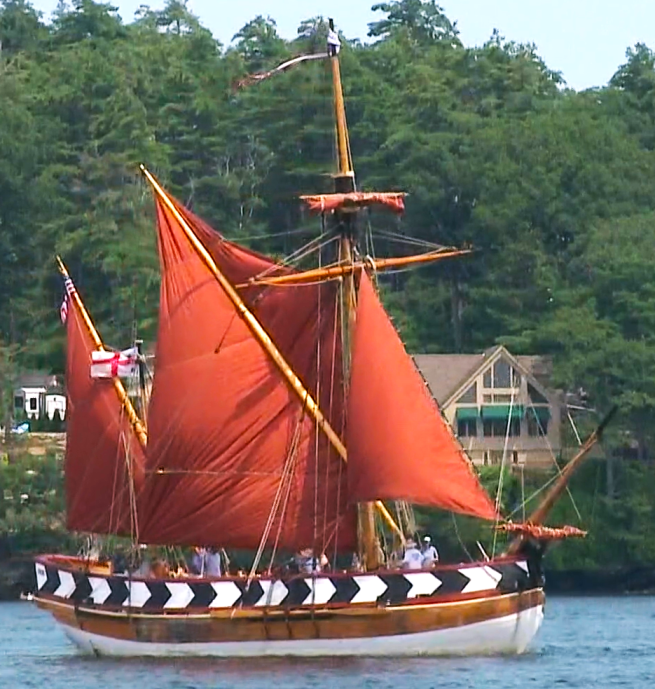
My week on a schooner enlarged my vocabulary.

For instance.

  1. A quarterboard proclaims the name of the ship at the bow.
  2. Quarterdeck, the little raised house behind the main mast, where the wheel is. The forecastle is the one at the other end, up by the bow.
  3. Dropping the hook, meaning anchor.
  4. Gaff, the more or less horizontal spar at the top of the mainsail and foresail. It makes those sheets irregular quadrilaterals in shape rather than triangular.
  5. Beam, the width. Crown, the roll of the deck for water to roll off. Sheer is the cut of the profile, usually voiced with aesthetic appreciation or disproval.
  6. Hatch, with the ladders down into the hold.
  7. Stern, the back, where we steer.
  8. Transom, the flat back of the boat , or, as you know now, at the stern.
  9. Yawl. It can be a kind of auxiliary sail, but in a schooner’s case, usually refers to the yawl boat riding at the stern when it’s not off somewhere on its own.
  10. Windward, meaning the direction the wind’s coming from, and leeward, the direction the wind’s headed. In a heavy wind, the windward side of the ship’s higher, while the leeward one dips toward the water. (When it’s really touching the water, the ship’s “running the rail,” meaning ripping along.)

I also like the term “running on one screw,” meaning propeller, except we didn’t have one.

We won’t even start talking tonnage, which seems to mean a lot for insiders.

Memories of Cincinnati

As I mentioned in a previous Tendrils (June 10), Cincy was the “big city” of my youth, an hour drive to the south once Interstate 75 opened.

Here are some memories.

  1. Music Hall:  Completed in 1878 and newly renovated, including a meticulous shrinking of the breathtakingly gorgeous main auditorium, this Venetian Gothic classic is the home of the Cincinnati Symphony and Pops orchestras, May Festival Chorus, and opera and ballet companies. I treasure the concerts I’ve heard there, often from the second balcony. It’s certainly among the oldest concert halls in America, with the Central City Opera House in Colorado being the closest rival for the title I’ve found so far.
  2. Carew Tower and Fountain Square: The observation tower 49 stories above the downtown, accessed by a “rocket speed” elevator, was my introduction to skyscrapers. It’s architect, William Lamb, went on to be one of the chief designers of New York’s Empire State Building, completed the following year. Fountain Square, in a dark canyon when I knew it, has since been given an airy plaza and become even more of a gathering place.
  3. Taft Museum: This small art collection celebrates one of the residents of the historic 1820 home at the edge of downtown, Charles Phelps Taft, half-brother of President and Supreme Court Justice William Howard Taft, who had accepted his nomination to the candidacy from its portico. The house fronts Lytle Park.
  4. Mount Adams: With the major art museum, repertory theater, Mahoghany Hall bookstore and jazz bar, a family-run Italian sub shop, and a once-famous Rookwood pottery operation at its edge, this was a bohemian center when I knew it.  
  5. Izzy Kadetz: Legendary Jewish delicatessen downtown where customers obeyed the owner’s orders, including, “Eat and get out!” He also charged customers based on their ability to pay.
  6. Zoo: I mentioned the opera in a previous post, and it’s no joke, but there’s more to the zoological and botanical garden. Home of the last known passenger pigeon, the institution has since pioneered species preservation and been a leader in creating habitats shared by various species.  
  7. Union Station: I vaguely remember a childhood train ride from Dayton and our late-night return. The grand 1933 train terminal was considered a masterpiece, one of the last, and today stands as the Cincinnati Museum Center, including the historical, children’s, and natural history and science museums. I think we went to the zoo during the day.  
  8. Riverboats: Several times during my youth, I found myself part of a group taken out on the Ohio River for a paddleboat trip. I heard a real calliope in the process.  
  9. Shillito’s: Cincy’s oldest department store was boldly art deco when my paintings and designs were included in the annual Scholastic Art competition displays on one of the upper floors. It was quite an honor and thrilling. Pogue’s, a somewhat more old-fashioned department store, was also fun to pass through. Shillito’s, Rikes of Dayton, and Lazarus of Columbus eventually became Federated Department stores, which ultimately took over Macy’s, including its name. Got that? Macy’s headquarters wound up in Cincinnati, returning to Herald Square in Manhattan only in 2020.
  10. King’s Island: The amusement park famed for its huge wooden roller coasters is my most recent encounter with the Queen City of the West, as Cincy had become known by 1820.  I remember the park’s earlier incarnation as Coney Island – or Coney Island of the West, to distinguish it from the tip of Brooklyn – where it was prone to flooding from the Ohio River. I did, in fact, visit once on a riverboat outing that originated and ended downtown. I’m surprised to see the first site survives as a water park. The visit to the current operation came while visiting my hometown. Accompanied by my two daughters, we ventured forth to the outskirts of Cincy facing Dayton and had a most memorable day.

Recalling some favorite magazines

As an editor and a writer, I’ve long been inspired by a stream of classy, glossy magazines with outstanding illustrations and design supporting sharply edited, masterful writing.

In this category, I’m skipping over purely literary periodicals, even the ones with deep pockets, as well as newsweeklies and many other kinds of magazines.

The ones I’ve admired, as I’m seeing now, all reflected a single editor’s voice and vision, not that I remember all of their names now. Maybe that’s for another Tendril.

For now, here’s what I mean.

  1. The New Yorker. The writing and editing, of course. I was captivated way back in high school – the staff of the Hilltopper even gave me a year’s subscription when we graduated – and still a delight in my retirement, maybe even more, in its current direction. Still, there’s no way to keep up. I should mention, in passing, its assiduous fact checkers, a vexation for many famed writers.
  2. Fortune, back when it was big and classy. Big? The pages were large, like 10 or 11 inches by 12 or 13 inches deep — often on high quality paper, and each issue was fat and thoughtful. Artists were commissioned to create portfolios, with authors to match. It definitely reflected wealth and luxury, unlike other business publications, which often felt pinched. And then the U.S. Postal Service began charging extra for oversize mailings, leading many magazines to shrink their formats. Titles like Life, Look, and Vogue lost their impact, and photographers, especially, took a hit.
  3. New York. Originating as the Sunday magazine of the New York Herald Tribune, this one took off on its own in 1968 after the newspaper’s demise. Brash and definitely connected to everyday life on Manhattan streets, it was an avatar of New Journalism and Push Pin graphics. Still has that cutting edge.
  4. Esquire. By the late ‘60s this former cheesecake vehicle had evolved into a champion of New Journalism and high-impact graphics. Some of the covers remain classic. More recently, Vanity Fair continued in that vein until its solid content evaporated in a demographic desert.
  5. Evergreen Review. Another of the late ‘60s blossoms, this one had a West Coast perspective, openly leftist leanings, and literary ambitions, including Beat poets. Its cartoon serial “Phoebe Zeitgeist” became an underground cult item of a scandalous sort.
  6. Playboy. As a matter of candor, consider its now-classic interviews, plus the fiction, and, yes, the cartoons, a nearly extinct venue these days. The photography was often masterful, no matter the content. The editor in this case did go on to become a pathetic caricature of himself, reflecting the vapid “philosophy” he was espousing.
  7. GEO. This hip German-based alternative to the National Geographic debuted in 1976, distinctive for its green-bordered covers, trend-catching photography, and progressive topics and awareness. The English editions blossomed and then trickled from sight. Much of it, like the international hippie roots it reflected, looks dated today.
  8. New England Monthly. Published from 1984 to 1990, it was an epitome of ambitious, sophisticated, city- and region-based magazines that flourished during the decade. It ran into an identity problem when big advertisers wanted a Greater Boston focus, while important regional issues spilled over into western Massachusetts and Cape Cod as well as Connecticut, Rhode Island, Vermont, New Hampshire, and Maine, where subscribers existed. The final edition featured a devasting account of the high-level executive arrogance regarding the Seabrook nuclear power plant in New Hampshire led to its corporate bankruptcy, rather than the commonly blamed regulations and enraged environmental protests. After revenue shortfalls shuttered the magazine, some of its writers went on to stardom.
  9. Elle. This upstart to established fashion bastions Vogue and Harper’s Bazaar was actually founded in 1945 in Paris as a newspaper supplement but came to prominence with a monthly American edition in 1969. Propelled by Gilles Bensimon’s inspired, fresh, even exciting photography and sharp page layouts that delivered in tight spaces, there was no mistaking this entry from its rivals. Another upstart, Sassy, a feminist teen platform aimed at well-healed Seventeen, lacked gloss and polish but sizzled on editor Jane Pratt’s brilliant assignments from 1988 to 1996, when it finally succumbed to a longstanding boycott by an evangelical women’s organization. As a former lifestyles editor, I found Pratt to be most refreshing.
  10. Harper’s. These days, it rules the roost for me. Its monthly index of seeming random statistics and trends, toward the beginning of each issue, even provided inspiration for these weekly Tendrils.