Takin’ the ferry in New England

Washington state isn’t the only part of the country where ferry service is important. The Staten Island ferry makes appearances in my Subway Visions novel, strange as that sounds. Check it out.

A bit further to the northeast, here in New England the boat service can also be impressive. Most of my trips here, I should add, have been as a walk-on passenger.

Now for a look.

~*~

  1. Casco Bay. Portland (as in Maine, not Ory-gone) overlooks Casco Bay and some of its neighborhoods are on islands. A state-created ferry service makes daily stops on four islands within the city limits plus two in towns beyond. The little yellow-and-white boats are rather picturesque, truth be told, and the fares are quite reasonable. We’ve become quite fond of the mail run, which has six stops on five islands out and then back.
  2. Portland to Nova Scotia: Also out of Casco Bay is a catamaran ferry that zips to Nova Scotia in half the driving time. (Looks like there’s one stop en route, at Bar Harbor.) Back when it was a conventional boat, much of the appeal was in overnight gambling, once you were out in international waters.
  3. Nantucket. There are several routes, mostly from Cape Cod. The island likes to think of itself as a world all its own.
  4. Martha’s Vineyard. Like Nantucket, but maybe more exclusive.
  5. Boston to Provincetown. The catamaran zips from downtown Boston to the Cape in just 90 minutes, half of the time of driving in good conditions. I might mention some Boston Harbor commutes for shorter ventures.
  6. Block Island. Out from commercial fishing Port Judith in Rhode Island, it’s a fine daytrip. Rent a motor scooter when you land for a quick tour.
  7. Isles of Shoals. Just downstream from us, there are several services linking Portsmouth and the Isles of Shoals. The small islands split by the New Hampshire-Maine boundary include the Star Island summer retreat run by a Unitarian-Congregational church arrangement.
  8. Mohegan Island. Penobscot Bay in Maine has several ferry trip choices available. Mohegan Island is a prime destination served from several points onshore.
  9. Lake Champlain. Several crossings connect Vermont to New York State. Of the ferry trips on this list, these are the only ones on freshwater, not saline. One even follows a cable from one shore to the other.
  10. Campobello Island. OK, that’s in New Brunswick, Canada, but it’s once again served by a small ferry from Eastport, Maine. Sometimes the boat goes further, too, out on the world’s biggest tides.

~*~

Ever been on a ferry or whale watch? What’s your experience?

A Casco Bay ferry passes one of several historic harbor fortifications in Portland, Maine.

Ever take a ferry for fun?

When I lived in the desert in Washington state, we used to joke about the “rainy side” of the Cascade mountains, the strip where most of the people resided and worked.

When we visited that side, though, we often found ourselves driving the car onto a ferry and venturing onward. The state government manages an impressive fleet, some of them small and others, well, more substantial. It’s the largest ferry service in the country and fourth largest in the world. Its boats even show up in my novel Nearly Canaan.

Here are its nine routes plus one, all on Puget Sound but the last, which is a private operation.

~*~

  1. Seattle-Bainbridge Island: 6,429,853 riders a year. Big-time commuter run from downtown. (That’s still only a fourth of the volume on the Staten Island ferry, and there’s no Statue of Liberty along the way. But the New York line has eight boats compared to this route’s two.)
  2. Edmonds-Kingston: 4,114,181. With a terminal just north of Seattle, this route offers a quick hop across Puget Sound. Obviously, popular with commuters.
  3. Mukilteo-Clinton on Whidbey Island: 4,073,761. It’s the first leg to Port Townsend from Seattle. Most of the riders are commuters who live on Whidbey Island.
  4. Fauntleroy-Vashon-Southworth: 3,059,587. Operates as a “triangular” route from West Seattle.
  5. Seattle-Bremerton: 2,739,926. Includes some hairpin turns getting into Bremmerton while passing a U.S. Navy shipyard.
  6. Anacortes-San Juan Islands: 2,009,438. The San Juans are four gemlike isles north of Seattle. Popular with sailboat owners.
  7. Port Townsend-Coupeville on Whidbey Island: 819,285. Port Townsend, at the “anvil” on the Olympic Peninsula, has become a trendy, artsy waterfront town.
  8. Point Defiance-Tahlequah: 812,786. Links Tacoma and Vashon Island.
  9. Anacortes-Sidney, British Columbia: 123,001. Also stops at Friday Harbor in the San Juans. Landing is a 30-minute drive from Victoria.
  10. Port Angeles-Victoria, British Columbia. Its 90-minute voyage across the Strait of Juan de Fuca links the Olympic Peninsula to downtown Victoria. The vessel carries up to 110 vehicles and a thousand passengers. The Black Ball Ferry is not a state-run route, but it is truly a “poor man’s cruise.” I remember eating well and being agog at our landing in the heart of the classy Canadian city. (A foot-passenger-only rival sails from downtown Seattle.)

~*~

How about your experiences riding ferries?

The Washington state ferries have views of both the Olympics and Cascades mountains.

How could you not be impressed by Rainier?

I’ve never seen a photograph that captures the breathtaking majesty of Mount Rainier. Even from miles away, it can seem to hover over your head, perhaps even reaching on around for the back of your neck.

Like Joshua and Jaya in my novel Nearly Canaan, I lived in the desert to the east. That meant we usually frequented parts of the national park that the folks from nearby Seattle were least likely to visit.

It’s been 40 years since I was forced to move elsewhere. Here are ten things that still impress me.

~*~

  1. The park: Established March 2, 1899, Rainier is America’s fifth oldest national park. It covers 369 square miles, making it the 21st largest in the continental U.S. and the third largest in Washington state.
  2. The central mountain: Also known as Tahoma, Rainier rises to 14,411 feet above sea level, making it the second tallest peak in the continental U.S. Unlike its rivals, its base is only miles inland from sea level. Measured from base to summit, or by its topographic prominence, that’s 13,210 feet – more than K2 in the Himalayas. It’s the most heavily glaciated mountain in the continental U.S.
  3. It’s a stratovolcano: Rainier is an active volcano, with sulfur-fuming pits in the ice at its summit. Considered one of the most dangerous volcanoes in the world, it leaves about 80,000 people and their homes at risk of an eruption.
  4. Distance from the summit to downtown Seattle: 59 miles, if you’re a crow.
  5. Diversity of ecosystems: About 58 percent of the park is forested, ranging from dense evergreen forest to open ponderosa. The tall Douglas firs and western red cedars are nearly as impressive as the sequoias further to the south. Another 23 percent of the park is subalpine, above the forests but having evergreens at distances. In season, this is wildflower heaven, with orange paintbrushes, lupines, and white-starred avalanche lilies in profusion. Above that, half of the remainder is alpine, having unique vegetation, while the other half is permanent snow and ice.
  6. Year-round ice and snow: Depending on your source, 26 or 27 major glaciers cling to the mountain. They release thunderous booms of breaking ice during the summer. Combined with permanent snow patches, they cover about 35 square miles.
  7. Ice caves: By late summer, the mouths of some of the glaciers melt away to form mystical blue caverns. They’re dangerous to enter but unforgettable if you’ve ever been in one.
  8. Reaching the summit: Climbers are required to register for permits before setting out. They must possess technical skills regarding ice axes, harnesses, and ropes and be in good physical condition. They face a 9,000-foot elevation gain over eight or more rugged miles. And then they repeat it in reverse. For most, it’s a two-day trek. About 10,000 people set out for the summit each year, with half of them succeeding. The mountain claims an average of two lives a year.
  9. Thermal hot springs: Furthest away from Seattle is the Ohanapecosh Hot Springs. Once a resort, it now features trails that are delightful to hike in winter.
  10. Two lodges: Situated at 5,100 feet elevation in the subalpine terrain, Paradise receives an average of 53 feet of snow a year. Sunrise, at 6,400 feet elevation, is the highest point the roads reach. The lodges are often snowed in till the Fourth of July.

~*~

If you’ve ever been there, what would you add?

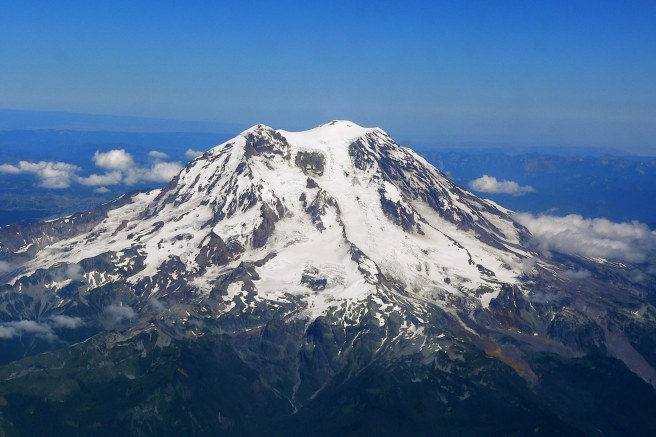
Mount Rainier from the air. Notice the clouds are below the summit. And much of the white covering is glaciers.

You don’t always have to eat those apples

In my novel Nearly Canaan, Joshua and Jaya find themselves surrounded by orchards. They quickly appreciate apples as much more than an orb to eat daily.

Here are ten unexpected uses.

~*~

  1. Headache relief. Cut a green apple open and start sniffing. It’s supposed to work faster than some pain pills.
  2. Christmas decorations. Slice an apple, then carve out the core. The rounds can be hung individually or as a garland on the tree or window. They’re fragrant, too, as they dry.
  3. Shrucken heads for Halloween. Bake them on low for three hours or so, then carve out a mouth and nose, maybe the eyes too. Add buttons or other small objects for the eyeballs. Quite spooky and yet funny.
  4. Kiddie craft stamper. Cut one open, then carve out a design for imprinting with ink on paper or fabric.
  5. Candleholder. Carve the core from an apple, then insert a votive or tea candle. It makes for a romantic glow.
  6. Hair rinse. Dilute cider in water, then rinse after shampoo and conditioner rounds. Removes excess oil.
  7. Salt reduction. Ever put too much salt in something you’re cooking? A few wedges of apple or potato added to the pot can turn the trick. Remove them after ten minutes. Don’t see this helping on the table, though. Any suggestions there?
  8. Green tomato ripener. Place an already ripe apple in a paper bag for a couple of days. We’ll have to remember this in the fall, when we harvest everything we can before the first big frost.
  9. Potpourri. Stud an apple with cloves stems and let it dry in a clothes drawer. I remember that from childhood.
  10. As a bow-and-arrow target. Especially if you’re William Tell.

~*~

Gee, aren’t we feeling like Martha Do-it!

What else do you suggest?

There aren’t many big metro areas in the Pacific Northwest

Like Joshua and Jaya in my novel Nearly Canaan, I was surprised by the relative importance of smaller urban areas in the Pacific Northwest. Look how quickly the population figures drop.

Looking at the states of Washington, Oregon, and Idaho, here are the ten largest cities by metropolitan area population. These figures have mushroomed since I lived in the region four decades ago and even desert communities have been deemed desirable destinations for retirees. As for geographic perspective, remember that the Seattle standard statistical metropolitan area includes the wilderness of Mount Rainier National Park. Anyplace else have an active volcano?

~*~

  1. Seattle, 3.9 million. Ranked 20th in the U.S. Feels more like Boston, Chicago, or Atlanta in its impact.
  2. Portland, 2.4 million. Ranked 30th in the U.S.
  3. Boise, Idaho, 730,426
  4. Spokane, Washington, 559,891
  5. Salem, Oregon, 432,102
  6. Eugene-Springfield, Oregon, 379,611
  7. Olympia, Washington, 286,419
  8. Tri-Cities, Washington, 296,224
  9. Bremerton, Washington, 269,805
  10. Yakima, Washington, 251,446. The major metropolis for the middle third of a large state.

~*~

Note that six of the ten are west of the Cascade range. None are in the eastern half of Oregon.

Just to the north, Vancouver, British Columbia, has 2.4 million population, making it Canada’s third largest metropolis.

~*~

What would your community match on the list?

What’s your favorite way to enjoy apples?

In my novel Nearly Canaan, Joshua and Jaya find themselves surrounded by orchards. They quickly appreciate apples as much more than an orb to eat alone daily.

Here are ten popular uses.

~*~

  1. Pies or turnovers.
  2. Sauce.
  3. Butter.
  4. Stuffing.
  5. Fritters.
  6. Waldorf salad.
  7. Candied or caramel.
  8. Juice, cider, or cider vinnegar. Let’s not overlook hard cider, either.
  9. Dried.
  10. Baked.

~*~

That’s all pretty basic, before we get to create ways to use ’em with other ingredients.

~*~

How do you like to enjoy apples?

Ten crops of the Yakima Valley 

In my novel Nearly Canaan, Joshua and Jaya settle into a place unlike anything they would have imagined. It’s desert, for one thing, where nearly everything has to be irrigated, for another. Quite simply, it’s a lot like Yakima, in the middle of Washington state and an agricultural mecca.

Besides the well-known crops of apples, hops, and grapes, let’s consider:

  1. Barley
  2. Peaches
  3. Nectarines
  4. Pears
  5. Apricots
  6. Cherries
  7. Mint
  8. Asparagus
  9. Eggplant
  10. Hay

~*~

Not necessarily in that order.

Ten more ways ‘Canaan’ is new and improved

My newest book, Nearly Canaan, is a thorough reworking of three earlier novels that now flow together as one.

Here are ten reasons the new version is new and improved.

  1. The book now focuses on the question of what impact one person can make for lasting good in our world, especially in and through our closest relationships.
  2. Jaya’s professional identity in her pioneering approach to nonprofits administration is quickly and more clearly established. Her career and its demands become a source of major conflict in the course of the story.
  3. Her character now grows out of her role in Yoga Bootcamp, which provides further understanding of her motivations and inner direction.
  4. The actions now show that the best intentions may have unanticipated negative consequences.
  5. Jaya’s desire to find an appropriate way of personally expressing her spiritual experiences finally creates a unique artform.
  6. Events are no longer left hanging at the end of what was the first novel. Life moves on in the aftermath of disaster.
  7. The overall work is now structured within three large, overarching sections, each presented by a different teller. The first one, focusing on Jaya, is comprised of three telescoping parts that propel the action to the distinctive landscape where the second and third sections also take place. The second section is told by one of Jaya’s yoga students while the third is told by a young wife who’s been a close neighbor. Each of them reveals details unknown to most of the other characters in their social circle.
  8. The story now has a short fourth section as a coda. I’m especially fond of it.
  9. Once again, changing some of the names of characters makes a huge difference, especially when that leads to fond nicknames. Just see what happens to Jaya’s beau, especially.
  10. I have far more sympathy for Jaya’s husband’s situation, even if it’s what he pressed so hard to find himself in.

Be among the first to read the story!

Nearly Canaan

Ten reasons I enjoy living in Dover

I’ve lived here for 20 years now, and worshiped here for another dozen.

Dover is the seventh oldest permanent settlement in the U.S. – and the oldest in New Hampshire. We’re preparing for its 400th anniversary in 2023. Did I mention I love history? We’re surrounded by it.

We’re also close to the ocean in one direction and mountains in the other.

Here are ten more things I appreciate.

~*~

  1. Right size. With 30,000 population, it has a small-town feel. We can stroll to a viable downtown from our house, have a drink or dinner if we wish, or just up the block to the bank or around the corner to the drugstore. That sort of thing. Even walk to Meeting on Sunday.
  2. Speaking of walking. The Community Trail, tucked in behind backyards and sometimes along the river, is a gem.
  3. Quaker Meeting. We’re the fifth oldest church in the state, and the first that wasn’t part of the government-backed Congregational denomination. First Parish, meanwhile, was the first congregation in the entire colony. It has an incredible organ.
  4. Greek-Orthodox. Its members have been an important part of the community for more than a century now, as I’ve been learning. The annual festival every Labor Day weekend is a blast.
  5. Ecumenical engagement. The twice-a-week soup kitchen the local churches provide is only part of the action. Immigrant sanctuary movement support has been extraordinary.
  6. The indoor swimming pool. For a senior like me, it’s a bargain. The locker room is tucked in under the children’s museum, which Dover lured away from Portsmouth, itself a reason to be proud to live in town. Oh, yes, let’s include the 50-meter outdoor pool at this point.
  7. Our hospital. It’s now a subsidiary of esteemed Mass. General, rather than being taken over by a for-profit corporation. Again, as a senior, top-flight medical access is a prime consideration. It’s within walking distance, too.
  8. The waterfall in the heart of downtown. It’s a pleasure to watch, along with the tide level below. There was nothing like this in the part of Ohio where I grew up.
  9. Proximity to the state university. Many of its students rent apartments here, and the school runs a regular public bus service through the region. Concerts, lectures, sports events, and the library are a plus. You should know hockey is hot here.
  10. Access to Boston. A comfy bus service to Logan airport and South Station runs hourly, and Amtrak’s Downeaster links to North Station with five trains each way daily. Apart from a small spur to the shipyard through Portsmouth, all of the railroad traffic to and from Maine passes within a block of our house. You can take the Downeaster in the other direction to Old Orchard Beach or Portland or even Freeport, home of L.L. Bean, if you wish. Riding the train’s fun.

~*~

What do you treasure about the place where you live?


Ten things to look forward to in ‘normal’

To put the U.S. coronavirus crisis in perspective, consider that its toll has surpassed the 58,220 deaths of American servicemen in the Vietnam war. And to think, it would have been much worse if we hadn’t hunkered down, even as the virus continues to multiply.

Yes, I know it’s premature to expect our social lives to be returning to “normal” anytime soon, but let’s keep the hope alive.

Here are ten things I’ll say we’re missing.

  1. Worship. Gathering together, not just solo meditation. Followed by hugs and handshakes. Even weddings and funerals are on hold. Don’t overlook regional board meetings, annual sessions, community suppers, or big festivals, either.
  2. Live public events. Let’s start with concerts, theater, dancing and dance, sports of all sorts, both as players and fans. Add festivals, graduations, political rallies, public lectures, governmental meetings. The things that bring us together as a community.
  3. Swimming and the gym. For me, this includes the daily banter with fellow swimmers I’ve come to know and the lifeguards, too. It’s like workout partners and trainers at the gym, so I’ve heard. Long walks just aren’t the same.
  4. Eating out and meeting for a drink. Let’s throw in catching up with a friend over a cup of cappuccino or stopping off somewhere while off on that stroll. A phone call is a poor substitute.
  5. Shopping. Yes, we can still go to the grocery (kind of), but many other places are closed. As for yard sales, where we find some of our best stuff without them? I’ll put banking in person here, as in being able to walk into the lobby.
  6. Beaches, parks, playgrounds. I couldn’t even harvest seaweed for garden mulch this year. Seriously.
  7. Health care and grooming. How much can we put on hold? OK, I don’t need a barber these days, but my cardiologist would like some blood work at the lab and our rabbits need their nails trimmed, which has been happening at the high school’s animal sciences center, or was.
  8. Travel and transport. As I posted about not going to Boston recently or noting friends stuck without cars (and we can’t really offer them rides, either). Add to that airlines, not that I was planning on flying. But we really would like to get away from the house for a weekend breather.
  9. Libraries and museums. Special sanctuaries.
  10. Community care. Things like the soup kitchen and fundraisers. And places with public restrooms when I’m out on those long walks.

Schools I’ll set aside as a whole special category.

What are you especially missing these days?