About the Wabanaki

In writing my history of Dover, I had to face up to the problems of the word “Indian,” which can refer to someone from the Asian subcontinent as much as it does to an Indigenous person of North America. In the end I decided to avoid it altogether unless it was part of a direct quotation or traditional title.

The fact is, the Native tribes themselves can differ widely in their language, customs, and culture, so a generalized label can be downright misleading. And in a particular place, the same people may have been referred to by different labels, depending. You know, the way a Daytonian was also an Ohioan, Midwesterner, or even Buckeye, though not necessarily an Ohio State football fan.

In addition, the tribes themselves may have been much more fluid in their associations than the English and American authorities could comprehend, insisting instead on a more rigid classification.

That was the case with the Passamaquoddy and Penobscots in Maine.

In the Dover history, I ran up against that when some sources called the local Natives Abenaki, while others called them Cochecho or Penacook or something else.

As the Wabanaki Confederacy explains, though, all Abanaki are Wabanaki, but not all Wabanaki are Abanaki.

That said, let’s take a quick look at the Wabanaki.

  1. It’s not a tribe. Rather, the confederacy today is an official alliance of four East Algonquian nations remaining in Maine – Mi’kmaq, Maliseet, Penobscot, and Passamaquoddy.
  2. Historically, it was a looser alliance of tribes stretching from Newfoundland and Prince Edward across Nova Scotia, Cape Breton Island, New Brunswick, and part of Quebec in Canada on to the Western Wabanaki in the Merrimack Valley of New Hampshire and Massachusetts and perhaps beyond into Vermont.
  3. Native names for the affiliation included “convention council” or “orator council,” “be related to one another,” “those united into one,” and “completely united.”
  4. The tribes formed their council after a rise in raids by their ancient enemy the Iroquois League, especially the Mohawks.
  5. In the colonial era, many members aligned with the French, who called the region of Maine the Wabanaki inhabited “Acadia.” Many of the Natives converted to Roman Catholic faith. The defeat of the French in 1763 proved costly for the tribes.
  6. For thousands of years, Mount Desert Island – in today’s Acadia National Park – was a summer gathering place, where they arrived by seaworthy birchbark canoes.
  7. They didn’t live in tepees. They lived in small round bark-covered buildings called wigwams.
  8. Most of them grew squash, beans, and corn, and also harvested berries and other wild fruit.
  9. They didn’t dress like the High Plains Natives out west. They had their own distinctive style.
  10. They loved storytelling and legends. Mount Katahdin, for instance, was inhabited by a half-human, half-bird winged spirit called Pamola who could make the night wind blow or generate snowstorms. And the Maliseet had tales about the little people, who were like brownies or leprechauns.
About the Passamaquoddy

Getting to or from Eastport means driving through the Passamaquoddy’s Pleasant Point Reservation. And yes, I dutifully observe the 35 mile an hour speed limit. I also gladly pay the voluntary “toll” that helps fund the fireworks for the tribe’s annual festival. Besides, it’s a better bargain than a movie and, anyway, we’re all invited.

Having lived previously at the edge of the Yakama reservation in Washington state, I appreciate having an Indigenous population so close at hand.

Here are some things I’ve learned.

  1. The first time I heard of the tribe was through a traditional healer and his apprentice who were our house guests maybe a dozen years ago back in Dover. And ever since, thanks to his warning, I never disrespect a mockingbird. Could that be why I’m still here?
  2. The tribe generally proclaims itself as “people of the dawn” or even “keepers of the dawn.” I’ve already posted that the dawns around here – the first light in the USA – are unique and full of wonder. But the tribal name’s root reflects the importance of fishing in their culture – “pollock-spearer” or “those of the place where pollock are plentiful.”
  3. Traditionally, for most of their 10,000 or more years, they summered in settled villages around the coasts and tributaries on both sides of the St. Croix River, where they harvested shellfish and worked the deep waters. In winter they dispersed inland, where they hunted large game.
  4. Today their centers are Sipayak (the Pleasant Point Reservation adjoining Eastport), where 2,005 members are enrolled; Motahkomikuk (Indian Township an hour to the north), 1,364 members; and Qonasqamkuk in New Brunswick, 206. There are also uninhabited tribal tracts inland.
  5. Economically, on-reservation families have a much higher poverty-income rate compared to Maine overall. The tribe is making efforts to improve income. A blueberry enterprise, a maple-syrup operation, and vacation sites are among its new directions.
  6. About 500 people speak its Algonquian dialect. After a steep decline in numbers over recent decades, efforts to preserve and reclaim its use are under way. It is being taught in the elementary schools.
  7. They’ve long been considered first-class loggers and woodworkers, as well as excellent basketry artists.
  8. In 1993 the state banned the use of the word “Passamaquoddy” by businesses, products, and activities without the written authorization of the tribe. Those using it before that date, however, were exempted.
  9. The tribe is one of four comprising the Wabanaki Confederacy today.
  10. Joe Clabby’s two excellent histories about Eastport and the Passamaquoddy vicinity delineate seemingly endless governmental mismanagement, mistreatment, and betrayal of the tribe and others in Maine and the nation – even when its members have served with honor in the world wars. One entry, relatively minor in comparison, hits home for me. In 1950, longtime “Indian agent … Hiram Hall allowed the state to charge the Passamaquoddy Fund $8,000 per home for home construction (the homes are worth only $2,500.)” Not that it ended his career.

A few memorable camping adventures in my life

I’ve mentioned the impact of my rogue Boy Scout troop on my life via hiking. Camping was related. We used homemade square tarpaulins – three rows of muslin our mothers sewed together that we then dyed and waterproofed.

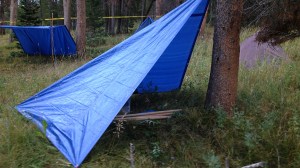
Here’s the general idea for pitching a trail tent.

We called them “trail tents,” though “tarp tents” seems to be more universal. They could be set up in any number of ways – a two-sided triangle with the front open was most common, using a second one as the ground cloth – or in good weather we could even roll our sleeping bags into one and stretch out in the open.

We took pride in our primitive camping abilities.

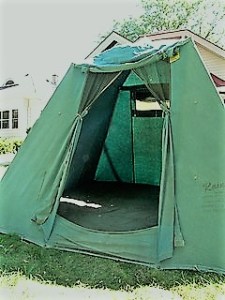
Our vintage umbrella tent was like this, with the poles inserted along the ridges inside.

My family, on the other hand, had a clumsy and often smelly “umbrella tent,” so named for the way you had to set it up from the inside and then remove the aluminum center post – well, they’re now called “cabin tents,” and apparently more flexible.

I inherited the tent and used it for many of my escapes in the Pacific Northwest, my complaints aside. It got a lot of miles over the years.

The result in either case was some memorable opportunities to get closer to nature. Among them:

  1. Family summer vacations at Indiana state parks, especially Spring Mill with its limestone caves; Natural Bridge in eastern Kentucky with its old railroad tunnel at the base of a mountain with a stone arch at the top; Mammoth Cave in Kentucky; and Lincoln’s Old Salem in Illinois.
  2. There was also a Florida trip we shared with a Chattanooga family Mom and Dad were fond of from his Army-Air Force days. At age 12, it was my first exposure to the ocean and a Southern belle a year or two older than me. Our trip back included a night 17 miles back from the highway in Okefenokee Swamp in Georgia, where we were surrounded by masses of mosquitoes, more than a few three-legged deer (the result of encounters with ‘gators), and raccoons that could open the doors to the porches of the camp headquarters and then raid the top-slider Coke coolers. Let’s say simply we heard a lot of eerie sounds in the darkness and escaped with our lives once the sun rose through the Spanish moss.
  3. My first time in a trail tent was shared with another neophyte. We proudly set up our tent, tying the front line to an Osage orange tree – I remember the strange color when we split firewood. Alas, a storm blew in during the middle of the night and pulled up some of our stakes. I rolled enough of the ground cloth around my sleeping bag to get through the night. Not so, Jackson. He nearly froze and his bag the next day must have weighed a hundred pounds. After that experience, I always checked the wind direction before deciding where to raise the tent.
  4. Another Scout outing, remembered vaguely, was in May or June in a farmer’s woodlot. It simply felt magical, nothing like a designated campground.
  5. Our troop joined one or two others in the summer at a site in Lake Vesuvius State Park near Ironton, Ohio. This time we used wall tents, but it was still primitive. The park had the remains of an early stone blast furnace, and we spent a day in rowboats exploring the lake. One fall, we returned to plant trees in a strip mine. I’ve hated that form of mining ever since.
  6. Out-of-state hiking trips also included overnights, usually two. I especially remember those of the Lincoln trails and others around Lexington, Kentucky. And there was the near-perfect night in Indiana when we rolled out under the stars only to be interrupted at midnight and having to hustle our gear under a nearby picnic pavilion when a harsh storm blew in. And then the rangers showed up and scolded our scoutmasters. But the next morning, and for much of our drive home, we saw tornado damage.
  7. Roan High Knob, at the end of our week on the Appalachian Trail, turned into a festive array of unconventional trail-tent setups. It was like a camel caravan had moved in. At least until the big thunderstorm and repeated deluges.
  8. Later, as an adult, there was a week circumnavigating the Olympic Peninsula, an event I celebrate in a longpoem.
  9. Also in Washington state, a week I spent in the North Cascades – where poet Gary Snyder, especially, wrote extensively as a forest fire lookout. Silver Star Mountain was especially memorable and worth a return with my then-wife.
  10. Another week in the North Cascades included time at the base of Mount Shuksan and Mount Baker. Washing my dishes in the small river, I recognized gold flecks in my bowl – not enough to pan, if I could, but the valley had been the scene of a big gold rush once upon a time. I also noticed that the river level kept rising through the day, a result of melting snow and glacier ice upstream, up above me.
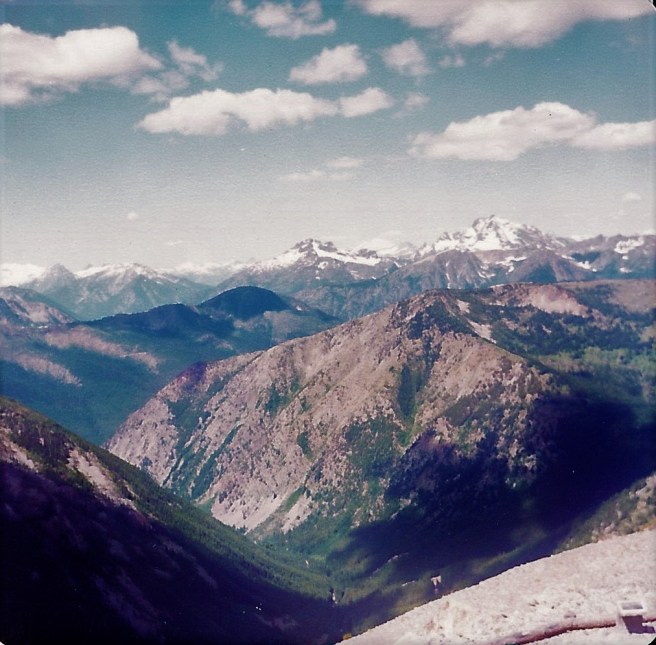
Imagine opening your tent flap and seeing this. I did, in the North Cascades.

Curiously, I haven’t camped since 1980, though there was a week I spent in a spartan, bare-bone cabin near Lake Sabago, Maine, in October ’99. That’s when I learned to canoe … and to steer clear of the middle of the water when it’s just me all alone.

Don’t overlook Baltimore

There are reasons it’s also known as Charm City. Or, as they say of neighboring D.C., it has Northern charm combined with Southern inefficiency. By the way, don’t blame me for that perspective.

USS Constellation, built in 1855, graces the Inner Harbor. (Photo via Wikimedia)
  1. Baseball great Babe Ruth was born here (1895) and poet Edgar Allan Poe died a drunk on its streets (1849).
  2. Speaking of baseball, the Camden Yard ballpark spurred the return of smaller professional arenas to central cities across the continent. Now, if the Birds could only fly higher than the Yankees or Red Sox in their division. They really are doomed in that association.
  3. Speaking of birds, the Baltimore Oriole got its name because its colors resembled those of the coat of arms of Maryland founder Lord Calvert. I have no idea about their religion, but he was an advocate of religious liberty.
  4. The port was second only to Ellis Island in the number of immigrant arrivals in the 19th century. And while the city sits below the Mason-Dixon line and has a Southern outlook, it also has a strong German presence and Northern connection strengthened by the Baltimore & Ohio train tracks.
  5. With his profits from those rails, Quaker Johns Hopkins founded the nation’s first research university in 1876. Today it and its related hospital and institutions are the state’s largest employer.
  6. The metro area is also home to McCormick spices. You can smell it in the humid spring air.
  7. The National Aquarium crowns the redevelopment of the Inner Harbor as a popular destination. The waterfront is also graced by the tall-masted USS Constellation of Civil War glory.
  8. American Methodism was founded in 1784 at the site of today’s Lovely Lane church. And a 1789 conference at Old Otterbein Church led to the formation of the United Brethren denomination of German-Americans (it merged in 1968 with the Methodists, giving them the “United” in today’s name). Also in 1789, the nation’s first Roman Catholic archdiocese was founded in the city; its cathedral was finished in 1821. It even produced a saint, I believe.
  9. A flag waving over Fort McHenry during the War of 1812 inspired Francis Scott Key to write the lyrics to the National Anthem, the one that was much in the air yesterday, but the music’s from a much older British drinking song. How ironic, especially since it challenges even the most professional singers.
  10. The city doesn’t show up in my fiction, despite my living in the inner city’s Bolton Hill and suburban Owings Mills for three years. Even if the place is so hot and humid you have to turn on your air conditioner on the same day you turn off your furnace. Or, as they say of neighboring Worshington, it’s built over a swamp you know.

Top zoos in North America

Yeah, yeah, I know the concerns about holding animals in captivity. But where else are kids going to learn about exotic fellow creatures? TV? They can’t smell them there. The circus? Few of us even live on farms anymore, and those dogs I see walked up and down the street are hardly exemplary of the animal kingdom. Frankly, they’re more spoiled than most children.

But I digress. Out of view, the best zoos are also places of serious research and attempts to keep gene pools alive.

Here are some of the best in North America:

  1. San Diego. It pioneered the open-air, cageless exhibits, for one thing, and is in a beautiful park, for another. So I’ve heard.
  2. St. Louis. More than 600 species on 90 acres, and you can get around via a mini-railroad.
  3. Omaha. Some of us remember it from a television series.
  4. Cincinnati. Includes a botanical garden, and for years it was also home to the summer opera, the nation’s second-oldest. Now that was an interesting mix.
  5. Bronx. It was the first with a zoo animal hospital and full-time veterinarian staff.
  6. Toronto. Features seven distinct zoogeographic regions – animals and relevant plants and climate displayed together.
  7. Smithsonian, Washington, D.C. One of the most diverse, and admission is free.
  8. Los Angeles. Founded in 1966, it’s one of the newer zoos in America and has zoomed in status.
  9. Columbus. Includes a notable aquarium, a manatee rescue and rehabilitation program, and Polar Frontier.
  10. Philadelphia. Also noted for its success with hard-to-breed-in-captivity species.

Honorable mentions to Miami, Fort Worth, Seattle, Brookfield and Lincoln Park in Chicago, Disney’s Animal Kingdom in Florida, Houston, and Denver.


Memorable hikes in my life

One of the blessings and saving graces of my youth was being a member of a rogue Boy Scout troop that included a big hike one weekend of each month and primitive camping on another. The two together introduced me to many essentials of the natural world and real life.

One consequence is that hiking has been a big delight in my life ever since, despite a 20-year gap at one point and the reality that my days of being able to hike a 25-mile stretch are long gone.

Here are a few memories I treasure.

  1. My first backpacking experience, from Clifton above Yellow Springs to Belmont in Dayton, Ohio. You couldn’t do that now, not with all the suburban sprawl and the ban on trekking along railroad lines post-9/11.
  2. The week we spent on the Appalachian Trail, ending at Roan High Knob in North Carolina/Tennessee when the rhododendron were in blossom. I had never seen them before. I was 12, with a 60-pound backpack. Funny, though, I haven’t backpacked since.
  3. A brace of Scouting trails we hiked in neighboring Indiana, Illinois, and Kentucky, earning a medal and sometimes a new scarf as a result. These included the Daniel Boone country around Lexington, the Lincoln country, even getting hopelessly lost in Brown County because some crucial trail markers had been shot up beyond recognition. Later, when I lived nearby, I realized the big lake now sat atop a road that had been paved with crushed geodes. Now that I’m thinking of it, in my return to the scene, I had a fine late-winter stroll through the same woods.
  4. Mount Washington, New Hampshire, ’74, introducing me to the amazing flowers of alpine terrain.
  5. Mount Rainier, Washington, multiple times from ’76-‘80. Though I never attempted the summit, I did make it up the permanent snowfields to Camp Muir twice. And the alpine terrain continued to dazzle me.
  6. Mount Stuart in the Enchanted Lakes wilderness area, Washington state. It was an early autumn outing. Again, I didn’t tackle the summit, though I was acquainted with the man who had been the first to make it to the top. The crisp late afternoon air abounded in cosmic rays.
  7. Mount Lafayette, New Hampshire, late ‘80s. Another mountain that reaches above the tree line.
  8. Mount Chocorua, New Hampshire, a decade ago. A more difficult climb than its altitude would suggest. But there are reasons the Indigenous people considered it sacred, even before the lovers’ leap story.
  9. Quoddy Head, Maine, three years ago. The day was foggy and wet, adding to the drama as we moved on the bluffs atop restless Fundy Bay water. The open peat bog and boardwalk added to the wonder. It was the first time since my initial encounter with Rainier that I’d felt so amazed by nature. It’s what convinced me to move to Eastport.
  10. Bold Coast, Lubec and Cutler, Maine, the past two years. Forget Acadia National Park. This is unspoiled and uncrowded. And for me, it’s now part of home.

Oh, gee, how can I not mention that crazy hike up the desert slope of the Yakima Canyon, Washington state, where I was among those to first to see the return of the bald eagle to the valley after a quarter century or more? I was looking down on an incredible wingspan and didn’t even know its species until later. It was still winter, ’77, and, because of the rattlesnakes, I wouldn’t have ventured into the landscape otherwise. It shows up in my novel Nearly Canaan.

Ten 19th century developments that greatly improved life where I live … and in much of the rest of the world

Some of these have already passed into oblivion, but they were still part of the transformation.

  1. Window screening. Maine is loaded with black flies and mosquitos. Somebody still had to go outdoors, though.
  2. Steamships. Not just allowing you to get away or back, but conveying the mail, especially. Think Internet and email for comparison. Remember, Eastport was a major port, including the exportation of canned sardines.
  3. Railroads. Ditto for mail and newspapers. As well as exporting goods to market. Or deliveries back. (Think Amazon.)
  4. Canning. Home canning, of course, but also grocery stores. Out-of-season food options suddenly exploded. Winter wasn’t mostly beans. Not that we’re so fond of it now that we have frozen food choices. But sardine canning also became the economic powerhouse of Eastport.
  5. Sanitation. Let’s start with antiseptics and move on to indoor plumbing as well as the rotary washing machine. Nowadays, that also means the clothes dryer and dishwasher.
  6. Electrical lighting. Especially in those truncated winter nights we have up here.
  7. Linotype. I used to live in Baltimore’s Bolton Hill, where its inventor resided. Daily newspapers and cheap books became commonplace.
  8. Telephone. Did any other invention save more steps? Or do more to relieve loneliness?
  9. Sound recordings. You no longer had to be a musician to have decent music any time you desired.
  10. Automobile. John William Lambert invented the first practical American gasoline automobile in 1891 in southwest Ohio and later moved his operations to Anderson, Indiana. I remember visiting a friend and seeing an old car with an impressive Lambert name in brass across the radiator sitting at an open garage door. “Ann,” said I, “is that car any relation to you?” She replied that her grandfather used to make them but otherwise conveyed no knowledge that he had been so prominent a figure.

And let’s not forget toilet paper to our roll of advances.

Popular fish caught around Eastport

And not all of it’s meant for human consumption. Some of it’s used for bait, usually for lobsters.

  1. Along the coast we have mackerel. It’s a small fish and oily, one that doesn’t keep well, but cooked promptly or smoked for storing, it’s a lot like salmon. For sports fishing here, seems everybody’s catching ‘em, sometimes six on a line. Some folks even trade buckets of them for lobster.
  2. Alewife. Migrates from the sea late every spring. Another small fish that needs to be cooked promptly or pickled for canning. Also used as prime lobster bait.
  3. Herring. A century ago, these were the basis of Maine’s sardine industry.
  4. Smelt. They’re small, often dip-netted, and can be pan fried and eaten whole. Pacific Northwest Natives called them candlefish, for their oil. Around here, they often show up on the line when casting for mackerel.
  5. Flounder. The species includes fluke, and they like to hang out around pilings and docks – the kinds of places where many folks fish.
  6. Halibut. Now we’re getting to the kinds of fish you might recognize on a restaurant menu or at the grocery.
  7. Haddock. Ditto.
  8. Turning to freshwater, we have several species of trout.
  9. And bass. or perch.
  10. Plus landlocked salmon. Migratory salmon are off-limits, however.

Clamming is also big when the tide’s out. Not that they’re actually fish.

Some common fears

  1. Intimacy. Oh, my, this could lead to another Tendrils. You know, the ways we feel vulnerable.
  2. Poverty. This one even gets twisted up in white superiority and racism, if you look really closely.
  3. Being pulled over while driving. Though it’s unlikely to be a death sentence for me.
  4. Lawsuits. Which can lead to poverty, above.
  5. Being held up or robbed. Well, that can be like a lawsuit plus potential violence.
  6. Rejection. Which also leads back to intimacy, above.
  7. Shame. Well, usually shame is linked to something you’re born with, but it still connects with fear, along with its first-cousin, guilt – arising from something you did bad, really bad.
  8. Hunger. Not that most Americans actually go without food long, but just watch their reactions when they have to fast or go more than two or three hours without a nibble.
  9. Debilitating illness or physical handicap. Blindness, deafness, dementia, for starters. Or falling off a ladder at my age.
  10. Dying as a failure. You know, without achieving something big to advance mankind. Or just plain going to Hell.

Do these all involve pain?

What would you add to the list?

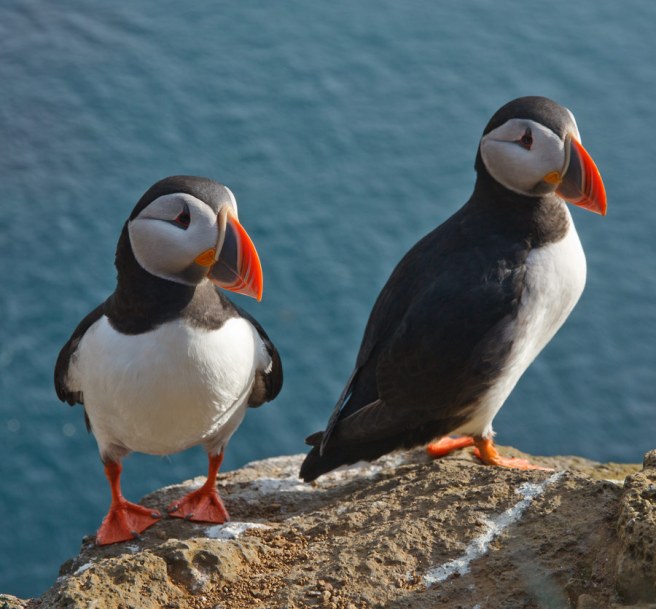
Regarding those photogenic cute puffins

Photo by OscarV055 via Wikimedia Commons

The distinctive seafaring bird is on any serious bird-watcher’s bucket list. Here are some things to know.

  1. They don’t make muffins, contrary to the children’s ditty.
  2. Apart from their nesting time on North Atlantic or Pacific cliffs, they spend all their life at sea, resting on the waves when they’re not flying. They’re essentially an arctic bird, though they come south to breed. Considering where I’m living, maybe I’ll take the boat tour and see some, too, if the outings aren’t already booked solid.
  3. These birds can dive underwater for a full minute and are fabulous swimmers.
  4. As a group, they’re a colony, a puffinry, a circus, a burrow, a gathering, or – get this – an improbability.
  5. They’re quite social, with one colony in Iceland reported to have more than a million nests.
  6. They can flap their wings in a blur of 400 times a minute, reaching a flying speed of 55 miles an hour. At least they’ll evade cops with radar guns.
  7. Two opponents in flight can lock beaks and then beat at each other with their wings and feet. OK, that’s ugly but still impressive.
  8. They generally stay with the same mate for life, returning to the same burrow nest.
  9. Sometimes they’re called Sea Parrots or Clowns of the Sea.
  10. A puffin’s beak changes color during the year.