I’m not as flexible as I was, and my sense of balance is unreliable. It’s even led to feeling queasy on heights, a realm I once fearlessly loved. And a fall late at night can be terrifying.
Along with spidery thin hair.
As for the bladder?
Slower mental recall, along with hearing.
Declining mojo.
Can’t get warm in winter. Or autumn. Or early spring. I’ve always been cold-blooded, but geez Louise!
Being addressed as “Sir” by polite female teens. I am, after all, emotionally still 17.
The shrinking horizon of life goals and dreams. Like is that best-seller ever going to happen, really?
All the damned pills in the morning.
Gee, and we haven’t even gotten to an inability to understand pop “culture” or the appearance of varicose veins.
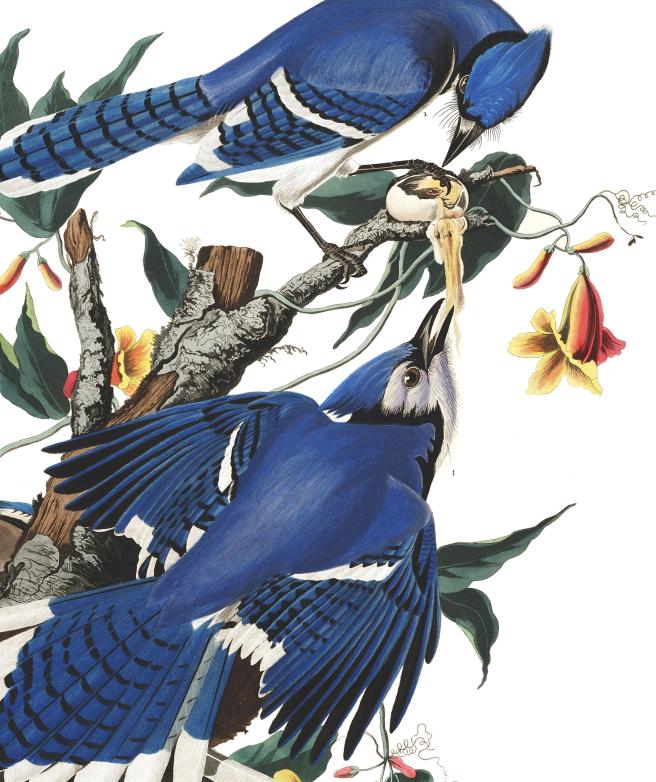
Or more accurately, the bastard son of a Frenchman in Haiti.
Yet, despite the iconic honor given his name, few have seen his legendary work in its full glory.
I’m speaking, of course, of John James Audubon, in the anglicized version of his name.
While I had viewed his work behind glass framing in art museums, nothing prepared me for my hands-on encounter with the four folio print volumes. That happened in Indiana University’s rare book Lilly Library when a librarian interrupted to ask if I would help her return two of the volumes to the cart so she could take them by elevator back to the stacks.
Yes, they really did need two people to move. As I’m seeing now, the books measured about 29½ inches by 39½, otherwise known as double elephant paper, the 435 prints being the same size as the original drawings.
We decided to take a peek and were both blown away. It was as if the birds had been pressed full-size onto the plate. You could actually see the veins in each feather. And that was, it turns out, a copy of the original. Oh, yes, and each species was presented full size, with some favored vegetation.
As for the color? Unbelievable. You have no idea how much is lost through any glass.
We both admitted it was too much for a single viewing.
Well, we had an acquaintance who was terrified of blue jays.
Now, for ten more facts.
As an 18-year-old, Jean-Jacques Audubon was sent to Pennsylvania on a false passport to avoid conscription into Napoleon’s army.
A feud originating during his research in Kentucky closed off American support for young Audubon’s work. Instead, his backing came from England, where subscribers underwrote the classic Birds of America.
One bookseller claimed it would never succeed because the book took up an entire table to view and would render other volumes useless.
A reduced-size two-volume collection, a gift from my younger daughter, has me appreciating the radical design and style of many of the images. There was no way, after all, to approximate the original color, yet any approximation opened other dimensions.
He worked from actual specimens he had shot and killed, arranged in lifelike settings.
He did create a controversy regarding the smell of turkey vultures, or what some of us call buzzards.
Some of the birds he discovered remain a mystery.
He’s known mostly by copies of copies or even additional copies, each time diluting the impact of the originals.
He had nothing to do with the national Audubon Society or its Massachusetts and New Hampshire spinoffs.
The popular image, shiver me timbers, comes straight out of Disney.
To set the record straight:
They didn’t punish people by making them walk a plank blindfolded. Instead, the victims were killed immediately or keelhauled – tied to a rope and dragged behind the ship.
They didn’t say “Ahoy!” or “Matey!” I’m not so sure about “Argh!”
Female pirates had to disguise themselves as men to protect themselves. But, by some accounts, there were many of them.
Forget the buried treasure. And their loot was often something other than gold or jewelry.
In fact, maps and some books were more treasured as booty than gold.
Captains were elected and could be removed. Who would have thunk?
The eyepatch wasn’t to hide a missing eye but rather to allow for rapid visual adjustment between above deck and below. Anyone want to try that for verification?
Conditions aboard a pirate ship were often more civilized than those on merchant vessels, where lousy rations and low pay were often common.
The skull-and-crossbones Jolly Roger wasn’t the only terrifying pirate flag, by far. How about Black Bart’s one having himself holding an hourglass with the Devil? Or Captain Low’s blood-red skeleton standing at the ready?
Pirates still flourish today, especially in the Indian Ocean and parts of the Pacific.
Well, Eastport’s annual pirate weekend festival’s coming up. We’re bracing for the invasion.
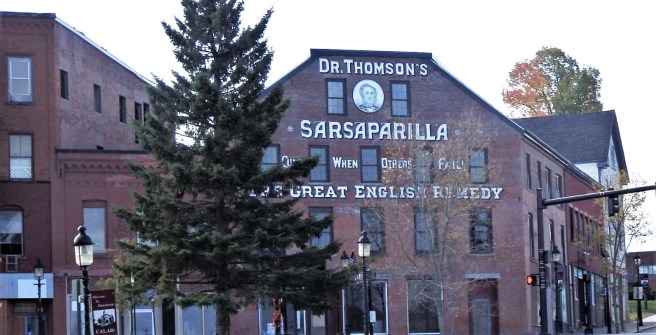
The biggest municipality in sprawling Washington County is the city of Calais, pronounced CAL-us, like hardened skin, rather than the French Cal-LAY, its namesake port on the English Channel.
Set north of Eastport and having a population of slightly more than 3,000, it’s the retail hub of the county and neighboring Canada and the principal international border crossing for traffic to and from the industrial port city of Saint John, New Brunswick, and other coastal points.
With that in mind, here are a few more facts.
Thanks to the border traffic, much of it as Sunbury tractor-trailer rigs, Calais has all of the permanent traffic lights in the county. Three, make that four, if I’m counting right. Yup, pay attention.
It’s the eastern terminus for the Airline Highway, a section of State Route 9 that connects those trucks to Interstate 95 in Bangor and all points south and west in the U.S.
Calais abuts Saint Stephen in Canada, which has both a candy museum and manufacturer and the best health fitness center in our region. The Saint Croix river separates them before continuing upstream as the international boundary.
Calais has the only new auto dealership in the county, as well as the only Walmart.
It’s home to the community college.
The first European to explore the place was Samuel de Champlain in 1604.
That year he was one of two leaders in settling on an island in the tidal stretch of the river. That effort was abandoned the following spring after a brutal winter in which more than half of the colonists perished. Had the venture succeeded, it’s possible we’d all be speaking French here. Today the site of this first French settlement in New France is commemorated at the Saint Croix international historical park.
While its name honors French assistance to the American Revolution, I should also point out that the original had also sometimes been part of England.
It was first settled by Daniel David Hill of York County, Maine. He was likely a descendant from an old Quaker family affiliated with Dover, New Hampshire.
In summer, it’s often much hotter than Eastport. In winter, it’s typically colder.
Oh, yes, there’s even a tiny movie theater we want to check out.
The “award-winning” writer or actor or whatever is such a cliché anymore I will assume everyone’s won prizes. It’s the ones with money that count.
Jail visitation makes the inmates feel safe, gives them respect.
A surprise way to increase your wealth. Hit square on the calculator! Beats the interest multiplier for sure. Could this be the secret of cryptocurrency?
I see she’s moved back to Allentown from Rhode Island.
Cops at the coffee shop. What an iconic image.
Playing cards were invented during the reign of Tudor king Henry VII (1485-1509) and his wife, Elizabeth of York. Their portraits have appeared eight times on every deck ever since.
New leap for storing leeks through the winter: peat moss! Rather than hay or straw or sand.
Overhead light in the car interior … not just replacing a bulb anymore …
The blue haze in the forests that gives the Great Smoky Moutains their name is actually a fog released by volatile organic compounds in the region’s vegetation.
Marden’s Surplus & Salvage has 14 locations in Maine. As for Remy’s?
Eastport – centered on Moose Island – is one of many small cities being overrun by deer. You may have met some of the culprits here at the Red Barn.
Here are some random bits as a result.
In the Wampanoag language, they’re known as “the ones with wet noses,” for the way they investigate the world around them.
Why do fawns have white spots? I suspect it could be a good opportunity for a storyteller to develop. Along with the question of why fawns eventually lose them.
They like apples. Man, do they. Some will dance on their hind legs in reaching for the branch overhead.
They can destroy a garden overnight.
That said, they’ll eat just about anything. One even swallowed a spigot on our bird feeder.
Speaking of which, a bit of cayenne pepper in the feeder seems to repel them. As the adage goes, better late than never, regarding some lessons.
They’ll eat out of your hand if you’re patient. Not that I advise that.
Bucks get bumped out of the circle as they come of age.
The most we’ve counted in our small yard at one time was ten.
We’ve had an albino in the north end of town. I first thought it was a goat in the night.
Here’s a shot from our dining table. Or hers, as well.
Eastport’s fleet doesn’t use nets to fish. Rather, they use dragging gear or baited traps, mostly.
Technically, the bulk of what they catch isn’t fish, which are vertebrates, have gills, and lack limbs with digits. Fish fall into the scientific superclass of Osteichthyes, as noted in a previous Tendrils.
Shellfish, meanwhile, are invertebrates, have external skeletons, and are classified as molluscs, crustaceans, and echinoderms. See a more recent Tendrils.
So today, let’s look at what the local commercial fishermen catch. Or, in some cases, used to.
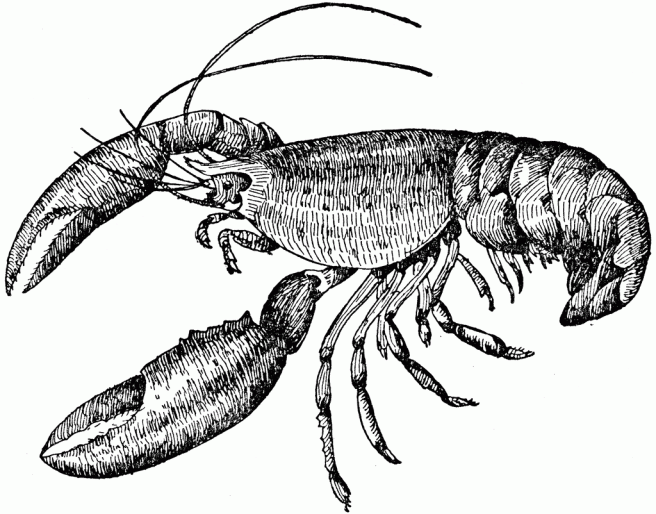
Lobsters. The mainstay.
Scallops. Some of the world’s best, in our humble opinion. The haul, though, is tightly regulated.
Clams. While many of these are raked on sand or mud flats at low tide, others are dredged by boats at sea. They add up to the state’s third most valuable fishery.
Urchins. A specialty niche making a comeback. Japanese foodies love them, but the market’s tricky.
Crabs. See a previous Tendrils.
Alewives, herring, and mackerel. Often caught for use as lobster bait.
Shrimp. Well, not anymore, but we can keep hoping the stock will rebound.
Mussels. There are some interesting attempts to establish farmed beds around here. Now that would be lovely.
Cold. I’m talking about the crusty fishermen. They do bundle up in the depth of winter, though, and rarely complain.
The sunrise. They head out early, all seasons of the year. Some of the views they catch are unbelievable.
Let’s not overlook salmon, a major product here, which are farmed in pens and harvested directly by special boats using tubes that work something like a giant vacuum hose. Not kidding.
Was it a mama moose I hit that cold night on my commute back from the office, rather than a deer? Now that I’m getting to know deer, I think the collision involved something bigger.
Red states? They’re where nobody really wants to live. Or at least the paying jobs.
How dark the house is at night in an electrical power outage! There’s no ambient light from the street lamps or apparatus power-on buttons.
Glyphs = little typographic devices.
I dreamed I was playing violin again. In an orchestra, no less.
How deeply backpacking as a youth shaped my values (forget efficient as a factor). It’s that travel light thing.
After living in New Hampshire, I’m still not used to a sales tax.
English country dance lyric, “If love were an ocean / and water was gin / I’d walk a long plank / and throw myself in.” It’s not from “Robin, Mad Robin,” is it?
A voicemail message for today: “Let me a message or text me. I’ll get back.”
And here I was about to investigate all kinds of melons, starting with cantaloupe.
That said, just consider:
A watermelon is one of the few foods to be classified as both a fruit and a vegetable. Wish I could count it twice on my daily dietary requirements but guess that would be cheating.
It’s a relative of both pumpkins and cucumbers.
It’s far and away the most popular melon in America.
There are more than 1,200 varieties, but the seedless hybrids are the only ones you’ll likely find nowadays at the market, at least in the USA.
Those seedless versions aren’t genetically modified. Technically, they’re simply sterile with white seeds that are perfectly safe to eat.
Watermelons originate in Africa and have been cultivated in Egypt for 5,000 years. That’s why they really do need a long stretch of summer.
Based on weight, watermelon is the most consumed fruit in America.
It’s 92 percent water yet rich in vitamins and contains only six percent sugar. By the way, there’s no bad fat or cholesterol.
Its flesh isn’t always red – orange, green, yellow, or white are other options.
In Japan they’re grown in glass boxes to maintain the unnatural cubed shape.
Ours are smaller than the glorious Dungeness of the Pacific Northwest or Chesapeake Bay’s popular Blue delicacy, named for the color of their tips.
But that’s not to say Maine doesn’t have crabmeat that’s as sweet. Ours comes from two species.
Here’s some perspective.
Jonah crabs are the slightly larger and more celebrated of the two. They’re reddish with large, black-tipped claws, and found primarily in deep waters offshore.
The meat comes from the claws. When Jonahs show up in a lobster trap, a fisherman typically removes one claw and throws the rest of the crab back. The crab, we’re told, can survive on one claw while the other grows back.
Jonahs are regulated by an interstate commission that places a 4.75-inch minimum size on keepers and prohibits the retention of egg-bearing females.
Atlantic rock crab, or “peekytoes,” live in bays and tidal rivers closer to shore. These measure just five inches across and are the most commercially caught crab in the state.
Peekytoes cannot be shipped live, presumably because they’re too delicate. Instead, they’re cooked and hand-picked before shipment.
Both commercial and recreational crabbers require a license from the state and must observe strict limits on their take. At least, those specifically going after them. See the lobstermen, above, for a clue to exemptions.
Locals in the know say that picking the meat from a crab is a nearly lost art. They admit they can’t avoid getting hard bits of shell in the tender flesh, no matter how carefully they try. Instead, as they advise, go to Betty’s in Pembroke or Earle’s down in Machias for your supply.
Favorite dishes around here are crab rolls, crab salad, and crabcakes. Our house also celebrates a heavenly crab imperial. Others make them into a dip or spread. And, in some circles, Jonah crab claws make an appetizer served like a shrimp cocktail.
They can be harvested year-‘round, though fall, when crabs are most packed with meat, is the peak season.
Smaller, invasive, nasty green crabs have been proliferating as Maine waters warm, decimating other marine species and their breeding grounds. Some enterprising chefs, though, see tasty opportunity in some dishes to counter that.
Me? I haven’t yet had to complain of having too much. Now, please pass the Old Bay.