Do you follow a to-do list?

I thought everyone did. And then one day, at the close of Quaker worship, I casually asked the circle if anyone in the room didn’t do such a checklist. I was surprised by the number of hands that went up, even if they were a distinct minority.

How do they get everything that needs to be done, done? It’s still a mystery to me. It’s like I need a map if I’m gonna get anywhere.

My wife and I have multiplicities of such lists. The problem is keeping them all straight. Sometimes, once we find where they’ve gone missing, just trying to read the handwriting is confounding, but even guessing still helps.

For years, I kept both seasonal and monthly lists, broken down into categories of Personal, Domestic, Creative, Quaker/Spiritual, and, at times, even Computer and Astro. I eventually kept a master file on my PC for easy updating and printed out pages as needed for a clipboard.

You know, reminders of auto tag renewal, driver’s license, income tax filing, ordering firewood (and the phone number), furnace and chimney cleaning, medical exam and dental cleanups, birthdays and anniversaries, Yearly Meeting sessions, drafting our local Meeting’s State of Society report, and so on.

To that I added goals like weekend escapes, writing and publishing agendas, gardening chores, home improvements, even exercise, which never did actually happen. Reviewing these can be embarrassing.

Yes, we can regiment ourselves or else try to go with the flow, even if that means trying to put out endless fires we hadn’t planned on. The frustrating part is all the stuff that never got done – or as I’m seeing in my review, did so only years later. Others remain unfulfilled dreams or promises.

The more practical solution has been my keeping of weekly planning calendars, though a master list would still help in inserting some of the tasks. This year, I’ve gone with a smaller book – make of that what you will. I do miss the big artwork, though.
Ready for a few recent thoughts arising from all of our teleconferencing (trademark?)?

(By the way, I’m wondering if that “?)?” is a first in the English language.) (Along with opening a writing in a parenthetical mark.)

To the point: After all of this time Zooming, specifically, I’ve finally found a visual background that works for me, almost a stage setting.

In our new old house, my workstation is in what’s also my bedroom rather than somewhere up in an attic. In common with many New England homes, there’s no closet, so when the laptop’s camera is in its usual, sharp focus, my hanging clothes are in full view.

How embarrassing. Or candid. At least I’m not naked, in all my senior-citizen glory.

I’ve played with several photographic backgrounds as alternatives, but they do use up valuable bandwidth, sometimes even interfering with the signal or pixilating my face, and they get wonky if I so much as twitch.

Moving myself and the said laptop to another room gets complicated, especially when I need to reach for a book or paper (back in the earlier room) for reference. New lighting conditions are an additional consideration.

Do we all need a stage manager or producer or even a dramaturge working on our behalf, much less sound engineers? I hope not!

So the solution, where low-tech me is? Voila! Or amazement. I chanced upon the “blurred background” option on the Zoom toolbar and like it. In fact, it can even look dramatic, keeping the focus on (drumroll, please) me. Maybe I’ll keep it.

~*~

As long as we’re on the subject of Zoom, does anyone else find conversation or dialogue unnatural and awkward? There’s hesitation when we’d simply join in and then jump out contrasting to talking over each other because we have no eye contact or other non-verbal cues regarding each other. There are times I’m sure I come off cold simply because I’m stepping back to listen yet other times I no doubt seem rude piping up the same moment others do, like drivers all trying to enter an intersection at the same moment.

By the way, I do think our faces are appearing in a less harsh light than we did earlier in this transition.

For a while, it seemed we were all at less ten years older, children excluded. We looked ghastly.

~*~

I’m also discovering there are many people I recognize more by the sound of their voice than by their faces. Maybe it’s a consequence of joining a new community in the age of Covid, but there is a world of difference between individuals unmasked on my computer screen and masked (or not) somewhere out in public, often miles out of context.

How has your Zooming changed? Any advice to share? Or off-the-wall particulars?

Restoring a one-of-a-kind Civil War mural

Now owned by the Tides Institute and Museum of Art, the post is being renovated to include a significant Civil War-era collection and display.

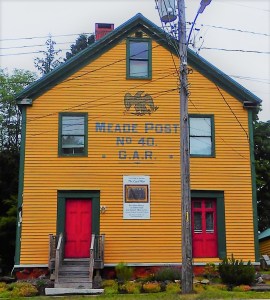
Eastport’s Civil War veterans had good reason for naming their Grand Army of the Republic post after Major General George G. Meade. Not only had he commanded the successful Union troops at the Battle of Gettysburg, he was stationed in Eastport after war to curb the Fenian Rebellion, an Irish liberation attempt that had organized in the United States and conducted raids in neighboring Canada.

During his time in Eastport, he caught pneumonia and nearly died, and some residents got to know him first-hand. One – the wife of the owner of the house where he was staying – complained bitterly for years afterward about his poor aim in spitting tobacco juice all over her home. Let’s hope he was better with a firearm.

The local post wasn’t the only one named in his honor, by the way, and the organization itself became a powerful force within the Republican Party, helping to elect at least four its members to the White House and pressing for progressive legislation.

In 1881, the local post took over a two-story frame structure at 6 Green Street as its meeting hall. As its membership – limited to Union veterans of the Civil War – died off, the building passed to the local Veterans of Foreign Wars for its post. The building next door included a bowling alley, roller skating rink, and dance hall all fondly recalled by youths of the time.

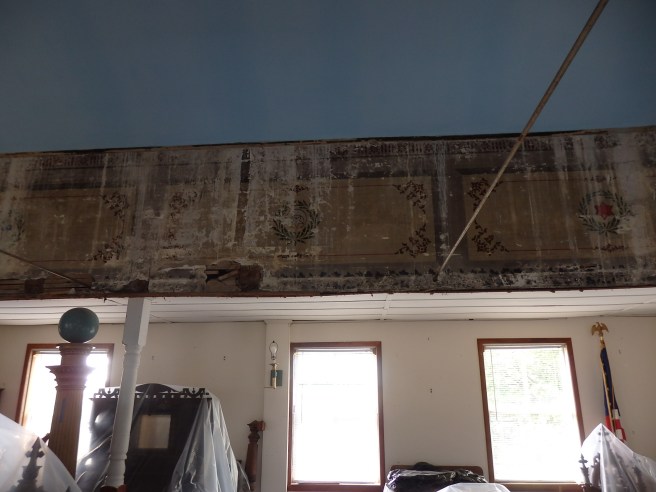
Nobody knew these were overhead.

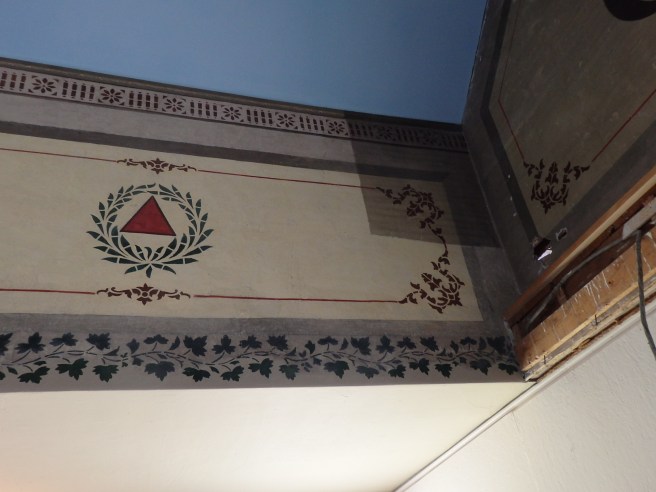
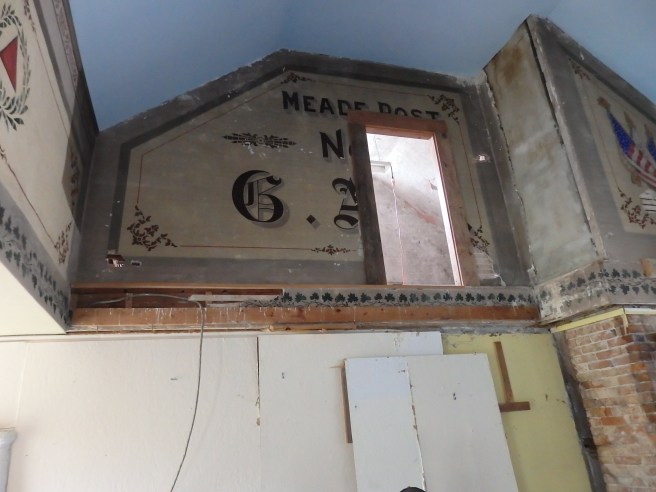
The murals and ceiling were long hidden by a dropped ceiling and rediscovered only shortly before 2014, when the building was gifted to the Tides Institute and Museum of Art.

The mural runs the length of the roughly 40-by-25-foot room and includes images of eight Army corps badges.

Tony Castro of New Gloucester, Maine, has been renovating the murals. Despite severe water damage, they may be the only surviving interior of their kind in the state.

The patch at upper right shows how this section looked before its restoration.

The Tides Institute has also been gifted with important Civil War artifacts and documents, which may be displayed as the museum adds gallery space.

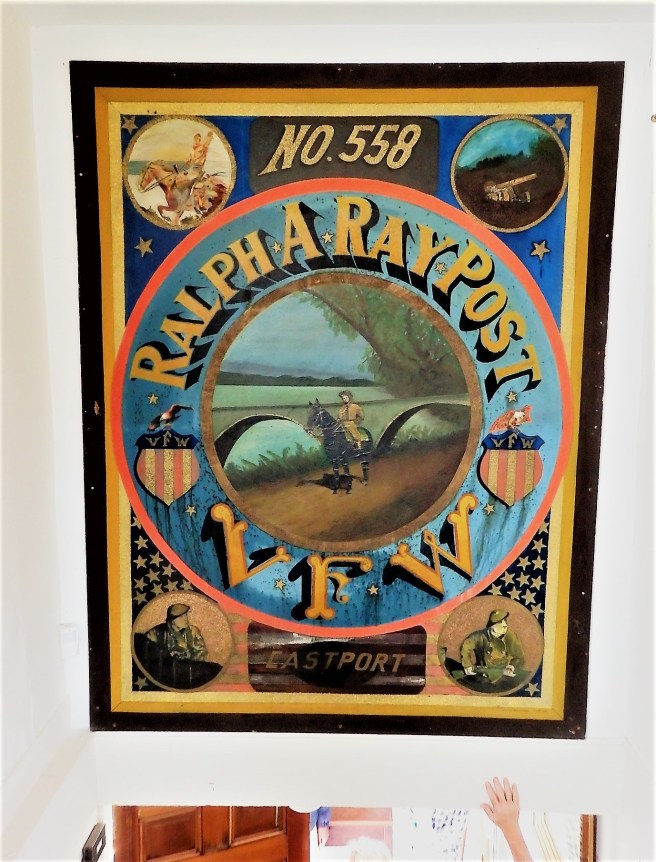
A sign from the hall’s later use as a Veterans of Foreign Wars post.

My work, as I see it

highly compressed

economy of expression

vivid imagery

an acknowledgement of mystery of the universal seed in the particular

if only I’d been able to uphold it in the newsroom

~*~

Yes, clean lines, stripped-down materials, and elegant craftsmanship meeting a love of the baroque in a quirky, inimitable style


Manifesto or perchance confession

Fellow workers in the field know the practice is not easy. They notice movements and deft accomplishments as well as slips and defects the wider public doesn’t. They’re also rarely moved by easy though flashy flourishes and scorn the con-artist and cheat.

I’m not referring solely to other writers or artists, either. Watch a gymnast evaluate a meet or a figure-skater a competition. Even a software writer or electrician. Or a surgical nurse.

That said, when I’m drafting and revising intensely, I’m also more appreciative of qualities in the writing of others. At the best is an admiration of something I lack, a time for humility and gratitude rather than jealousy or envy.

It’s work, after all. Which is why published pages are called “works.”

Given a choice, the rational decision would be to browse through great pages already given to us by others. Browse, as sheep or cattle – OK, I joke, but the fact is I seldom find what most calls me.

Writing is work, especially when you’re already working a regular full-time job somewhere else. Why else where there those periods in my life where I rose at four a.m.  to write and revise before going in to the office? How many others do likewise? At what personal cost to their lives and growth?

Real work, I’ll contend, is the practice of being fully alive. Aware. Totally there, at times.

Some people charge up and then release it in an extended explosion, as Kerouac did in his fiction.

I, in contrast, see it as a balance, between inspiration – breath within – and exhalation – the atmosphere without.

Creativity? No, God creates.

Man discovers, cultivates, nurtures, at best.

Practicing an art (and likely much more) means wrestling with power – including, in the Apostle Paul’s phrase, the “powers and principalities.” Powers of destruction, on one hand, and sustenance, on the other. Destruction that can, as seen too many times, include the artist. Hence, the fascination with Faust. With madness. Alcoholism. And on.

Self-absorption and inflated self-importance. We hazard much, often without the slightest awareness of the risks afoot. In Satan’s dominion over “the world,” which is the realm of the arts, or in Eastern thought, the traps of Maya, that spider web of worldly attraction and deadly illusion.  Either way, cause to be wary.

~*~

Self-discipline, route to true freedom, strips away false attachments, barriers, chaff.

Writing involves observing my own shifting mind while opening to manifold living energies around me. It means simplifying, following unexpected leadings and openings, sometimes to dead ends, other times to unanticipated ranges.

~*~

Some of my fellowship at the time would have argued that’s not where I should be. Some were praying for me through this period. The kind of work that once would have had me read out of Meeting. Is this acceptable activity for a free Gospel minister? All I can do is explore the Truth given to me.

“We Quakers read only true things.” Distractions from worship? Traps of the flesh? So where does fiction fall?

The piece goes its own way: a living organism: readers, editors see it differently from you. What you would cut they love. What you love they see as sore thumb.

Versus becoming so rarified we lose all sense of joy and delight. The danger of Plainness or strictness, that it suffocates personality, makes us so humiliated we cannot move forward in the Holy Spirit to perform bold action.

~*~

My poetry has been influenced by the craft of headline writing and news reporting more than I care to admit. The trade paid the rent, provided a point of resistance in my personal endeavors. The Political Science Fiction I once envisioned has since come together in real history as a horrid reality.

Not that we’re anywhere near done yet.

An artist’s handwriting

Coming across a handwritten note from a friend who’s a wonderful artist, I once again thought how amazing the handwriting is. Not just his, but other’s I’ve known.

Sometimes I’ve suspected they’re taught a special draftsmanship script, but now I’m seeing they differ.

Still, they are amazing.

Ending with “In peace and friendship …”