On photographer Francesca Woodman

Is she daring us? To what? Her self-portraits from her intense, brief life burn with some secret hunger. Do her images contain clues for answers? How I wish she could speak or at least listen.

In contrast, she leaves us baffled by her short career, ended when she leaped to her death from an open window at age 22.

She can be seen as fascinated with death itself. A few images, such as those with her arms wrapped in bandages or holding a knife, may be from a suicide attempt that’s mentioned in passing.

Her images are infused with a gothic premonition of death – the Romantic obsession with tragic, youthful demise, and lost opportunity. To speak of an eroticism of death is eerily heightened by knowing of her suicide to come – the images of her holding a knife or extending her bandaged forearms or climbing (sometimes naked) through Victorian gravestones become eerily chilling, leaving the viewer with a morbid fascination.

Her shots appear to surface from the birth of photography itself, an homage enhanced by black-and-white – often scratchy – prints.

And then there’s the matter of her family – both of her parents and her brother were artists, each in a different medium.

Consider the sense of self-entombment in her photographic legacy.

As I delved into the images her family had released (there’s criticism they’re withholding much more), I pondered alternative directions my What’s Left novel could have gone. These photos, to me, could have been by Cassia’s father if he hadn’t taken up the Tibetan Buddhism and then been granted the support he received from his wife’s family.

In contrast, I encounter her after three of my novels followed a hippie-era photographer, and the newest tale picked up on his legacy nearly a half-century later. This time, it’s told by his daughter, Cassia, who’s trying to uncover his essence after he vanished in a Himalayan mountains avalanche when she’s eleven. Her biggest evidence as an investigator stems from his cache of photographic negatives. The way we do with Woodman.

Cassia’s research paradoxically forces her to reconstruct her mother’s side of the family in depth and all of the reasons her father found refuge among its members.

His, I’ll presume, are professionally competent and moving increasingly into color as the technology advances. Woodman’s work turns inward; his ranges outward, through the changing times around him. His death comes unexpectedly, in a period of blissful encounters, among the monks and mountains who expand his vision.

So I return to the darkness of her vision and the imagined brightness of his. Both, in their own ways, tragic.
Lobster rope doormat

Colorful, hardy, distinct, and local. I am surprised by how much they’re going for online, compared to what our galleries and boutiques are charging here.

Once used to tether lobster traps to their buoys, the polypropylene or polysteel rope has many other nautical uses, where it’s touted as “marine-grade commercial fishing line.”

It shows up in creative baskets and other woven items, too.

WWJD in practice?

Quakers advise living in simplicity, but it can be complicated.

For example, how do we feel about heated car seats?

Especially if the car already came equipped with them?

And, for extra points, was purchased used?

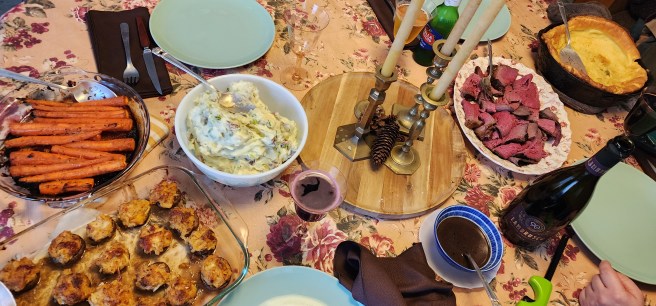
As another example, how about eating fresh scallops in season? Sure, they’re expensive but also so heavenly. Cooked at home, a dinner can be priced out around the cost of a meal at McDonald’s these days and will likely be healthier. The morsels are also so simple to cook, if you’re paying attention.

If you’ve worked through the Money Talks exercises on my Chicken Farmer blog, you know I’m a believer in simple luxuries, things my frugal wife labels as Quality of Life improvements. These can be as simple as a great cup of coffee savored in the morning, rather than a full pot gulped habitually. Or a fine sweater purchased at a yard sale that still gets compliments a dozen years later.

Looking closely also points to many conflicts we see as First World problems, things that upset spoiled Americans and Europeans and the rich in other realms but are utterly beyond the reach of most of the world’s people. You know, even having a car.

Those could prompt a Tendrils here at the Red Barn, but I’m passing for now. I mean, some folks are upset having to eat leftovers while the majority of the global populace is going hungry.

My most recent round with this arose over the funeral arrangements for someone who was not exactly in our family but still being handled by one of us rather than one of hers. As I was saying about complications?

Without getting into the details, I can say that hers, shaped by family and friends’ expectations, easily cost many times more than a Quaker burial would have – and the memorial service itself would have been free and far more personable.

When I go, I definitely want any earthly wealth to go to my family and worthy endeavors than being poured into the ground. OK?

Now, back to those car seats. How do we feel about air-conditioning in the car?

Various lifestyles I’ve lived

Maybe it’s a good thing we didn’t have selfies through most of it. Most of those shots would have no doubt been embarrassing now.

So here’s how my life’s shaken out in terms of lifestyles.

  1. Straight ‘50s middle class: Growing up in the Midwest.
  2. Hippie: From college to Upstate New York and various moves thereafter, including my first marriage to an emerging visual artist. Well, this does fuel my novels Daffodil Uprising, Pit-a-Pat High Jinks, and Subway Visions.
  3. Monastic: The rogue yoga ashram in the Pocono mountains. See my novel Yoga Bootcamp.
  4. Ascetic: In many ways, this was still hippie as I lived in a loft in a small downtown in a place resembling what I’ve called Prairie Depot.
  5. And back-to-the earth: The next move was a return to my college, this time as a research associate position before leaping on to the interior Pacific Northwest, one with my personal life filled with growth as a published poet, a shift to Quaker spiritual practice, and immersion in backwoods and wilderness wonder. These inspire my novels Nearly Canaan and The Secret Side of Jaya.
  6. William Morris: Steel mill region in what one called the Near East, aka the Rust Belt. Included a divorce and rebound. Hometown News arises in that experience.
  7. Nearly Plain Quaker slash Muppie: The Mennonite Urban Professionals I was hanging out with in Baltimore were the less expensive version of Yuppies. Living in a federal-style brick rowhouse in the Bolton Hill neighborhood was the culmination of my big-city dreams. During the week, I was often on the road with a company car and expense account. This was a rich mix for me, a time of much personal growth, ending in a self-gifted sabbatical year hunkered down in a suburb in which I drafted early versions of much of my fiction.
  8. Yuppieville on the Hill: Relocating to New Hampshire, I wound up living in a complex where I rented a small townhouse. Back in the working ranks rather than management, I was freed from long unpaid overtime hours and the neckties and suits of my earlier professional situations. Contradancing, especially, steeped me in Boston, an hour to the south, while I immersed my personal writing in poetry circles. My love life had many ups and downs.
  9. City farmer: Remarriage prompted my move to the New Hampshire Seacoast, where we bought an old house within easy walking distance of downtown and the Quaker Meeting. That “farmer” label actually befits my spouse, the avid gardener. The property also had the small carriage house you know as my Red Barn. Retirement included serious choral singer and daily swimmer roles.
  10. Island author: We needed to downsize, which led to the remote fishing village with a lively arts scene you’ve been reading about here.