I used to find ‘sale prices’ puzzling

In my mindset, a product or service has a fair-value point. You know, it costs so much to make and distribute, even before factoring in a profit. If you’re selling it at a lower price, why don’t you keep it there all the time? Maybe my outlook reflects the one-price for all practice of Quakers who objected to the upper class who expected to get a discount over the poorer masses.

Beyond that, the concept of bargaining or haggling found in many cultures absolutely repulsed me. I still feel like poor artisans and farmers in those countries are getting cheated or at least cheating themselves.

Either way, I rarely buy much and usually shy away from the more expensive range of items. Quite simply, I’m just not a shopper.

In my two years working as a field representative for a newspaper syndicate, I did finally come to appreciate the need to have something special to motivate a potential buyer. We couldn’t offer “specials,” and in most markets, we no longer had competing newspapers vying for our latest product. It was frustrating. There was nothing to make an editor jump onto our latest comic strip or columnist or game feature, no matter how excellent these were.

In the book publishing industry, free advance reading editions and review copies were sent out in the hopes of creating a buzz, but for digital books, that is a more challenging effort. Giving somebody a coupon to order online just ain’t the same as handing them a paper book.

So just what can an indy author do to get reviews or, better yet, a word-of-mouth buzz?

Welcome to Smashword.com’s big July-long ebook sale, where writers opt to present titles at sharp discount or even free.

Remember, this year I have two recent works available for free and two other new works at half-price.

Check them out at my Jnana Hodson author page! And then look at many of the fine offerings by others, too.

The DLQ adds up

The Q in my DLQ acronym doesn’t stand for Quaker, though it’s not that far off, either. Instead, it’s from Dedicated Laborious Quest, a concept I constructed from Gary Snyder’s Real Work, or life mission. It usually differs from daily employment or a career. Maybe the middle term should have been “labor-intense” or “labor-filled,” we can discuss the subtleties later.

As poet Donald Hall pointed out in his memoir Life Work, our labor falls into three categories: jobs, which we do to earn money; chores, necessary tasks that pay nothing; and work, which can be energizing. In his own case, he realized that when your work coincides with a job, life’s good. For most of us, work is a money-losing activity. More of his thinking along those lines could be found in the Talking Money category at my Chicken Farmer I Still Love You blog.

In one draft of what would become my novel Nearly Canaan, DLQ was the core of Jaya or her earlier figure’s life, a blend of yoga spirituality (only at that point it was Sufi), an arts engagement, and the altruism of her career. It also came to reflect Kenzie’s journey in the hippie stories, though not so overtly.

It may even be an expression of an individual’s magnetic center in the esoteric philosophy of P.D. Ouspensky. If I interpret this correctly, you have to have something you do with a sustained passion, such as an art or a sport, something that requires daily practice and discipline. Without that foundation, you cannot advance spiritually. Checking up on that, I’m seeing a whole literature on magnetic center in mechanical physics, making me wonder if it’s applicable to Ouspensky’s metaphor, if at all.

This goal isn’t for everyone. As the Bhagavad Gita says, only one in a thousand – or maybe one in a million – pursues it, and out of that, only one in a thousand – or a million – arrives at the summit.

Whatever it is, the yogis at the ashram, Kenzie and his Buddhist buddies, and Jaya all craved it.

~*~

The practice of writing is a big part of my own DLQ, but for a long time I felt vaguely guilty about the amount of time I devoted to it, as if it was a selfish endeavor when I should have been doing something more productive or even more worthwhile. Only after the prayer workshop at New England Yearly Meeting of Friends that one summer, when I was told that writing was a spiritual gift I needed to nurture, did I feel the permission to type away as needed.

My job at the time had me on a four-day workweek, which gave me a three-day weekend after a double-shift on Saturday. Following a suggestion from the workshop, I dedicated one day a week, usually Tuesday, to my writing and revision efforts.

It didn’t seem like that much, frankly, but looking back, I now see that added up to ten weeks a year, plus another two or so of my vacations. For perspective, consider how many people manage to draft a full novel in the month of November as part of the NaNoWriMo challenge.

For me, that time was allocated among fiction, poetry, and nonfiction projects – one of them resulted what became the Talking Money series at the Chicken Farmer blog after a book publisher backed away when a potential coauthor with financial counseling creds failed to mesh into the proposal. Submissions and queries also occupied some of that time.

~*~

It was also time taken away from other parts of my life: from my spouse or significant other, family, travel, hiking or camping, physical exercise, service on city council or a school board, friendships. Even reading got slighted.

From another perspective, I could have devoted it to an overtime shift every week, at time-and-a-half pay, which would have more than covered the mortgage.

~*~

What becomes apparent to me in these reflections is that the DLQ was essential for my sanity. My moves across the country and, for a while, up the management ladder, kept uprooting me, leaving much uncompleted in each place or, at a gut level, undigested. Writing was not only a means of recording highlights and depths before I lost them but also of releasing and letting go of self-imposed obligations to my past, freeing me to more openly face the present.

Officially released today, hooray!

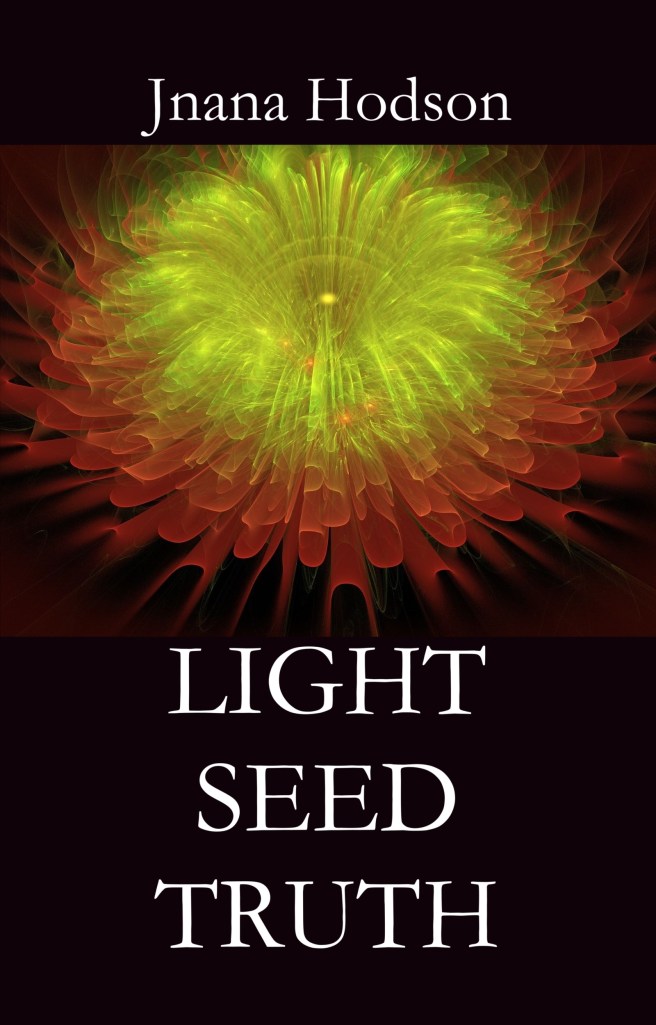
I rather backed into this project, beginning with the elusive question, “What do Quakers believe?”

It led me to something much bigger, ranging beyond the Society of Friends, but springing from the seemingly quaint language of its earliest voices in mid-1600s Britain. There are good reasons the time and place are referred to as the world turned upside down.

Centering their experiences in three interlocking metaphors – Light, Seed, and Truth – they created what’s been called an alternative Christianity, and though their thinking and process have been diluted over the centuries since, their foundation remains revolutionary, startling, and challenging. I’ll argue that it’s cutting-edge contemporary, as well, in a time of disbelief and skepticism.

For one thing, how do you see “truth” as a verb? It becomes something quite different from carved marble or courtroom proceedings.

While some of the chapters originally appeared as chapbooks at Thistle Finch editions, this newly enlarged volume of essays is now available on your choice of ebook platforms at Smashwords.com and its affiliated digital retailers. Those outlets include the Apple Store, Barnes & Noble’s Nook, Scribd, and Sony’s Kobo. You may also request the ebook from your local public library.

The book now ranges far beyond religion and spirituality, by the way. Even atheists have their beliefs. Change the perspective, as I think I do, and you can find the exchange of first-hand experiences refreshing. How else can we talk about the deepest issues in life?

The move unites the essays in a single volume, rather than a series of four smaller chapbooks, and makes them available to a wider range of readers worldwide.

Do take a look.

Why you should preorder Light Seed Truth

My newest book, Light Seed Truth, challenges traditional religious teaching, the kind that results in “thou shalt not” combined with a fear of eternal suffering or some equivalent.

My book outlines an alternative to the legalistic framework found across religious traditions with their institutions and rituals grounded in second-hand retelling of mystical encounters. As you’ll see in the book, it’s not just religion, either.

Do note, though, the price will more than double shortly after the official release on June 7. So buying now helps you.

Preorders are one way of boosting the algorithm of first-week sales, and that can increase the title’s visibility on those ebook retailers’ bookshelves. So that helps me.

You can find it in the digital platform of your choice at Smashwords prior to the official release.

Be among the first to check it out. Thanks!

When up turns down turns up

For many people, worship – or even spirituality – is a way of escaping everyday life and conflict.

For Friends, in contrast, worship is a place and time to embrace it, face it, transform it, find harmony and appropriate action.

Not that I would have said that before. In fact, for years the high I felt in the hour did provide me a weekly respite.

A few thoughts spinning around Scripture

  1. Even if Biblical Scripture is essentially the “men’s minutes” of divine history, the women therein generally come off much better than the men – and whenever the women are named, there is growth in the church: Sarah, Rebecca, Rachel, Miriam, Deborah, Hannah, etc.
  2. Because the male gender language has been inclusive, representing the universal, there is no English way for men to refer to themselves in the particularity of being male – no way, in other words, that we can distinctly represent the specifics of being male only. So just who has been more impoverished by this defect?
  3. When I get away from my emotions, I’m also far from my God … (God is love).
  4. Argument: It’s possible to do religion without faith, but impossible to maintain a mutually loving connection without faith i.e. trust. Thus, positive relationship exists with the Divine.
  5. Hosanna and Alleluia as universal expressions of awe and ecstasy.
  6. Hashem = “the unnamable name” = neutral.
  7. Adoni = lord = male.
  8. Elohim = breast = female.
  9. The idea of “casting spells” is that you can order God/the gods/spirits to do your bidding rather than the other way around.
  10. Zionism originated to save a language. That is, a language needs a place where it lives.

Hodie, hodie!

My choir has been singing a joyous Renaissance piece that translates, in Allen M. Simon’s rendering, as:

Today Christ is born:
Today the Savior appeared:
Today on Earth the Angels sing,
Archangels rejoice:
Today the righteous rejoice, saying:
Glory to God in the highest.
Alleluia.

I first heard it in the second classical concert I ever attended, around age 12, with the velvety Roger Wagner Chorale on tour. Never, ever, did I imagine I’d be part of presenting it myself.

Still blows me away, all around.

Missing my ‘tinis …

We’re well into the annual Nativity Fast now, and that means going without alcohol.

I’m not bound by Greek Orthodox discipline, even though one year we did try to follow the Advent diet, which is largely vegan. It will be a while before we do that again, admirable as it is.

For me, the big challenge is in admitting just how much I enjoy martinis. Very dry, gin, with an olive. Some fellow Quakers would definitely look askance at me on that count, though I did have a good Friend who was a definite exception.

Alas, he passed over before I ever got to sample one of his legendary concoctions.

Growing up in a teetotaling household does throw a curve on my outlook. I’m repressed enough as a result, even after hippie liberation. But then came the yoga, which frowned on both meat and alcohol even before any tipsiness.

More recently, here on Moose Island, I’ve found myself indulging come late morning rather than closer to bedtime. OK, I’m usually up and working on the keyboard before sunrise, too, so there are some adjustments in the daily schedule, especially when I get an afternoon nap in.

So, to keep me in control of my imbibing, rather than the other way around, I haven’t touched a drop since November 16, apart from a glass of Cotes du Rhone on Thanksgiving, a nod to the Orthodox relaxations on designated feast days.

Drinking is, after all, something that can become habitual, and there are good reasons to break certain habits or to strengthen one’s self-discipline.

But still, I am counting those days till Christmas.

Cheers!