One commute I can’t complain about

Some Sunday mornings, my drive to and from the Quaker meetinghouse a half-hour from my home is a meditation in its own right.

Even in fog or snow, it can be refreshing.

Much of the road is through forest, plus stretches along Passamaquoddy and Cobscook bays and their tributaries. The route also passes through a tribal reservation and a national wildlife preserve, which does sound a bit exotic though I take it as routine.

Eagle sightings are common, and I have had to stop for deer or turkeys in the middle of U.S. 1. Once I even spotted a moose far ahead on the pavement.

A radio program of classical choral music on a CBC station that comes in quite clearly is often also an element, depending on my mood.

Do you remember the freedom you felt when you first learned to drive? Some mornings, especially when there’s no other traffic, that elation returns.

While I’m tempted to proclaim “What could be more glorious than this!” I will also note many of the scattered homes I pass resemble junkyards – poverty in Washington County is a constant – so there’s a reminder of that reality, too. I suspect there are more dead cars and trucks here than people.

As an added touch, there are no traffic lights, either.

I’ve been meditating for more than 50 years now

Well, I haven’t been living as a monk in a Himalayan-mountain cave any of that time, but it does sound more impressive that being a “meditator” or someone who practices in a contemplative religious tradition that long even when it’s only once or twice a week.

The thought came to me in Quaker worship the other Sunday morning, the center of what has remained my spiritual discipline and community after the yoga-based version faded away over the years – even my rising before dawn to sit cross-legged in front of a small altar and its candle before I tackled poetry and then took off for the paying job for the rest of the day.

~*~

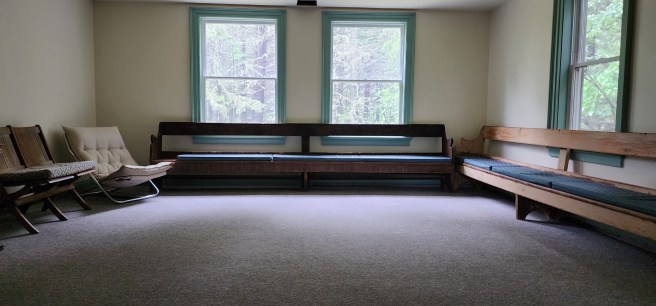
While I can no longer park myself on a cushion on the floor in the Asian style but rather settle in much more loosely on an old meetinghouse bench – do not call it a pew – the bigger change has been in the focus of my sitting.

The goal of the yoga exercise was to transcend, leaving behind mundane awareness altogether. Somewhere you might encounter your past lives, even. If not that, then a natural high, as an advanced version of a drug trip. At least an awareness of an altered state of consciousness that might even address authentic ethereal reality.

Instead, in the Quaker vein, what I’ve found is a time of being mentally and emotionally renewed and even gaining clarity into my daily engagements.

Or, as one quip goes, some of the best barns in New England were designed during Quaker Meeting. In this case, meaning the hour of shared and mostly silent worship.

~*~

The half-century mark also takes me back to my first Summer of Love, detailed my novel Pit-a-Pat High Jinks, a book that has scenes triggering the erotica filter, should you try to order a copy.

While I was preparing to live in the yoga ashram to our south back then, I experienced my first summer with a daily exposure to the outdoors, including swimming in mountain lakes, often naked, Upstate New York. It was a time of great struggle, discovery, growth, and redirection for me.

And at the end of all this, at the closure of our hour of silent worship here in Maine, one Friend (aka Quaker) voiced an insight from a Native perspective that when it comes to time, the focus is on the past – it’s the only one we can know. The future is the one behind us, rather than ahead. Not that there’s that much ahead for me in this lifetime.

~*~

Still, it’s was a kind of day that had me wondering, can life be any better than this? (Even with those aches et cetera of aging.)

Dipping in glorious waters

I haven’t written a real poem
in at last a decade
prose, especially fiction, has taken the fore
plus relocating to a remote Maine island
do I even consider the photography

How else do you think
other than by talking to yourself even silently
or through the fingers or feet

I’ve long preferred instrumental music, abstract
or airs in languages I don’t understand
and usually forget the lyrics and lines in scores
I’ve sung in concert

So I was swimming a half-mile a day
before the pandemic but haven’t been back
in deep water, fresh or surf, indoor or out till today,
my first venture in a little-known river pooling
too rocky for laps but perfect for extending myself
in the familiar chill under a cloud-strewn afternoon sky

yes, it’s glorious and refreshing
in a way I discovered my first year after college
in hippie abandon or the New England coast
and Dover’s Olympic pool later
it’s the sunlight and breeze
stretching above, around

a call to attend to my rooting as well
in meditation, prayer, Scripture, favored poets
all as seemingly impractical

Sitting down to do our annual donations

Rather than making most of our charitable contributions ad lib during the year, we’ve adapted a new strategy since moving Way Downeast.

This is the time of the year when we decide what we’re supporting and then make those payments.

The process means deciding between giving smaller amounts to a wider range of organizations or instead sending somewhat larger amounts focused on a few recipients.

Mailing those checks off always feels good, though we also wish we were sending more.

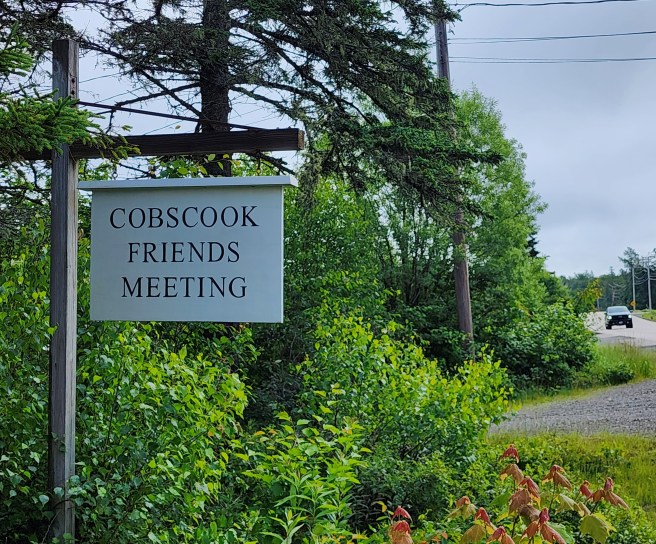
Welcome to Cobscook Friends

As a small, rural Quaker fellowship, we’re especially happy to be worshipping together in one space every Sunday again, at least through the summer and early autumn.

Covid, of course, had us connected only by Zoom through much of the Covid onslaught and after that, coming together in a physical space on alternative weeks only. We do live at distances from the meetinghouse, so winter weather can often be a challenge.

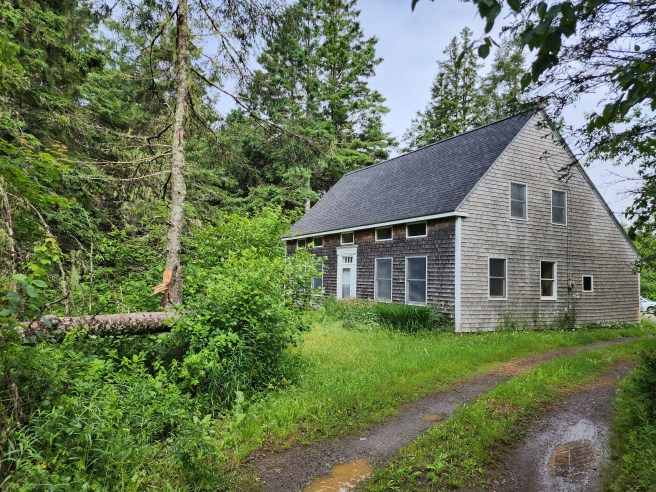
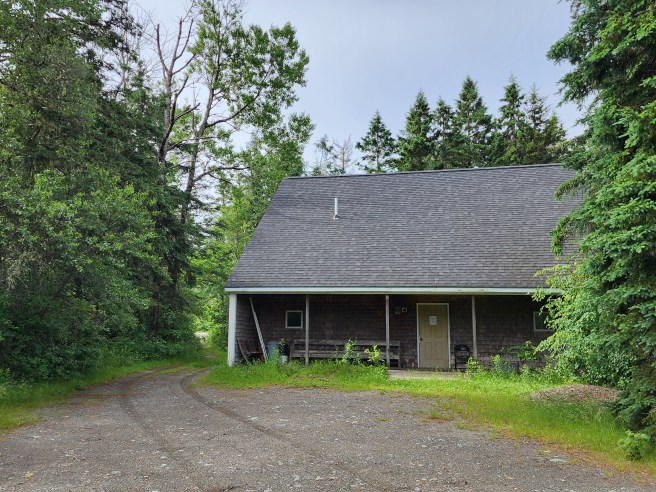
Not so summer. We’d love to have others join us in our hour of mostly silent centering, beginning at 9:30 on Sunday mornings. The meetinghouse is in the woods along Maine Route 189 in Whiting – on the way to Lubec and many great outdoors trails.

If you meditate in some practice, you’ll fit right in – and if that seems foreign, it’s still a great time for personal reflection. I always find it renewing.

As a professional historian friend said after one of my presentations

New England history is all through Harvard. And then Yale and Williams College.

Except, of course, a few mavericks like me. (Even though, humbly confessed, I’m not a historian.)

Well, you do have another opportunity to see why he said that if you register promptly for my free Zoom presentation from Cape Cod at 12:30 Sunday afternoon ( https://bit.ly/QuakingDover ).

Here’s hoping to hear from you there!

All advocates of peace are invited

I didn’t make these points this baldly in my book Quaking Dover, but as I’ve prepared for my upcoming presentation from West Falmouth Friends’ Peace and Social Order committee’s Zoom presentation, I’m seeing these elements at play.

I do hope you can join us online for this free presentation on Sunday, July 9, at 12:30 pm. Please not that preregistration is required at https://bit.ly/QuakingDover. 

You don’t have to be a Quaker to participate, either. (Insert smiley face emoji if you must.)

Just how do peaceable communities emerge and survive?

What is the meaning of life?

Might as well start by eliminating the word “meaning” from the question.

That leaves the core mystery to savor before expressing its wonder in mere, pale words.

Life itself is unfathomable. Why me, you, us? As is our very awareness. It’s more than a neurochemical reaction or the like.

Descartes, for me, fails the mystery altogether. Thinking, which can wander all over the place, is secondary. Feeling is more primal, closer to what the Bible calls heart.

I prefer recasting it as “I breathe, therefore I am,” as more embodied. You know, inspiration, expiration. Inhale, exhale. It’s more Zen, and the Hebrew word for breath is the same word for soul, so I’ve been told. (And soul equals heart there.)

Action, then, perchance, as a way forward? Even one breath at a time?

Explain any of that, if you can.

Without raising too many more questions.

Now, have a great day.

My history essentially drifts off about the time the textile mills take over

Among other things, I would love to know more about the livelihoods of Dover’s Quaker families, especially as they evolved over the generations. How did they acquire new skills, for one thing, as the town went from being a fishing and shipbuilding center to timbering and sawmills and then milling in general, even before its emergence as a calico capital?

New England farming, of course, underwent its own permutations, especially after wool was displaced by cotton in the early 1800s.

As Dover shifted from a rural village with agricultural roots and fishing and shipbuilding to an industrial city depending on an immigrant workforce, the Quaker presence shrank to a mere thread. Even so, as I like to think, some of the Friends’ values continued in the descendants of the Meeting’s earlier members, even when the family was no longer Quaker.

Many had moved north or east in search of new farmlands, and others were about to head off to Minnesota and Iowa.

Dover Friends Meeting was already declining when the textile mills started changing the character of the community. Moreover, the new arrivals brought new churches and ethnic identities, and these are stories waiting to be told in the upcoming celebrations. I’ll be all ears.

As the ownership of the mills passed to out-of-town investors, the profits being generated in Dover prospered an upper crust elsewhere, most likely the famed Boston Brahmins. In contrast, Dover became a largely working-class neighborhood. The same can be said for the busy rail lines passing through town.

The centerpiece of Dover is the Lower Falls of the Cochecho River, capped by a dam that increased the waterpower to the textiles mills. Here, water from the river rushes into the tidewaters below and runs through an arch in the mills that define the downtown. Who can’t be inspired by such a sight, whether the river’s running high or low, in season?

Although a visitor to Dover today would have no problem seeing the town’s character as New England, its identity today comes from the brick mills erected at the falls four-and-a-half or five miles north of the Hilton settlement. There is no town common, a wide green square surrounded by imposing Colonial houses and white church under a lofty steeple. The same can be said for neighboring Portsmouth, formed around the harbor, and Exeter, with the elite academy. Yes, there are the iconic church spires and rooster weather vane but not the central green common. Hampton, which remained largely agricultural, does have a tiny green, not that it would pasture a single horse.

As my new book and these blog posts note, David Hackett Fischer’s Albion’s Seed: Four British Folkways in America explains that the stereotypical New England arises in the customs and culture of East Anglia, the region of England that produced most of the Puritan migrants who shaped Massachusetts and Connecticut. He sharply counters that with the Quaker migrations from the Midlands into Pennsylvania, and from the Royalist cavaliers who predominated the Virginia planter society, as well as from the Borderlands people in northern England who share commonalities with the Scots-Irish settling the Appalachian spine from Georgia to Maine.

Fischer examines these complex workings in a set of specifics that include distinctive speech, architecture, geographic patterns of settlement, family, marriage, gender, sex, child-rearing, naming of children, attitudes toward aging, religion, magic, learning and education, food, dress, sports, work ethics and practices, use of time and recording, ideas of social order and institutions, authority and power, and more, including differing concepts of liberty and social restraint.

Quite simply, there was no generic Englishman. Even the dialects could prove incomprehensible when taken from one part of the country to the other.

While the new settlers to the Piscataqua settlement were primarily Puritans, imbued with its Protestant ethos, they were also overwhelmingly from Devon, with folkways quite distinct from their East Anglia brethren.

I suspect these contrasting folkways play a major, though previously undetected role, in the deep conflicts about to emerge in the seeming isolation along the Piscataqua as well as elsewhere in other pockets of New England.

Far from being a homogenous nation, Britain was a patchwork of many long-buried identities, some of them resurfacing in new guises. The country had never suffered an Inquisition, either, to suppress them. Its Christianity had been imposed from the conversion of the regional kings, whose subjects might publicly worship one way but another in private.

English Quakers, too, had never suffered the trials of sustained violence with New France and the Indigenous American tribes or racial slavery or a Revolutionary War, as their American coreligionists did, especially in New England. Little wonder the English Friends were baffled by the separations that ultimately divided Quakers in the New World.

It was a rich brew. And, frankly, still is.

~*~

Though Dover Quaker Meeting was reborn in the ’50s after a hiatus, its viability is challenged, but so is much more of contemporary American society.  Besides, I’m not comfortable in considering the period as “history,” much less examining it systematically or comprehensively, though I tell what I can. Some early readers think it’s the best part of my book. I won’t argue.

I will say that our Quaker Meeting is a beautiful community, one I love dearly and invite you to experience.

As well as Dover.

~*~

Check out my new book, Quaking Dover, available in your choice of ebook platforms at Smashwords.com.

Welcome to the upcoming 400th anniversary.

There’s plenty for other researchers to expand on

My Dover history project has taught me how slippery much of the material – especially the early parts – can be. What comes through is often fragmentary.

Did Edward Hilton actually look like this?

There’s the very enigma of Edward Hilton, for starters, just trying to prove he was here from 1623. From the circumstantial evidence, I’m convinced that he and Thomas Roberts definitely were, and besides, there are no rival hypotheses regarding their arrival. But that’s not rock-solid documentation doesn’t appear until retroactively. Maybe some of it, taken to London, survived the big fires and plagues and will resurface. Don’t hold your breath.

I’ve seen some of the early charters and patents and, for all of their descriptive prose, find them baffling. The layers of landholding are just the beginning.

What, for instance, did William Fiennes – the eighth Baron Saye-and-Sele – and Robert Greville, the second Baron Brooke, receive in compensation when they relinquished their proprietorship of the New Hampshire province to Massachusetts? And for that matter, how did the Massachusetts Bay colony arrange the transaction?

I would even like to see the details on what Edward Hilton had received when he earlier sold his proprietorship – again, just what did he possess? – to Lords Saye and Brooke. His reason, according to one source, was a sense that the Massachusetts authorities were preparing to seize the Piscataqua and his defense would have been inadequate. Saye and Brooke had clout, as well as a colony in Connecticut named after themselves: Saybrook.

There are also questions of how the “governors” and ministers of the province were selected prior to Massachusetts’ control of New Hampshire.

Just trying to decipher the script and text requires an expert, perhaps even an antiquarian lawyer. And how many of the documents remain, anyway, in the mother country or the New World?

Fellow blogger Mark Everett Miner touches on some of this when he remarks, “It is thought that William Hilton was somewhat educated as he wrote several competent, if poorly spelled, letters.” They are, however, quite convoluted. Here’s an excerpt from a 1633 letter to John Winthrop:

“There arived a ffishing shipe at Pascataque about the 15th of this p’sant moneth where in is one Richard ffoxwell whoe hath fformerly lived in this cuntery he bringeth nuse yt there were tow shipes making ready at Barstaple whoe are to bring passingers & catell ffor to plant in the bay he hath leters ffor mr wearom & divers others at dorchester wch hee intends to bring hr to the bay so soone as posible he can like wise he heard ffrom mr Alerton whoe was making ready at Bristole ffor to come ffor this cuntery other nuse he bringeth not that I can heare of onely mr Borowes purposeth to come ffor this cuntery ffrom london & soe desighring you to convey thes leters in to the bay wth what conveniency you can desighring the lord to blesse you in your lawffull designes I humbly rest …”

How do you make sense of such surviving documents?

In Dover, First Parish records don’t pick up until John Pike set down his memories, beginning with his arrival as minister in 1677. Still, as later minister and historian A.H. Quint observed, “There are no extant Dover church records before Dr. Jeremy Belknap’s ministry,” beginning in 1767, “except that he copied into a record book a list of baptisms and of members, commencing in 1717. The town records are also very defective during the period of Mr. Pike’s residence.” He adds, “This is due partly to the Indian troubles, and partly to the Masonian difficulties.”

By the time Samuel Bownas first visited Dover, the Meeting’s earliest minutes had already been lost – in a barn fire, according to oral lore.

Old volumes in the Dover Friends library tell mostly about Quakers elsewhere. These rare books do not circulate.

In Quakers in the Colonial Northeast, Arthur J. Worrall notes, “The clerk was the most important of the persons active in meeting affairs.” While his examination focused on the yearly meeting level, he remarks, “Clerks had been appointed before 1700, but we know little about their activities. Their note-keeping was careless at best, and … it was not unusual for a clerk of many years’ standing to lose his copy of the minutes.”

One consequence is that we are unlikely to learn much of Dover Quaker life in the early years from the Yearly Meeting books.

Dover’s surviving records begin with the women’s minutes in 1701, with a gap from 1785 to 1814, and the men’s minutes, from 1703. Its vital records stretch back to 1678 but, curiously, were not begun until 1787.

Missing, of course, are the accounts of the early persecutions by the Puritan authorities, the reactions to the Waldron incarceration of Natives or their later attack on the village, or even the early leadership of the faith community.

For family genealogists, the Quaker sources are among the best available family records in America before the 1850 Census, the first to name everyone in a household. The Friends minutes, however, name only those families in good standing as members. Even so, they can be very useful in framing a family overall.

New England records were never comprehensively indexed along the lines of William Wade Hinshaw’s six-volume Encyclopedia of American Quaker Genealogy, covering Pennsylvania and New Jersey, New York, North Carolina, Virginia, and Ohio, or its seven-volume companion by Willard Heiss, Abstracts of the Records of the Society of Friends in Indiana. But Dover Meeting’s surviving family records were serialized from 1903 to 1909 in the New Hampshire Genealogical Record, the Official Organ of the New Hampshire Genealogical Society. Its editor and publisher was Charles Wesley Tibbetts, an attorney. I haven’t been able to determine if he is a direct Quaker descendant, but his kin were prominent in the Meeting.

Dover’s surviving records are preserved in the New England Yearly Meeting archives in the special collections at the University of Massachusetts Amherst, where they can be accessed by researchers and readers. As I already mentioned in an earlier post, a truly close examination of them would add much to a more thorough history of Dover Friends – a list of clerks, for instance, or the Revolutionary War volumes of discipline – but the results would likely be too arcane for my intended audience.

Still, if opportunity ever presents itself, hunkering down for several weeks in Amherst might be revealing.

Other things I would also like to see:

  • A fuller presentation of the Devon folkways, without the Virginia overlay in David Hackett Fischer’s Albion’s Seed.
  • A history of Salem, Massachusetts, drawing on the culture clash that runs through my own book. I suspect that much of the witch trial hysteria originates in those differences, abetted by a “perfect storm” of related factors. Likewise, the Salem Friends Meeting and its successor at Lynn need a bigger profile.
  • Ditto for Hampton Friends, morphing into today’s Amesbury Monthly Meeting.
  • A major overview of Quakers in Maine. Again, the fragmentary nature of the surviving minutes would require amplification from court records, deeds, and genealogies.

~*~

Welcome to Dover’s upcoming 400th anniversary.