Let’s not get nostalgic, OK?

A while back, revisiting my high school yearbooks in a search for additional first names befitting the times of a story I was revising, I was shocked even appalled to admit how physically ugly so many of my classmates were, not that I was a prime example of emerging manhood. Some even had aspirational birth names, yet our uptight upbringing would be difficult to escape, as I was perceiving. Even those I considered alluring typically fell short in the longer haul.

Physically, at least, some people appear doomed from birth. And just what were their parents thinking when it came to first names like Jethro or Candy?

What if my fiction had delved into that darkness, rather than my idealized escape?

At the least, it was something I might have engaged in my psychological therapy sessions but didn’t. Add to that, my scope of ministry since.


WITHOUT MUCH HARD EVIDENCE (meaning journals or perhaps snide notes) to fall back on, my high school years are blurry. As I posted last May, I didn’t start journaling until I graduated from college, even though when I was winding down a summer internship a few weeks before the beginning of my junior year, the editor-in-chief of the newspaper where I was working a pivotal internship called me into his office for a parting chat. He strongly suggested, make that urged, I begin keeping a journal, a practice he found invaluable in life. He also counseled me to change my major from journalism to “something that will expand your mind – we can teach you to write news stories and headlines as part of the job.”

On my return to campus, I did change my major, to political science, along with sizable chunks of literature (Indiana University had both comparative literature and traditional English programs) along with economics. Maybe I should blame Glenn Thompson for much of my wide, maybe overly wide, range of focus since.

My journaling, though, didn’t begin until nearly two years later, after graduation, and then somehow not quite by intention. I just started scribbling during a tempestuous, unanticipated week’s trek in Montana and Utah, which was also my introduction to the Far West.

Now, as I delve into the pages, some of the general impressions I presented in that post need refinement. For one thing, contrary to many of the later years, I had periods in that first decade of making detailed entries daily, rather than week-to-week or so that became common later.

Candidly, as you’ll see, those were some rough times for me.

~*~

Here are the covers for three of the four high school yearbooks from my time there. I do admire the intense draftsmanship of the first, and will admit the last one was mine, pretty much on the fly when the original concept fell apart.


~*~

I HAD EXPECTED TO FIND my journaling volumes had been pretty well picked over in the drafting of my novels and poems but instead found many entries that remained untouched.

That led to keyboarding entries of flashes and insights before discarding the volumes one-by-one in ceremonial flames. The gleanings will get one final airing as I let go.

Quite simply, I see this as one less burden on my “survivors” after I pass but I do expect to draw heavily on the selected entries in my postings at the Barn this year.

Consider them Spiralbound Memories. Do note that I will be changing the names of some of the characters, in part to respect a bit of their privacy and in part to recognize that they likely saw the events quite differently.

Looking for clues about what really happened

If I had become famous, some unfortunate scholars would likely be poring over my many pedantic, even ghastly, pages of scribbling in personal journals that I’m instead purging. Ceremoniously incinerating, here on the craggy coast, far from my native Midwest, in a pale imitation of a Viking pulling up his ship at the end of a long voyage that landed him or me in what emerged as the mid-Atlantic states and then led, by degrees, to the Pacific Northwest before inching backward and ultimately winding up in this remote island in Maine.

There is, by the way, evidence to argue that Vikings had indeed landed here along Passamaquoddy Bay.

I’m not speaking of my novels and poems, which I do believe need a supportive discovery or rediscovery, but rather my 200-plus volumes of personal journals.

Yipes!

Of course, had I instead become fabulously rich, some poor souls would be tending to these details and making them look brilliant. Vanity, vanity.

Oh, for the dreams, dashed dreams, of youth and a few decades following. I can’t speak for you, but for my part, adulthood has turned out to be quite different from anything I had anticipated.

Trying to understand how it happened is another matter. Even at the time, you might see things and note them but not realize their import. Coming across a detail like that years later can be stunning. What if?

These are, or more accurately, were my personal journals.


MY JOURNALS CULLING is another step in downsizing, one prompted by trying to fit my books and recordings into my new bedroom. At my age, I’m also cognizant of the burden they would place on those who survive me, as the phrase in obituaries goes. Besides, most of my 200-plus volumes haven’t been opened and revisited in years – at least since my novels were drafted and revised. Just what the heck remained in them?

Early on, I had a custom of revisiting the previous year’s notations as part of a Christmas Greetings and New Year’s reflection, but even that fell away sometime around the time of my remarriage. Frankly, everything changed at that point. Everything before became ancient history, abetted by my memory sieve.

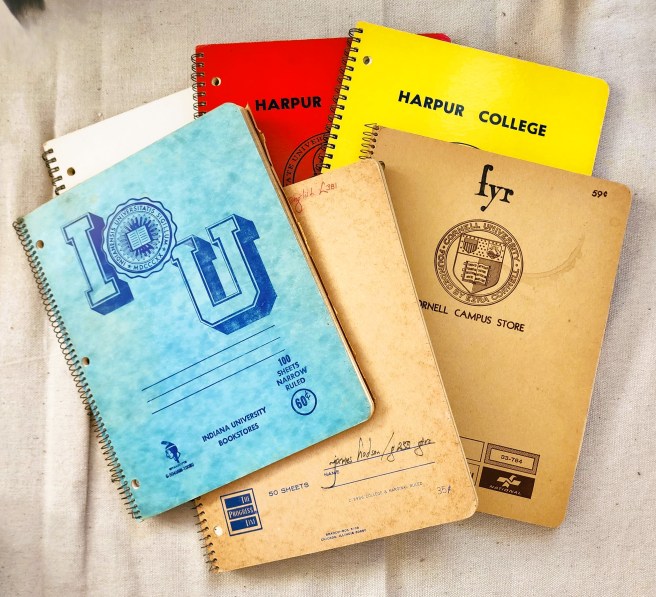
One of my goals for the past year was to read through my journals one last time, keyboarding any gleanings that might still be useful and letting go of the rest. For the first dozen-and-a-half years after I graduated from college, my journaling took place in inexpensive spiralbound notebooks, hence the title for the series I’m introducing. The entries cover my moves from Indiana University to Upstate New York, followed by the yoga ashram in the Poconos of Pennsylvania, back to a small rust-belt town in Ohio and then returning to Indiana before leaping to the interior desert of the Pacific Northwest, and then rebounding to a troubled steel town in the Midwest.

There are good reasons I keep seeing myself as a fortunate survivor. We have lived through some wild times.


AS I’VE ANNOUNCED, I’ll be drawing heavily on those early entries in the posts here in the coming year. So much has changed in American life in the past half-century, and not just for me. Readers from elsewhere can weigh in as they will.

As for the remaining decades of journals? Please stay tuned before I strike the match.

We may aspire to be a bit illegible this year

Having revealed my blogging direction for the coming year, please allow me to fill in some of the background.

As we enter the Barn’s 14th year, the merry-go-round concept continues, including Tendrils on Tuesdays and Kinisi on Sunday evenings. With our home renovation on pause, you’ll see fewer entries on that project, though one of its consequences will become the main focus over the year. To wit: As I posted last May, I need to downsize my possessions to fit into our new space, meaning collections, and my 200-some volumes of journaling have become a target. Frankly, I hadn’t opened most of those scribblings aka manuscripts in the past decade or two. Was I likely to do so in the next five years or so? Or would they continue to collect dust? As I was saying? Besides, do I want to burden my wife and daughters with one more burden to clean out when I’m no more? Heavens, no.

Setting forth five months after my New Year’s goal of culling those pages, I expected to find that the earliest volumes had been thoroughly mined in drafting my novels and poetry, and that what remained would be embarrassingly sophomoric. Well, many passages were. But there was enough other material I didn’t want to lose, which led to keyboarding those bits before ceremoniously burning the volumes themselves. More on that later in the season.

So far, I’ve gotten through the first decade after my graduation from college. Far more remained from what I had imagined.

As these appear here, perhaps they’ll work along the lines of Ned Rorem’s Paris Journals, though much less scandalously and thoroughly lacking celebrities. Who knows what morbid fascination you might engage.

I’ll try not to add too much context but rather let them pour forth largely unedited. You might feel something like an eavesdropper that way. Some of the identities may, however, be changed to protect the guilty.

With fewer photos here in the coming year, the Barn will be more word-driven, befitting a novelist and poet, but with a funky edge. As a “gentle reminder” I came across last year advised:

“Let life feel a little illegible sometimes. You’re not a quote. You’re not a theme. You’re a page with scribbles, rewrites, margin notes. Let it stay messy. That’s what makes it real.”

Thanks to YouBook Story at Instagram for that inspiration. Let’s see how it fits.

Onward, then!

Religion turns off readers, and yet …

That’s an advice given to authors, though it’s something I cannot avoid in my own novels and even poetry. Where else can we fully address the deepest values we hold?

Politics doesn’t seem to be working that way, for sure.

Is science fiction the best we can do for now when it comes to grappling with philosophical issues?

Still, I’ve dug in, ranging from the spirituality of yoga and Buddhism in Zen and Tibetan traditions to Quaker and Mennonite Christianity to Greek Orthodoxy as well as Indigenous strands.

I tackle this most directly in Light Seed Truth, an ebook that includes four earlier booklets investigating the revolutionary impact early Quakers found in applying the metaphors of Light, Seed, and Truth. To that I add examples of the power of metaphor in modern secular society, just for balance.

My goal is to raise readers’ awareness and sensitivity rather than convert anyway to a particular faith.

With religion, I want to hear how faith is experienced by different individuals, rather than what they speculate they should be experiencing.

The best mystics I’ve known have surprisingly practical and humorous.

~*~

You can find it and more in the digital platform of your choice at Smashwords, the Apple Store, Barnes & Noble’s Nook, Scribd, Sony’s Kobo, and other fine ebook retailers. You can also ask your public library to obtain it.

Avoiding the G-word while examining faith

One of the things I’ve learned over the years is that turning any discussion of religion away from the doctrinaire formulas and instead to direct feelings and experiences can be quite refreshing, even inspiring.

Essentially, that boils down to shifting from “head” speculation and instead to personal encounters, “heart,” if you will. It moves the focus from the abstract to something more concrete.

In my book, Light Seed Truth, I try to take that a step further by avoiding the G-word altogether except in direct quotation. Part of that stems from a Jewish tradition that considers the name of the Holy One to be too sacred to be uttered, leading instead to substitutes that include the all-cap LORD in English translations, meaning The Name. And part stems from just how different our individual perceptions of the word can be, often defaulting into an old bearded male of some sort, despite other options. Even Adonai and Elohim carry different connotations, not that I go into them. Just be aware.

Besides, the G-word can too easily create a wall between those who “believe” and those who don’t.

Add to that the surveys that find atheists, overall, are more familiar with the Bible than are members of varying denominations, and I do want to include them in the discussion.

In my ebook, I do hope to encourage an appreciation for wonder itself in our lives.

Not a bad place to start, is it?

You can find the volume in the digital platform of your choice at Smashwords, the Apple Store, Barnes & Noble’s Nook, Scribd, Sony’s Kobo, and other fine ebook retailers. You can also ask your public library to obtain it.

Could this be how it ends?

The time to go has come. It should have arrived several years earlier, rather than continuing in so much wheelchair loitering, trapped in a dream-state. Now the phone call, “I don’t expect him to live another week,” leads into packing and flight.

Unable to awaken, fully, from the bewildering disconnections. This is not the heart attack or car crash I had predicted. Nor the old age of graceful evaporation into a vanishing point of history. No one will say now, “He lost his mind,” but the new names change nothing. This terminal illness, in stages, until the patient no longer remembers how to eat or breathe. Perhaps, mercifully, an angel will break through the sterile chambers of medical enterprise, and another nature will take its course.

This flesh, shrinking to bone, rather than feather.

Message from another era

Art Newlin rose in Meeting and told of driving two- or twelve-hitch rigs as a young man. Once he hitched two strawberry roans to a tongue, and while they’d worked a rig before, they’d always followed and never really felt the bit or anything. Nonetheless, they performed well, even backing on command. Only later did he realize the risk he’d taken. “They could’ve become runaways. They could’ve killed me.”

He credited faith for protecting him.

From Orpheus to eternity

Contrary to widespread opinion, hell is air-conditioned, though prone to frequent power outages. This is crucial, according to the dream, since hades exists largely as something akin to cyberspace – that is, its endlessly interlocked and hushed interiors are covered with wall-to-wall carpeting and bathed in recessed fluorescent lighting, each room assigned to a particular array of deceased souls. There, they may be called up on large-screen, high-definition television screens, although addressing them is an experience akin to conversing with an advanced Alzheimer’s patient. Unlike most funeral homes, these room contain is little furniture and no flowers.

The experience of hell is not fire, as commonly thought, but rather that there’s nothing to do. The result is endless boredom, with only the memories of a single lifetime to reflect on. There’s no music, neither harp nor lyre, and singing never emerges from the throat. Here, insanity is not an option. Escape is impossible from the utter silence. This is solitary confinement amplified, without even periodic meals for variation. The basis of humanity is awareness. In damnation, the awareness is amplified – awareness of nothingness.

Visitors to this realm must be careful not to be separated when a power outage strikes. Do not go to the bathroom alone or attempt to double your productivity by working multiple rooms at the same time. Should two members of a family obtain an unequal knowledge of the deceased – information gleaned separately during their quest to better know the departed, but not yet shared with each other – they may be told they cannot leave hell, but must themselves join its ranks. This is, of course, a bald lie, but getting through its sales pitch is emotionally exhausting.

The power outages occur to reinforce the awareness of eternity. That is, they retain a rhythm of time within timelessness.

Dante, we should note, wrote of inferno before electricity became part of human life. Had it been, he may have placed the worst offenders in electrical chairs, with continuous executions. It’s possible that happens in the deepest recesses, contributing to the power outages. I report only on what I’ve seen, briefly. I remember nothing of our guide, other than his dark, single-color suit and highly polished shoes leading us down a set of three steps into our last room.

~*~

My, I don’t quite know now where that originated in my mind. But there it is, from some deep past.

Hello, readers!

I’m excited to announce that my lineup of ebooks is available as part of a promotion on Smashwords for the month of July as part of their Annual Summer/Winter Sale. This is a chance to get my novels, poetry collections, and Quaker volumes, along with volumes from many other indy authors, at a discount so you can get right to reading. Some of mine are even free, as you’ll see.

The sale begins today, so save the link:
https://www.smashwords.com/shelves/promos/

Please share this promo with friends and family. You can even forward the news to the avid readers in your life.

Thank you for your help and support.

And happy summer reading!