
As for the other one?
You never know what we'll churn up in cleaning a stall
When it comes to jazz, I have to confess a bias toward instrumental – piano, especially. It probably has a lot to do with the abstraction into emotions that so attracts me to classical music.
My wife and daughters, on the other hand, prefer vocals. They’re all more word-oriented than me, the writer.
What gives?


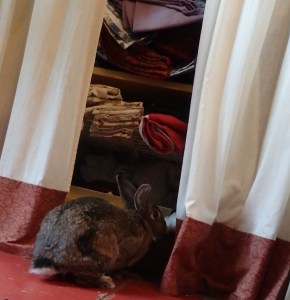
We let our bunnies run free on the first floor during the day. They love to explore, as Pepper is here, but they also love just hanging out in their favorite spots.
Its first-in-the-nation presidential primary has the Live-Free-or-Die state in the headlines these days. We want to meet and evaluate them all. It ain’t always easy.
The state’s presidential primary originated in Town Meeting Day, which is traditionally conducted on the second Tuesday in March each year. Since everybody had already come out for this unique form of grassroots democracy, it made sense to add one more item to the warrant, as the agenda is called, rather than make yet another trip to the town hall. (Besides, being winter, we’d have to heat it.) As other states have tried to jump into the spotlight, the presidential part has moved forward on the calendar. Theirs, though, don’t have organic roots like ours.
Contrary to what some candidates label their appearances, a real Town Meeting is not a political lecture or Q&A opportunity but rather a community session for debating and then voting on local government decisions for the year. Everyone can speak up and be heard. The town and school budgets are major considerations.
Now for some other perspectives on the Granite State:
~*~
Ever been to the Granite State? What can you add to the list?

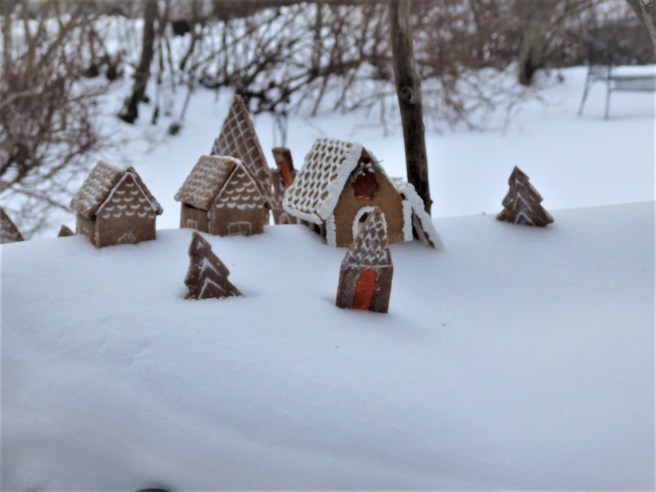
Sometime after the Twelve Days of Christmas end on January 6, we take our gingerbread decorations outdoors for the wild critters to discover and devour.
Here’s part of a village inserted into a pile of snow on a tabletop.
Looks like it belonged there all along. The squirrels, however, will soon be scampering off with the pieces.
Perhaps you’re familiar with the abundance versus scarcity question. You know, do you feel you’re blessed with enough – or do you instead feel you’re always lacking.
I’m programmed from early childhood to feel the latter. My parents were children of the Great Depression, after all, and handed the attitude down.
It tends to make me something tighter than frugal. Generosity doesn’t come easily, I don’t open up to others easily, either – not even to ask for help. It’s a long list of negatives.
As I returned to this concept recently, I’ve been feeling a lot more sense that I have more than enough in many ways, even on a very limited budget.
So much for material goods.
Curiously, it’s time where I’m feeling the scarcity kick in. There’s just never enough. Not for what I’m trying to do.
I’m realizing, often after the fact, how much that outlook crimps my relationships.
This is, ultimately, a spiritual matter. The one place I find time opening up is within the hour of mostly silent Quaker worship. Not that it’s always easy, not even after all of these years I’ve been doing it. But it is always refreshing and renewing.
To think, I started meditating to get naturally high, as in stoned. But somewhere along the way it became a practice to simply get natural – to breathe and get grounded again.
Oh, but I’m still on the internal clock, even there. How on earth am I supposed to cope with Eternity just around the corner?
Now on the sixth day:
bulls eight, rams two
– Numbers 29:29
Everett Fox translation
Sounds like a National Football League forecast, apart from the improbability of the score itself. Besides, it’s set for a Saturday, not Sunday.
Still I was amused when that line popped out at me from the page.
Now, for a little perspective, here’s how Robert Alter renders the text:
And on the sixth day eight bulls, two rams, and fourteen unblemished yearling lambs.
It’s all part of a series of proscribed daily sacrificial burnt offerings.
Any Chicago or Los Angeles fans out there?
It’s not Ohio, for one thing, even though a surprising number of people don’t know the difference. And it’s really quite distinct from Idaho, out in the Rockies further west. It doesn’t even have a big-league sports team.
But thanks to its unique party caucuses for presidential candidates, the Hawkeye State is back making headlines, at least for now. It makes for a big diversion, now that the crops are in.
Here are some quick perspectives.
~*~
Ever been to Iowa? What can you add to the list?
 Jnana's Red Barn