As for that dream house itself?

We’re at a point of downsizing. On a limited budget, at that.

Here’s what’s on my list of considerations.

~*~

  1. A pleasing work area: In my case, that’s the writing studio. For my wife (the foodie), the kitchen and pantry plus utility space. And in both, abundant wiring.
  2. A good view: In our dream, we’re looking at the ocean, but a lake or mountain might do.
  3. Wood heat: At least as backup. We’ve been very happy with our efficient Jotul wood stove. Besides, it’s good backup during power outages.
  4. Adequate insulation and heating/cooling: We’re set on New England, after all. Cold drafts are expensive and annoying. And summer is really only six weeks.
  5. Easy maintenance: I’m not a hobby do-it-yourselfer, and I have other ways to spend my time than amateur house repair. Our budget needs to keep calls to construction-industry tradesmen minimal.
  6. Smart use of space for our needs: Think affordable IKEA. Bigger is not necessarily better.
  7. Sufficient and efficient storage: Closets are a recent addition to New England houses. Take it from there. In our case, this would also include expansive bookshelves and a large garden shed.
  8. A three-season porch: Elbow-room, if you want, especially for entertaining guests in all but deep winter or tackling special projects.
  9. Minimal snow plowing: Even a short driveway can be difficult to clear if there’s nowhere to pile the snow. A long driveway can be expensive to keep clear and, for that matter, decently paved. As for parking?
  10. Hot tub? Well, this is a dream list and there is that three-season porch.

~*~

What would be on your list?

What would your dream home have?

My, have things changed from the time I first proposed this as a Tendrils topic and the time I actually sat down to draft the text. I thought I’d be living in Dover for the rest of my life, but now we’re actually looking to relocate to somewhere, well, for us more dreamy. I’ll leave it at that for the time being, and besides, that prospect just may turn out to be a very pleasant pipe dream.

What I am sensing that much of the dream has to do with location, beyond the house itself. This week I’ll focus on the locale. Next week, the walls, floor, and roof.

~*~

  1. Walkability: Pedestrian-friendly, with suitable restaurants, stores, parks, medical facilities within an easy stroll. What we like to call civility.
  2. A Quaker Meeting: Kindred spirits and spiritual friendship.
  3. Natural wonder: At the moment, that includes a view of the ocean. Nearby trails a plus.
  4. Cultural amenities: Classical music, live theater, classic film series, that sort of thing. A good choir to join, poetry readings, especially. Plus a decent library.
  5. Medical facilities: At my age, having qualified doctors and a hospital or well-equipped clinic at hand has become an important consideration.
  6. Good neighbors: We’ve been quite lucky in Dover that way.
  7. Community spirit: A sense of common good makes a huge difference. I’ll include local and state taxes here, with an eye to what’s provided for the buck. (In Dover, for example, my indoor swimming pool activity would fit into the equation.)
  8. Public utilities: Hard to think that in our times, the reliability of the electrical system or broadband access has to be questioned. Water and sewage become considerations, too.
  9. Visual balance: This includes houses, gardens, and retail areas that are well maintained and have personal expression. That rules out most suburbs.
  10. Safe and secure: Low crime rate, as well as fast fire and ambulance response, are definite considerations.

~*~

What would be on your list?


Be sure to carry a raincoat in the Olympic Peninsula

The Olympic Peninsula, set off in the northwest corner of the continental U.S., is a unique place. My longpoem American Olympus is a travelogue of one week we spent camping there.

Here are ten things to consider.

~*~

  1. Size: About 3,600 square miles, it’s a large arm with the Pacific Ocean on the west, the Strait of Juan de Fuca on the north, and Puget Sound on the east. You can’t drive straight through it, by the way – only around the perimeter.
  2. Distinctive features: The Olympic mountain range fills the center. It’s dominated by 7,980 foot elevation Mount Olympus, which has seven notable glaciers. The peninsula’s Pacific coastline (including 73 miles inside the national park) has impressive sea stacks and dense old-growth rainforests.
  3. Precipitation: The Hoh Rainforest receives 12 to 14 feet of rain a year – that is, up to 170 inches. In contrast, the eastern half of the peninsula, facing Seattle, is in a rain shadow, where lawns and gardens may require irrigation. The mountains, as you may have guessed, get buried in snow.
  4. Public lands: The peninsula includes Olympic National Park and national forest, plus designated wilderness areas and state parks. The national park itself covers nearly a million acres.
  5. Rangers: The national park has 139 full-time rangers. Seasonal support pushes that to 256 in season, assisting nearly three million visitors a year.
  6. Natives: It’s home to eight contemporary tribes of Native Americans and ten reservations.
  7. Population: 104,000 people. The largest city is Port Angeles, 20,000 residents.
  8. Wildlife: Cougars, bear, elk, bobcats, eagles, salmon.
  9. Freshwater attractions: Glacier-carved and crystal-clear, 12-mile-long Lake Crescent is up to 624-feet deep. Average depth is 300 feet. The peninsula also touts 13 significant salmon-bearing rivers, most of them wild, plunging from the mountains to the sea.
  10. Who was Juan de Fuca? The band of seawater between the peninsula and Canada is named for a Greek maritime pilot who lived from 1536 to 1602. Though we know him by his name in Spanish, he was Ioannis Phokas, sailing in service of King Philip II of Spain. He claimed to have discovered the strait on a voyage in 1592, and though much of his report departs from reality, a few details make it possible that he was just a lousy recordkeeper.  

~*~

What’s the wildest place you’ve explored?

Sea stacks are shown at Ruby Beach. The Olympic Peninsula coastline is often strewn with tangles of fallen trees like this.

On the road to satori

Like Zen, my mind works in strange ways, and this is how I too often see things.
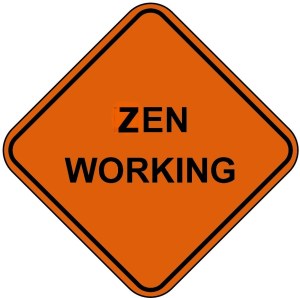
How I often see or hear life around me.

I can imagine a Buddhist sutra in which two monks observe the sign. They’re walking, of course, rather than driving.

The first says something pithy asking how Zen, being nothing, can do anything, much less work.

And the second replies that work’s nothing, too. But it’s not lazy.

Better, I suppose, than “ZZZ Working,” which many assume while passing the usual sign and seeing the crew standing by idly.

If you like this, please clap with one hand.