Things I want to do in the year ahead

Or at least tell you I want to do. Here goes.

  1. See my newest book through to publication, followed by learning that everybody’s reading and talking about it.
  2. Get the renovation of the house under way. And that includes no outrages regarding the supply chain.
  3. Worship with Friends face-to-face again, both here and at Yearly Meeting. You know, normal after Covid.
  4. And that normal includes singing in a great chorus and other settings.
  5. And New England contra- and Greek dancing.
  6. Visit neighboring New Brunswick and maybe even Quebec City or Nova Scotia without having to get tested and wait 72 hours.
  7. Spot minke, humpback, and fin whales from the Breakwater downtown.
  8. Eat a lot of fresh, locally harvested, scallops.
  9. See the elusive white deer on the island.
  10. Spend more time with the people I love.

As for your list?


When you wish upon a fish

Back before Covid, folks in Eastport would kiss the giant sardine sculpture that descends on New Year’s Eve from the Tides Institute’s headquarters as a gesture for good luck. This year, however, the act turned into placing a sticker on a surrogate fish, fun all the same.
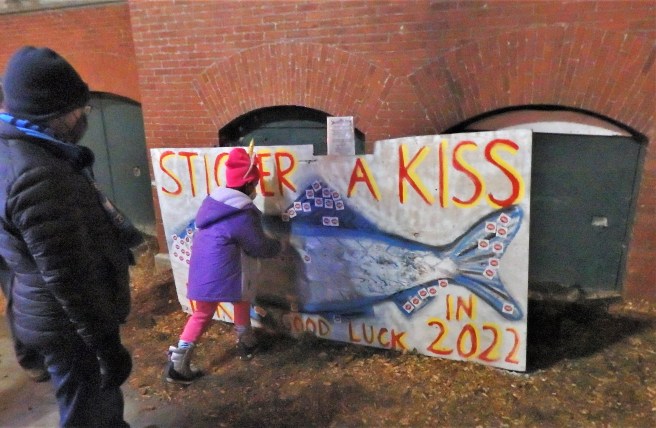
To learn about the giant sardine and its companion maple leaf, you’ll just have to stay tuned till next year here. By then, I’ll be anxious to hear how many of your wishes came true.

Here’s wishing you and yours all the best in 2022.

How to know when a work’s done

I’m talking about a poem or a novel here as a point of reference, but you can add some of your own perspectives, say as a painter or carpenter or gardener or cook.

  1. You have nothing more to say.
  2. You’re tired of the subject. So you close the cover, in effect.
  3. The previous revision was better. So you stop while you’re still ahead or don’t further overcook it.
  4. You’ve run out of time, like coming to the end of a vacation. Or something’s more pressing.
  5. You’re on deadline and it’s due. (Remember, I worked in newsrooms.)
  6. You perform it in public and there’s no squirming or coughing in the audience.
  7. It gets published. A literary quarterly is nice but a book’s even better.
  8. The critics are kind. Though that can make you question their standards.
  9. You arrive at your destination. You know how the story ends, for one thing.
  10. The kids grow up and move away. Or maybe you do.

Whew! What a year!

Let’s clink to putting Covid behind us, more or less. Even if drinking the toast requires us to take off our masks. And clink again for better things ahead.

Two olives, for me, marks a festive occasion.

On my end, the year included downsizing earlier than anticipated when I uprooted from ducky Dover to diehard Downeast as a vanguard for the rest of the family. It was their idea, for the record. Not that I’m complaining while some old, long-buried dreams finally come to fruition. And in all of this, I’m still in their good hands.

Along the way, I drafted a juicy, unorthodox history of early Dover in time for the 400th anniversary of its settling. Forget what you thought about Colonial New England, this take challenges a lot of the prevailing view. (You’ll be reading more about that here at the Barn in the months ahead.)

I definitely wasn’t planning on researching and writing another book, but here it is, finished.

Clink once more.

It adds up to a lot of change to digest.

So clink again. Remember, in moderation, it’s supposed to help the digestion. Cheers!

Just to get Saint Nicholas clear

He’s not a synonym for the fat man who comes down the chimney at Christmas, especially in Eastern Orthodox Christianity, where he’s especially revered. Let’s set the record straight.

  1. He was born in 270 CE to wealthy parents of Greek descent in Patara, now southeastern Turkey.
  2. After they died of an epidemic, he went to live with an uncle, also named Nicolas, who was bishop of Patara and guided him into the priesthood. After ordination, he gave away his large inheritance to those in need, establishing his reputation for generosity.
  3. During the first half of his life, it was illegal to be a Christian in the Roman Empire. Even so, he was ordained bishop of Myra, also in southeastern Turkey, before being imprisoned for refusing to worship idols.
  4. After his release from prison in 305, he zealously made the rounds of local pagan temples and shrines, smashing their idols and turning their temples to dust, as the account goes.
  5. In 325, Nicholas was sufficiently esteemed to be summoned by Emperor Constantine to a gathering to discuss issues Christians were facing. There, at the First Ecumenical Council, he became so outraged at hearing views voiced by Arius (“the first heretic”) that he either punched or slapped the offender. He was then stripped of his bishop’s robes and thrown into prison because it was illegal to strike someone in the presence of the emperor, to say nothing of his own violation of his bishop’s code of non-violence or self-restraint. While in shackles, Nicholas repented of his actions but not his views, and then received a nighttime visitation by Christ and the Theotokos (Virgin Mary). Constantine freed him the next morning. (Nicholas is somehow not mentioned in the writings of any of the people who were actually at the sessions. Ahem. It’s still a hot story.)
  6. In another report, a formerly wealthy man had three daughters of marriageable age but not the money for a dowry or prika for them to be married to good men. He feared they might become slaves. When Nicolas heard of the man’s plight, he came by the house secretly at night and tossed a sack of gold through the window, where it bounced into a sock or a shoe. This happened each time before a daughter’s wedding. The third time, the father saw who the secret donor was. Nicolas pleaded with him to keep the secret. In another, more salacious version, the father had planned to sell off his daughters, into either slavery or prostitution, and Nicholas arranged to save them all from a host of sins.
  7. He is attributed with many miracles, including saving drowning people at sea, rescuing three innocent soldiers from execution, and restoring at least one mortally injured sailor.
  8. He’s widely known as Nicholas the Wonderworker and one of the highly regarded Eastern Orthodox saints.
  9. He died peacefully in his sleep in 343 in his old age, that is, 73.
  10.  In 1087, Italian sailors from Bari seized at least part of the saint’s remains from the church where he was buried in Myra, over the objections of Greek Orthodox monks. Two years later, Pope Urban II personally placed those relics under the altar at the new Basilica di San Nicola in Bari. For the Eastern Orthodox and Turks alike, it remains theft.

~*~

So much for Santa Claus, eh?

Ten reasons I write

I’m talking about the poetry, fiction, even letters and blogging. My “personal” stuff, much more than anything I usually did at the office.

  1. To remember.
  2. To explore.
  3. To play with language.
  4. To connect.
  5. To dialog with myself.
  6. To read/share in public. To be part of a community.
  7. To become visible, earn recognition in the now fading dream of fame.
  8. As a form of prayer.
  9. To better understand and appreciate other writers. See what makes their work tick from the inside.
  10. To make money?