Fellow counselor giving cigarettes to his campers.
You never know what we'll churn up in cleaning a stall
Fellow counselor giving cigarettes to his campers.
Ever encounter shining moments like these?
As I found in a Facebook comment mentioning me: “A compelling and brilliant man.”
Oh, my.
Or, another time, a friend telling of a colleague who asked, “Who was that distinguished looking gentleman you were with?”
Really?
That said, everyone needs some positive reinforcement!
FLAY
FRAY
FADE
While Edward Hilton is hailed as the father of New Hampshire and was early on joined by his older brother William, both drifted away from my history Quaking Dover. Still, some points of interest remain.
Among them:
REPTILE
DYSFUNCTION
What would you look for in moving to a new community? It’s an interesting mental exercise, even if you’re staying in place.
What we’re seeing when we look at Eastport is the reality of how ephemeral much of what its attraction for us remains. Quite simply, people are a big part of what makes this place so special, and most of the population here skewers toward the gray end of the scale. Who’s in the wings to step up when they move on?
Our young director of Stage East, Mark Macey, for instance, is heading off to London on the theater fellowship. It puts a dent in the scene.
For me, having a Quaker Meeting is a central factor. Ours is small, older, and spread over a wide geographic area. It’s precious while it lasts.
And, as you’ve seen on this blog, natural wonder in the outdoors is important.
Let me add to that music, usually especially in a classical vein. Eastport is especially blessed on that front.
For example, before I had even met John Newell, his influence became a swing factor in my moving to Eastport. Other family members were already on board for relocating, but I was less ready to uproot, no matter the natural wonder of the place. But then, during a visit, I saw a poster for an upcoming Quoddy Voices concert and sensed this was no ordinary community chorus. Its repertoire was much like the one where I was singing in Boston – except that we didn’t yet have a piece in Chinese. Mandarin? (Which our conductor there did speak.) I also appreciate the fact the Down East ensemble is not auditioned and was told, at a small store downtown, that they’d likely really welcome another male voice. (Whew! I can’t imagine auditioning, only the fright.)
Flash ahead to actually living up here.
During the Covid lockdown, I joined the ensemble as it continued to rehearse via Zoom. At least it kept us in shape, and I did see how much fun everyone had together. But how would we sound when the time came?
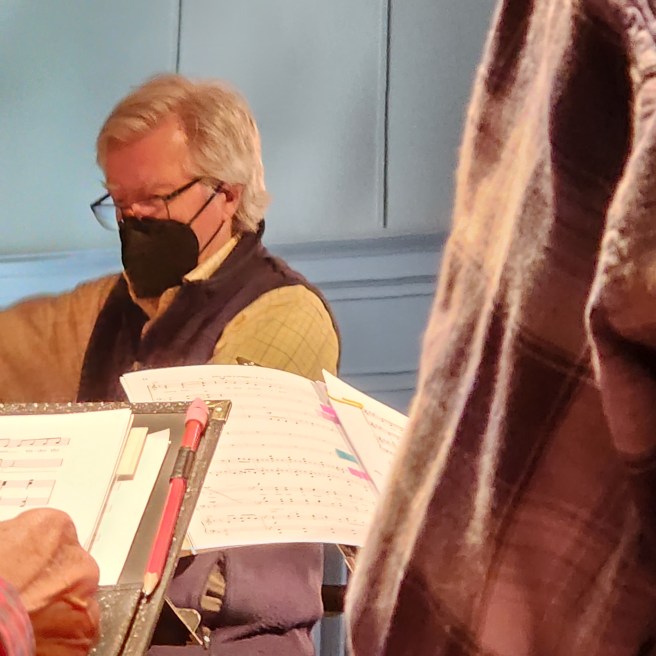
Quite simply, at our first in-person rehearsal post-Covid, I knew from the first two chords out of our mouths in warmup that this was home. After my first concert with the group, I especially appreciated an aside from another bass-section member, “We’re so happy to have you,” or something to that effect. It’s a much smaller chorus than my previous one, and thus more demanding.
Quoddy Voices is, of course, John’s dream and labor of love. Like my previous directors, he’s meticulous yet patient, a published composer, an excellent keyboardist, a clean conductor, and someone with fine senses of humor and delight who also genuinely cares about his singers and colleagues. (George Emlen and Megan Henderson deserve posts of their own. Note to self.)
How perfect!
But, after ten years at the helm of the chorus, he and his wife are relocating to be closer to family for much of the year.
One thing about singing together is the personal warmth people often develop. The right director can be especially admired, for many good reasons.
John will be missed, of course, and warmly remembered. Many thanks to him for all he’s given to us and the wider community.
If you want to see more of our feelings, visit the Eastport Arts Center’s Facebook site.
We do hope he’ll be back often, perhaps even singing under our next director, someone we know is also a Character in his own right.
Meanwhile, from here to September we have a gap in our Monday night schedules.
Florida as a place of limbo
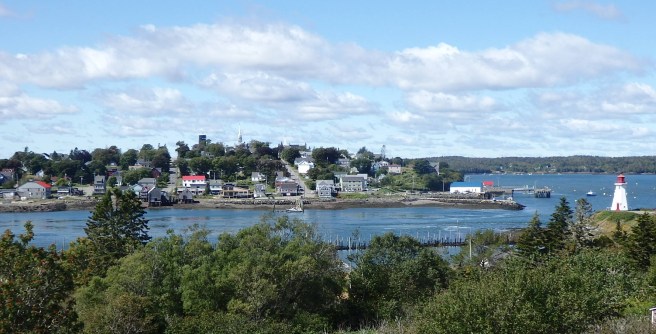
I’ve been posting a lot about Eastport and nearby scenes but said little to date about the neighboring communities here in Way Downeast Maine.
So today I’ll turn the spotlight to a town to our south, one we easily see from the Breakwater and other points in Eastport. It also sits across the water to our west. Despite the proximity, driving between the two takes nearly an hour.
~*~
Here are a few additional facts.
olive-skinned and sly smile
dark eyes
how golden, the rites of passage
I’d rather skip
back to
at the intersection of North and South streets
welcome to Calais, Maine
 Jnana's Red Barn