I’m sold on Maine’s crab

Ours are smaller than the glorious Dungeness of the Pacific Northwest or Chesapeake Bay’s popular Blue delicacy, named for the color of their tips.

But that’s not to say Maine doesn’t have crabmeat that’s as sweet. Ours comes from two species.

Here’s some perspective.

  1. Jonah crabs are the slightly larger and more celebrated of the two. They’re reddish with large, black-tipped claws, and found primarily in deep waters offshore.
  2. The meat comes from the claws. When Jonahs show up in a lobster trap, a fisherman typically removes one claw and throws the rest of the crab back. The crab, we’re told, can survive on one claw while the other grows back.
  3. Jonahs are regulated by an interstate commission that places a 4.75-inch minimum size on keepers and prohibits the retention of egg-bearing females.
  4. Atlantic rock crab, or “peekytoes,” live in bays and tidal rivers closer to shore. These measure just five inches across and are the most commercially caught crab in the state.
  5. Peekytoes cannot be shipped live, presumably because they’re too delicate. Instead, they’re cooked and hand-picked before shipment.
  6. Both commercial and recreational crabbers require a license from the state and must observe strict limits on their take. At least, those specifically going after them. See the lobstermen, above, for a clue to exemptions.
  7. Locals in the know say that picking the meat from a crab is a nearly lost art. They admit they can’t avoid getting hard bits of shell in the tender flesh, no matter how carefully they try. Instead, as they advise, go to Betty’s in Pembroke or Earle’s down in Machias for your supply.
  8. Favorite dishes around here are crab rolls, crab salad, and crabcakes. Our house also celebrates a heavenly crab imperial. Others make them into a dip or spread. And, in some circles, Jonah crab claws make an appetizer served like a shrimp cocktail.
  9. They can be harvested year-‘round, though fall, when crabs are most packed with meat, is the peak season.
  10. Smaller, invasive, nasty green crabs have been proliferating as Maine waters warm, decimating other marine species and their breeding grounds. Some enterprising chefs, though, see tasty opportunity in some dishes to counter that.

Me? I haven’t yet had to complain of having too much. Now, please pass the Old Bay.

Still the talk of the town

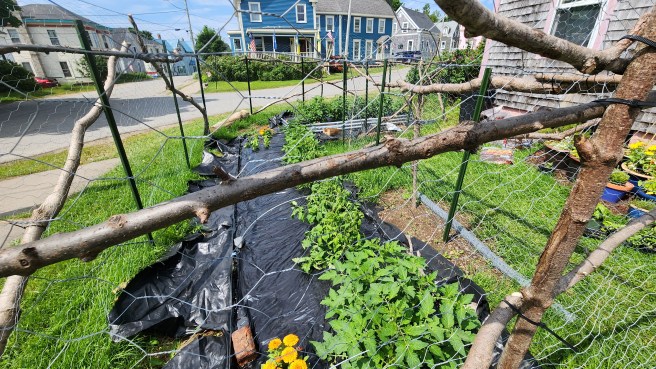
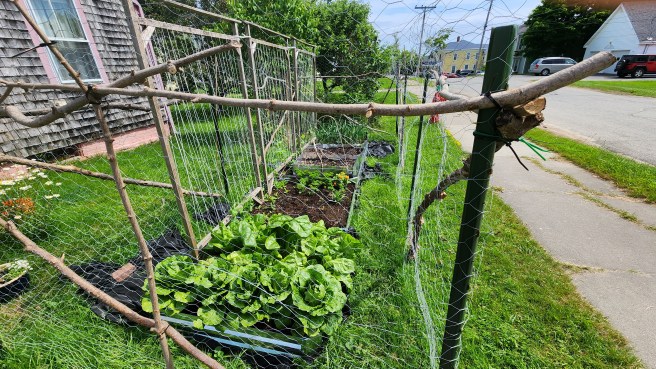
So far, so good. The deer haven’t yet pushed the garden fence over or managed to get in despite the chicken wire.

That, in itself, gets a lot of the locals coming by to take a look at my fortifications and then talk, as well as a number of summer folk. Eastport is a pedestrian-friendly village. Others are in vehicles that slow down and roll down their windows.

Beyond that, many are also avid gardeners who admire what’s growing and then advise us while introducing themselves. Some have even left packets of seeds on our front-door steps.

Strangers have also come up to me downtown to say how much they like what we’re doing. As I acknowledge, my wife deserves most of the credit.

Either way, it’s one more positive small-town aspect of living here. You’re simply engaged with life all around you.

Nor have I mentioned how heavenly the buttery fresh lettuce tastes or how much a sugar-snap pea vine can grow in a day.

The fact that all this is in our front yard does, no doubt, make the garden more public, but it is where our best sunlight falls. Folks around here are practical and take that all in stride.

Speaking of practical? It’s that much less lawn I need to mow.

This is the big day for pyrotechnic displays

Unabashedly, I am a snob when it comes to putting big fireworks together in an aesthetic whole, rather than something that resembles an action movie big car smashup.

A smart design team can use the entire sky as a canvas of evolving colors, combined with the timing of a sharp comedian.

That said, here’s some perspective.

  1. A show like Boston’s on the Charles River Esplanade fires off 5,000 pounds of explosives in its half-hour glory. That performance requires a computerized launch system for five barges floating on the water.
  2. Macy’s, the nation’s biggest, goes for an average 1,600 shells a minute – more than three times as many as a typical town display uses for the entire night. That show has more than 40,000 shells fired from six barges in the Hudson River.
  3. China produces 85 percent of the world’s fireworks.
  4. Many of the styles are named for flowers such as peony, chrysanthemum, or dahlia. Others, after trees, as in willow and palm tree.
  5. Prices vary wildly, especially when you’re looking for some serious color intensity and blending rather than honky-tonk garish.
  6. Shells are sold by tube diameter, commonly six-, eight-, and ten-inches, with each additional inch typically adding another 100 feet of elevation to the shot. Are some of those bursts really a thousand feet overhead?
  7. An aerial shell contains six parts. Or more, depending on what bells and whistles are added on.
  8. Larger shells cost average around $336 apiece and may require an 840-foot display radius.
  9. Even a small-town show will run between $7,500 to $15,000 to produce, just for the fireworks. Add to that set-up and clean-up labor, sanitation, musicians, and public safety expenses. The average municipal show costs $25,000. In contrast, a wedding show is tabbed for $1,500 to $3,000. But don’t hold me to those figures. Other estimates I’ve seen simply soar.
  10. Injuries send about 10,000 Americans to the emergency room every year, two-thirds of them males, and many of the injuries are to children. That’s in addition to 7.9 fatalities. As another safety consideration, more fires are reported on July 4 than any other day of the year – some 19,000.

Have you ever been to Acadia National Park?

Maine likes to tout itself as Vacationland, and Acadia National Park is definitely a star attraction. I know people who gush that it’s their favorite place ever. Not that I’d go that far.

Still, let’s consider:

  1. With four million visitors a year, it’s among the 10 most popular national parks. Most of them crowd in during the prime summer months.
  2. The official version has the park being named after Arcadia, a region of Greece that it supposedly resembles. New France, however, referred to eastern Maine as Acadia before being expelled by the English in 1763. In their migration, some of those Acadians became known as Cajuns down in Louisiana. I’m siding with the French here, despite my fondness for Greek culture.
  3. It was the first national park established east of the Mississippi and encompasses 47,000 acres, mostly on Mount Desert Island. Not that there’s any desert, it’s just wild. Additional, less well-known tracts are on Schoodic Peninsula (my favorite) and Isle au Haut as well as smaller islands. And a fourth of the land total is privately owned but under easements and similar arrangements.
  4. With 108 square miles, Mount Desert Island is the biggest island in Maine and the sixth largest in the contiguous United States.
  5. The park has 158 miles of maintained hiking trails spanning mountainous terrain, panoramic views, rocky Atlantic shoreline, mixed forests, and lakes. Former carriage roads are also popular with bicyclists.
  6. There’s a private trolley service for those who’d prefer to view the scenery more than the traffic jam.
  7. Backcountry camping and overnight parking are not permitted, but there are campgrounds and lean-tos for those who plan well ahead.
  8. French explorer Samuel de Champlain gets the creds as the first European. He encountered the place in September 1604 when his boat ran aground on a rock. He applied the name Isles des Monts Deserts, or island of barren mountains, to the bigger scene. Well, some are pure rockface.
  9. In the 1880s, the island became a summer retreat for Rockefellers, Morgans, Fords, Vanderbilts, Carnegies, and Astors who built elaborate vacation dwellings they called “cottages.” Many of those were destroyed by a vast wildfire in October 1947.
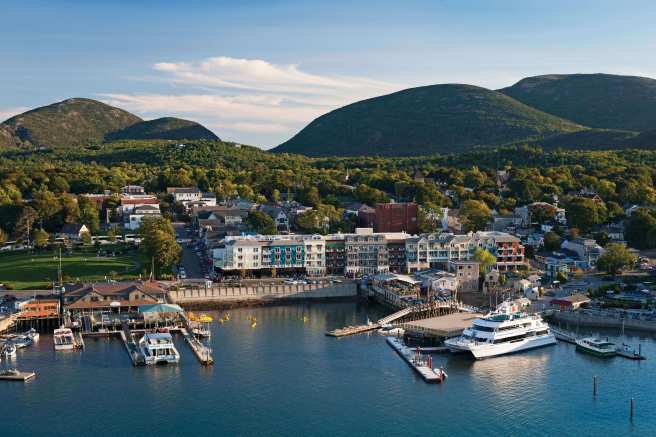
  10. Its principal gateway is Bar Harbor, a city of 5,000 full-time residents that swells with summer people and their second homes, tourists, and often a big cruise ship or two that add several thousand more people to the crowd. Be warned that parking is at a premium in high summer.

For more adventurous souls, let me suggest exploring two hours to the east, to the Bold Coast, for a less spoiled alternative.