Recalling some favorite magazines

As an editor and a writer, I’ve long been inspired by a stream of classy, glossy magazines with outstanding illustrations and design supporting sharply edited, masterful writing.

In this category, I’m skipping over purely literary periodicals, even the ones with deep pockets, as well as newsweeklies and many other kinds of magazines.

The ones I’ve admired, as I’m seeing now, all reflected a single editor’s voice and vision, not that I remember all of their names now. Maybe that’s for another Tendril.

For now, here’s what I mean.

  1. The New Yorker. The writing and editing, of course. I was captivated way back in high school – the staff of the Hilltopper even gave me a year’s subscription when we graduated – and still a delight in my retirement, maybe even more, in its current direction. Still, there’s no way to keep up. I should mention, in passing, its assiduous fact checkers, a vexation for many famed writers.
  2. Fortune, back when it was big and classy. Big? The pages were large, like 10 or 11 inches by 12 or 13 inches deep — often on high quality paper, and each issue was fat and thoughtful. Artists were commissioned to create portfolios, with authors to match. It definitely reflected wealth and luxury, unlike other business publications, which often felt pinched. And then the U.S. Postal Service began charging extra for oversize mailings, leading many magazines to shrink their formats. Titles like Life, Look, and Vogue lost their impact, and photographers, especially, took a hit.
  3. New York. Originating as the Sunday magazine of the New York Herald Tribune, this one took off on its own in 1968 after the newspaper’s demise. Brash and definitely connected to everyday life on Manhattan streets, it was an avatar of New Journalism and Push Pin graphics. Still has that cutting edge.
  4. Esquire. By the late ‘60s this former cheesecake vehicle had evolved into a champion of New Journalism and high-impact graphics. Some of the covers remain classic. More recently, Vanity Fair continued in that vein until its solid content evaporated in a demographic desert.
  5. Evergreen Review. Another of the late ‘60s blossoms, this one had a West Coast perspective, openly leftist leanings, and literary ambitions, including Beat poets. Its cartoon serial “Phoebe Zeitgeist” became an underground cult item of a scandalous sort.
  6. Playboy. As a matter of candor, consider its now-classic interviews, plus the fiction, and, yes, the cartoons, a nearly extinct venue these days. The photography was often masterful, no matter the content. The editor in this case did go on to become a pathetic caricature of himself, reflecting the vapid “philosophy” he was espousing.
  7. GEO. This hip German-based alternative to the National Geographic debuted in 1976, distinctive for its green-bordered covers, trend-catching photography, and progressive topics and awareness. The English editions blossomed and then trickled from sight. Much of it, like the international hippie roots it reflected, looks dated today.
  8. New England Monthly. Published from 1984 to 1990, it was an epitome of ambitious, sophisticated, city- and region-based magazines that flourished during the decade. It ran into an identity problem when big advertisers wanted a Greater Boston focus, while important regional issues spilled over into western Massachusetts and Cape Cod as well as Connecticut, Rhode Island, Vermont, New Hampshire, and Maine, where subscribers existed. The final edition featured a devasting account of the high-level executive arrogance regarding the Seabrook nuclear power plant in New Hampshire led to its corporate bankruptcy, rather than the commonly blamed regulations and enraged environmental protests. After revenue shortfalls shuttered the magazine, some of its writers went on to stardom.
  9. Elle. This upstart to established fashion bastions Vogue and Harper’s Bazaar was actually founded in 1945 in Paris as a newspaper supplement but came to prominence with a monthly American edition in 1969. Propelled by Gilles Bensimon’s inspired, fresh, even exciting photography and sharp page layouts that delivered in tight spaces, there was no mistaking this entry from its rivals. Another upstart, Sassy, a feminist teen platform aimed at well-healed Seventeen, lacked gloss and polish but sizzled on editor Jane Pratt’s brilliant assignments from 1988 to 1996, when it finally succumbed to a longstanding boycott by an evangelical women’s organization. As a former lifestyles editor, I found Pratt to be most refreshing.
  10. Harper’s. These days, it rules the roost for me. Its monthly index of seeming random statistics and trends, toward the beginning of each issue, even provided inspiration for these weekly Tendrils.

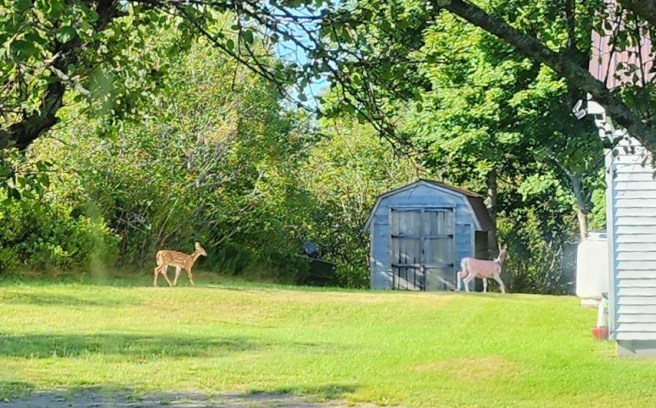
Our white deer and a fawn

Eastport, as you may have gleaned from this blog, can be overrun with deer. They do make gardening a challenge.

The encounters become more lively when mention of an albino deer arises. We’re discovering that Moose Island, where we live, has had a series of white deer, including fawns with the gene.

For the record, they’re probably not albino but leucistic, and as I saw in this case, mostly pink. Defining piebald has its own set of technicalities.

This encounter was on a Sunday morning while I was heading out of town on my way to Quaker Meeting for worship. I passed what I thought was lawn decoration and then realized it wasn’t. When I whipped back, this was the best I could capture before lowering the car’s window, and by then they had slipped behind the house. Wily critters they can be.

The deer in question, by the way, is on the right in the photo.

Memories of places in the town I grew up in

I’ve mentioned a few others, such as the art museum, in other posts here. Now, to add a few more, in no particular order. Again, I’m looking at Greater Dayton rather than strictly inside the city limits.

  1. NCR: The National Cash Register Company’s world headquarters looked more like an open college campus with linden trees and pristine lawns than an industrial jumble behind barbed wire and hurricane fencing. It even had a fine auditorium and pipe organ, used for its gatherings of salesmen but also the concerts of the Civic Music Association – I heard a number of famed musicians there. And I was awarded my Eagle Scout badge and later my high school diploma on its stage. And, oh yes, I can’t overlook Old River, the employee park with the lagoon and boating, a fine miniature golf course, and a huge outdoor swimming pool – when one of my buddies whose father worked at NCR and thus had a pass to the park asked if I wanted to go, there was only one possible answer. Please!
  2. The corner display windows at Rikes department store: The pioneering retailer was the place to shop in town, and anytime we took the bus, say to the library or a movie, we’d wind up checking the latest display – especially at Christmas. During my senior year, some of my art work was used in the background of the featured fashion.
  3. The YMCA: I learned to swim at the indoor pool and sometimes applied my allowance to a grilled cheese sandwich later, over on the men’s side. And then, little kid that I was, I enjoyed the freedom of taking the bus home on my own.
  4. Frigidaire employee park: Thanks to my best friend’s father’s employee pass, we spent many summer nights enjoying free Starlight movies. My dad worked for another General Motors division in town, one that had no such benefits.
  5. Troop trails: My Boy Scout troop had a long hike one Sunday a month, in addition to a primitive camping weekend. Our routes often followed a river or crossed farmlands or even trekked along railroad tracks. I remember especially a few that traced the abandoned Miami-Erie Canal with its mule bank and its eerie remains of limestone locks left in vines and trees.
  6. Suicide Hill: A decent snowfall (quite modest by what I’ve experienced since) meant sledding at Hills and Dales Park. How insignificant the slope looks now, but there were some serious injuries. I had a near call.
  7. Memorial Hall: It really wasn’t designed for concerts, but it’s where the Philharmonic performed, and since my dad had access to tickets, I heard many top soloists. Hard to believe now, actually.
  8. Our big ugly high school: built in the 1960s and long since torn down. In my memory, I recall it more than the older but equally ugly elementary school.
  9. Yellow Springs: Once I got my driver’s license, the bohemian town in Greene County, home of Antioch College, became a welcome retreat. Its funky stores, before funky was a word in my consciousness, were mind-expanding. Nowhere else could we find Earl Grey or gunpowder tea or sticks of incense or perfumed soaps. Then there was the professional summer theater series at the amphitheater, itself a revelation. By that time, I was in love, at last. And that leads to mention of a covered bridge by moonlight: Yes, making out afterward in the moonlight at a covered bridge that’s no longer existent down an unpaved road.
  10. The Art Theater: Where I first saw foreign films, black-and-white alternatives to Hollywood’s commercial concoctions. And then there was the Lemon Tree coffee house next door with its folk music and blues.

My, all that was a world ago in my life.


Think of it as an ‘advance reading copy,’ after the fact

Many of the books in my personal library arrived in the newsroom as advance reading copies, intended for reviews or perhaps mention in a column, except that we rarely printed one of those. Instead, the freebies went out on a shelf for first-come to be first-served.

For the book publishers and authors, it was a huge waste of money.

In addition to the two books I’m offering for free at Smashword’s big July-long sale, you can pick up a copy of my new Hamlet: A Village of Gargoyles poetry collection at just half-price.

It really is worth a visit.