Where were the Baptists?

I’ve mentioned my bewilderment at the failure by the Church of England to serve its communicants in New England during most of the 1600s.

As well as the fact that Dover’s First Parish could have been the first Baptist church in America, beating Roger Williams in Providence, Rhode Island, by a year.

What perplexes me is that I find nothing in New Hampshire before almost 1800, although there was a church in Boston, a place where Friends struggled.

The fact is that the Baptist tradition originated as a liberal movement. We’ve seen threads of that continuing in Jimmy Carter and Bill Moyers.

In my research, I kept coming across fleeting references to Baptists during the years before the American Revolution, but curiously not much outside of Rhode Island to indicate ongoing activity in New England. They were not singled out like the Quakers as great dangers to social or godly order, even though they were still outlawed and ridiculed. Did they meet secretly, perhaps even at times other than Sunday morning? None were hanged in Boston, for one thing. In New Hampshire, they had only three congregations by 1770 – Newton, founded 1755; Madbury, adjacent to Dover; and Weare, which had a strong Quaker presence. Still, as I sense, theirs is a crucial history yet to be written.

Considering all the furor around minister Hanserd Knollys’ brief tenure in Dover, just before he began preaching definitively Baptist doctrines, as well as the support he had, I keep wondering about his legacy in the Piscataqua settlement. Somehow, he set off an unorthodox flame in the community, at least by Puritan standards.

Curiously, as I considered the matriarchal role in the continuing nurture of a faith tradition, the path led back to Thomas Roberts and his wife, Rebecca Hilton. This time I chanced across not their Quaker impact but rather a Baptist one.
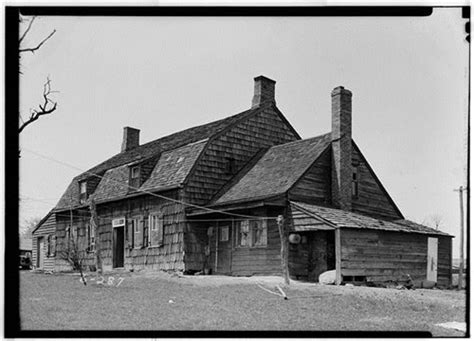
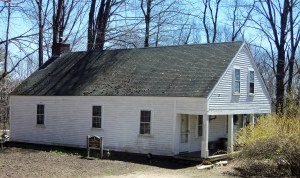
Hugh Dunn Sr. built this house in New Jersey after moving from the Lamprey River and Dover in New Hampshire. He was one of the original settlers of Piscataway and a founder of the Baptist church there.

Their daughter Esther – also recorded as Hester and Easter – born around 1625 and one of the first English children in New Hampshire, married John Martin (also Martyn) around 1645 in Dover. He descends from Mayflower arrivals in Plymouth Bay. After a round of public service, they relocate to Oyster Bay on Long Island, perhaps among those who flee to avoid persecution, but in 1666 move on to New Jersey shortly after the British seized it from the Netherlands. Joined by Drake, Dunn, Gilman, Hull, and Langstaff families from New Hampshire, as well as other Baptist New Englanders, the name Piscataway soon sticks to their New Jersey community, reflecting their Piscataqua roots. Theirs was perhaps the seventh oldest Baptist congregation in America. The colony itself came under Quaker proprietorship in 1675, assuring religious liberty. Think about all that the next time you’re driving along the New Jersey Turnpike and see the signs for that exit.

That’s the last I find of Baptists in New Hampshire until a Scammon from Stratham on Great Bay – a surname that appears early among Friends – weds a Rachel Thurber of Rehoboth in southern Massachusetts in 1720. Resettling in Stratham, she struggles for 40 years, making one conversion, before moving on to Boston and being baptized into its second Baptist church.

Glory, hallelujah, and all that.

~*~

Welcome to Dover’s upcoming 400th anniversary.


Come to the book release party!

If you’re anywhere near Dover, New Hampshire, on Nov. 5, feel free to stop by the Quaker meetinghouse for the official Quaking Dover book release party.

The meet-and-greet event takes place at 7 pm at 141 Central Avenue and is free and open to the public. As a Covid precaution, we will be masking.

Copies of the book will also be available for purchase and author signing.

In the meantime, it’s release date is coming up on Saturday. Check with your local bookseller to order a copy.


Seaman’s Church

The Congregational house of worship was constructed in 1828 along austere classical lines and proportions.
Its spire served as a landmark for mariners on the water. Somehow, it was soon known as the Seaman’s Church.
The building likely came after New England’s traditional box seating had fallen from use.


Go west, young Friend … and they did

Dover, New Hampshire, sits on the tidal waters of the Atlantic Ocean but that didn’t inhibit its influence on Midwest and then West Coast Quaker growth.

Consider the leadership of Dover Friends Meeting in the years leading up to the American Civil War. Benjamin H. Jones served as clerk for six years, 1841 to 1847, and also traveled in ministry. Olney Thompson then served a year as clerk, followed by John Meader, 1848 to 1851.

In September 1852, however, “Benjamin H. Jones, having removed with his family to reside within the limits of Salem Monthly Meeting (in Iowa), inquires after a Removal Certificate thereto for himself, his wife Mahalth E. and their children, Robt H., Lucy T., and George N. Jones.” This would have been a transfer of membership taking them west of the Mississippi River.

New England’s rocky soils – usually either clay or sandy, rarely loam – had long made for difficult farming, and railroads were making Midwestern crops and livestock competitive in eastern markets.

In 1855, James Canney, an overseer and assistant clerk at Dover, moved with his family to Minneapolis and later to San Jose, California.

The Beans, who settled in Gilmanton in 1772 from Brentwood, became a remarkable case. Among their descendants was John Bean, who wed Elizabeth Hill. The four of their five children who lived to adulthood – James, Joel, and twins Mary and Elizabeth – all headed west before the Civil War. Their education included terms at the Friends Boarding School in Providence, Rhode Island – today’s Moses Brown School.

John sold the farm in Gilmanton and moved to Rochester to become a businessman. Self-inflicted financial difficulties, however, resulted in bankruptcy despite the attempts of Dover Friends John Roberts, Thomas Roberts, Elijah Jenkins, Ken Graham, Daniel Meader, and John Estes to guide him. The experience embittered and devastated him.

That may have set all four of the children looking to horizons beyond New Hampshire. They would each move to Iowa and eventually on to California and Oregon, becoming recorded ministers along the way, as did three of their four spouses, too. Quite simply, they were crucial in the establishment of Friends Meetings west of the Mississippi River.

Before going, daughter Mary wed Charles H. Tebbetts under the care of Dover Meeting on January 19, 1854. Their clearness committee was Sarah K. Prentice and Cyrus Bangs. After a stint in Iowa, the couple moved on to Pasadena. Their son, Charles E. Tebbetts, would become a prominent Quaker pastor and president of Whittier College.

James Bean went with a wagon train to Iowa and Minnesota in 1855, returned to Rochester to wed Roanna Fox on August 16, 1858, and together they moved to the prairie, where he tried his hand at a grocery and a bookstore before becoming the U.S. government paymaster and clerk for the Chippewa Indian agent. In time, they landed in San Jose.

At West Branch, Iowa, Elizabeth Bean wed Benjamin Miles, a widower with three children from Miami County, Ohio. They would move to Newberg, Oregon, where his children would establish George Fox College.

Joel Bean married Hannah Elliott Shipley in Philadelphia, but they were introduced in Iowa when she was visiting. With her prominent Quaker connections, the wedding took place in the Orange Street meetinghouse on June 29, 1859. From there, they went straight to Iowa. In the spring of 1861, they set out as Quaker missionaries to Hawaii. On their return to Iowa, he rose to the position of vice president at a bank and served as clerk of the Yearly Meeting. He and Hannah also traveled in ministry to England, 1872-1873.

So much for four humble siblings from Dover Friends Meeting. They would, however, become embroiled with controversies involving Holiness movement evangelism besetting many of the Midwestern Friends, including a shift to full-time pastors, revivals, and hymn-singing. Joel and Hannah moved on to San Jose, California, in 1882. (Their granddaughter Anna Cox Brinton, widely known among liberal 20th -century Friends, continued to use Plain speech – mostly with her husband, Howard.) They were joined by James and Roanna.

Dover’s former clerk, Benjamin H. Jones, had returned east, to Lynn, Massachusetts, but was about to try homesteading in Montana with his wife. His son, George, was already in San Jose.

In the end, rather than join California Yearly Meeting, the San Jose Meeting remained independent. Officially, after being disowned by Iowa Friends after he had left, Joel and Hannah applied for membership in Dover Meeting, despite the distance, and were welcomed.

As far as pioneering went, they were way ahead of the high-tech revolution that would take place in their final locale.

~*~

Add to that Tom Hamm’s book, The Transformation of American Quakerism: Orthodox Friends, 1800-1907, which details the impact of railroads and commercial farming on Friends’ life during the nineteenth century, especially across the fertile Midwest.

During this time, the wider Quaker world underwent a number of modifications. Gone in some circles was the restrictive discipline, along with the requirements of Plain speech and dress and the marriage limitations, but sometimes it came with theological strife and new legalism.

By the end of the century, pastors had been introduced through much of the American Quaker world, including Gonic and Meaderboro. Friends had influential roles in interfaith organizations such as the YMCA, too.

~*~

In 1884, Asa C. and Emeline Howard Tuttle, along with their son, returned to Dover “after spending some years among the Modoc Indians in Indian Territory,” as James Bean observed. “They were both ministers of ability. They remained in Dover, beloved and respected by all until Asa’s death in 1898, when Emeline removed to Rhode Island. and later to Louisiana. After the removal of Emeline Tuttle and Lydia E. Jenkins, the meeting continued without a regular minister for some years.”

Emeline is credited with discontinuing the separate men’s and women’s business meetings in 1886 and merging them into one.

~*~

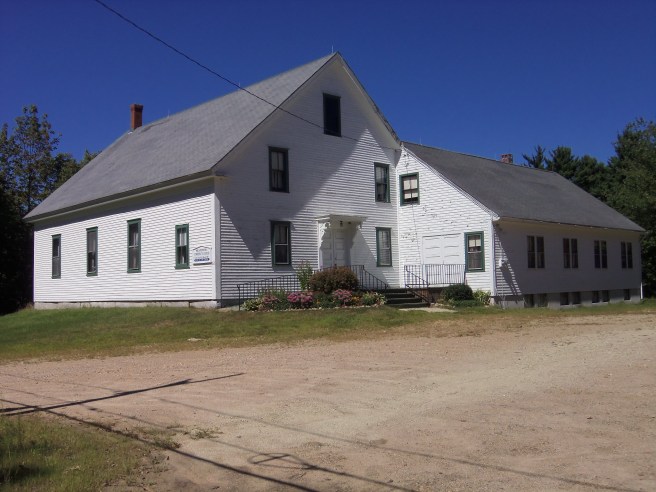
In 1913, the faithful remnant proved to be too small and too old to continue on its own and regular worship was discontinued in the meetinghouse. Officially, Dover Monthly Meeting went on at the Gonic meetinghouse, which had both a pastor and financial support from the mill there.

~*~

Check out my new book, Quaking Dover, available in an iBook edition at the Apple Store.

Welcome to Dover’s upcoming 400th anniversary.

Dover Friends’ long reach is seen in the Meader family

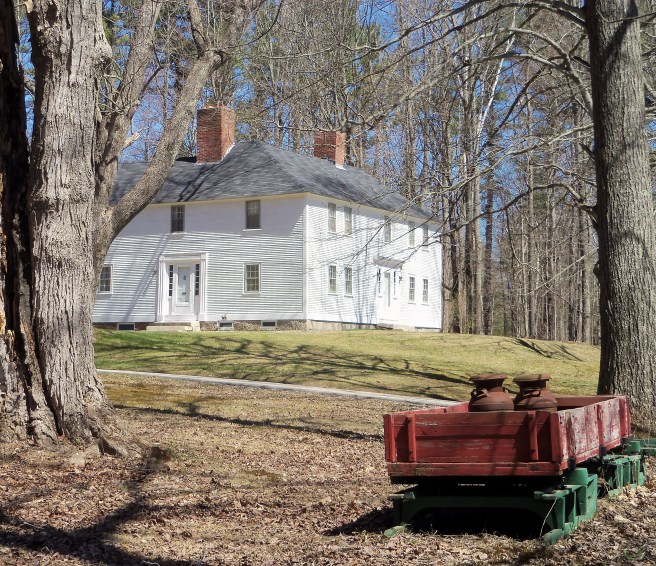
After coming to New England and working as a farmhand at Oyster River, then part of Dover, John Meader (1625-1715) wed Abigail Tuttle of Ispwich, Massachusetts, in 1653. Granted 100 acres in 1656, he erected a garrison house by 1660.

He took the oath as constable of Dover, and on July 4, 1663 was ordered to tie Edward Wharton, “a vagabond Quaker” to “ye Carte tayle” and whip him out of town, administering not more than ten lashes. That didn’t stop two at least two of his sons from joining Friends.

In 1684, he was one of at least 34 landholders who refused to pay land rents to the Mason heirs and were disposed of their land titles. The next year, they petitioned King James II for relief from the arbitrary decisions of Governor Cranfield, and their representative, Nathaniel Weare, managed to get their lands and other rights restored.

In the 1694 Oyster River massacre, Meader’s garrison and the nearby house of his son, Joseph (1753-1820), were burned, but the family escaped.

Joseph Meader and his first wife, Abigail Field (1759-1784), had son Valentine Meader, born on August 6, 1777. He was a carpenter and a Quaker minister who traveled widely, dying of an illness during a religious visit in 1837.

Joseph later married Elizabeth Gould (1756-1814) and had son Joseph Meader on September 22, 1788. The son married Mehitable Varney in 1810 and was a farmer who became an acknowledged Quaker minister at Sandwich Meeting in New Hampshire’s White Mountains. In the Wilburite Separation, his family aligned with the conservative faction, in 1845. He died on January 28, 1864.

Quaker Meaders spread from Oyster River, or Durham, north into northwest Rochester, forming its Meaderboro village, and further north into Sandwich. Others were at Lee, with its Meeting.

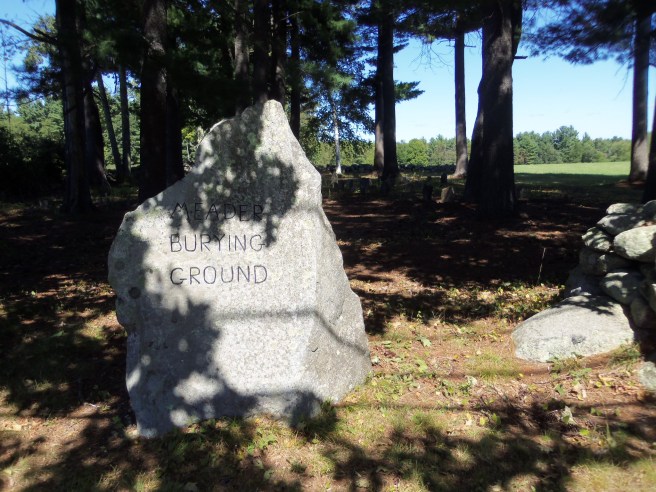
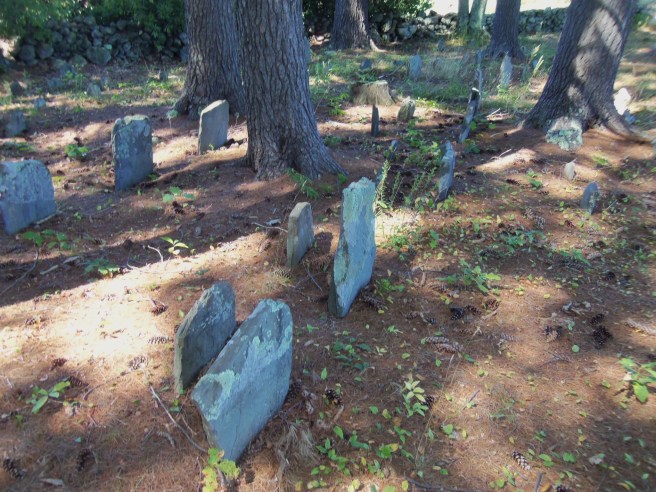
The family burial ground in Meaderboro embodies Quaker humility. The fileldstones mark the plots but are either left plain or engraved with nothing more than initials and dates. Others went unmarked altogether.

Meaderboro descendant Elwyn M. Meader (1910- 1996) was a University of New Hampshire horticulture professor famed for plant varieties he created for northern climates. As the Fedco Seeds website noted, “If you’ve ever grown vegetables or raised fruit or flowers, Professor Elwyn M. Meader’s work has probably touched your life. … At least half his introductions came after he ‘retired’ from a distinguished 18-year career as plant breeder at the University of New Hampshire. He could have gotten rich from royalties on all his releases, but instead he gave them away ‘as payment for his space on the planet. … I was working for the taxpayers,’ he would say in his broad Yankee accent, ‘and the results of my work belonged to them.’

His accent, I will confirm, was classic New England. At least one linguist recorded it for posterity.

Fedco’s profile continues, “A deeply religious Quaker, Meader was always modest about his creations, but not shy about his opinions. He disdained plant patenting. ‘Plants shouldn’t be patented if there has been one dollar of federal or state money used to fund development.’ At one point in the 1950s he refused to serve on university committees (except one to abolish all committees) maintaining he had been hired to do breeding work only. He offered inspiring advice to the wave of homesteaders who arrived in the ‘60s, ‘Try all things. Hold on to that which is good,’ but added curtly, ‘If you can’t make it without bringing along your TV, you’d better forget the whole thing.’

Dover Friend Silas Weeks drew heavily on him in researching what would become the book New England Quaker Meetinghouses, Past and Present.

And after Elwin’s death, when he had declined a memorial service feeling unworthy of one, I clerked a Quarterly Meeting session that discerned otherwise. The ensuing service was a glorious – and memorable – occasion.

Meaderboro Friends Meeting disaffiliated from Quakers in 1963 and continues as a community church.

~*~

Check out my new book, Quaking Dover, available in a Nook edition at Barnes & Noble.

Welcome to Dover’s upcoming 400th anniversary.


The Cartlands were part of the Underground Railroad

Closely related to poet John Greenleaf Whittier was the Cartland family in Lee. In fact, Greenleaf was especially close to cousin Moses Cartland, though their expectation of dying as bachelors was ultimately crushed when Moses wed a much younger first cousin, contrary to Quaker discipline.

My trail starts with Joseph Cartland, born in Dover in 1721, who moved the family to Lee and established Walnut Grove farm, which would eventually encompass two thousand acres. With first wife Lydia Allen, who died in 1758, and second wife Anna Hanson, he had 11 children, most of them active Quakers.

The Cartland home in Lee is known as a stop on the Underground Railroad of escaping slaves.
The meetinghouse doubled as a Friends school.

Their spacious home became a stop on the Underground Railroad, and the Quaker meetinghouse, which doubled as a Friends school, stood across the road.

His son Jonathan Cartland, married to Elizabeth Austin, and their children included the noted abolitionist and educator Moses A. Cartland, a confidant of second-cousin John Greenleaf Whittier, who was a frequent guest. Moses also served in New Hampshire’s House of Representatives and was a founder of the Republican Party. His brother Joseph Cartland, husband of Gertrude Whittier, headed Haverford College for four years before they became principals of the Friends School in Providence, Rhode Island. They retired to Newburyport, Massachusetts, which had a Meeting that was part of Hampton/Amesbury Monthly Meeting.

Cartland influence in Dover continued. In the late 1800s and early 1900s, William and Howard Cartland owned Cartland Grocery on Locust Street.

From there, my notes trail off.

~*~

Check out my new book, Quaking Dover, available in a Nook edition at Barnes & Noble.

Welcome to Dover’s upcoming 400th anniversary.
 

Whittier in Dover didn’t reference the poet

Dover Friends have long been proud of their connection to the rock-star protest poet John Greenleaf Whittier of neighboring Amesbury Friends Meeting in Massachusetts.

His mother was from the Hussey family in today’s neighboring Rollinsford, New Hampshire, and she married in our meetinghouse.

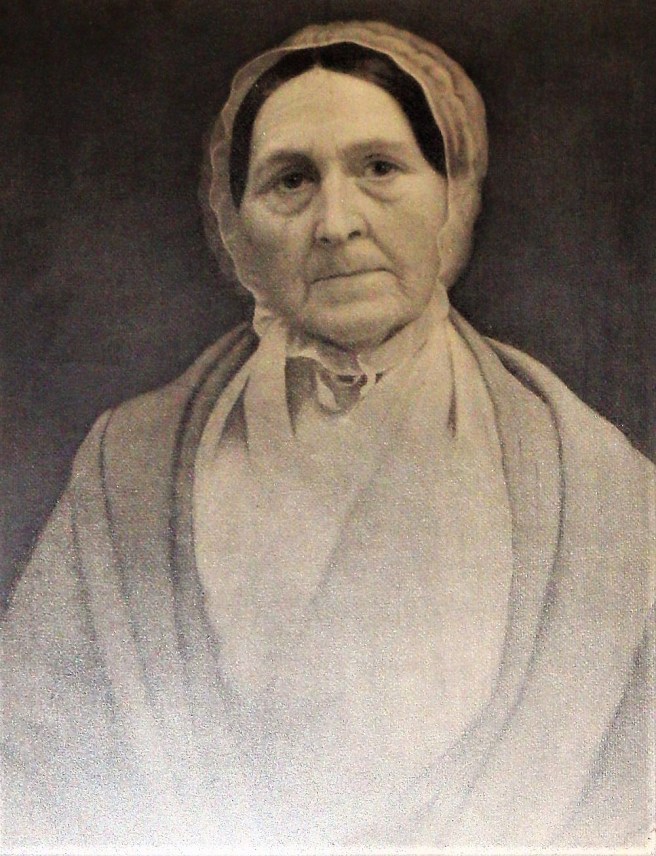
Abigail Hussey, mother of poet John Greenleaf Whittier

Usually, we trace her ancestry through the Husseys of sprawling Hampton Monthly Meeting, which eventually settled down into Amesbury.

But Greenleaf’s uncle Obediah thickens the plot.

Quite simply, Dover’s Whittier Street and Whittier Falls in the Cochecho River are not named for the famed poet, but rather his uncle and cousin.

And the alternative Whitchers spelling and pronunciation is most tempting, though I won’t go there.

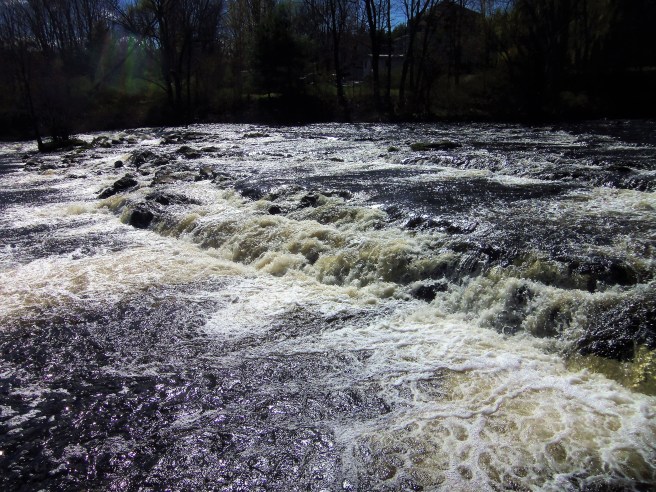
Whittier Falls in the Cochecho River.

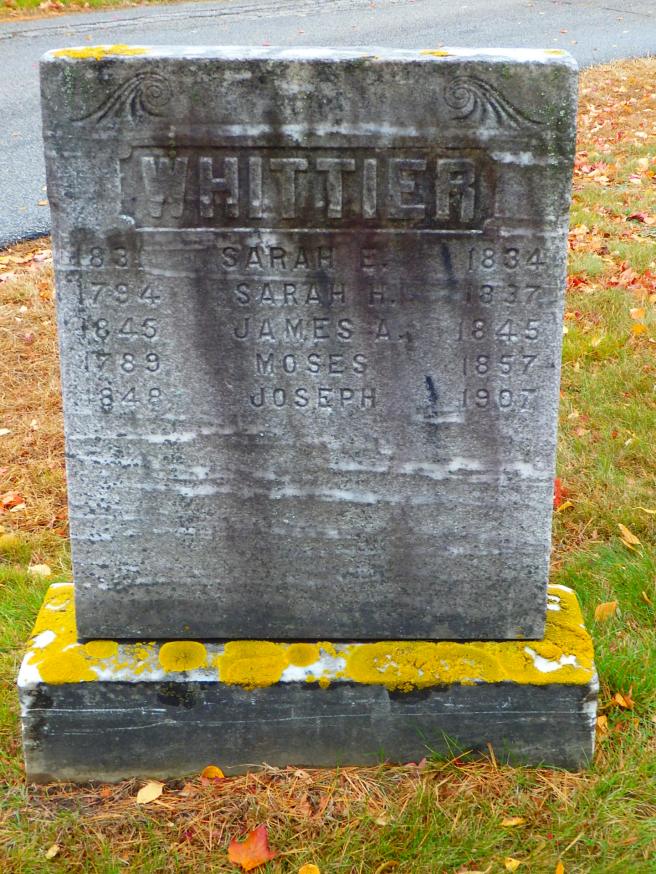
Obediah Whittier (1758-1814) moved from Haverhill, Massachusetts, to Dover and married Sarah Austin of Rochester in 1786. He owned a fulling mill, gristmill, and building for dressing cloth on the eastern side of the upper falls of the Cochecho River that were destroyed in January 1817 by a fire that broke out in the carding mill. Son Moses Whittier (1789-1857), however, at once erected new machinery and resumed the carding, fulling, and clothing business the following month. The falls, now known as Whittier Falls, were also called Whitcher’s (a variant on Whittier), Tolend, or the Upper Falls, though there were more cascades upstream.

Obediah and Sarah’s daughter Anna wed Isaac Wendell of Dover in 1809. Daughter Sarah married George D. Varney of Somersworth in 1813. Daughter Mary wed Gideon C. Smith of Somersworth in 1827. (Isaac Wendell was a cofounder of the Dover Cotton Factory, which was the origin of the big mills downtown.)

Son Moses (1789-1857) married Sarah Hacker Jones (1793-1837) of Brunswick, Maine, in Durham, Maine, in 1821, probably at the Friends Meeting. The Jones cemetery in Brunswick has stones for several Dover surnames, including Cartlands, who were also related to the poet – and many of these use Quaker dating.

Dover’s Whittier family is buried in Pine Hill Cemetery abutting the meetinghouse.

It’s possible that Greenleaf’s father, John Whittier, met Abigail Hussey through visits to his brother in turn, or that Obediah, likewise, met his wife through other family visits. Opportunities either way would have strengthened any fascination and eventual courtship.

John Greenleaf Whittier’s brother, Matthew Franklin Whittier, even moved to Dover at one point but died in Boston.

You’d never guess any of this walking today’s Community Trail along the river.

~*~

Check out my new book, Quaking Dover, available in your choice of ebook platforms at Smashwords.com.

Welcome to Dover’s upcoming 400th anniversary.
The very important network of Friends

Early histories of Friends in New England generally overlook Dover, Hampton, and Salem, apart from fleeting references. The focus is instead on Rhode Island, Buzzard Bays, and Cape Cod, in part because of their relative wealth and influence and in part because of their cache of surviving records.

My investigation, prompted by the 400th anniversary of the British settling of Dover, has convinced me that the three northernmost Quaker Meetings of the late 17th and early 18th centuries were equally as important, and their stories need to be told.

One thing I’ve found is that these Friends were not ignored by traveling Quaker ministers. Some of them, especially from England, essentially “set up camp” on the Piscataqua, and their journals offer candid insights into the community and its struggles.

Friends were also connected through New England Yearly Meeting and, closer to home, through Salem Quarterly Meeting, before the creation of Dover Quarterly Meeting in 1815.

We see that in the assistance industrial pioneer Moses Brown of Providence, Rhode Island, provided Dover Friends in the manumission of their slaves in the years leading up to the American Revolution.

Today the Moses Brown School in Providence, Rhode Island, is a highly respected prep academy. Dover Friends who could afford to sent their children there.

The Friends Boarding School in Providence, later renamed in his honor, became another way for Quakers to become integrated into the wider Society of Friends – especially when it led to marriages with other Quakers. Much later came the prestigious Quaker colleges at Haverford, Swarthmore, Guilford, Earlham, and more.

Facilitated by the traveling ministers, who likely also conveyed business information and perhaps even money, along with the counsel of financially savvy elders, some Friends prospered in the industrial revolution. Some Dover Friends did find success in Philadelphia or Massachusetts, and others spread up the Cochecho River and across Maine.

Today, we also connect through alliances like the American Friends Service Committee, the Friends Committee on National Legislation, Friends General Conference, Friends United Meeting, the Friends Historical Association, the Quaker Theological Group, and much more.

Well, as Jesus said, wherever two or three more are gathered …

But it’s also how we stay recharged and focused in the work we’re called to do. Heaven knows, we can’t do it alone.

~*~

Check out my new book, Quaking Dover, available in your choice of ebook platforms at Smashwords.com.

Welcome to Dover’s upcoming 400th anniversary.
 

Dover’s Quaker families quickly became closely intertwined

Through much of its history, the Society of Friends was rooted in families, in contrast to today’s more individualistic lacework.

I use the earlier term, Society of Friends, rather than the more modern version, Religious Society of Friends, because Quaker practice emphasized all facets of one’s life, not just a spiritual component. We can argue about whether Friends worship is mystical or meditative as well as about our understandings of the nature of the Divine, but the faith has led us over our history to closely examine our political, business, educational, community, and family interactions. Often, as we’ve seen, from an intensely practical point of view.

It has been said that there are no Quakers apart from a Meeting, meaning that we need each other to hold ourselves to the path and practice. Families, too, need other families who share a similar vision.

When Friends had large nuclear families, three households could easily fill a small meetinghouse, especially when grandparents and unmarried siblings were included. As Quaker families intermarried over the generations, it became common for children to address everyone in Meeting, except their own parents, grandparents, or siblings, as aunt, uncle, or cousin. We can see how that would easily apply in Dover.

What I hadn’t expected when I began examining the genealogies of Dover’s early Friends was to discover just how intermarried their families had already become in the four decades between the arrival of the Quaker missionaries and the beginning of the Meeting’s surviving minutes. Some families were close even before that, suggesting religious conversions, “convincements,” often came within extended relations or among neighbors more than one by one, individually.

In other cases, some lines of a Dover family were Quaker while others hewed to the Congregational church. Even after a surname line left the Society of Friends, some individuals might later rejoin, and sometimes it is hard to determine precisely when or how. In addition, children of households listed in Dover Friends records might seem to disappear from further consideration when, in reality, their location was one finally set off within a newly recognized Monthly Meeting. In effect, their Meeting moved while they stayed put on the same land. A diligent researcher will need to go to those minutes to continue, if possible.

Compounding this, in terms of this particular history, is the fact that for some of Dover’s Meeting’s families, few or maybe none of the households lived within the current city limits. The Eliot, Maine, role – still officially in the town of Kittery – stands out, as do the Berwicks, in Maine, and Oyster River, now Durham, New Hampshire.

As long as a family was Quaker, we can make some general assumptions about its values and lifestyle.

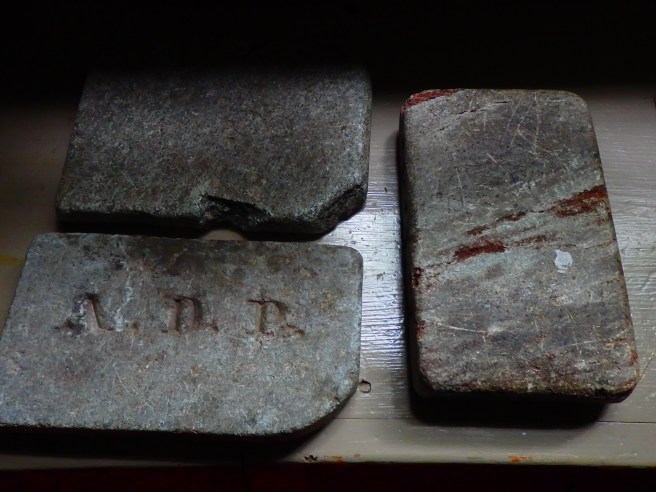
Through much of the history, neither the Congregational nor Quaker meetinghouses had heat in the winter. Instead, members heated soapstone cut like these and carried it in containers from home. I have no idea why they were given to the Meeting, other than a reminder of how tough those characters were.

In some ways, they were like Amish today, with distinctive dress and turns of speech, though choosing to “live behind a protective hedge” rather than separate more totally from the wider world. We’ve seen that Dover Friends were not afraid of speaking out in public and pressing for political redress, unlike the Amish.

Among the values were simplicity, plainness, integrity (honesty, no oathtaking), pacifism and nonviolence, equality of sexes and races. In addition to an avoidance of oathtaking, gambling and gaming, military service, Friends eschewed vain entertainments, including fiction, theater, dance, music, visual art. Science, mathematics, and poetry, however, were valued. There were no headstones until the 1850s. Nor did Friends take other Friends to court – differences were to be settled within Monthly or Quarterly Meeting. Quaker inheritance guidelines sought equal distribution for all the children rather than the bulk of an estate going to the eldest son – over time, raising the overall wealth of a family.

Anger, which commonly leads to violence, was curbed or suppressed – at a hidden price of burying all of one’s emotions.

Yes, the restrictions could be severe, but they also led to some remarkable accomplishments.

As I’ve reviewed Dover Quaker surnames, I find some moved out of the immediate area altogether. Others stayed, but moved completely out of the Society of Friends – still, their accomplishments were part of the larger society.

Even in a small community like Dover Friends Meeting, trying to keep the 41 or so surnames straight over several generations becomes difficult, but is a tight-knitted fabric of individuals and kinships. Sometimes, when I’m sitting in the silence of the meetinghouse, I feel that they’re also sitting with me. It’s a comforting, even strengthening, experience.

~*~

Check out my new book, Quaking Dover, available in an iBook edition at the Apple Store.

Welcome to Dover’s upcoming 400th anniversary.
 

Standing aside in a time of war

In January 1774, a large protest meeting against England called by the town of Dover was held in the Quaker meetinghouse. A resolution upholding the demand for the right of representation in government was unanimously passed.

We’re left wondering why the Friends meetinghouse rather than the Congregational one funded by the town, or whether the town fathers even asked permission.

But a year later, Quaker Nathaniel Meader and others made a public declaration, “We do not choose to sign allegiance to the colonies,” in part as a matter of not swearing oaths but more likely a reflection of their desire to avoid warfare.

~*~

Like the earlier decades of hostilities with the French and their Native allies, this was a special trial of faith for Quakers, who were committed to nonviolence and peacemaking. The historic peace testimony given to King Charles II in 1660 declared warfare to be contrary to the spirit and teaching of Christ as well as the practice of the apostles. Friends recognized clearly that violence begets more violence and arises from sin.

“Our principle is, and our Practice have always been, to seek peace and ensue it and to follow after righteousness and the knowledge of God, seeking the good and welfare and doing that which tends to the peace of all,” the testimony states. “We know that wars and fightings proceed from the lusts of men, out of which lusts the Lord hath redeemed us, and so out of the occasion of war. The occasion of which war, and war itself (wherein envious men, who are lovers of themselves more than lovers of God, lust, kill, and desire to have men’s lives or estates) ariseth from the lust. All bloody principles and practices, we, as to our own particulars, do utterly deny, with all outward wars and strife and fightings with outward weapons, for any end or under any pretense whatsoever. And this is our testimony to the whole world.”

The document also rejects conditions for allowing arms:

“That the spirit of Christ, by which we are guided, is not changeable, so as once to command us from a thing as evil and again to move unto it; and we do certainly know, and so testify to the world, that the spirit of Christ, which leads us into all Truth, will never move us to fight and war against any man with outward weapons, neither for the kingdom of Christ, nor for the kingdoms of this world.”

Friends were instead set upon living out the Peaceable Kingdom described in the prophecies of Isaiah. “For which cause we shall freely give up our bodies a sacrifice, rather than disobey the Lord. For we know, as the Lord hath kept us innocent, so he will plead our cause, when there is none in the earth to plead it. So we, in obedience to his truth, do not love our lives unto the death [that is, a life of sin, but rather] that we may do his will, and wrong no man in our generation, but seek the good and peace of all men. And he that hath commanded us that we shall not swear at all, hath also commanded us that we shall not kill, so that we can neither kill men, nor swear for or against them.”

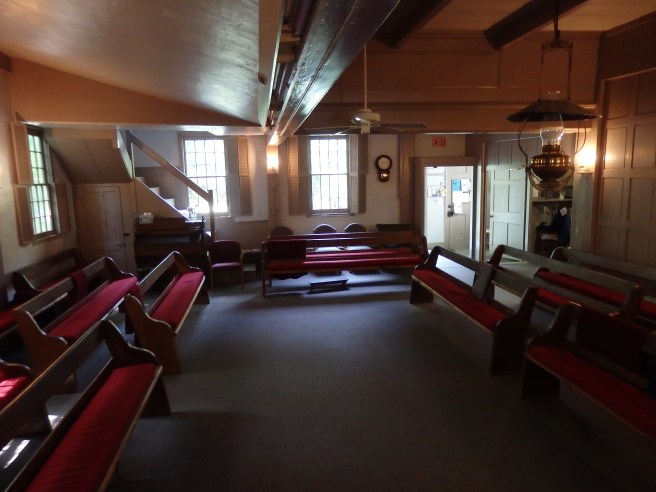
Important public meetings at the outbreak of the Revolutionary War took place in this room. The dividing wall to our right would have been raised, doubling the space. The seats would have faced toward the camera and the raised platform. The balcony, or gallery, overhead would have added more capacity for a crowd.

A Dover Meeting minute of 3rd mo 23rd 1776 speaks of three who went to war: “After deliberate consideration thereof it is the judgement of the meeting that the above named friends should not stand as members of our said meeting until they return with unfeigned repentance for the above misconduct.”

Even so, the first reading in town of the Declaration of Independence was made at the Quaker meetinghouse.

The Peace Testimony wasn’t the only reason for Friends to be troubled by the Revolutionary War. There was no basis to assume that a new government would respect their hard-earned religious liberty. Quakers also had strong ties to their British coreligionists.

Some, like Nathaniel Greene of Rhode Island, did take up arms or otherwise support political independence. British unjust seizure of his brother’s shipping fleet pushed Nathaniel into action. As a general, he is renowned as a brilliant strategist, though his most famous campaign was one largely of retreat that ultimately exhausted the enemy.

Dover Friends sadly agreed that those who joined the fighting could no longer be counted as members, at least until they expressed repentance. The decision came at a steep price.

The Quaker archives at the University of Massachusetts contain three collections of Denials, or disownments, at Dover. The first covers general offenses, 1761 to 1801. The second, marriages, 1721 to 1800. The third, military service, 1775 to 1778.

I’m sure all three are heavy reading.

In Berwick alone, at least 18 young men with Quaker surnames enlisted, according to a tally by the local historical society. Assembling similar tallies in the other communities covered by Dover Meeting would be a challenge.

In the end, the Constitution of the new nation would include a Bill of Rights based largely on Quaker William Penn’s 1701 Charter of Liberties for Pennsylvania. To commemorate the jubilee anniversary of that charter, a large bell was commissioned to be cast and initially known as the Great Quaker Bell, now renowned as the Liberty Bell for its inscription from Leviticus 25:10.

Look it up. It’s a revolutionary economic and social concept.

~*~

Check out my new book, Quaking Dover, available in your choice of ebook platforms at Smashwords.com.

Welcome to Dover’s upcoming 400th anniversary.