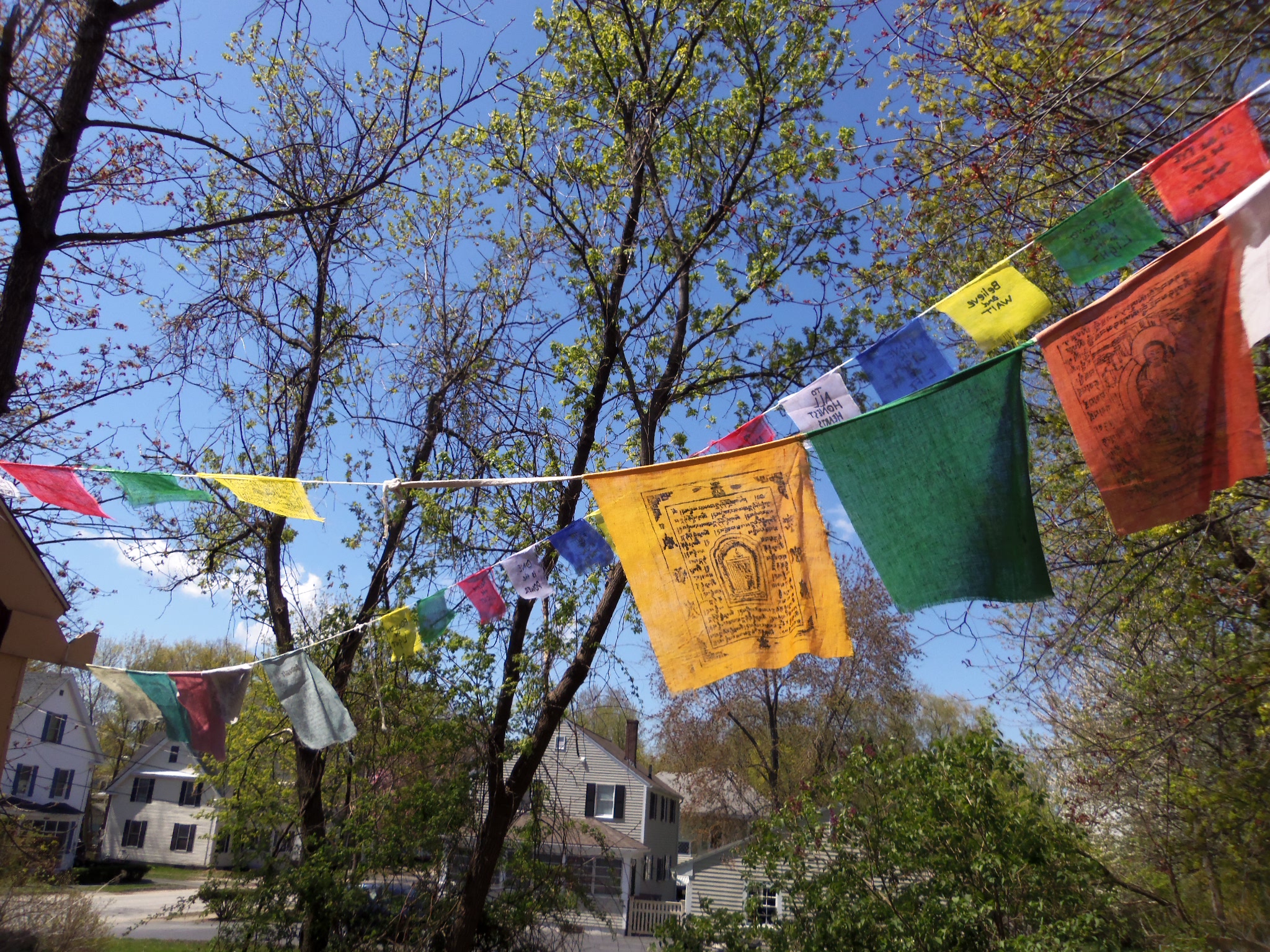
The Apostle Paul has urged Christians to pray without ceasing.
I view Tibetan prayer flags rising in the breeze as joyous reminders my heart can do likewise.
You never know what we'll churn up in cleaning a stall
The Apostle Paul has urged Christians to pray without ceasing.
I view Tibetan prayer flags rising in the breeze as joyous reminders my heart can do likewise.
Asked for a short theology, I’m likely to reply I’ve come to the conclusion God has a different way for us, individually and as a society, to be living.
It’s the story I see evolving in the Bible, for one thing. And in much of the history since.
It’s not hierarchy-based, for starters, and something quite different from nations, with their armies, as we know them.
We get a hint of it in the suggestion of the Jubilee, the redistribution of wealth every 50 years for the entire populace.
Maybe you’re already sensing I don’t draw a distinction between here and eternity, not the way Augustine did. It’s the “Kingdom Come, on Earth as it is in Heaven,” as Christians pray.
The long version, of course, is where all the details come into play.
I’ve suggested meeting with some of the historic Friends sitting on our meeting library shelves, and mentioned the possibility of finding one or two who converse intimately with you, usually in the English of another era. (I’ve seen this happen rather frequently, even if it takes time to find the unique voice.) In this sense, one or two may become timeless companions in your inward growth. Or maybe an old Quake is simply a mentor along the way.
Knowing them can also help us as a PEOPLE of faith. Their range of experiences and concerns provides insights into other streams of Friends today, as Dover Friends have found in our relationship with Cuban Quakers. It also gives us a basis for renewed dialogue on everything from worship and teaching to outreach and social justice issues. We quietist Friends have as much to learn from Evangelical Friends as they do from us – even as we explore our branching out from the same powerful roots.
I’ll leave this for now, saying only that in digging for Quaker roots, it’s possible to find yourself jolted, like grabbing onto a live wire. And who knows where that will lead.
* * *
Now, for an update. For ease of convenience, let me point you to overviews of these earlier Friends, all at my As Light Is Sown blog:
Some have observed that Friends look to their history more than most other denominations do. They say a group that lacks dogma, creed, or liturgy will by necessity rely on its tradition for its guideline and authoritative reference. Well, maybe so. After all, to function as a Society of Friends, we need a common language that enables us to convey our diverse experiences, insights, desires, and needs in ways that knit us together. English Quaker Caroline E. Stephen (1835-1909) was amazed that any group of mystics could actually operate together at all, yet Friends do – and have. Eventually, I think, that functioning becomes part of the attraction early Quakers, especially, extend to us.
While much can be learned by exploring the history of Friends, there’s even more to be gleaned by uncovering a historic Friend who resonates especially with YOU. Sometimes these appear in the published journals, which relate inward and outward journeys through life (a gem may pop up in the middle of an otherwise tedious stretch of travel). Other times, they’re in memorial minutes, letters, or tracts. Sometimes, the words of an obscure Friend begins a lifetime dialogue. Ask around meeting, and there will be many suggestions. Or simply delve into the meeting library (the leatherbound collection holds many surprises, too).
In my experience, I can say that in actively invoking these ancestors, we cross a point where they’re no longer quaint (that nostalgic view of the smiling Quaker Oats man or people in some country meetinghouse) but instead astonishingly revolutionary. Their struggles and discoveries may suddenly speak to our own, even if what erupts is a loud argument – like the one Lewis Benson and John Curtis had in the mid-20th century before concluding that George Fox meant exactly what he was saying, scriptural citations and all. To speak of walking cheerfully in the face of brutal oppression and imprisonment is startling – and a starting point for transformation. It’s beneficial, too, when we discover we don’t need to constantly reinvent the wheel in our practice of faith, but also disconcerting when we realize how much of the work they began remains for us to continue. At least they stand ready to help us.
One of my annual rituals involves emptying the large compost bin as we prepare to enrich the garden for our new plantings, and then refilling it with layers of collected leaves (bagged by our neighbors, especially, each October), a winter’s worth of kitchen garbage, and bunny-cage hay and its prized pellet-manure. The production of “organic matter” to counter our clay soil is also part of our battle against what my wife calls Dead Dirt Syndrome, and it’s been a wonder to observe progress over the years we’ve been at it.
The Apostle Paul has exhorted Christians to pray without ceasing – an impossibility, as we know – yet as I lift forkfuls from the big bin, reline its sides, load and unload the wheelbarrow, I often find myself entering a prayerful zone of reflection. First, there’s the reminder that humus – the stuff of compost – and humility are words sharing a common root, and that both are nurturing elements for life. Then there’s an awareness of our essential abundance – all the meals we’ve enjoyed; the reality that children in America are familiar with tastes that kings in earlier times would have never imagined. We haven’t gone hungry. In fact, there’s so much waste to lament, a resolution to be more frugal or attentive, and then a sense of contrition knowing that we’re still putting this to work rather than tossing it out to the local landfill. Soon I’m appreciating the stages of transformation as I observe how matter breaks down into something resembling potting soil – rich, dark, soft. But I also know this always requires patience and will go at its own pace, no matter how I might try to rush it.
I’ve learned to watch the stages of change, too. That period when the pile begins steaming and its interior reaches 140 degrees or so. Followed by that period when the red wigglers (or is it wrigglers?) appear and proliferate. My buddies, reducing the leaves and hay and newspaper and cardboard and garbage into finished compost. You could view them as angels, arriving from wherever to bless the home and garden. At least I do. Yes, gratefully.

Spring yellow, for Easter. I cut branches of forsythia, bring them indoors, find an appropriate vase with water, if Easter’s falling early. And then they open, with a profusion of yellow. Sunshine.
Some, soon adorned with suspended eggs.

Nowhere do we see a bigger before-and-after contrast of the hippie impact than when looking at mainstream religion in America.
The idealized smiling family of father and sons in suits and ties and mother and daughters in their hats, dresses, and heels – maybe even with gloves – was once a common image with the church and steeple in the background. But that has become a rarity, and even at funerals and weddings the dress is likely to be casual. Intact families are a minority – weekends are often custody matters – and going to church or temple is a low priority.
Before we blame it all on hippies, we need to look at other influences from recent decades, including the elimination of blue laws, and the expansion of weekend job demands and children’s soccer leagues and the like.
Still, I see a few glimmers where the hunger many hippies felt for a spiritual connection has taken hold.
First is the practice of meditation, which is no longer considered exotic. Even health providers are urging people to turn to it daily, maybe not as a religious pursuit but at least for letting go of some of the daily stress.
Second, yoga studios are everywhere. It may not be with the strong spiritual teaching I feel is essential, but it is another way of opening ourselves to inner awareness and peace.
Third is a recognition of the feminine side of the holy, including the Jewish and Christian traditions. For that matter, think of all the women pastors and rabbis now found across the continent. Others will point to Native American, Wiccan, and other teachings with feminine components that now proliferate.
Fourth is a sense that faith is not an obligation, to be performed as a social requirement, but rather a relationship that includes hands-on, sensory experience. As the axiom went, “If it feels good, do it,” extends to religion this way.
As a fifth facet, I’ll point to outdoors encounters with their Transcendentalist streak. God, as you’ll be reminded, can be felt keenly when you’re close to nature.
Look closely and you can see the hippie influence working. There’s a desire for community and caring, on one hand. And the mega-churches with their rock-concert emotions, on the other, as well as the praise songs with their repetitions function more like Hindu chanting (kirtan) than the motets and hymns of Christian tradition.
But there are also examples of shoots gone astray. I keep thinking of Jim Jones’ Peoples Temple and its cyanide-laced Kool-Aid, especially.
As we kept watch in the ashram, the warning was this: “You’re on a false trip.” No matter how exciting it might have felt at the moment, there was always the danger of ego-based excitement rather than a deepening surrender to the Holy One.
For me, then, the most crucial part of the legacy is in having a circle of others committed to the practice, to encourage one another and keep each of us on course, as best we can. This form of discipleship is rather communal, actually – and far from what I saw growing up in the pastor-and-sheep model.
So what are your spiritual encounters these days? And how’s the “inner hippie” responding?

As I said at the time …
After dropping the kid off at school for a rare Saturday session (costume design class), noon, I stop off at Mount Isinglass for a short hike, in part to eat up a bit of time before our customary Saturday afternoon wine tasting and opera broadcast.
While most of our snow has melted, the woods are still covered, even in Gonic. The trail’s quite icy, with a few bare spots for relief.
Amazing how many people rely on their dogs as an excuse to take a walk – as the droppings in the snow attest.
Still, a good exercise, this trek before the snowpack is completely gone, at least if I don’t slip, fall, and injure myself.
Coming down near the river and former bridge, I view a black pool of stilled water brimming slightly over the usual banks, a complete contrast to the two snowy forest hillsides it cleaves. The utter beauty is timeless, and yet totally of the moment. While the water is quiescent, the air resounds with the ferocious chords of the cataract just out of sight.
I approach the top of the falls, the water gaining inevitable velocity and muscle, some of it careening into rockface and then pushing across the current. The narrow, sloping trail down to the base of the cascade, however, remains ice covered, and the places I would normally cross to the river are now mid-stream anyway. I back off, and head back, rather than attempting to scale the cliff to a possible overlook from above.
The temptation becomes too much, and I venture off the return trail, my feet crashing through snowpack that still comes to my knees, until I come to a place where the falls are in view off to the side below me. Rather than the miniature Niagara I’d expected, however, the water’s not rounding off to drop vertically, as I’d seen it in high water here the previous autumn. Rather, it shoots straight out – sometimes into a sheer wall of rock.
All of this wild power – untamed, exuberant, destructive or even cleansing, hissing like strong wind with drumming somewhere deep within. Anyone pulled into the current would be broken by the weight, crushed on the rock, torn by the crossfire. The mill that once channeled this energy has long been swept away by such outbursts, with only a few foundation stones remaining. Downstream, this water will be used at least twice to generate electrical power, but here it explodes for its own glory.
What is it that attracts us to cataracts? The description that comes to mind is “awe,” an acknowledgment of natural, inexplicable power far greater than our own mortal existence. Or maybe the seemingly inexhaustible stream of profusion that outlasts our own span of concentration and observation.
Even so, as the Psalmist noted, “He leads me beside the still waters,” not down to the base of the torrent. I think of two Plain meetinghouses in Ohio, both named Stillwater – one Quaker, the other Old Order German Baptist Brethren. The still water as a place of clarification, the sediment dropping away, a clear drink or safe place to water livestock and wildlife. Waterfowl, too, take refuge. Here the energy is latent and gathering, ready for release. In the meetinghouses, the worshipers gather, still themselves, become clear, preparing for the channel of the week ahead.
The contrast within one stream couldn’t be sharper, one as the other face of its complement.
On the walk back to the car, an icy beech leaf turns translucent on the snowy trail.
a beech leaf
translucent with ice
floating on snow

As I told them:
Although Jnana does not hunt, he observes points at which ancient traditions – including hunting and gathering – influence modern religious practices, meditation high among them. Jnana also acknowledges the role organized sportsmen have performed in restoring populations of wildlife, and has learned from hunters eminently adept at reading animals’ ways in the field. These days, living in New Hampshire, he keeps an eye open for moose rather than elk along the highway.
As a writer, I love taking a phrase and rolling it around, substituting one word or thought and seeing what happens.
With the Grimms’ fairy tale opening, “A long time ago, when wishes came true,” I began substituting “prayers” for “wishes” and realized many people seem to assume that prayers really did have more effect a long time ago – say back in the time of Moses or King David – than these days.
But that also has me wondering about the depth of our wishes today. Are we too directed by advertising and material possessions to seek what’s truly desirable? The fairy tales and Holy Scripture, as I recall, have a lot to say on that account.
 Jnana's Red Barn