A LITTLE HOLY CONFESSION

Coming, as most of us modern Quakers do, from other faith traditions, it’s fair to ask ourselves just what we carry with us into the Quaker circle.

My own family, for instance, was quite active in the Evangelical United Brethren denomination, now merged into the United Methodists. Despite the many Sunday mornings spent listening to quarter-hour sermons, however, I find myself remembering very little. There was one telling us not to waste time (because time was a gift from God), another about our bodies being temples that should not be abused by smoking or drinking, another about non-conformity as a Protestant duty (this back in the gray-flannel ‘50s!), as well as the annual money sermon, reduced to a plea for financial support. Surprisingly, I recall no Bible stories. The senior pastor, a quiet and bookish man, quoted many volumes along the way, yet my sense is that he was likely much more effective in his hospital visits and pastoral counsel than he was in the pulpit. The youth pastor, meanwhile, taught me more about organizing and managing successful political campaigns and establishments than about matters of the Holy Spirit.

More influential, I suspect, were the short trailside vespers of our Scout troop. One boy, a preacher’s kid, even spoke of the church being the people, along the lines of the Quaker argument I’ve previously presented. And then there was the twilight circle of rowboats and candles when we camped at Lake Vesuvius – that awe of the stilling day and waters reflecting something of our current worship.

It all seems so long ago, and so far back. Yet a few turns later, emerging from a yoga ashram, I encountered a circle of Friends who began opening the Scriptures to me, and then a few Mennonites who restored the hymn legacy, and something from that past took shape, in a new way. Maybe the last laugh, though, belongs to those EUB officials of my youth who tried to steer me into their ministry – and a faith I soon rejected fully. After all, it opened the way that landed me into free Gospel ministry here.
TIFFANY?

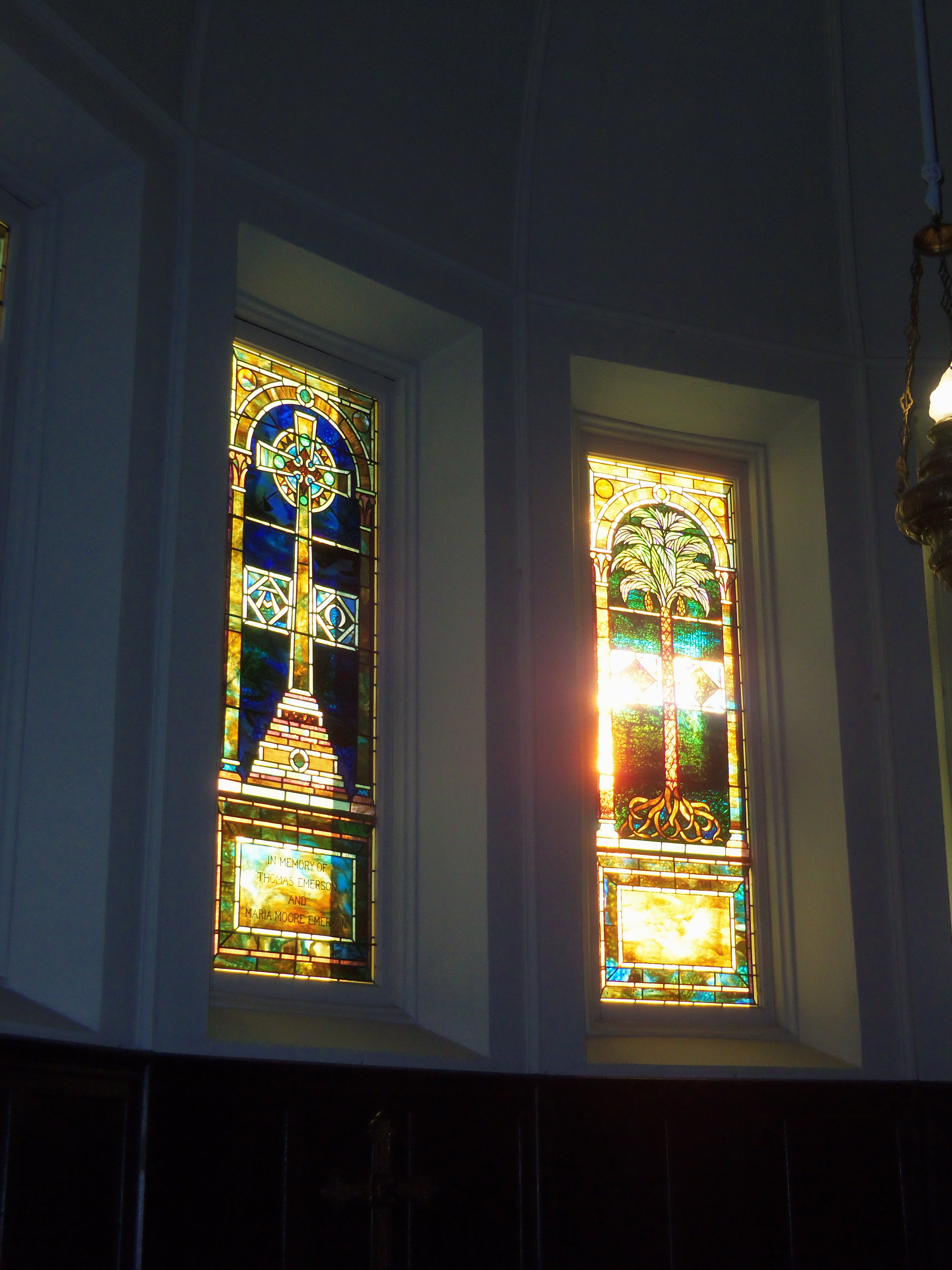
From the pews in the sanctuary, the five stained-glass windows over the altar appear curiously bland in contrast to the two vast arrays to the left or the rear. Only if you cross into the chancel and catch a glint of sunlight might you sense something quite different is at hand before you.

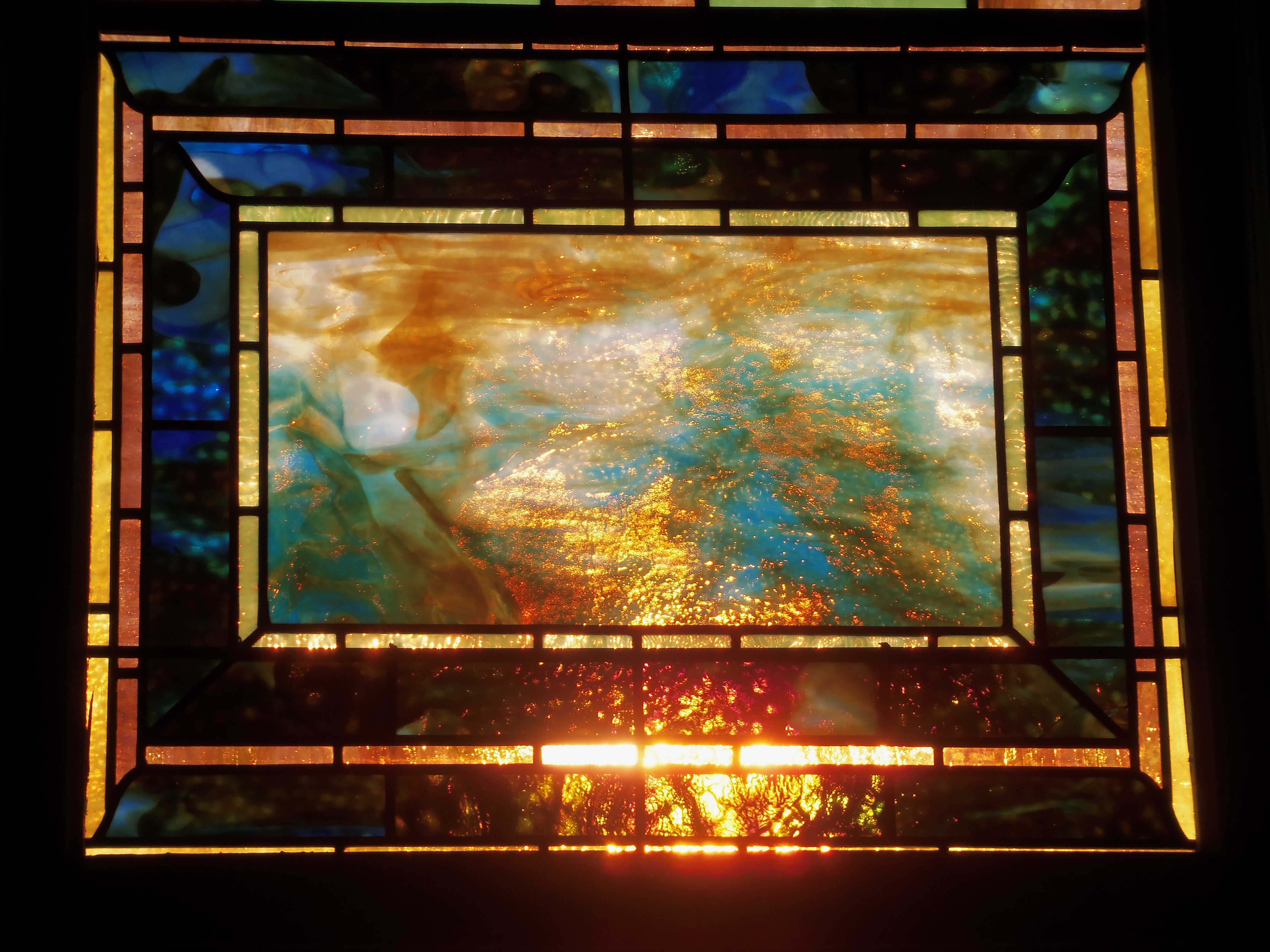
That’s how I first noticed that unlike traditional stained glass, none of this set had been enhanced by paint. All of the color was in the glass itself, yet there were no muddy patches where colors overlapped, as might be expected while mixing pigments. Some of these resembled Impressionist painting or bookmaker marbling. Moreover, when direct sunlight hit some of the pieces, the color blazed with gold or copper or fine jewels.

Look at that gold blazing.


A little context.
A little context.

Could it be? I’d heard that one reason Louis Comfort Tiffany obtained such incredible effects in his work was that he used such materials in his glass. For starters, the only way to get a gold color is to use gold.

As I started to seek documentation, some fascinating connections appear.

As it turns out, the Tiffany Glass Company and its successor, Tiffany Glass and Decorating Company, created thousands of ecclesiastical church windows. Many of these were designed and executed by his studio, rather than Tiffany himself, but they would nonetheless bear his stamp and influence.

Tiffany’s 1890 Hay Memorial at Emmanuel Episcopal in Pittsburgh presents some striking similarity to the set at the 1895 St. John’s Methodist in Watertown, Massachusetts.

A simple design.
A simple design.
Such a range of colors, shifting with the light.

Both are narrow arched windows with greenish bottom panels ringed in copper tones. The central cross resembles the crosses at Watertown. And the mention of Tiffany’s love of exotic Oriental painting and his travels in northern Africa might explain the two Watertown windows dominated by palm trees.

The Watertown congregation originated in 1836 in the Whitney family home, and they remained active supporters at the time the 1895 stone building was erected. Their David Whitney Jr. relocated to Detroit as a young man, quickly became that city’s wealthiest resident, and built an 1894 mansion that still features its elaborate Tiffany windows.

Finally, I run into the pastor as he’s leaving his office. I pose the question, “Tiffany?”

“Technically, no.”

“His studio, then?”

“Yes.”

Regardless of the creator’s name, these five windows are marvelous, especially when struck by sunlight. Unfortunately, their placement on the west side of the building means the Sunday morning worshipers would not get to view them at their best.

Vespers, anyone?

Three of the five windows around the chancel in late-afternoon sunlight.

CHURCH WINDOWS

I’ve long joked that our Quaker meetinghouse has the prettiest stained-glass windows in town. That’s because they’re clear, looking out to the hardwood trees surrounding the grounds and all of the seasonal changes. The colors are those of snow and ice, spring greening, fog, mist, rainfall, autumn foliage. Admittedly, the new synagogue, with its view over a hillside to forest beyond, and the Methodists, at the edge of a millpond, can make rival cases. I’ll plead to being partial.

Crucially, though, transparent windows remind us of the world beyond the house where we sit in worship, a reflection of our awareness that our faith is a constant part of our various daily life activities. They remind us as well of the powerful rhythms of nature and God’s creation.

On the other hand, most congregations – including the Evangelical United Brethren of my childhood – gather within rooms of filtered light cast by stained-glass designs. I was puzzled by it then, and remain so today. Yes, I know the colored windows of the great medieval cathedrals were illustrated storybooks for the illiterate populace, but what I encountered always felt second-rate and often mildewed. Few individuals, I suspect, could say much of anything about the event being depicted or express any understanding of the decorative filling. Pointedly, the translucent windows cut off any view beyond the room. Perhaps the intention is to create a holy space – one set apart from normal life; perhaps, too, this hints at eternity as a departure from the landscape we know. But a shady or even creepy quality always seemed to lurk in the shadows. This is, I will note, quite different from the icon-based frescoes of Eastern Orthodox custom.

Apart from a few December afternoons at the National Cathedral in Washington, when I finally experienced the dazzling sunlight through the windows and recognized how Rose windows earned their esteem, my encounters with stained glass were few and fleeting. That is, until late one afternoon last year when I arrived early for our weekly chorus session and stepped from the room where we rehearse, crossing into the sanctuary on the other side of the sliding shutters. The square vaulted room is dominated by two imposing displays in traditional style – painting, essentially on pieces of colored glass that are then leaded together. Something about these, though, suggests quality sustained by wealthy donors. The impressive room has demanded closer investigation.

If the late 19th century brought about a flowering of stained glass in America, it was also a time before the spread of public art museums. Windows like these, then, would have been art made available to all for their wonderment.

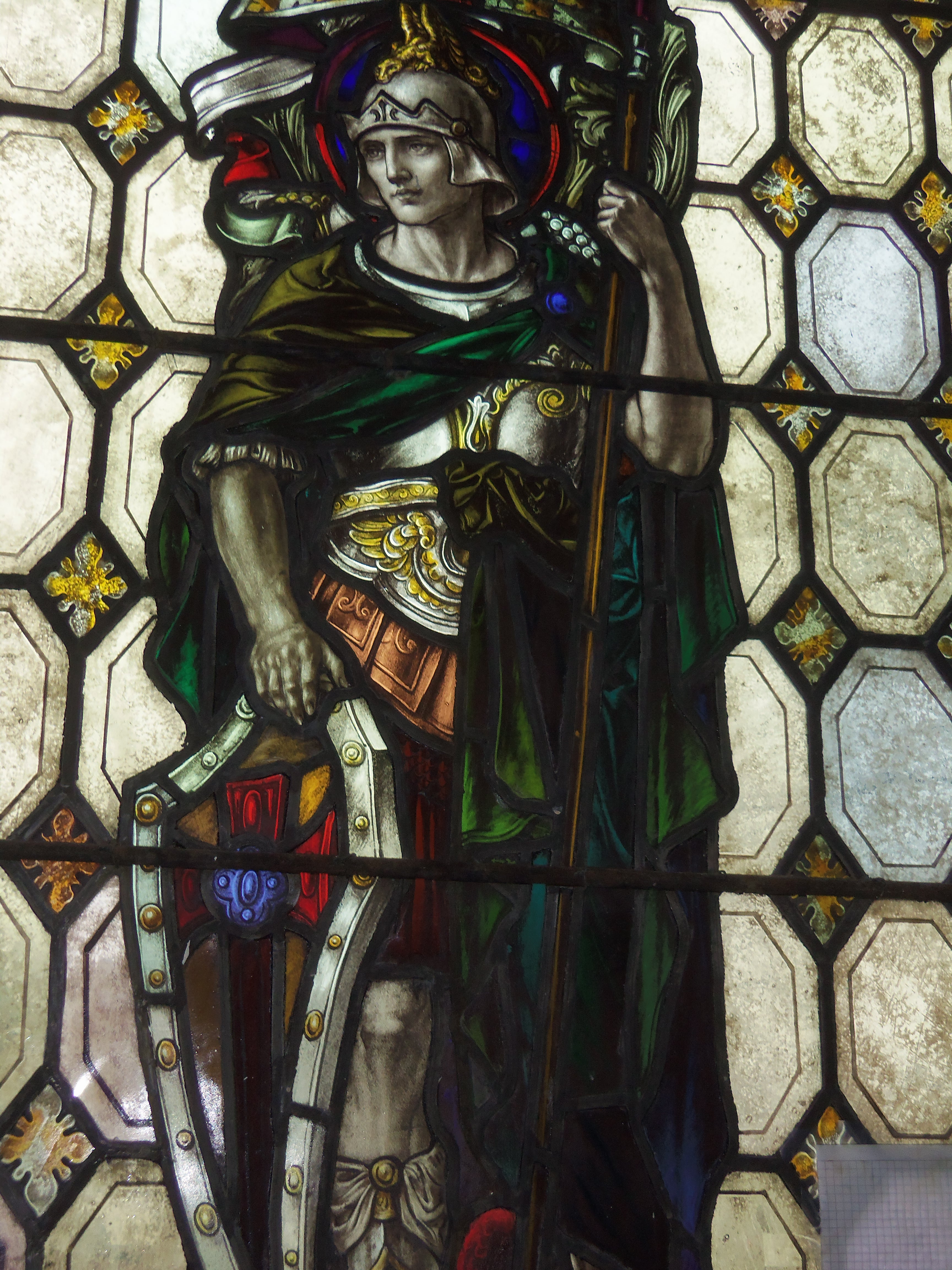
The south wall of the sanctuary is dominated by this traditional design, which includes a row of named angels along the bottom.
A detail of one of the angels.
A detail of one of the south windows.
Traditional stained-glass style using cut pieces painted with enamel.
A decorative window in a social hall where our chorus rehearses.

PIPE ORGANS

Waiting in silence.
Waiting in silence.

For a classical music enthusiast like me, one of the great things about living in New England is the plethora of fine pipe organs. They’re found not just in many of the historic steeplehouses, but also in places like the city hall in Portland, Maine, or the music hall in Methuen, Massachusetts, built especially for the massive Wurlitzer, and, of course, Symphony Hall in Boston.

(They’re not, however, found in our Quaker meetinghouses, except for the occasional harmonium or a modest electronic organ in a corner. I could even point to my quibbles about the expense of building and maintaining great instruments in a house of worship, but let me add how much I appreciate listening when they’re played in good hands.)

Their very variety can be remarkable. Locally, we have an 1876 Hutchings instrument that two Eagle Scouts rescued in unplayable condition from the old Methodist chapel, carefully dismantling, numbering and cataloguing the pipes, storing them in a barn, and eventually seeing their restoration in the congregation’s new building. (Hutchings, by the way, created the original part of the organ at Boston’s Symphony Hall in 1900.) Hook and Hastings, meanwhile, is credited with an 1850 one-manual instrument at First Baptist, a 1908 two-manual at St. Charles Roman Catholic, and a 1911 two-manual at St. Thomas Episcopal. First Parish (U.C.C.) has an impressive 1995 Faucher hybrid that incorporates the building’s earlier Goodrich and Hutchings instruments. Expanding the circle a bit adds a wonderful 1975 two-manual baroque-style instrument at Durham Community Church and the oldest playable organ in America, the circa 1665 Brattle, now at St. John Episcopal in Portsmouth. (Manuals, for the uninitiated, are the number of keyboards, one atop another. And don’t overlook the incredible bass notes played by the pedals under the feet!)

Maybe I shouldn’t have been surprised, then, when I stumbled upon a four-manual keyboard in Watertown, Massachusetts. “Is it still playable,” I asked. “Oh, yes. I sit down to it from time to time,” I was told. “It has a lovely, soft sound. It was built by Aeolian-Skinner but never made leaner,” meaning the E. Power Biggs’ influence in the ‘60s, especially through his performances and recordings on the Flentrop organ at Harvard’s Busch-Reisenger Museum and his advice – or misguided advice, depending – to organ owners in that era.

I love the soft, late afternoon light in the chancel.


THE RELIGIOUS TWIST

While my personal struggle bobbled between practicality and art for its own sake, the yoga and Quaker teachings introduced new tensions. Consider:

Creativity? No, God creates. Man discovers. Man cultivates and brings culture and learning, nurtures, softens, establishes coherence. This is the difference between the artist who submits to a greater power and the one who tries to use it for his own ends. The first desires to serve God, by whatever name or description; the second, his or her own ego.

Which leads to: Problems of the ego. Gertie Stein: Every writer wants to be told how good he is, how good he is, how good he is. Insecurities!

Yet in yoga, all for God: the sacrifice, the labor gifted to generate good karma. (As if your boss is another deity, rather than bottom-line motivated and conscious. Here’s a letter of commendation plus your pink slip.)

Early church father Tertullian warned, in De Spectaculis, Latin circa 200 C.E. Essentially: “The Author of truth loves no falsehood: all that is feigned is adultery in His sight. The man who counterfeits voice, sex or age, who makes a show of false love, anger, sighs and tears He will not approve, for He condemns all hypocrisy. . . . Why should it be lawful to see what it is a crime to do?” (Translation by Kenneth Morse).

These are hard charges, along with the seduction of “preaching for sin,” as George Fox warned.

So to examine the multiplicity of personality / goals / desires. Just who am I? Who are you? Empathy. Anger. Bliss. All the rest.

Honesty. Our dark sides. Do we really express our weakest aspect in our art? (In vocal ministry, how often the message comes from that area of our current conflict!)

Versus becoming so rarified we lose all sense of joy and delight. The danger of Plainness or strictness, that it suffocates personality, makes us so humbled we cannot move forward in the Holy Spirit to perform bold action. Crushes or stifles the imagination.

So how do we make a living without violating our beliefs? (Military-industrial extensive penetration of all facets of American society: not even the universities immune.)

Or how do you practice your art to the fullest, without undue restraint, while still being faithful?


ACKNOWLEDGING TWO WORLDS

So what have our children learned, as far as religion goes? What seeds have we planted? Actually, I’m thinking of this not so much as a curriculum matter for the Religious Education committee or as a reflection for parents but rather as a consideration of what’s happened in American society in general – the kind of place where soccer practice is now seen as more valuable (“value enabling”) than Sunday School. Or where a child may develop an aversion to being viewed, in any way, as a “Miss Goody Two-Shoes.”

My thoughts leap ahead to the tension many of us feel in the workplace. As Michael Lerner writes in The Left Hand of God, it’s the conflict of values between our dog-eat-dog competitive economy and those we hold dear and sacred. Fundamentalists, at least, attempt to resolve it by separating the two worlds, but at what cost? Children, of course, pick up on this, tuning out what they see as useless to their survival. And that includes what they observe at home. (Should we note the popularity of so-called “reality TV” – as manifested in The Survivor?) The Amish and other old orders attempt to hold the values of workplace, home, and faith in one sphere, but we can easily imagine the difficulty that, too, presents.

Obviously, I’m not going to resolve any of this in the next few sentences. Without the music of hymns and praise songs, the pageantry of robes, processions, lighting of altar candles, and communion, or the attentive consideration to set prayers and sermons, what do we give our children to cling to? (In the old days, did the plain clothing and “thee/thou” speech offer some refuge or rooting?) Or what invitation do we extend to those “voted off the island”? What I am going to suggest is that the answer is not found so much in any catechism or ceremony as in the way we treat our smallest members, our moments of laboring together, and, yes, the repeated ritual of a certain casserole on youth retreats and its reception.

PHILISTINES AND AMERICAN SOCIETY

Before my graduation from college, back in my social activist period, I wondered how American society could possible afford High Art while so many went hungry and homeless – domestically as well as internationally. Then I began to see everywhere a desire for expressiveness even in every ghetto – for that matter, ranging from ghetto blasters to Playboy. There were murals and blues bands. To say nothing of the infusion of professional sports, to which every poor youth, from the inner city to the mining company towns, seems to aspire. So opera and museums and other “Establishment” operations came to lose their exclusivity in my mind. Indeed, over the years I’ve heard that the real classical music lovers are the ones in the cheaper seats, the ones they can afford. Mankind, after all, has a need to reach to the higher realms of thought and the imagination of the spirit; anything less reduces our existence to nothing more than economics, impoverishing everyone in the society.

Look closely, and you’ll also see that in America, Art has become the state religion, no matter the level of state and federal funding exists. In this country, at least, there’s also been a long recognition of the fine arts as an adjunct to wealth, for whatever reasons. Many sense an abstract “goodness” in the products of art chamber music, art museums, Shakespeare festivals, opera, poetry, the “book” that so many people dream of writing even if the artist himself/herself remains (often with good reason!) somewhat suspect, a shady character. Perhaps that’s why these big institutions stand between us and the rest of ourselves, as artists and audiences. Something abstractly “good” even when they themselves admit they don’t know much about the field. Contrast that to the related state religions in America: collegiate and professional athletics, Hollywood movies, and rock concerts, wherein no one actually advocates any common wealth. (The High Priests are paid handsomely, after all.)

Art as the semi official State Religion of today? Or should that be entertainment and its host of celebrity worship? The stamp of approval. The aspiration.

Art as commodity, too. “How much did it sell for?” What was the box office?

At heart, all art is, primarily, either spiritual/religious or secular/amusement in intent and execution. Take Milton or Pepys. Today, the overwhelming materialism of our society reflects an insatiable hunger.

Even as starving artists we’re enmeshed in materialism, one way or another. It’s so easy to hold the artist up in some idealized light or the product itself as the object of worship, an idolatry, totally forgetting to turn to the Source of All. The worship of living genius, from Beethoven and the Romantic era on. Or the pretty faces of mostly Hollywood celebrity today.

As an editor on newspapers where nearly everyone was giving totally (many unpaid hours of overtime, etc.) in an attempt for excellence, I was always appalled by the charge of “elitism,” which comes to mean “give me mediocrity not the truth” or “mere pleasantry” from the same people who would not accept such standards in their professional football team or new automobile.

The shift in the meaning of “culture” from learning and aspiration to the mundane lowest common denominator of daily life. Culture, as in a petri dish of mold or germs, rather than a rare book library or new opera.

Still, if you want to comprehend the view from the top of the mountain, you need to climb it. And be warned: driving, if a road’s an option, loses a lot in the translation. From a religious point of view, at least, we can’t settle for anything less than the best in the end.

GEORGE AND MERTIE’S PLACE

As I said at the time …

You asked about my handle, Jnana. In essence, it’s Sanskrit for the spiritual “path of the intellect,” but that knowledge comes into fullness only when it finds harmony with the other forms of devotion – passion and compassion, physical labor, humility, charity, and so on. “Theoretical knowledge” misses the mark; rather, the name was given to me, in the ashram, only when I came to appreciate all the other spiritual gifts people have. Eliade calls it “the knowledge of ultimate realities” as well as “philosophy.” Perhaps “discernment” would be its equivalent in Christian practice. Whatever, I do tend to dwell in the mind and to dance in a field of ideas; I become grateful for those around me who help ground me in everyday applications.

Here it is, two months after hearing of your decision to shutter the place. (Hmm, was it a rooming house, bed-and-breakfast, or mountain inn? – so many possibilities!) Six years is a respectable run and for that, our gratitude and respect.

I once heard that before Caterpillar was launched, its editors had resolved that a journal has only three years of fresh insights to offer, and so they limited its life span to that – truncated, in my opinion, though I have my own theory of being in the public eye, which I first saw when I was pushing new comic strips and text features to newspaper editors: I see the “talent” as having a 10-year creative span – two years for readers to catch on to a new regular feature, and roughly five for a feature to start to take off in popularity; meanwhile, the artist/writer is using up the conceptual reservoir, so at five years the project is going into decline. You can tally your own list of television, radio, newspaper, or magazine projects that continued long after they had gone stale. (Of course, sometimes an individual will catch a second wind, but that’s another story.)

A year-and-a-half ago I stepped down as clerk of Dover Quarterly Meeting after a six-year term. That meant I had been presiding officer of a fellowship that met four times a year, gathering most of the local Quaker congregations in New Hampshire. (New England Yearly Meeting is the parent body, obviously named.) I was really happy to discover in the Book of Faith and Practice that limit to the length of service in any one post! It was long enough – I had initiated all I could.

More recently, I had hoped to be sending off some new material for you to consider. After a number of upheavals, of a positive sort detailed below, I’m back at writing again – got tied up, though, in some heavy-duty theological drafts rather than “creative” stuff. Things like why “Christ” equals Logos or Light more than Jesus, or why God wanted Adam and Eve to eat the fruit and why their expulsion from the Garden was not the cause of Original Sin, contrary to Augustine’s teaching. Who knows what those whackos in your neck of the woods would make of all that.

Your observation about the lack of time really hits home. It’s a disease or unease of today’s America – something that has received a lot of consideration in our Friends Meeting when we look at what we’d like to accomplish as a faith community, and then what we feel we can volunteer. Or when I debate whether to accept some OT shifts, which would help with all the bills, but decide instead to decline.

And your plans to move hit home, too. Guess the best place to catch up is just to cannibalize from the long-draft of my annual Yule letter from this past winter. Maybe some will resonate. If it doesn’t, skip!

FLATBED

Returning to my native corner of Ohio, I’m astonished by its flatness; what had seemed to be large hills or significant valleys now appear embarrassingly horizontal.

On the other hand, as I’ve uncovered my ancestral roots in that land, I’m finding a lost and untold richness in what was essentially a Pennsylvania Dutch heritage continuing in western Ohio. Feel free to take a look at my findings at the Orphan George Chronicles.

MAYBE WE’RE ALL TEACHERS

We’re well into the back-to-school swirl. Considering how many Friends teach for a living, it’s a wonder we don’t talk more about what Quakers used to call Sound Doctrine.

Not dogma, creed, doctrinaire, or even indoctrination, mind you. Doctrine, meaning teaching. The essentials for practicing our faith, just as certain skills are needed in mathematics or foreign language. Or, for that matter, for good cooking or carpentry or sewing.

It’s not just the children, either. Some messages arising in worship are basically teaching, and some are admittedly sounder than others, the latter including those that George Fox derided as mere “notions.” (Consider the Quaker who preached that Friends should not disturb the ground to obtain well water, until another spoke out during worship, “And Abraham digged a well,” citing Genesis 21:30 and apparently settling the matter.) Our own reading and inquiry, meanwhile, can be pretty much hit or miss. Who knows about other sources? Film, television, radio? And, as with all teaching, how strict should one be – and how flexible?

If we were passing a hat to collect slips of paper suggesting what should be included in our own “sound doctrine,” what would you write on yours? For that matter, how much would be a matter of content – and how much, process?

Sometime, perhaps, we’ll even have a session to hear our teachers talk a bit about their teaching – both content and method – and a continuing awareness of learning. Or maybe another, to consider all the ways we have learned from each other – and not just matters of faith, either. The progress of my compost bins, after all, is guided in part by eavesdropping on a few after-meeting conversations and their lessons of patience, humility, and renewal.

~*~

This has me wondering, as well, how we might extend a pursuit of “sound doctrine” into our secular circles. Economics, politics, education, even entertainment could all use a dose of what Friends used to call “close labor” – the effort of living with ever greater integrity. Any ideas?