Truly, he is risen!

For Eastern Orthodox Christians around the world, today is Pascha, or Easter. Having already celebrated at midnight and into the wee hours of the morning, the faithful return for a late-morning vespers service where the Gospel reading is from John 20:24-28, the story of the disciple Thomas, “the Twin.”

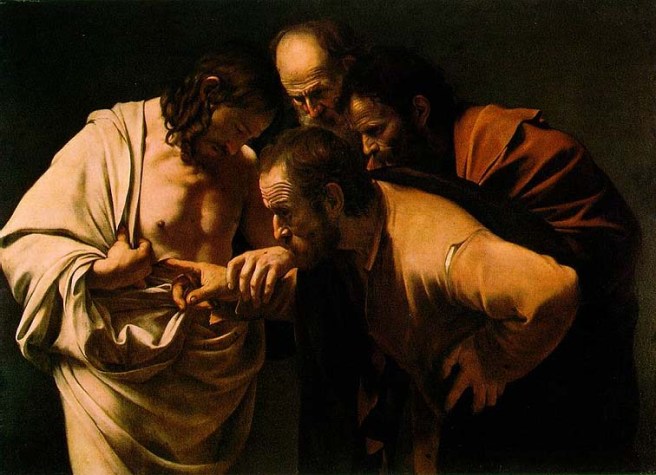
Painting by Caravaggio

Rather than relying on second-hand rumors, he demands first-hand knowledge.

Wisdom, arise!


Those who lived here for millennia need to be acknowledged, too

One of the things the Dover 400 project is doing is raising an awareness of the Indigenous peoples who inhabited the region for millennia before European colonists arrived.

The tribes were far more varied than the generic “Indian” label conveys. Sometimes they were in open conflict with each other, and there were many differences in language, culture, and lifestyles. There were also alliances with other tribes, creating subtle but significant relations across the region.

Some lived in permanent villages, often along streams. Others ranged from ancestral site to site through the year in a cycle of fruit, vegetable, and animal fare.

As hunters and fisherfolk who often traveled by water and lived in villages along the shores, many of their names for places are often translated as some variation of “water,” with distinctive nuances that are lost to Western ears but still hint of sharp observation of the character and advantages of each site.

Their name for Hilton Point, for example, is something along of the lines of “place encircled by water,” while Cochecho is more like “foaming falls,” each one, however, unlike other points or coves or waterfalls.

As for our own names applied to these places? I doubt we give them a second thought other than perhaps their spelling.

And, to our loss, we have none of their mythopoetic stories in their original richness – narratives rooted in their unique environment. At least we can begin to listen to those told by surviving tribes in neighboring Maine.

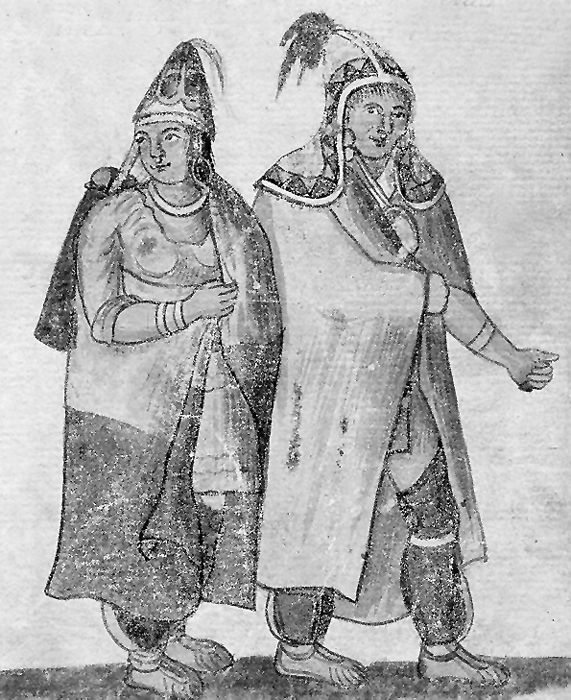
There are good reasons the Abenaki and other New England tribes didn’t dress like the High Plains Natives far to the west.

  ~*~

WHEN THE ENGLISH ARRIVED in New England, most of the tribes had been decimated by pandemics, many of the illnesses resulting from contact with earlier explorers and traders. The sharp loss of population gave the Pilgrims an opening in their settlement at Plymouth.

The first traders brought items the Natives appreciated as useful – metal pots, knives, blankets – that could be obtained in exchange for furs.

As we know, the dynamic changed. We’ve rarely heard the Indigenous voices tell their side of the struggles. The English, French, and Dutch all have barbaric actions to atone for.

The marker at Ambush Rock on Route 101 in Eliot, Maine, for example, makes it sound like the victims were an innocent party on its way home from church one Sunday in 1697. There’s no mention that the prime target, Major Charles Frost, was Richard Waldron’s cohort in the notorious “games” of 1676 that ended up in the arrest of nearly 400 Natives who were then executed or sold into slavery. The Natives waited 21 years for revenge. Frost was the highest-ranking militia officer in Maine.

For me, the missing details change my view of the event entirely. It’s not an isolated instance.

~*~

DOVER WAS IN PENNACOOK COUNTRY, a tribe closely related to the Abenaki – the identities are sometimes merged, suggesting change over time. The Pennacook spanned over much of New Hampshire, neighboring Maine, and parts of Massachusetts. The English jurisdictions didn’t match theirs.

Another consideration is how many of the English settlements occurred at earlier Indigenous villages, as seems to be the case both at the falls in today’s downtown Dover or neighboring Exeter, Newmarket, Durham, Rollinsford, Somersworth, and South Berwick.

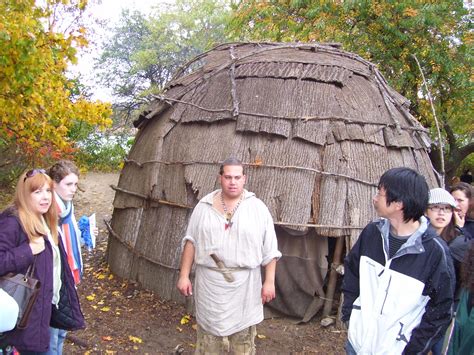
A wigwam at the Plimoth Plantation living history museum allows visitors to explore a typical Indigenous winter dwelling. The interior is bigger than you’d expect. (Photo by Swampyank via Wikimedia Commons.)
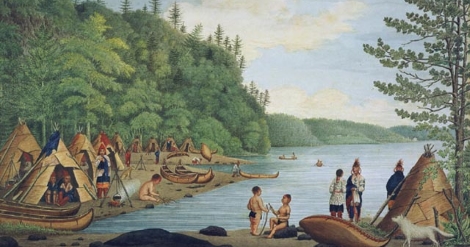
A Pennacook encampment much like those in the Piscataqua watershed.

~*~

ONE THING THAT WAS OBVIOUS TO ME in a visit to the Plimoth living history museum in Massachusetts was how superior the Wampanoag’s communal wigwams were for living through winter compared to the Pilgrim’s drafty cottages of 1630.

I’m sure the same can be said of the shores of the Piscataqua.

~*~

Welcome to Dover’s upcoming 400th anniversary.

‘Why look among the dead for someone who is alive?’

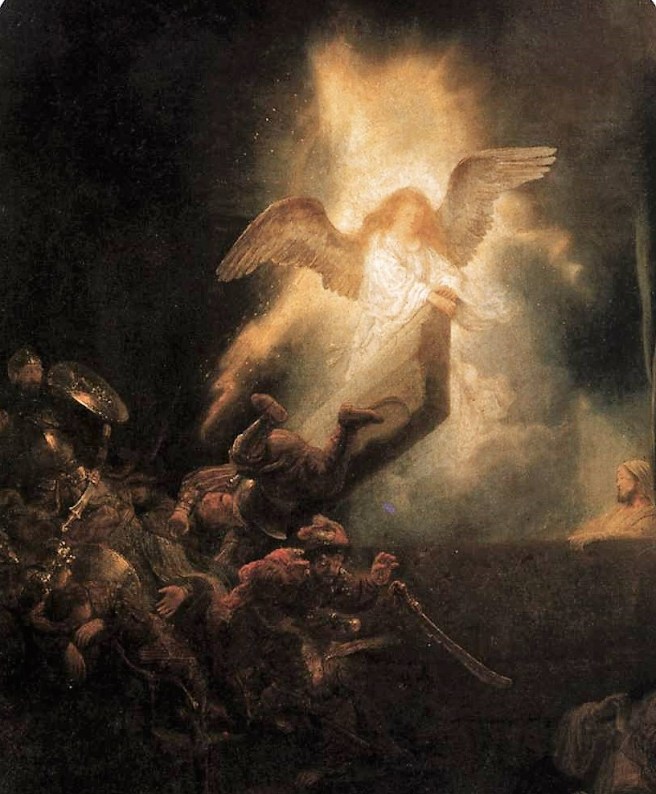
Rather than portraying the women disciples at the empty tomb, Rembrandt focuses on one of the angels and the world-changing impact of their message.

Luke 24, by the way, describes them not as angels, with wings, but rather as two men in shining garments or brilliant clothes or even gleaming like lightning, depending on the translation.

The words must have struck like a thunderbolt.


A few things I had hoped to do with Friends Meeting but never quite got around to

The position of clerk in a Quaker Meeting is akin to being president or chairman, except that you’re not the boss. Historically, it was more like being clerk in a courtroom, recording decisions from a judge in the bench above – in this case, Christ or, if you prefer, Light. For Friends of a less Biblical bent, things get more tangled and less focused, at least my perspective.

A Meeting in the Society of Friends, as we’re more formally known, whether of the open, traditionally “silent” worship like mine or of the more widespread pastoral “programmed” variety, has a presiding clerk as well as a recording clerk for its monthly business sessions, as well as a clerk for each of its committees. The Monthly Meetings are then grouped in neighboring Quarterly Meetings, which gather four times a year and have a similar structure, and are then joined together as regional Yearly Meetings that have annual gatherings – and that’s it for hierarchy. There’s a lot of work to do, just as there is in any family.

In my strand of the Quaker world, we don’t have a pastor but we often expect the clerk to fill many of the functions, sometimes everything except preaching or praying aloud on Sundays. I was detailed those expectations in an article published in Quaker Life magazine. In theory, you’re more of a moderator. In reality, you’re the first person the others turn to when a light bulb is out, the key to the door’s missing, or the fire alarm’s going off in the meetinghouse after a power outage. As for real emergencies?

As I’ve observed, there’s a lot of burnout, usually after two years.

I tried to pace myself accordingly in the six years I served as Quarterly Meeting clerk and the five at the head of Monthly Meeting as well as the nine or so I was a member of the Yearly Meeting’s Ministry and Counsel committee.

Along the way, I’ve come to admire some amazingly skilled clerks as well as pastors, priests, and rabbis in the wider community. Few of us, I should note, are really trained in this matter of dealing with people or institutions, and most of us would rather be fine-tuning theology of one sort or another.

~*~

As I entered retirement, I felt a curious softening in my personal Quaker identity. Part of it was a consequence of finally having lived with children, in addition to a spouse’s input. Ours never did run along the lines of a Quaker Meeting, as I had once idealistically envisioned. (I would like to be able to go back to interview the now-grown children of a few families I had known who proclaimed “Jesus is the head of this household” to discover how well that had worked, usually in rural settings.)

By the time I left full-time employment, I realized there was no previous period in Friends history where I would have fit in comfortably. I love the fine arts too much, for one thing. Nor could I go Plain today, though I had once flirted with it: the Plain dress and speech need to be part of a community, not of a lone ranger seen only as an eccentric or even scary. For a while, my beard was along the lines of Amish and Brethren, with no mustache, but once I had married, my wife found that look too severe.

I’ve rounded some corner into now. Wherever that is.

~*~

Lately, I’ve been sharing with you some reflections as I’ve been comparing my original plans for retirement with what’s actually happened in my life in the decade since leaving full-time employment. The review has included Quaker service as well.

Even before retiring, for instance, I had hoped to send out annual thank-you cards and letters, recognizing Friends for their service. Too often, that goes unacknowledged but still expected or even subtly demanded. I also wanted to invite the clerks and the other officers, such as the treasurer, and their partners to a big dinner, probably a cookout in our Smoking Garden in early summer. I envisioned something similar for the charter school board where my wife was chairman. Alas, these never happened.

Well, our big parties there had pretty much faded from the schedule as the years progressed and other demands crept in. We are hoping to resume them in our new locale, once the renovations and our full relocation are in place.

Something more ambitious was what I termed the Light Project. Prompted by questions asking, exactly, what Friends believe theologically, I had found myself connecting the dots in early Quaker thought and found myself facing an alternative Christianity, one they dared not articulate fully in the open. I’ve presented my take in four booklets you can download at my Thistle Finch blog, and I would love to hear your insights and reactions.

I had expected to be spending more time following up on these foundations, both in journal articles and traveling around the country to lead workshops and discussions, but Friends have had more pressing realities to contend with, as we found springing from the Trump administration and now Covid. On my end, revising and releasing my novels also deeply engaged me, bringing with them a feeling of personal satisfaction and accomplishment.

So, for now, my Light Project has rather fizzled out. Perhaps the release of my next book, a history of Dover Meeting and a wider counterculture in New England, will revive the Light Project, too.

~*~

Other unfinished business on my heart involves outreach, attracting like-minded souls to our legacy. Having a booth at community fairs was a start, as was an open house, but I was hoping to do more with the campus center at the neighboring state university, perhaps guiding a weekly “worship sharing” event or Quaker Quest series, as well as visiting more widely among other Friends Meetings and retreat centers, in a tradition called intervisitation.

And then there was hosting the monthly Poetry in the Meetinghouse series I mentioned earlier. It may have even been part of a cycle of weekly events that included folk music concerts, films and discussion, and a lecture.

Oh, my, the last item reminds me of something I had hoped to revive from the local religious leaders’ fellowship – their Cochecho Forum. Look up Bill Moyer’s Genesis project, which aired as a series on PBS, to see how I wanted to launch something similar through DARLA. It would have been exciting.

~*~

Well, revisiting all of this reminds me of an old Quaker adage, and perhaps find comfort in it: “Be careful not to outrun thy Guide.”
A map is seen much differently from the water

One awareness I’ve gained living in New England is that when you’re out on the water – say in a sailboat, fishing boat, whale watch, or ferry – the geography fits together quite differently than it does on the land.

For example, where I now live in Maine, it’s only four miles or so from our downtown to the one just south of us. That is, if you’re just looking, going by water, or a bird. To drive, though, you have to head north and loop around Cobscook Bay, a distance of 38 miles and about 46 minutes. At least it has no traffic lights.

The water perspective is especially important in understanding the dynamics of early Dover, centered as it was at Hilton Point and Dover Neck between the Piscataqua River and Great Bay. For example, the heart of the town of Kittery was in today’s Eliot, just a mile away by water but 18 miles by land. And today’s Kittery was ten miles downstream or even longer by land.

Hilton Point was just to the left of the “cat” in Piscataqua, while the Shapleigh Kittery House was just to the cat’s right. Getting there by land, though, means going all the way up to the Salmon Falls River. Even finding a map like this of the watershed can be a challenge. Usually, it’s divided by the state line that runs up the river.

Oyster River, or today’s Durham, was only four to eight miles to the west, depending whether you were stopping at wharves along the way or going all the way to the Lamprey River’s falls and the landing.

A trip by boat between Eliot/Kittery and Oyster River/Dover was – and still is – no big deal.

In fact, by water they were closer to Hilton Point than was the village at Cochecho Falls, today’s downtown Dover.

For perspective, I’ve read that a man on the Isles of Shoals thought nothing of rowing ten miles – six of them on the open ocean – for an evening in Portsmouth and then ten miles back in the dark.

In comparison, the relocation of families from Eliot/Kittery to Oyster River becomes much more sensible than a land-based movement would suggest, and much less puzzlingly.

Also, the boundary between New Hampshire and Maine largely dissolves. The watershed becomes the defining perspective.

In terms of understanding history, “Piscataqua” can mean not just the original settlement at Hilton Point but also the expansion across both sides up and down the river. That seems to be the case when Portsmouth, Kittery, and New Castle all claim a 1623 founding.

You might even say it muddies the water.

~*~

Welcome to Dover’s upcoming 400th anniversary.


Selling Natives into slavery was not an isolated instance  

One of the more disquieting things my examination of early Dover and New England stirred up for me is an awareness of a prevalent expression of white supremacy.

It starts out as fear, expressed in the emphasis on fortifications. The Plymouth settlers, for instance, spent much of their first year on building palisades rather than farming, which led to a nearly disastrous shortage of food through the winter. The defenses were apparently intended against Native raiders more than the Spanish, French, Dutch, or pirates.

Later, Puritans required palisades around their houses of worship as well, as happened at Dover’s second meetinghouse, and ordered that all men carry arms, which were lined up against the wall during public assemblies such as religious services.

~*~

THE PREMISE OF WHITE SUPREMACY COMES THROUGH CLEARLY embedded in descriptions of the Indigenous as savages or pagans and is intensified in the resolution of legal conflicts in an unjust system of jurisprudence. Natives always came out on the losing end, with no means of appeal.

Especially telling is the reaction to the killing of John Stone and seven of his crew in 1634 in retaliation for his kidnapping and murder of the Pequot sachem Tatobem. Even though Stone had previously been banned from Boston for drunkenness, adultery, and piracy, and news of his death brought outright joy to some residents in the city, officials demanded the Natives turn over the warriors responsible to face trial. The Pequot, however, refused, even after paying atonement.

Simmering tensions erupted in 1636 after the killing of trader John Oldham and several of his crew on a journey to Block Island, Rhode Island. Even though Oldham was a troublemaker banished from the Plymouth colony, his death caused sermons across Massachusetts and prompted military action that quickly escalated into war.

Telling of the implicit racism is Roger Williams’ line of congratulation to John Winthrop in 1637 for disposing of “another drove of Adam’s degenerate seed.”

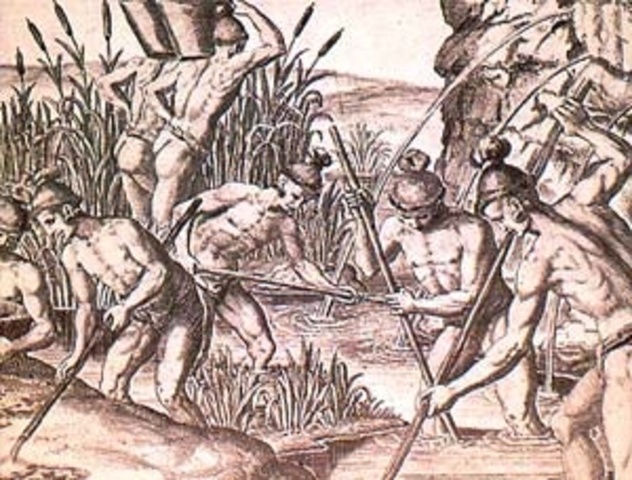
Natives being hunted down and captured.

~*~

BY 1638, MOST OF THE PEQUOT had been massacred or sold into slavery in Bermuda or the West Indies. An estimated 1,500 warriors had died in battle or been hunted down. And what followed was a landgrab by the colonists.

Military leader John Underhill, responsible for the massacre of Pequot women and children fleeing their burning village, then came to Dover, where he was briefly governor of the upper province, meaning Dover.

Bluntly? From the colonists’ perspective, a bad white man was worth more than a noble Native.

~*~

SLAVERY WAS PART OF NEW ENGLAND from the beginning.

When David Thomson settled at Pannaway in 1623, he had a Native as a slave, presented to him by an Indian leader. Yes, there was slaveholding among the Indigenous, too.

And whites could be enslaved as well, as was seen in threats to sell Quaker children in the late 1650s.

A key turn in the emergence of Merrymount in 1625 was the sale of some of the project’s indentured English male servants to Virginia and the impending sale of more to the tobacco estates, where death within a year was likely. Thomas Morton used the situation to rally the remainder to resist and stay put, leading to his libertine colony south of today’s Boston.

The origins of African slaves in New England are murky, but Pequots were exported so that they could not escape and return to their families or be freed in retaliatory raids. Instead, they were exchanged for Blacks, who could be held at less risk.

Natives labored in Barbados and the West Indies after being exchanged for Africans as slaves.

In 1637, during the Pequot War, the first American-built slave ship, the Desire, was constructed in Marblehead, Massachusetts, outfitted with leg irons and bars, and armed. She set sail to the British West Indies carrying Boston rum, dried fish, and captive Pequots, and returned seven months later with tobacco, cotton, salt, and enslaved Africans from the Caribbean plantations.

Thomson’s friend Samuel Maverick bought two Blacks as slaves in 1638. Another prominent slaveholder was John Winthrop.

In 1641, the Massachusetts Body of Liberties document included a formal recognition of slaveholding.

~*~

UP TO THE AMERICAN REVOLUTION, despite opposition, some Quakers held slaves, and Dover was not exempt. Up to ten were manumitted, likely with the equivalent of a year’s wages. There’s more on this in my book.

~*~

Welcome to Dover’s upcoming 400th anniversary.


She was truly one of a kind

In reflecting recently on the Quaker tradition of creating memorial minutes for “weighty Friends,” I was surprised that one example I had never posted was of another clerk of our Dover Meeting. She was struck down by a particularly virulent, fast-moving cancer, and it’s hard to me to see that nearly five years have gone by since her passing.

There’s much more that I could tell, but the approved minute will give you a good sense of her vibrant character.

Jean V. Blickensderfer

November 11, 1946 – June 16, 2017

Among Dover Friends, Jean was the flash of gold in the morning, a welcoming soul others naturally confided in, a faithful worker who eventually filled nearly every organizational position – from children’s teacher and treasurer, to co-clerk and finally presiding clerk.

Raised Unitarian-Universalist in Methuen, Massachusetts, she came to Friends in the early ‘80s after she and her first husband, Dean L. Davis, had settled in Eliot, Maine, and were seeking the right church for a family that included daughters Thaedra May and Sarah Joy. They were quickly entrenched among us.

Jean was twice widowed.

She married Dean the day after his graduation from the Maine Maritime Academy in 1967, and then managed their home during his long assignments at sea. During his interludes ashore, they built their own post-and-beam house on the banks of the Piscataqua River and could often be found boating, sometimes to visit other Quakers upstream, or on his motorcycle, which they rode to Meeting in good weather. He died in a freak automobile collision in 1992, an accident his wife and daughters survived unscathed.

In 1998 she married Del Blickensderfer and worked as his partner at Del’s Service Station until his passing of lupus in 2006.

Deeply grateful for the mentoring she received from seasoned Friends, Jean was a stickler for Quaker process and, over time, became the memory of the Meeting’s business itself. She sought to walk a line between holding her tongue and being direct, when needed. A witness to the movement of Christ in our midst, Jean’s infrequent vocal ministry could be powerful. Her skills as a professional typist assured the Meeting’s minutes were of archival quality and, combined with her business-school training, led to the Blue Books for committees and their clerks detailing their responsibilities. She was particularly fond of drawing on the Advices and Queries from London Yearly Meeting’s 1994 edition of Quaker Faith and Practice as guideposts for our own action. An avid knitter, she took comfort in seeing others do needlework during our business deliberations, their patience reflecting the work before us. In time, a midweek knitting circle became what she called a “wicked good” time of refreshment, nurture, and fellowship.

More pressing obligations had precluded her attending yearly meeting sessions, a “bucket list” item she resolved to achieve. All along, she warmly welcomed the wider world of Friends to Dover.

Other delights in her life were yoga, visiting with neighbors, shopping and dining with dear friends, walking the beach, doting on her Pomeranian Sumi, and especially being with her grandson Jonah. His living in Albuquerque, New Mexico, did not prevent her from accompanying much of his childhood and youth, from celebrating birthdays and holidays to attending his piano recitals to cheering him on in mountain bicycle races, whenever she could.

In all, her presence, generosity, and deep and lively spirit were a gift.

With loved ones at her bedside through the final days of her cancer, she passed at age 70, peace and grace abundant.

APPROVED by Dover Monthly Meeting July 16, 2017, Charles Cox, clerk

 ENDORSED by Dover Quarterly Meeting July 31, 2017, at North Sandwich, Erik Cleven, clerk


Food as religion

Perhaps you know the counsel, “’Eat to Live,’ rather than ‘Live to Eat.’”

Still, a big change has occurred in America in the past half century. While the impact of organized religion has declined, a quest for a rich, even exotic, cuisine has flourished. As I posted a few years ago, dining out became the major fine art form of our time, rather than music, theater, film, or dance.  It’s the ethereal experience, the sensual transcendence, that’s the goal – ultimately, subjective rather than objective, heightened by long exposure to the field. Examples? Just look at the restaurant and wine reviews, along with their arcane or cryptic dialect.

Well, that also takes it into the realm of spirituality and religion, too, although that might also temper the feasting with periods of fasting. Maybe all of the limitations that have popped up, usually for health reasons or weight control, fit in here. It has been said that you can’t read the life of Jesus without getting hungry – there’s food or a food event at nearly every turn. (As a rabbi told me, that’s because Jesus was Jewish and in social settings, you always wind up with something to nibble in your hand.)

I’m left wondering how this translates to the home kitchen. Cooking skills, by and large, seem to be less universal than in the past, and time to devote to food preparation usually comes at a premium. Is takeout a kind of sacrificial nod to the food gods?

One thing I will say in all of the transformation. Thank God for the microwave oven.

As the story goes, he’s a perfect villain

The three Quaker women who come to Dover in 1662 and 1663 are tormented principally by Major Richard Waldron. He and his brother William arrived from a staunchly Puritan family in Warwickshire in 1635, and after returning to England to marry a woman against her family’s wishes, Richard returns to Dover. History does not record her name, only his second wife’s. In 1642 he buys up rights around the dramatic waterfalls of the Cochecho River about five miles north of Hilton Point.

In building mills there and establishing a village, Richard consolidates power and wealth. He has, for one thing, obtained a monopoly on fur trade with the Natives and, for another, rises to head the colony’s militia, a politically powerful position. In addition, he serves 22 years as a deputy of the General Court of Massachusetts, its assembly, seven of them as its Speaker. He votes to impose the anti-Quaker acts of 1656 and 1657.

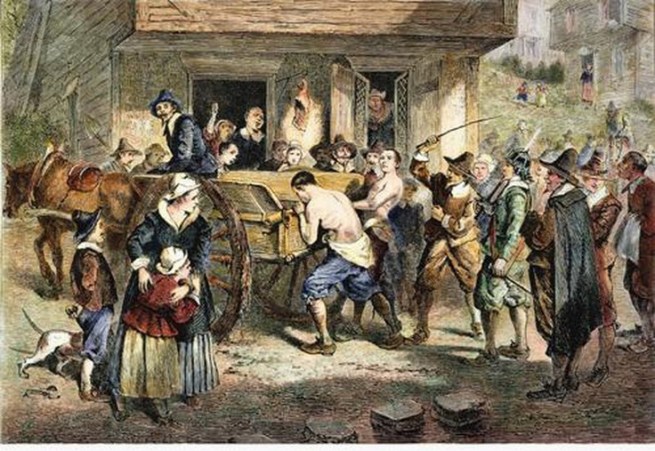
Richard Waldron was influential in the passage of the anti-Quaker Cart and Whip act and other punishments.

Dover is not his only residence – at least three of his children are born in Boston and he has ships on the sea. He’s also the magistrate who imposes the Cart and Whip sentence on the Quaker women who come to Dover – in effect, a death sentence if constables in towns down the road follow through on his order. Even his wife is appalled by his cruelty.

He’s also the mastermind behind the invitation to the Natives to participate in a mock war game and festivities in 1676. After the 20 armed Natives fire their weapons, they are surrounded and arrested, along with 350 or more, mostly women and children. Seven or eight of the leaders are sent to Boston and executed. The rest are sold into slavery in the Barbados or West Indies.

Major Richard Waldron masterminded the sham war game that led to the captivity of local Natives who came in peace.

The Natives do not forget Waldron’s deceit and cunning. Knowing they cannot trust the English, they form an alliance with France. Many of them convert to Catholicism under French priests.

In 1689, they take their revenge, attacking and burning garrisons at Cochecho village, killing 23 and taking 29 captive to Canada. Quakers are not spared. Waldron, however, is singled out for torture and death.

The early morning raid is the beginning of devastating violence large and small across northern New England that does not end until the end of the French and Indian Wars in 1763.

Every family in Dover would suffer losses. They were far from the only ones.

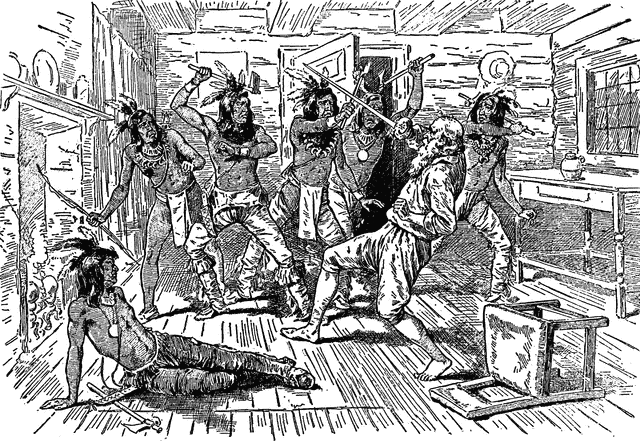
Major Waldron was singled out in revenge.

Behind the scenes, an ominous shift in the settlement’s character had been occurring, centered on Waldron. The sixth son of a well-off Puritan family, he was “immensely able, forceful, and ambitious,” arriving with his oldest brother in 1635, when he was barely twenty. In 1637, he returned to England, married a young gentlewoman despite her parents’ opposition, and brought her to Dover. Her name and dates are unknown. He then married Anne Scammon and had eleven children.

By 1642, he had accumulated the rights to land around the falls in today’s downtown Dover and erected his first sawmill. Emerging as the town’s central figure, he eventually controlled much of the Native trade and amassed large land holdings. In pressing for Dover to submit to Massachusetts jurisdiction, Waldron placed himself in opposition to Thomas Roberts, who then lost office when the Dover province was subsumed by the Massachusetts Bay colony.

Waldron, in contrast, became a deputy to the Massachusetts General Court, or legislature, in 1654, where he served for the next twenty-two years, seven of them as its general speaker, one of the most powerful political posts in New England. How much time was he spending in Boston during this period, and how much in Dover? At least three of his children – Elnathon, Esther, and Mary – were born in Boston.

Brother William also held public office and eventually purchased a part of the Shrewsbury Patent in today’s town of Stratham. He was, according to Massachusetts governor John Winthrop, “a good clerk and a subtle man,” one who “had an inclination toward drink and contention,” which leaves me wondering about Richard as well. While crossing a small river at Kennebunk on his way back from Saco, Maine, in 1646, William drowned. Whatever his skills as a public official, his business dealings left him in debt to many creditors. Like the Hilton brothers, we have a case where the younger brother fared more successfully than his elder.

After his death, another brother, George, showed up in Dover after 1650, when he was a chandler in London. From 1659 through 1677, he was taxed as a resident of Dover. His domestic life, however, was strained. In June 1661, he was in court for being absent from his wife, and again in the fall of 1662, when she was reported dead twelve months. In June 1680, he petitioned the court to be rid of his son, “who instead of holding me hath rather destroyed me and what I had in drinking.” Impoverished, elderly, and nearly blind, he appealed for a guardian. Mrs. Richard Waldron took him in until her husband’s return.

Richard, on the other hand, flourished, not just in politics. He traded widely, as is seen in the death in Algiers around 1669 of his son, Paul, “probably on board one of his father’s vessels.” Another son, Timothy, died while a student at Harvard. Daughter Esther died on the Isle of Jersey. Quite simply, his family wasn’t stuck on the banks of the Cochecho or Piscataqua rivers.

The Cochecho Falls and the village that grew up around them were part of Richard Waldron’s power base.

As Jere Daniell observed, “By the 1670s the portion of Dover known as Cochecho had become something like Waldron’s personal fiefdom, and citizens in the other areas of settlement rarely challenged his social authority.”

A man like that had to have enemies and a capacity for revenge.

From everything I’ve seen, he was quite unlike Nicholas Shapleigh just across the river.

~*~

Welcome to Dover’s upcoming 400th anniversary.


Remembering a dear Friend

One of the cherished traditions among Quakers is the creation of memorial minutes for members who have served the Meeting faithfully.

The minute is a unique document. It’s neither an obituary nor a eulogy. Rather, it attempts to candidly reflect the movement of the Divine Spirit in the individual’s life.

Here is a recent example.

Earl ‘Chip’ Neal

(December 9, 1945-June 25, 2021)

When Chip Neal brought his family to Dover from Maryland in 1978, they loved everything about their new home except the proposed construction of a nuclear power plant in nearby Seabrook.

He had been hired by New Hampshire Public Television to do a nightly news show, having worked his way up from entry-level floorman in a pioneering community college television station to cameraman at WETA in Washington and then director/producer at Maryland Public Television.

Across the Granite State he became known for the segments he produced and hosted on “New Hampshire Crossroads,” where spent many years traveling every corner of the state bringing unique New Hampshire features and people to a statewide audience. It was in one of those stories that he coined the phrase “Yankee yard.” His curiosity was sweet-tempered and non-judgmental. He also produced segments for the popular weekly “Windows to the Wild” outdoors adventures series featuring Willem Lange.

Although he attended the University of Illinois during the Vietnam era, he did not earn a degree until he worked at the University of New Hampshire for NHPTV. He graduated from college the same year his daughter, Amanda, graduated from high school.

He never aspired to go into management. Rather, he always preferred to be hands-on, something son James inherited.

That was reflected in the family’s old farmhouse near the Cochecho River, where they began rearing a few chickens, sheep, and honeybees. After aligning with the Clamshell Alliance opposing the Seabrook Station, he realized the activists he admired the most were all Quakers, and soon he, too, was worshiping in the old meetinghouse, along with children Jamie and Amanda, while his wife Nell continued at First Parish just down the street. Over time, as she felt her spiritual growth being nurtured more through connections with Friends, she, too, became part of the Meeting.

Their social life included visits by boat with other Quaker families living downstream or around Great Bay. Inspired by what he had read about the Amish and a “why not” attitude, Chip determined to try a barn-raising of his own, resulting in a merry one-day celebration that did, indeed, accomplish the task.

Chip was commissioned to create a private documentary profiling Silas Weeks, who had been instrumental in the reopening of the Dover Friends meetinghouse. The interviews, now available on YouTube, remain a touching intersection of the faithful lives of both Silas and Chip.

Many of the qualities of Chip’s spiritual life also infused his professional career. A fellow producer noted that Chip possessed a brilliant communication talent in short-form and long-form storytelling. He not only saw the heart of a story, he let it speak for itself, time and time again. Where most producers tended to interpret meaning for the viewer, Chip had the unending patience – and absolute stubbornness – to never let that happen in his work. Thanks to his relentless focus, firm discipline, and above all a fabulous sense of humor, time and time again he would dig down until he found the light of truth hiding inside the most humble to the most exalted story, and to let it shine like a diamond in the wide open, all on its own, available and meaningful to the viewer.

As he grew and matured, he more and more thought deeply and broadly about events and phenomena, all with a spiritual bent. Often, this led to rising in the middle of the night to write down his ideas and insights, sometimes as haiku with a snap.

He emphasized the necessity of being centered in the present, explaining, “Life is that thing you’re doing right now.” From that, he had an ability to view difficulties from the side and then provide helpful alternatives to the knot before us.

During his terms as clerk of Dover Friends Meeting, Chip would stand after the closing of worship with the shaking of hands and then, gazing around the room, say simply, “Thank you for sharing your spiritual journey with us this morning – whether spoken or unspoken.”

He loved serving as clerk and treasured Quaker process, especially taking sufficient time in our labors together.

The advance of Parkinson’s interrupted his service to family, Friends, and the wider world, but not his presence. He had often reminded us that in trying to reach a destination while sailing, one had to constantly make adjustments – tacking.

He was also fond of a Navajo prayer:

All above me peaceful,
all below me peaceful,
all beside me peaceful,
all around me peaceful.

He passed over peacefully on June 25, 2021, in the comfort of his wife, Nell.

Memorial minute approved by Dover Monthly Meeting, November 21, 2021