HOT DOG BUNS VERSUS FRANKFURTER ROLLS

Once upon a time, or so it seems now, a girlfriend sent me out with orders to come back with hot dog buns, which is what I did.

But when I handed her the grocery bag, she cried out, “Oh, no! What are these?”

“They’re hot dog buns,” I replied ever so naively.

“No they’re not!” she insisted.

“But they’re what I’ve always had hot dogs on,” and they were.

She would not believe me, so off we went, together, to the supermarket.

“These,” she said, “are hot dog buns.”

Asked to pick out a hot dog bun, which would you choose -- the ones sliced on the top, at left, or on the side, at right?
Asked to pick out a hot dog bun, which would you choose — the ones sliced on the top, at left, or on the side, at right?

They looked like a flattened loaf of bread cut in fat slices. The side of each “bun,” in fact, was without crust – naked, to my taste.

Pointing to another shelf, I looked at the kind I’d always known – the kind, that in fact, came labeled Hot Dog Buns. Hers, in contrast, were labeled Frankfurter Rolls.

Hmm, we both said without satisfaction.

She had, in truth, grown up in New England and lived nowhere else. And her idea of how to serve a hot dog was unique to the region. Not in something she considered a torpedo roll.
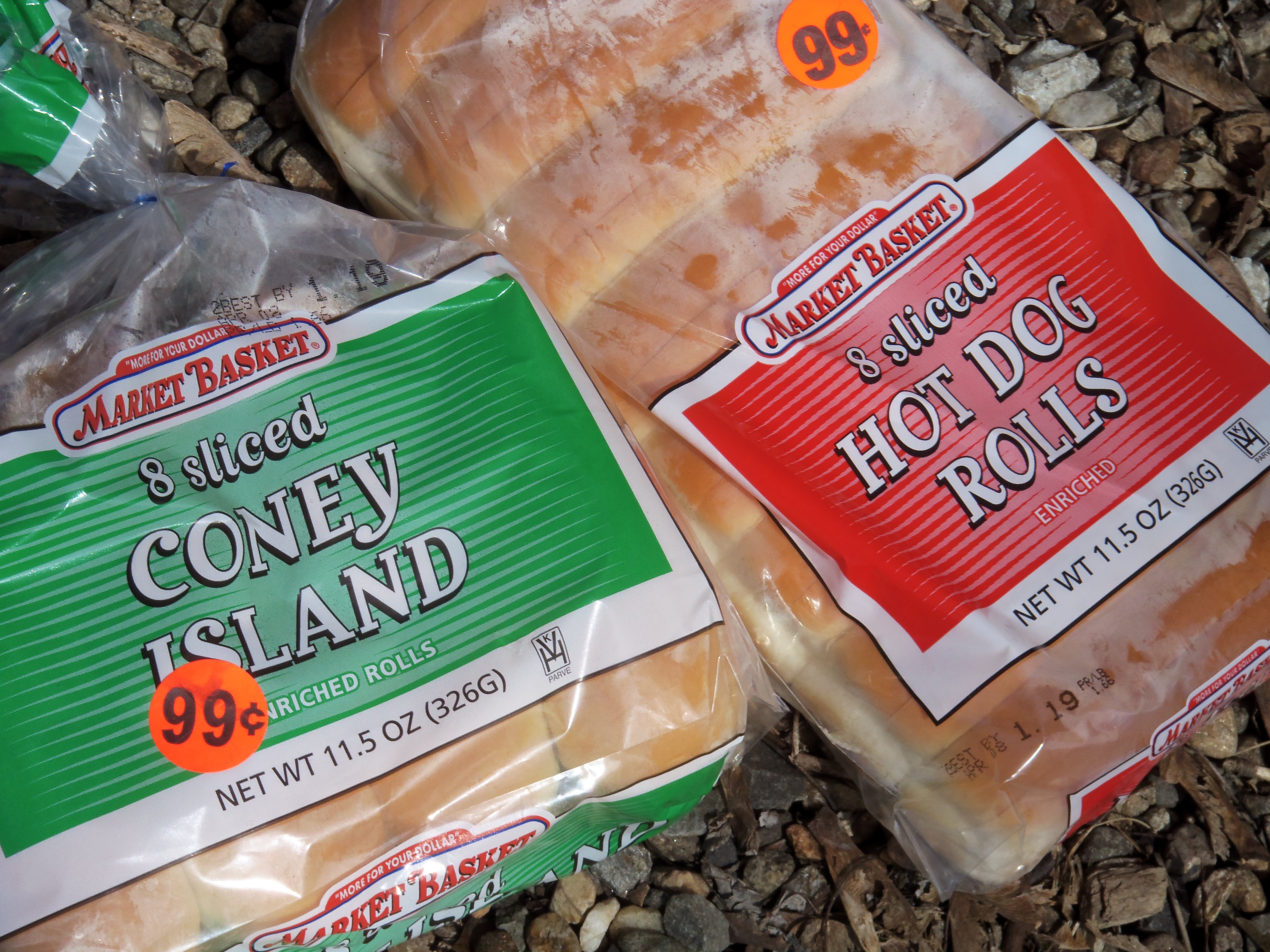
Ah, but the plot thickens. As I bought packages of each this time around, there was no Frankfurter label -- and the Hot Dog tag instead went on what my wife confirms are often called Frankfurter buns or rolls around here. As a further complication, we now have the term Coney Island, which confounds my elder daughter while bringing to my mind something completely different, a miniature hot dog where I grew up, often served covered with "chili." But that's a whole other story.
Ah, but the plot thickens. As I bought packages of each this time around, there was no Frankfurter label — and the Hot Dog tag instead went on what my wife confirms are often called Frankfurter buns or rolls around here. As a further complication, we now have the term Coney Island, which confounds my elder daughter while bringing to my mind something completely different, a miniature hot dog where I grew up, often served covered with “chili.” But that’s a whole other story.

This can, in turn, point to a lot of other regional distinctions. Whether you call a device a watercooler, a water fountain, or a bubbler, as we do here. Or whether you order a soda, a pop, or a cola. Feel free to expand the list. It can go on a long time.

Fast forward, then, to lunchtime at a national conference being held in Rhode Island. I sat down and joined a random group that included a handful of teens. One was from North Carolina. I pointed to the hot dog on his neighbor’s plate. He looked bewildered. “What’s it wrapped in?” he asked.

“Would you call it a hot dog bun?” I prompted.

“No way!”

“Oh yes it is,” said the girl from Connecticut. “It’s what we always use.”

You know where the conversation went from there. Yes it is, no it isn’t.

At least the college cafeteria knew to stock both Hot Dog Buns and Frankfurter Rolls.  As we all discovered.

Hmm. Maybe next time we have a crowd over and we’re grilling hot dogs, I’ll get packages of both – and then see which kind goes first.

SEASONS OF THE SPIRIT

To perceive a spiritual journey as Seasons of the Spirit acknowledges how much of it is out of our own hands, like the weather. We yield to the Spirit and are guided by it, to the extent we are faithful. “Which Spirit is thee speaking of?” I hear echoing, a memory of elder Mary Hawkins of rural Ohio before she counseled me of other spirits, such as anger and jealousy and so on. For the record, then, this is what I now call the Spirit of Christ – specifically, the Light and Life addressed in the opening chapter of the Gospel of John. You may define your encounters as you may. My interest here is with an experienced connection with the Divine and a heightened awareness of its manifestations among us.

While everyone talks about the weather, few openly discuss religion. Too often, those who do raise the subject seem unwilling to listen, at least openly, and their arguments are cast along the lines of dogma or creed. Again, my focus is not on what we have been taught about faith, but what we can say about its workings in our own lives. When we can get past the formulaic responses, a discussion of religious experience allows us to search some of the deepest desires and fears of human existence. It can also unleash extraordinary social reform, as we might see looking through history, or be constrained to do the precise opposite.

 *   *   *

To speak of Spirit in this manner requires us to search for the ways it becomes embodied in our lives and our world. That is, how it takes flesh. What is abstract reveals itself in concrete decisions and actions, as well as thoughts and emotions.

POSITIVE AND NEGATIVE POTLATCH

Among the coastal tribes of the Pacific Northwest was a custom known as the potlatch. Essentially, it was a way for the wealthiest members to enhance their status by redistributing the wealth downward. Starting with blankets and maybe a festive meal.

But then things got out of control. The way things do at a party when you forget about tomorrow, again.

Still, you first need to know everyone in the village and the fact it’s your home. Yes, the way families and neighbors just might function together.

Even so, remember. Maybe it was all Coyote’s fault, after all.

A LIVELY CAST

One of our favorite TV comedies has been Little Mosque on the Prairie, a Canadian series about a small, struggling Muslim community the fictional prairie town of Mercy, Saskatchewan. I’ll let those of you in other faith traditions weigh in on the parallels, but I suspect you’ll find each of the show’s characters already existing in your own congregation.

You’ll also see many of the same dividing lines and tensions. Traditionalists versus modernists, for instance, or those bred to the faith versus converts. There are even the basic questions of identity and self-identity or motivation and discipline.

As I look at my own Quaker circles, I sometimes see a line between those drawn to the hour of worship itself and those drawn to the peace-and-justice witness, such as gender and racial equality, global non-violence and fair trade, prison reform, environmental concerns, and the like. Sometimes the difference shows up most sharply in the announcements that come at the end of our period of silence – those who want to leave quietly, savoring the calm, and those who instead urge us to attend all kinds of lectures, discussions, demonstrations, fundraisers, and other gatherings in the coming weeks.

Sometimes the lines even cross.

MUG, MORE THAN A CUP

Seems I’ve always been a coffee lover, as far back as those “coffee milks” our Gran used to serve my sister and me on Sunday afternoons. Maybe that’s why I still prefer mine café au lait – half milk heated with a liberal dose of sugar or sweetener.

For decades now, my days have begun with a round of hot coffee, often abed – yes, how blessed I was after remarrying, when my wife would appear with the perfect mug when I needed to awaken. And how much I lament how that ceased, in part because the office rejuggled my schedule, meaning she never knew quite when I would be rousing.

For someone in a faith tradition that eschews rituals, I have to admit where they really appear – and be willing to acknowledge anything that’s an addiction, as well. (Remind me to take a coffee fast in the next year, OK?) Yes, maybe the editors of one poetry journal had it right when they admitted they were devotees of the Goddess Caffeina. (Oh, she has temples everywhere.)

More recently I’ve begun to question whether it’s really the coffee itself I like. That is, I can drink it black. And, yes, I also demand dark coffee – the darker, the better. I even like Starbucks, though that has nothing to do with my years in the Nevergreen State. (Remember, I lived in the desert side of Washington state.) No, I realize when the mug’s turned cold, my beverage tastes a lot like the cartons of chocolate milk we used to purchase in the elementary school vending machine – the ones that cost us a nickel. So maybe it’s that chocolate underpinning that grabs me.

Is it possible that even at six-foot-two, the chocolate stunted my growth? We can’t blame the coffee, now, can we?

LONG-DISTANCE MEMORIES

In the email age, the personal letter has become a cultural artifact. Here’s what might be an example from someone or another wandering, perhaps in a private desert of Sinai.

*   *   *

Greetings on this sunny but nippy Valentine’s Day! How much nicer it would be to still be abed, next to you, both of us pleasurably sated and, well, how do you like your coffee? (A local roaster makes a savory version it markets, tongue-in-cheek, as Charbucks – “You told us you like it dark.”) But now, does that mean I have to untie those silk scarves? Or go find those tiny keys again? (Dream on, old man!) Here I am, on the first full day of my fifty-first year (gads, even saying that feels a bit like coming over the first crest on the Cannonball wooden coaster at Canobie Lake!) trying to recover from another grueling double-shift Saturday at the office – the weekly 9 a.m. to 10 p.m. no-letup newspaper editor’s nightmare. So I decided to stay in from worship this morning to try to catch up on some personal affairs, including setting down that letter I’ve been composing in my head the past several weeks – and which, now that I’m at it, I can’t even begin! Which thread should we pursue first? (Fact? Or fiction?) Yikes!

Suppose we should start off by saying how much I’ve once again enjoyed all of your confessions of the journey of the emerging psyche. One of the remarkable things you are doing is giving voice to experiences in a rite of passage for a generation coming of age but who remain so incredibly tongue-tied.

One of the incomprehensible elements is the psychological pain so many teens and young adults in America carry – this, from a generation that has received more physical comforts and leisure than any other in history – food, education, fashionable clothing, shelter, cars of their own. You admit the “emotional demons, trying to survive in the face of my fragile nerves and emotions.” I wonder how that involves the essential nature of being a creative person, someone drawn to the arts, who craves a deeper experience and more fulfilling explanation of life than the material/materialistic surface can ever provide – and how much reflects a very serious and deep breakdown in American society itself, one in which the pursuit of individualism at all costs and the ever-accelerating accumulation of more and more wealth and power in fewer and fewer hands simply leaves fewer openings for most of us to come together as meaningful community. Positions that once allowed genuine opportunities for decision-making and personal expression – like the local bank president or newspaper publisher – are now just mid-level bureaucrats. And physicians and surgeons are just beginning to be sucked up in this process, thanks to HMOs or hospital conglomerates. (As one was recently quoted: “I used to be a physician. Now I’m just a health care provider.” Or as I sometimes say, not entirely in jest: “I used to be a newspaper editor. Now I’m a copy processor.”) The field – and life opportunities – have certainly changed since I set forth, and not for the better, I fear.

So pains, yes.

Wish you were here.