WHERE SMALL TOUCHES ADD UP TO DELIGHT AND PLEASURE

My wife is big on “quality of life” touches that affect our sense of living. They don’t have to be big expenses, either, as many of her yard-sale finds demonstrate.

The concept hit me while changing the bed the other day in my gratitude regarding a new set of striped flannel sheets, unlike the old floral patterns.

Just wait till we slip in, I thought. Oh, the sweet anticipation!

THOSE FIRST BLUSHES OF AUTUMN COLOR

Last weekend, we got away to the Northwest corner of Vermont for a lovely, make that magical, gallivant enhanced by a Friend’s gracious hospitality.

The jaunt began with a long overdue stop at the Saint-Gaudens National Historic Site in Cornish, New Hampshire. Admittedly, sculpture – especially public statuary – has taken a lower rung on my visual awareness to painting, drawing, and printmaking. Let me say simply that this visit to the home – originally summer residence – of the American genius Augustus Saint-Gaudens was a revelation. The National Park Service has done a remarkable job in preserving not just his house and studio but in displaying his studies and castings of his memorable monuments. The glade devoted to the “Shaw Memorial” alone was worth the visit. And, let me add, the floral displays in the gardens at this time of year, when relatively little is blooming, were delightful. As for his work designing American currency, at the invitation of Teddy Roosevelt? The short take is we’re ready to return, soon.

That was followed by a late afternoon jaunt across the Cornish-Windsor covered bridge spanning the woefully low Connecticut River, due to an ongoing drought, into Vermont and eventually through the Green Mountains, taking a questionable route our host suggested through Rochester Gap and Middlebury Gap, one I doubt we would have found via GPS but altogether perfect. This was the real Vermont, not just twee but also working-class hanging in there, apparently happily so. We’re still wondering how many of these folks get to work through the winter.

Not much later we were sitting on his deck, sipping hard cider we’d brought from the Granite State and munching some amazing cheese from his locale. Oh, yes, while watching a feathery sunset stretching toward us from the New York State’s jagged Adirondack mountain range. Does life get any better than this?

The next morning brought my reason for being here, a committee meeting an hour to the north, and the first of two breath-taking mornings with a drive that included Adirondacks in the distance on one side of the highland farm country I traversed (with its seemingly contented dairy cows and huge barns), and the Green Mountains, a wall on the other side, along with glimpses of long Lake Champlain far below to the west.

Still, we weren’t seeing what we’d anticipated: signs of frost. Not all that long ago, northern New England – especially this far north – would have had a killing frost by mid-September. Instead, where we live, we’ve been able to get to the end of October with an occasional throwing blankets over the garden. In other words, global warming is real. And that frost, by tradition, is essential to the famed New England fall foliage.

Leap to Sunday morning, when we ventured off to Appalachian Gap in a second crisp, dewy morning with the mountains veiled in a haze – breathlessly, as it were. What surprised us the most was how quickly some trees were already in prime foliage, albeit surrounded by green. The color comes in waves, actually, and much of the glory depends on the ephemeral angle and quality of light more than the leaves themselves. So the autumn foliage was beginning to arrive. Just like that.

In the week since, it’s starting to appear where we live, too. And, to heighten our awareness, we know all too well what will follow, just a month hence.

~*~

My essays and photographic slide shows on New England autumn foliage are available in the archives of my Chicken Farmer I Still Love You blog. Take a peek!
WHERE HAVE ALL THE OLD HIPPIE DUDES GONE?

As I reexamine just what happened to the hippies and conclude that the movement continues in many strands we now take for granted or simply overlook, I am nonetheless struck by a reaction in seeing a number of men who continue the look. Their long hair and threads may fit the style but for the most part they exude an aura of loser. Or, worse yet, a bum.

Sometimes it’s the cane they need for walking or an indirection or their lonely gaze. Missing a projection of derring-do or colorful theater or cool leadership, they instead seem to be more in need of a handout than any extension of underlying comradeship. In the height of the outbreak, back in the ’60s and ’70s, we often found ourselves pooling resources and abilities, perhaps just for a communal dinner or a party or a rally. There was an unstated mutual responsibility. Here, I feel only one-sided need. Never among them do I see someone I’d consider for a roommate, if I were still single.

Let me add this doesn’t fit all of us older guys in beards and long hair. But we have come through quite a lot over the decades, personally and as the carriers of a vision, to make me feel more like a survivor than a victor. For the most part, it’s been rough. Some of us did find ways to pay the bills without abandoning the style. Some have done it in the inner city, while others kept truckin’ on in a back-to-the-earth mode. Some have evolved into something, uh, higher. More mellow, peaceful, even wiser.

My own experience in the past year of growing out my remaining hair into a ponytail has brought its own perspective. It never seemed to tangle like this, for one thing.

A FINE EQUATION

Simplicity = enough = balance.

Or we could start with an unbalanced state, where many if not most of us seem to be, and work backward. How much is enough, after all? And so you simplify.

I also like the aesthetic equation (when it’s all in balance):

Elegance = simplicity = beauty.

It all adds up. Satisfaction.

When you’re ready.

UNTANGLING THE ROOTS AND THEIR RICHES

As I said at the time …

Your memories of your father’s side of your family are vital. His parting ways, in effect, holds G-d to account for its half of the Covenant in the face of the pogrom.

Fair enough. And it’s a history that must never be forgotten.

After Dad’s funeral, I spent a lot of time in a similar project with his “baby sister” and one of their first cousins as a consequence of a mention, “You know your grandpa’s slogan was ‘Dayton’s Leading Republican Plumber.’ It was on all of his advertising and even the trucks.” I didn’t remember that, but added to what she saw as my grandparents’ hypocrisy, along with their entire church circle, I had something to start with; even though I’d spent a lot of time with them, I never really felt I knew them – it was mostly through my mother’s rather resentful eyes. Up to this point, my genealogy research had leapt over them to get to the roots they rejected. Now there’s (one more) book-length manuscript, probably my one with the most commercial potential, at that. One of the things that intrigues me is the number of times each of us remembers an event or issue differently, or not at all. My advice? Rather than aiming for consistency in the narrative, embrace the variations. Thicken the plot and the possibilities. You’ll rarely know for certain, anyway. Sometimes more details make everything more mysterious. For instance, my aunt finally found the picture of all the trucks and sent me a copy. There was no slogan, though I do have a greeting card where he includes it. Come to think of it, this would have been Grandpa and Grandma’s anniversary – yes, they were married on Lincoln’s birthday, in Uncle Leroy and Aunt Anna’s parlor (I have the photo). Talk about Republican?

At the other end of the string, I found someone online whose explanations took my Hodgson line back across northern Ireland to a still-remote corner of northwest England around 1530. More writing to clean up and eventually submit!

Considering that growing up, I had really no sense of roots or cultural identity, and only much later discovered how much of my ancestry had been in radical religious practices – Quaker and Dunker (a.k.a., German Baptist Brethren and then Church of the Brethren) – has been a real mind-blower. Even though all of my dad’s lines were here before the American Revolution, most of them were pacifists, meaning there are only two ancestors whose actions would allow my sister to join the DAR, if she desired (fortunately, the answer’s no). On Mom’s side, though, there was an aunt who wanted to join, but the lines all get too blurry going across Kentucky – where a number of them were slave-owners, nasty and small-mined people, from the fragments I see.

Obviously, Dad’s side, up to his parents, is what I identify with and cherish. When you speak of the difficulty most people have with understanding the matter of continuing to be Jewish while being, as the term goes, nonobservant, I can point to similar strands on both the Quaker and Dunker sides – essentially, a culture rather than the faith. In the genealogy and broader history, I’ve been interested in seeing what values an individual keeps or discards after leaving the practice, especially across generations. By the time I reached college, I was essentially agnostic or logical positivist, yet I knew, in my bones, I could not fight in Vietnam – this, without any outward religious support and even though my father had served in World War II. Knowing its depth in my ancestry would have been very comforting and strengthening.

HARD-HEADED RESOLVE IN THIS MATTER OF DIVERSITY

As I said at the time …

May I plead for some hard-headed Friends in our midst? We’ve been blessed with many compassionate, sensitive, open-hearted individuals. (Not that we wouldn’t welcome many, many more to join in our circle.) But in our emotions and good intentions, we can also be easily swept up in more than we can handle as a faith community.

There are many reasons to value the Friend who asks the hard or even embarrassing question in the midst of our business discussions, even if we find ourselves momentarily annoyed. The one who keeps asking, How will we pay for this? Who will do it? What are the long-term consequences? Where’s the documentation? Sometimes it’s someone who sees needed repairs and sets about getting them done. The legal issues and nagging details, too. Often, it seems like throwing a wet blanket over our enthusiasm, but I’d rather have that happen before we set out on a venture than have us break down in discouragement when unexpected difficulties arise once the project is in motion or we find we lack the time and commitment to follow through.

For all of our talk of diversity, we do tend to be largely a self-selected group – like attracted to like – and this can leave us with some large gaps in our skills and outlooks. Any auto mechanics or accountants, for instance? Or, as the French novelist Andre Gide once asked, Where are the shoemakers and cobblers in the Society of Friends these days? Which is another way of saying, the people who help us keep our feet on the ground when we’re caught up in the Spirit.

A ROCK AND THE RIPPLE

Looking back on the passing of Silas (all those years ago, now) also stirs an acknowledgment of a major transition in our Meeting, something that had been in process over recent years as he retreated from the active business of our fellowship, all the while remaining a guiding spirit. Now came the finality and the reality. What’s become apparent in our recollections is that despite our emphasis on equality and the avoidance of hierarchy, some Friends are more dedicated, committed, active, forceful (fill in your own words) in their service than are others. This is a statement of fact, not a value judgment. The two decades I knew Silas, after all, came in his retirement years – which were focused fully on his passionate causes.

Maybe we were also admitting we had no one stepping into his shoes. And maybe, to some extent, that’s a good thing – he was, let’s face it, a character all his own. On the other hand, a lot of tasks in Meeting are left unfilled, to our own loss. How we would address these in the coming years was yet to be revealed.

By coincidence, we had a message a few weeks earlier about the absence of guru-style teachers among Friends. Even so, as I wrote, we encounter a string of teachers in our Quaker practice, each one a unique presence. Among them, we would have to count Silas. A Boston Globe at the time carried a story of another, by then in a nursing home in Washington state, and a violin that he’d begun making in prison during World War II, finally completed by his grandson and a friend. As I started to retell this story of someone I’d last seen more than a quarter-century previously, my younger daughter interrupted me to say she’d heard the report on public radio. With all of these overlapping circles, it can be a small world, indeed, and sometimes rather timeless. Maybe our harmony, too, will be heard, well beyond our imagining.

What I feel now is gratitude for each one in our fellowship, and the gifts we bring together. Wherever we are going in the coming years is not entirely in our own hands, but an opportunity for a revelation in faith. Maybe our being here, itself, was not entirely in our own hands, either. That, coupled with a wondering about our ripples and how far they might carry.

~*~

A wonderful documentary with Silas is now available as an online video. Just click here.

REMEMBERING SILAS

Sometimes an image says everything. I remember sitting on the green at Bowdoin College one afternoon during Yearly Meeting sessions and looking out to see a line of boys marching along the far sidewalk. Four or five, maybe six of them, ages somewhere between eight and 12, and determined with a destination. In tow, perhaps twice their height, was another, hunched forward in his gait, a man obviously grinning to be part of such a mystery – Silas Weeks, of course. Who knows what they had to reveal to him? Only that it must have been important – very important, in ways that remain veiled or part of that precise moment.

The fact that they were leading him, rather than the other way around, says a great deal about trust and openness, in both directions. Even the role of affirmation. Everything so natural and rare.

Silas was one of those “old Quakes” who had managed to become A Character, in the best sense of the meaning. He was already well into retirement by the time I relocated to New Hampshire, and remained a force in Dover Meeting for much of the next two decades, despite his growing deafness. He was one of the handful of Friends who reopened the meetinghouse to weekly worship in the 1950s, after its use had become irregular for several decades, and he faithfully served it in many capacities, including clerk, over the years. That’s not to say he couldn’t be stubborn or cranky, but he did manage to get Friends moving on a project. Thus, his passing at 94, though not unexpectedly, brought a deep sense of loss to the meeting.

“Silas tells funny jokes,” is what Eli Abbott, 13, remembered.

Silas stories were bountiful, within and without the meeting, and there’s no way I could begin to tell them all.

When majoring in community development at the University of New Hampshire, however, one of our friends had Silas for her academic advisor. She remembers being honored to be part of a group of students invited to a social gathering out at the farm, until he announced on their arrival that it was time for potato planting – and then pointed to the spades. For them, it was an awkward situation where nobody could say no freely. The next semester brought another invitation, this time accompanied by the revelation that it was now harvest time for the spuds.

Apparently, there was no ill will. After learning that they shared the same birthday, however many years apart, these two begin meeting for a dinner each year to celebrate together – not always on the exact day, but as close as they could manage – a tradition that spanned three decades. And she still keeps a garden, in response to his lessons.

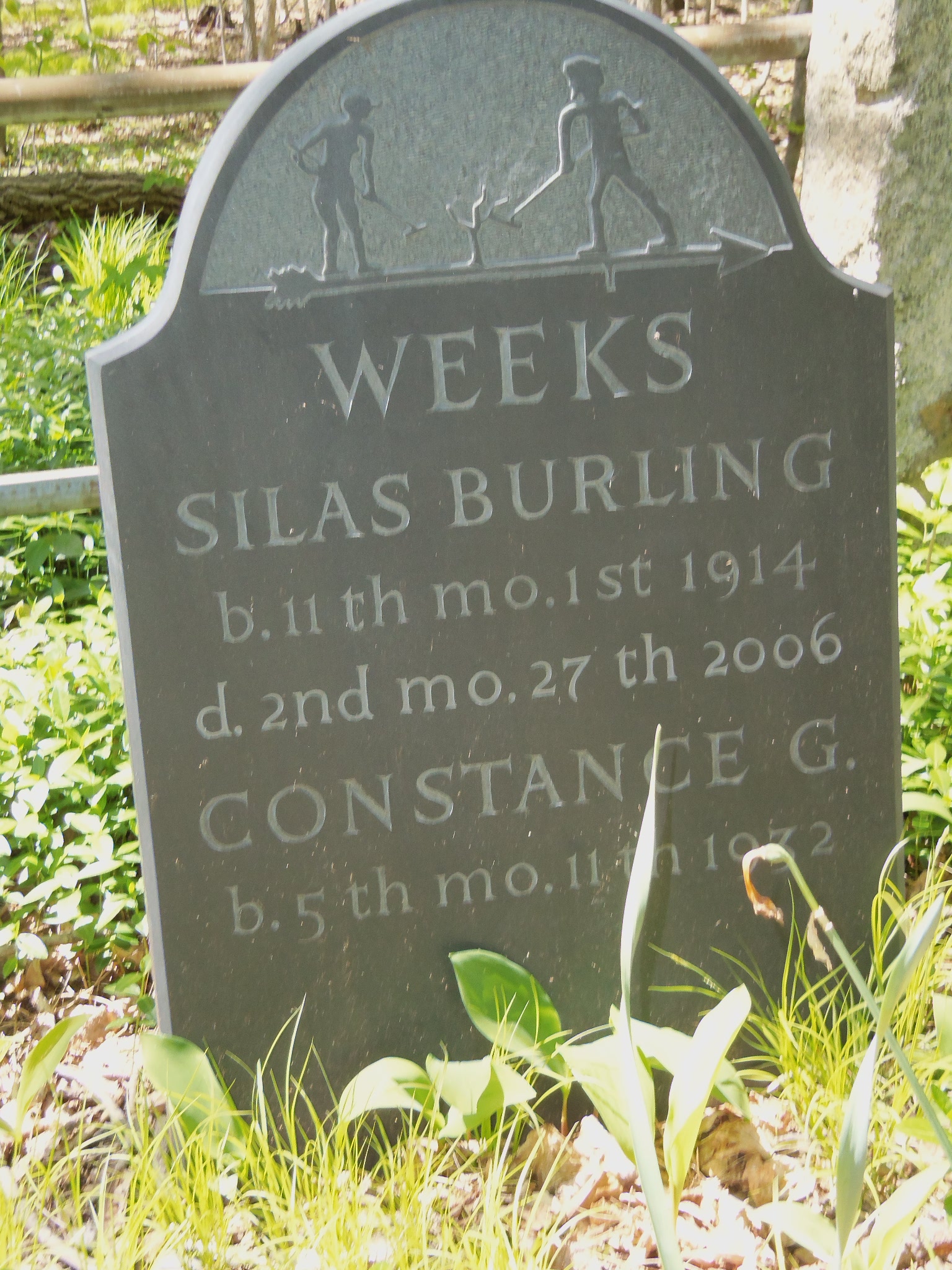
He chose to be buried in an existing burial plot on the farm, rather than in the meeting's cemetery. The engraving atop his stone is one designed as their emblem.
He chose to be buried in an existing burial plot on the farm, rather than in the meeting’s cemetery. The engraving atop his stone is one designed as their emblem.

Kodak9 033

LABORING TOGETHER

In his book of essays, Life Work, Donald Hall divides our labors as jobs, chores, and work. Jobs, of course, are done for income; chores, the things that must be done to keep a household running, are gratis; but work, he says, is done out of passion, and if we’re really lucky, it even pays our bills. In other words, work energizes us.

Another poet, Gary Snyder, uses the term, The Real Work, which is also the title for a book of his own essays and interviews. There, he argues that real work is a matter of attention and focus, as well as finding our unique place in the universe of the moment.

From the Shakers’ “hands for work, hearts for God” practice, I would add that real work is not rushed, but rather proceeds at a sensible pace, without too much concern for “productivity”; real work includes times for reflection and play. Otherwise, you’d never conceive and create things like a circular saw or clothespin. And, increasingly, such work is rarely found in the workplace. (Job-place?)

From a conference representing three different strands of Quakerism, a statement from one of the Evangelical Friends has stayed with me. She differentiated between “church work” and “God’s work.” One, she explained, was agreeing to teach First-Day School because an adult body was needed; the other was a response to something deeper and fully engaging. In Hall’s view, one was a chore, while the other was work.

Nominations time will approach all too shortly. Yes, our pool of available bodies is shrinking and aging. Still, I’ll ask that you search your heart for the ways you might respond to God’s work in our midst. (As clerk, I was more and more amazed by the range of skills needed to keep this building and its activities running!) Look especially at the little ways this might play into your own larger Life Work – and for ways we might engage playfulness into our labors, transforming chores into the real work.

I’ve spoken of what I call the parable of the geese – the image of our clerks, rotating in the lead so that none get exhausted. My turn, your turn, his turn, her turn. And to think, the birds fly almost as fast as cars on the freeway. Maybe it’s another image of the perfect Meeting. In one of the first quarterly meetings I clerked, as I looked out from small table at the high bench in the Henniker meetinghouse, I thought, Look at all those former clerks! It was my turn, and I felt comforted to know I could trust their guidance.

So who’s leading the geese? And how do they decide in their lineup? I can’t decide if they’re barking or laughing as they fly, but they sure sound like they’re having fun – coming or going.

AS IN EYE, FLOWER, AND GODDESS OF THE RAINBOW

As I said at the time …

Yes, your substantial, thought-filled, and most welcome letter arrived. You fire off in so many facets I’m tempted to send off separate replies, one in each envelope. Or maybe try subheads instead, to be read in any order you desire. But that would appear too formal for this ongoing conversation.

Yes, one insight or comment stirs a dozen others – I’ve been talking to you in my daily commute, and now maybe some of that ought to reach paper and then your mailbox.

All these years later!