We may aspire to be a bit illegible this year

Having revealed my blogging direction for the coming year, please allow me to fill in some of the background.

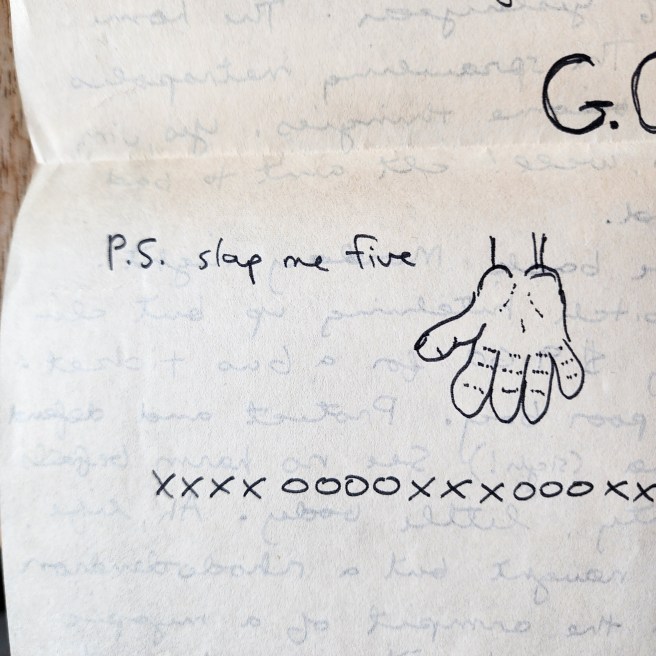
As we enter the Barn’s 14th year, the merry-go-round concept continues, including Tendrils on Tuesdays and Kinisi on Sunday evenings. With our home renovation on pause, you’ll see fewer entries on that project, though one of its consequences will become the main focus over the year. To wit: As I posted last May, I need to downsize my possessions to fit into our new space, meaning collections, and my 200-some volumes of journaling have become a target. Frankly, I hadn’t opened most of those scribblings aka manuscripts in the past decade or two. Was I likely to do so in the next five years or so? Or would they continue to collect dust? As I was saying? Besides, do I want to burden my wife and daughters with one more burden to clean out when I’m no more? Heavens, no.

Setting forth five months after my New Year’s goal of culling those pages, I expected to find that the earliest volumes had been thoroughly mined in drafting my novels and poetry, and that what remained would be embarrassingly sophomoric. Well, many passages were. But there was enough other material I didn’t want to lose, which led to keyboarding those bits before ceremoniously burning the volumes themselves. More on that later in the season.

So far, I’ve gotten through the first decade after my graduation from college. Far more remained from what I had imagined.

As these appear here, perhaps they’ll work along the lines of Ned Rorem’s Paris Journals, though much less scandalously and thoroughly lacking celebrities. Who knows what morbid fascination you might engage.

I’ll try not to add too much context but rather let them pour forth largely unedited. You might feel something like an eavesdropper that way. Some of the identities may, however, be changed to protect the guilty.

With fewer photos here in the coming year, the Barn will be more word-driven, befitting a novelist and poet, but with a funky edge. As a “gentle reminder” I came across last year advised:

“Let life feel a little illegible sometimes. You’re not a quote. You’re not a theme. You’re a page with scribbles, rewrites, margin notes. Let it stay messy. That’s what makes it real.”

Thanks to YouBook Story at Instagram for that inspiration. Let’s see how it fits.

Onward, then!

He said, she said

He would have said alert but she’d counter twitchy
He would have said observant but she’d counter oblivious

He would have said free-thinking but she’d counter too serious
He would have said independent but she’d counter aloof

He would have said sensitive but she’d counter nervous
He would have said inquisitive but she’d say he rarely asks questions

He would have said accepting but she’d counter indecisive
He would have said nurturing but she’d counter cold

He would have said serious but she’d counter silent
He would have said playful but she’d counter negative

He would have said witty but she’d counter legalistic

He would have said intelligent but she’d counter uptight

He would have said slightly bent but she’d counter insecure
He would have said self-sufficient but she’d counter evasive

He would have said caring but she’d counter mean
He would have said spiritual but she’d ask how that makes him a better person

He would have said spirited but she’d counter lazy
He would have said somewhat reserved but she’d counter socially deficient

He would have said somewhat shy but she’d counter loner
He would have said elitist in quest of excellence and quality but she’d counter self-centered

He would have said egalitarian in opportunity and expectation but she’d counter workaholic
He would have said outdoorsy but she’d counter escapist

He would have said rainbow chaser but she’d counter impractical
He would have said aging but she’d agree

He would have said youthful but she’d counter bald
He would have said honest, direct but she’d counter defensive

He would have said exploring but she’d counter unemotional
He would have said hedonist but she’d counter lazy

He would have said ascetic but she’d counter dull
He would have said a bit gallant but she’d counter straight-laced

He would have said organized but she’d notice he rarely dusts furniture
He would have said self-starter but she’d counter with a list of projects

He would have said visionary but she’d counter icy
He would have said original but she’d counter quirky

He would have said inventive but she’d counter weird
He would have said creative but she’d counter unrealistic

He would have said hopeful but she’d counter inexpressive
He would have said responsive but she’d counter boring

He would have said kind, gentle but she’d counter too serious
He would have said frugal but she’d counter tight-fisted or fiscally irresponsible

He would have said financially marginal
but she would have countered too willing to pay full price

Now, for her side of the dialogue?

Highest with lows

What was the best year of your life and how did it look?

Pondering the possibilities for my most perfect year, I see how much even the best was tainted.

’72, I had the high of the ashram but it involved going through a lot of psychological muck and growth to get there. See Yoga Bootcamp for the parallels.

’73 was the whirlwind with my future wife, but I was laboring at subsistence pay, at best. See Nearly Canaan for the parallels.

’83 encompassed both my divorce and an exhilarating engagement with the young cellist who promised to be The One. It was also crushed in long workdays as a shirtsleeves manager in a newsroom, no matter how engaging I found the challenge professionally.

’86, I was deeply ensconced in a self-awarded sabbatical, but generally loveless. The core of my fiction was drafted in this period, and my circle of friends included Mennonites and my introduction to part-singing.

’99, the excitement of the ultimate woman in my life, as well as our frustrations in trying to find a home we could afford along with some emotional upheavals at the office.

2021, my exile to Eastport in what became a heavenly writer’s retreat, resulting in the publication of Quaking Dover the next year. It did mean being apart from my family and friends back in Dover for much of the time, but included exploring the fantastic outdoors of the waters and woodlands around me as well as the artistic stimulation of my new community.

So here I am now, with what’s turning into the home of my dreams in the sunset of this life.

On to the Pacific Northwest via the prairie and Ozarks

My second brace of fiction, ultimately three books in all, addressed the dozen years in the aftermath of the hippie outbreak, though I’ve tried to fudge the era precisely. I do think much of it is continuing.

Naturally, for me, they were semi-autobiographical, even though the protagonist is now a woman named Jaya who winds up with a much younger lover who becomes her husband.

The pivotal piece is Yoga Bootcamp, with her now as a central character, along with the guru they sometimes called Elvis or Big Pumpkin. My residency in the ashram was a transformative period in my life, even in the face of details I’ve since learned. We were a rogue outfit in the period when yoga took root in America. This down-to-earth story will probably scandalize your local yoga studio instructor, but the experience did reshape many of our lives, hopefully for the better. I’ve certainly carried many of its lessons far through some other faith traditions.

The central piece is now compressed into Nearly Canaan, originally an ambitious triptych that comprised the hefty novels Promise, Peel: As in Apple, and With St. Helens in the Mix. At the outset, a sense of place was central as Jaya relocated from a small town on the prairie in the American Midwest to the hardscrabble Ozarks to the apple orchard country in the desert of the Pacific Northwest, but the central theme now condenses as the question of how much influence one person can extend over others, hopefully for the better. I can ask now whether it would have been more compelling if she’d been conniving and manipulative.

The third book, The Secret Side of Jaya, is a set of three novellas, each one set in the places she lived after leaving the ashram. Each one, quite different, is premised on hearing and seeing figures in a locale that others don’t. Maybe you encounter them, too, where you are.

You can find these books in the digital platform of your choice at Smashwords, the Apple Store, Barnes & Noble’s Nook, Scribd, Sony’s Kobo, and other fine ebook retailers. They’re also available in paper and Kindle at Amazon, or you can ask your local library to obtain them.

Anyone ready for a dark valentine?

Love, if you haven’t noticed, can be very hard to define. Really define.

Here are some examples. Add “Be Mine” at your own risk.

  1. “Love isn’t soft, like those poets say. Love has teeth which bite and the wounds never close.” – Stephen King
  2. “The pain of love is the pain of being alive. It is a perpetual wound. – Maureen Duffy
  3. “Love is a hole in the heart.” – Ben Hecht
  4. “Sex isn’t hard, but intimacy is terrifying.” – Tatiana Maslany
  5. “Love meant jumping off a cliff and trusting that a certain person would be there to catch you at the bottom.” – Jodi Picoult
  6. “But let there be spaces in your togetherness and let the winds of the heavens dance between you. Love one another but make not a bond of love: let it rather be a moving sea between the shores of your souls.” – Khalil Gibran
  7. “You are the knife I turn inside myself; that is love. That, my dear, is love.” – Franz Kafka
  8. “I will not have you without the darkness that hides within you. I will not let you have me without the madness that makes me. If our demons cannot dance, neither can we.” – Nikita Gill
  9. “Truth is, everybody is going to hurt you; you just gotta find the ones worth suffering for.” – Bob Marley
  10. “Never love anyone who treats you like you’re ordinary.” – Oscar Wilde

As a postscript, let me add this: “If I love you, what business is it of yours?” – Johann Wolfgang von Goethe

So how do you define love?


Is anyone reflecting you or those you know?

Look in the public media around you and tell me where you see your life presented. Is there anywhere in TV shows, movies, advertising, magazines, newspapers, or novels that reflects life as you know it? Beyond that, is there anywhere that voices your aspirations and values? You know, where you want to be?

Writing this is a painful admission, but true. Somehow, though, I don’t picture myself in a typical suburban strip mall, either, no matter how often I’ve wound up there or been stuck in associated traffic.

What I do see, though, points to the reality that so much of what’s being presented and ingested is an escape from the daily grind. I don’t intend this as a judgmental stand, though I would counter it with the spiritual approach of trying to live in harmony with life as we encounter it in a specific place. Still, what I’m seeing generally rings hollow.

I’d issue a call for revolt but doubt that anyone would follow. Oh, well.

My, I didn’t expect to be hitting at the psychological malaise in the national soul, definitely not this quickly, but here we are. Just don’t hand me a cape and expect me to save anyone. I’m just a lowly writer, remember? Well, you could hand me a very dry martini (gin with an olive), but that would be my own favorite escape.

Now, to return more or less to the topic.

During my stint as a field representative for a major media syndicate, I called on newspaper editors in communities across 14 states. What struck me was how little sense their papers gave me of a unique local identity. There was rarely a distinctive voice in the generic mix. Maybe I’ll wax on some outstanding exceptions as a future post. I did try, mind you, to accomplish some of that where I was as an editor.

~*~

When I entered the workaday world, it was in the height of the hippie explosion, as well as the Vietnam quagmire and the first moonwalk and civil rights and, well, you could say generally everything was in flux and has remained so.

The pace of daily journalism, however, left me feeling there was so much change in the works that we were overlooking, especially in any in-depth way. For me, my impressions became fodder for fiction, which would allow me some leeway and definitely free me from footnotes and fact-checkers, not that I’ve veered from relating what I witnessed or even imagined as truthfully as I could, even with a degree of inventiveness and aspiration.

In that journey I wound up living in places that were outside of the big media spotlight, and what I faced ultimately differed from what was coming out of New York, Washington, Los Angeles, Chicago, San Francisco, or similar backdrops. My record reflected, I hope, just everyday folks who had to muddle on, best we could, in irreplicable circumstances of human progress or tragedy.

Ultimately, I tried to distill what I experienced from these unique viewpoints into novels that originated as “contemporary fiction,” though I’ve come to see the paradox of the label. Even without the scheduling conflicts of working a “day job,” I was caught in a time-delay of drafting and revising, even before trying to find publication. At the least, that would be a two- or three-year gap before a piece became public. Tastes and trends drastically change in that span. And here I am, shrinking from the crap shoot of fashion.

Or, now we are, decades later, perhaps trying to make sense of it all.

Not that I was alone. Every book author was running behind the frontlines where even the boldest got shot down, should they make it that far.

The consequence, quite simply, is that too much has gone unexamined beneath the superficial rush of what we once Baby Boomers and now creaky seniors and perhaps great-grandparents lived through, individually and jointly, from Watergate to today. No wonder things are such a mess. Look, kiddos, it wasn’t all our fault. Do note, I’m among those who wants to lend you a hand.

Mea culpa, then, though I’ve left some evidence of sorts to build on. Please stay in touch. That matter of “Don’t trust anyone over 30” was a brilliant slogan but ultimately BS.

As I’ve noted, we definitely needed elders. And so do you, on the frontlines now.

You can find my ebooks in the digital platform of your choice at Smashwords, the Apple Store, Barnes & Noble’s Nook, Scribd, Sony’s Kobo, and other fine ebook retailers. They’re also available in paper and Kindle at Amazon, or you can ask your local library to obtain them.