Finally, I was really settling into a journal … some verse, some encounters, some intellectual speculation.
Recognition that I had been conflating Todd and Andy, housemates. They do form one character in my fading memory.
~*~
Skye’s sister Laura was up, Saturday night, with all the male competition for her attention wound up landing with Willow in my bed. She was another non-swimmer, as I learned Monday at Empire Lake.
As I later learned, B.L got her pregnant, with an abortion, and then she was out to prove herself a slut; 16 guys since September, one at a time; guess she was with Andy. A trip with here to the ashram was a bummer for her. It became exit for me.
When I broke up with Willow, Gannett purchased the Sun-Bulletin and moved everything into the Press newsroom. So much junk.
Skye was enticing in a white gauze India blouse.
Me, remembering Fay, parked along a dirt road beside Little Miami River covered bridge in humid summer moonlight her eyes glistening, teeth glistening, face glowing.
Another Tuesday I was off, unlike the usual Wednesday, had to go to the office to get my paycheck, though; got stopped for doing 41 in a 30 zone, let off with a warning.
D-Man, remarking on how much a company spends on advertising a product that’s bad, but who spends that much un-advertising it?
Phoned Kara, thought she’d dig blueberry pie; she was too busy sewing. Has seen the movie Bananas. Then said I was grossing her out, “swimming with nothing on,” stuff like that. She’s so afraid of herself. When I tried explaining yoga, she couldn’t understand.
When you’re off-center, meditation is difficult.
~*~
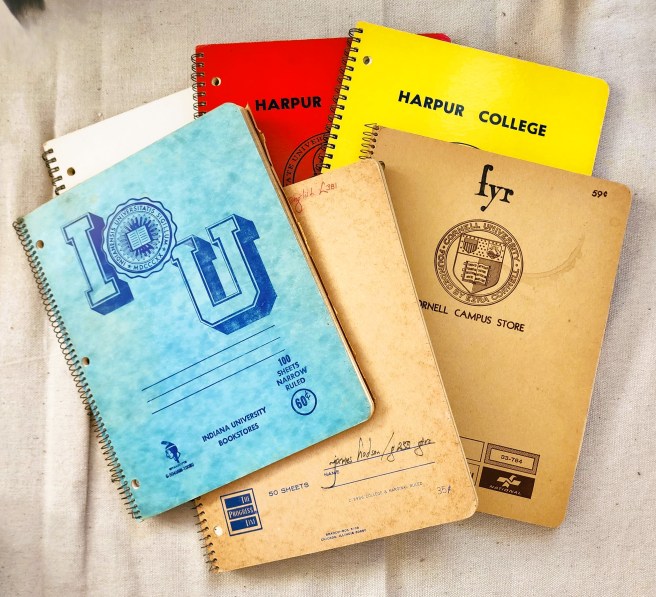
A few of my early journals.
The joy of keeping a journal: I thought the task would give me insight into my depression, but last night in reading a volume found it is better as a record of my ups and stimulates once again the highs that make me happy.
Molly: Everybody can tell you their problems, like what they dislike, but few can tell you what makes them happy.
Keep a journal of both but read only one.
~*~
From Spiralbound Hippies, with commentary from now.
As I post these journals gleanings, they’re appearing in chronological order. But as they accumulate, they will also be read in reverse order. How curious.
Excerpting from the next volume of Spiralbound Hippies, with commentary from now.
~*~
FIRE: the great connecting link between all symbols. Joining mind and matter, vice and virtue, etc. “The most conflicting elements [values?] in a single image.” Double-meaning, destruction and creation [the phoenix].
Saint Anthony fire: he was more feared than worshiped. Pagan superstitions carried into Xristian mosaic.
A partial return to a Jewish sense of Satan as instrument of G-d. Pandemonium under thrall of Satan. Laws of nature have collapsed, obliterated distinctions between Truth and lies.
Life, in Bosch, midway between good and evil.
The paradoxical becomes possible.
The triumph of the strawberry!
$2.30 taxi fee to work today. [Nearly an hour’s pay.]
Polly: “I’m no materialist but I am learning from living with Ajax that money is very important at times.” Security breakdown: food and rent worries.
She said I look more like a painter than a writer.
Her parents found out about her situation with Ajax. Best wishes for his Bayville journey tonight.
Parts for my car finally arrived, Spring Valley station.
Did I make a trip to Dayton in here? Take some of my goods back, perchance? [Had already resolved to move to the ashram in late fall: felt, rightly, I had much unfinished business to attend to first.]
~*~
Girls? “Oh, you know, typical bitch,” sez Tom.
“Lost in that red meat of Rembrandt” – sez Pound.
Rainbow got an abortion. Thus, the tension with Speedo.
Fryyr up!
My earliest memory, age 2: people in yellow raincoats and some gray in the mist or fog on the boat at bottom of Niagara Falls. So why didn’t I record the falling water or roar?
Their adolescent neighbor believes her mother is a whore: “I knew it when I saw her walking down the street arm-in-arm with a Black man.” [Let’s be honest about the racial stereotyping.]
Luna, angrily, “Am I your wife or just your fukkin’ lay?”
Moose, laughing, “What’s the difference?”
Blueberry farm: Meeker, like Hub! Water cannon booming.
Donald Barthelme is right: art in our time is collage: television, a collage of ads and story: museum a collage of paintings or other artifacts, exhibits: libraries, a collage of books and magazines: we are a collage of consuming.
Incas built without mortar: each stone complete harmony/union within wall.
Swimming into sleep.
Pd car insurance $170.
Shifted into brown ink.
Economics dilemma: what happens when there’s free energy? [Solar, wind, tides?]
A novel is a private experience, requiring each reader to create own vision of characters, settings, etc. Film is public, shared – a group creation, just look at credits, Yet a novel is much longer, including reader time commitment: it is created in solitude, reflection.
From Sci Am: “For many cultures of ancient times, springs were sacred places, perhaps because the phenomenon of water issuing from the earth without any apparent source seemed magical.”
From Fay I learned to raise my eyebrows, opening my eyes wider: a movement to say hello … seems some acquaintances now know me this way.
Quick trip to Arrowhead after work on Saturday early shift … great time on the raft … what was happening at the camp?
Skye used to play cello. Her younger sister has a $25,000 Galluci or some such. [Four years’ pay by my measure.]
~*~
~*~
Long list of meanings for PICK, too.
Stanton, addicted to working Saturday mornings, Midwestern heritage: work hard! No interference on Saturdays, creative joy.
“It blows my mind that you open yourself so totally to me. You don’t tell me anything about your job, your family, your home. You just show me your power. If I never see you again, you will always be close to me. I never knew contacts between people could be so joyful.”
So was this something someone told me or rather something from Be Here Now or another ideal?
Am surprised I fill this volume in within a single month.
Another Saturday begins a journal, as noted midway down second page.
Pages of teletype snafus, many becoming my Sun Spots series of concrete poems.
An intermediate stage in the creation of my Sun Spots series of concrete poems.
~*~
Harpur [College] music room closed: open mon-fri 9-12, 1-4. Am assuming this was the record listening room and I used it.
NY Native tribal lines: no more than 70 to 80 Iroquois villages in New York State at any one time. [I imagine that figure has undergone major revision.]
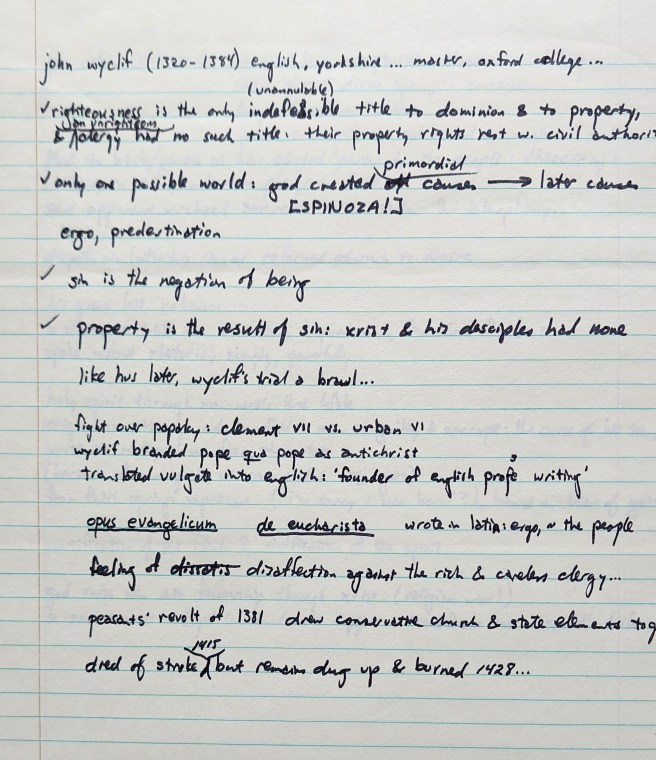
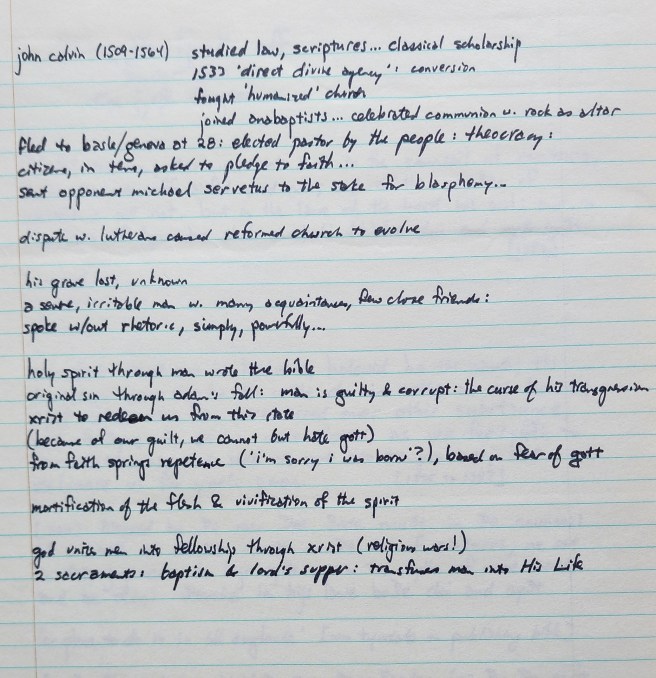
And then details on Jack Hus (1373-1415), Wycliffe, and Calvin.
Surprised to see Hus read and translated Wycliffe … was excommunicated with 200 companions by Pope Alexander V in 1409 … the archbishop burned 200 volumes of Wycliffe … this was pre-Guttenberg typesetting!
New pope or antipope, John XXIII [not to be confused with John XXIII of 20th century], renewed ban in 1411, placing Prague under edict … issued safe conduct pass in treachery.
More typographical poems, as well as drivel.
Wyclif: sin is the negation of being. Property is the result of sin (Jesus and the apostles had none) … he is the founder of English prose writing.
Again, early notes of Quakers – summer of ’71. [Still, I had no idea what was ahead.]
At this point, Carlos Williams, not Snyder, my measure of excellence.
Met Stephanie, late June. Much of this used in my novel Pit-a-Pat High Jinks. She was a non-swimmer. Of note now, the big men’s loafers in the bedroom left 2½ weeks earlier. Disappeared, in a later detail. Zippo, whatever his name, the dealer, dropped in, bad vibes: “Guess he gave her the motorcycle leg burn” that was still purple this day, her first without the bandage
Todd and Gwen were also at Empire Lake that day.
Later, swimming in another mountain lake, “the highest in Pennsylvania,” Quaker or Arrowhead, I presume.
Continuing reflections on Bosch and theology, Christian and Tibetan.
A bookstore spree: Carlos Williams, Bly, Joyce, Creeley: $5.99, total.
Joy of possession: inscribing my name on the opening page.
Ponderous clouds of lead and fire.
~*~
Stopped at Jennifer’s, she wasn’t home. Then Stephanie’s: she was spacy, no sleep, as noted in novel. Did get some details on her ex, a philosophy major.
Trip to Stephanie’s at Bear Mtn and then Polly’s for the 4th on Long Island … Grannie Mully’s for steak, beer, and surf. “What! Another nature freak!,” as one of Polly’s cousins sniped.
This was the 4th when my Buick broke down on Thruway. Sequence of hitchhiking experiences home. I stayed at Tom and Ajax’s the following week, 9 Doubleday Street. Sounds like a novel only one publisher would touch.
Polly was 50 pages from the end of Sot-Weed Factor when the puppy ate them.
Ezra Pound’s later cantos an intensely personal collection/collage of whatever was on his mind at the moment: artist vs audience, spirit or craft? So here we are.
~*~
Rusty was from Old Westbury. Skye, from Roslyn Heights. They were, however peripheral, special housemates during this time.
~*~
View from the road, more mountains.
No entries since Sunday.
~*~
Tom, home from a faculty party: They once hired a veterinarian to sit with their gerbil all night, giving it injections every half-hour. Imagine the two of them, sitting up with the vet sitting up with the gerbil. He kept saying, I don’t know it this will work. They told him, Don’t worry, just do it, you’re getting paid. And everybody was talking about everybody’s affairs, like Peyton Place. Who the college president’s sleeping with now …
Ajax’s new job: can labeler. Never before knew “labeler” was a category. This morning he’s snoring like a hand-pushed lawnmower.
~*~
From Spiralbound Hippies, with commentary from now.
Continuing my Spiralbound Hippies, journals excerpts, with commentary from now.
Got home from work: sunbathing in back meadow: my chance to develop lifeguard bronze: indulge in luxury, nudity [was thinking about the kids at Oak-Day pool when I was 10 or 11 or 12 or later, mostly on the outside of the fence, couldn’t afford the admission. The lustful yearnings of adolescence.]
Then heard Andy call me. I walked back to the barn. “Wanna go swimming?” After sweating in 83-degree humid sun, I expected cold spring water. “Um, OK, I can dig it. Let me get my gear.” (Books, blanket from field: nose plugs, upstairs.)
“Hey, can we take your car?”
“OK, fine with me.”
[Matter of trespassing, be a good boy, keep a clean nose, keep out of danger.]
Camp Arrowhead, atop a mountain: lake hidden back from the road; private cabins around half of the shore. [Quaker Lake, larger, was a mile or two further.}
Speedo led the way on his white Indian.
His girlfriend, Rainbow, braless as usual, wet white top revealing black tits: “Mean old bitches over on the other side chased us off.”
I dived in, not too cold, invigorating. Swam to the other side. Later swam underwater. As for Todd or Rusty further?
Luna, skinnier than me, afraid. “I don’t know how to swim. Don’t go in there, it’s too slow.”
Treading, I realized cold water is tiring.
Way home, told Luna she’d have to clean up the backseat after the dirty dogs (footprints all over the car). She did, swearing and dirty looks, everybody smoking cigarettes.
My own skin is so alive.
Thunder, it rains near lakes, they’re cooler than here though only a mile away. Scattered showers in the mountains, says Rusty.
So much easier to do and not worry than not do and worry.
With Rainbow, a shared appreciation of Bosch.
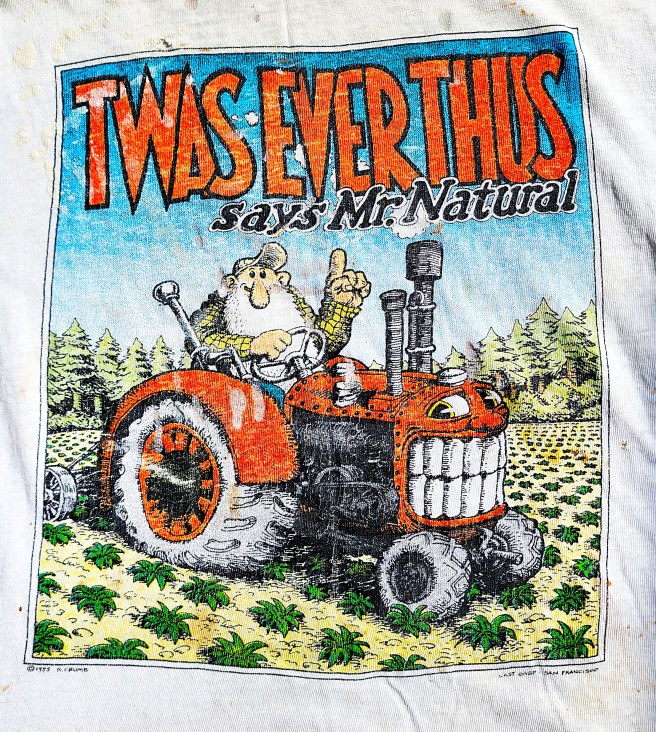
And R. Crumb?
From a treasured T-shirt, much later.
~*~
Got my vacation check – three checks, actually, and felt rich …
Left car at station for repairs and hitched to the ranch ….
~*~
[Arrowhead Bible Camp is still in operation: no denomination mentioned ]
Rusty and I swam across the lake, a long, cold way, and back again.
Looking down into green murky depths: monsters below?
[Like Quaker Lake, these were in Silver Lake Township, Susquehanna County, Pa. Edge of the Endless Mountains}
“You’re all born in sin, you’ve got to repent and accept Jesus,” as the camp counselor went on quoting Scripture like a jukebox
Rusty: “Acid really clears up your head and clears away your ego.”
Shayna lives in a L-shape room.
Polly used to knock my laughter. And now?
A.Z., at office, used to study under noted poet David Ingatow.
Thor, bored, missing Sharon, came out to the farm and we walked forever … he says all the aspiring writers he’s known are weird … I replied that they can never be totally engaged in the event, though they try to capture it and analyze it …
Jennifer, blonde, 22, Baldwin Street in Jackson City, English major, boyfriend graduates next fall … looks 16 … a good kisser, has my sleeping bag … her expression is always so open, willing, expectant …
On meeting me, saw me as a writer. Her friend Claudia, the art major, saw me as a painter.
~*~
First trip to big lake … Jennifer saw me but was with another woman and two guys; they were leaving as we arrived.
A day later, took her to Morey’s for dinner … and saw the Andromeda Strain … told me she had laryngitis last week. I shouldn’t have kissed her goodnight so much but then I already had a sore throat. She was raised Baptist on a big farm.
Guess I was with Esperanza … had left my wallet at her place …
A white plaster sky.
Snyder: long hair a return to nature, short hair a sacrifice to the goddess
~*~
A year ago, you asked where I thought I’d be now. I didn’t expect on a rundown farm in the mountains with wild strawberries, meditating, still employed on this copydesk: yoga and no woman.
Peru, maybe, or Boston Globe. The Cummins p.r. job held faint promise yet …
Two years ago I couldn’t foresee the long hair. Binghamton and New York in general had just entered my life, and we had parted, desiring each other. I could not foresee your journey, either.
Now, paying $5 fine for bald tires. Austere waiting room, everyone jumpy. Mother, to me after everyone else had left: “That’s not fair, just not fair,” while her daughter was crying in the justice’s chamber and the father was pleading the case of an unregistered car. Suspended sentence.
Zazlenski, born Andre in France – en-dray, en-dry …
Eliot telling Danny to aum for calmness. A dead, um. “Hey, that really helps!”
Sounds like a guppy?
Fern: The Beatles crippled more girls. They couldn’t go out with American guys for years. There was always one Beatle, the one of their choice, tells much about herself: the ideal for others to fall short of.
My sister’s was Paul: as a fan, shy, retiring, flower in hand.
~*~
So, seven volumes to cover my first year after college?
Next volume starts with date, 22:V:71, and the death of our photo retoucher’s death in newsroom on a Saturday night. He was in a pool of yellow on the floor. A medical history of diabetes. He died of and in fear. He was a lousy retouch artist.
We did get his pulse going before the ambulance arrived, but they lost it on the way to the hospital.
The fear, the shaking, the anger: what is death and why?
He had just told copy courier Roxie how to make a million. Showed her which stocks he had just bought for his son.
Purple face and gurgling
piss on the floor
no way to go out
with elegance
even from a crowded cubicle.
Remembering Gran, white as ice a few blue veins thrashing her arms against bed rails and moaning her bald head and sunken face unconscious did she even know I was there?
In her case, there was nothing I could do, but this?
We tried and failed.
~*~
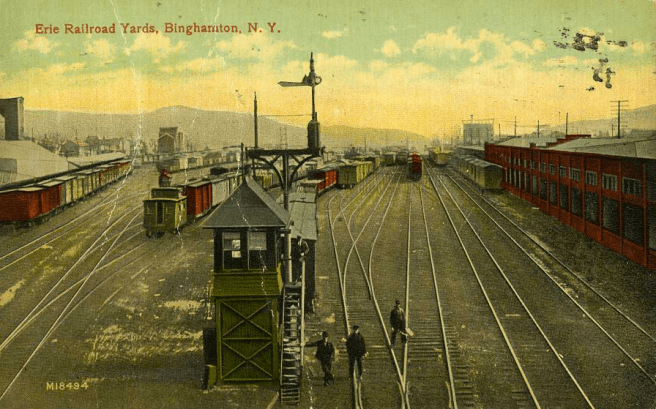
Situated halfway between New York City and Buffalo and points west from there, Binghamton was long an important station and switchyards for the Erie Railroad (shown here in a circa 1910 image via Wikimedia Commons); the Delaware and Hudson Railway with its connections to Albany and New England; and especially the Delaware, Lakawanna, and Western Railroad of Phobe Snow fame, with its superior route via Scranton and then Elmira along the Susquehanna River.
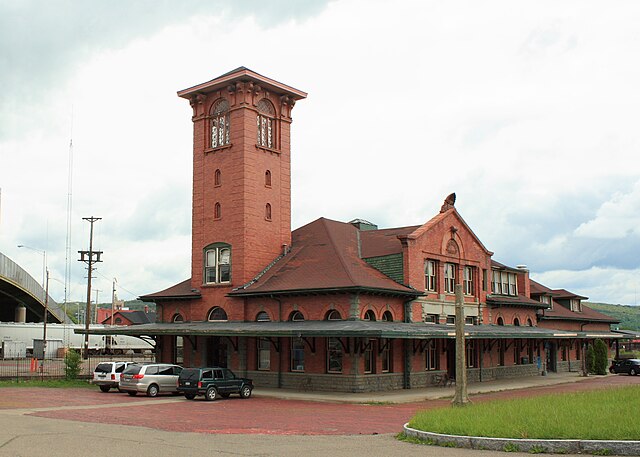
The Lakawanna station on Chenango Street is shown below in this 2009 Harrishhu Wikimedia Commons photo. Scranton connected to points south, such as Philadelphia and Baltimore, as well as west to Pittsburgh and the Midwest, as well as the Pennsylvania anthracite coal mines that fueled industry, trains, and even homes..
In Binghamton, the abundance of single men working the rails and businessmen on layovers or overnight stops was rumored to have sustained a seedy scene of prostitution and more. There were stories regarding the Victorian apartment building where I lived, which had definitely had more fashionable days. Some of them show up in my novel, Daffodil Uprising.
~*~
In my journal, notes of my acid trip, D-Man and Helene’s: “things like Odyssey album covers and Peter Max, only better.” Reading Rilke at dawn while Rochelle brushes her hair. Seeing my police pass press photo, said I look better with short hair, “makes your features stand out more, especially your nose”
She was living with Willie but not sleeping with him, “It’s a bad arrangement,” but I wasn’t getting anywhere with her, either
When heard stoned, Mozart’s music is too beautiful, powerful, perfect to be believed. His orchestration so fantastic, original, ethereal: like Berlioz.
Line from an English opera: the spider combs the air.
Driving stoned, impossible to remember the next curve or the last
Chocolate chips and milk: Pebble and Marj.
Damn Marj: dirties all the dishes, cleans out my paper and paper clips, devours my broccoli and Familia, and moves the milk around so I drink the sour … and lets the garbage (hers) pile up …
Tari, good-looking tomboyish friend of hers, stopped by … with Eileen downstairs.
In the middle of my nap, Steve and Joyce phoned.
Memorial Day, returned key to Vera, she said Coen would mail my security deposit, we’ll see. [He didn’t.]
Both D-Man and Helene said I’m one their few friends they both like.
“D-Man, how the hell could you and Thor stand me last summer?”
“Oh, you were OK, a little fucked up, but I feel things for people and don’t know why I like a person or not. Sometimes Thor and I would want to be alone, away from you. A friend, you can tell him you’re pissed off with him or want to be alone, and it doesn’t offend him. You can’t do that with Danny.”
Helene said she couldn’t live in the disarray of the ranch. She confirmed my impression that both D-Man and Thor are essentially straight after all.
Gave Rainbow my blue denim Dutch boy cap, the one Fay must have returned.
I’m a frikkin’ prince living in a frikkin’ zoo.
In a later entry: O shit! Rainbow, the Lolita of Eggs Ackley, is 15!!! If we ever get raided??? [Fact: she was 16.]
Later additions: She’s from Colombia. Freaked out to learn Esperanza and Eileen from P.R.
Eileen was Esperanza’s roommate … on Exchange Street?
Rainbow’ Speedo is 20, worked in city as a messenger driving a bicycle in Manhattan professionally, maniac!
~*~
On back of Lenox String Quartet program of June 5, my handwritten notes of upcoming films on campus: Marx Bros and Buster Keaton; Max Ophul; Orson Wells; Joseph von Sternberg. Which explains earlier entries about attending films with female friends and neighbors: less weight than a “date” in a commercial movie house. If only any of those had progressed further? I felt very alone and lost.
~*~
From Spiralbound Hippies, with commentary from now.
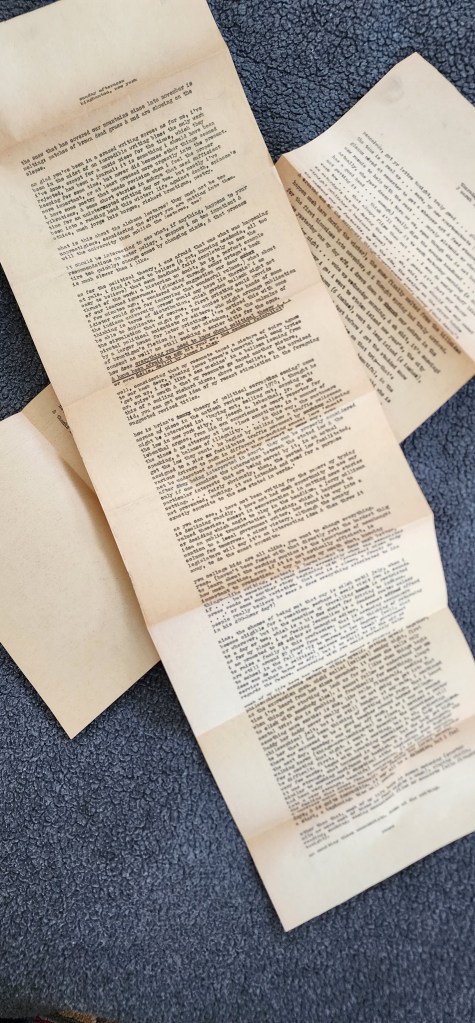
The titling on the next spiralbound notebook cover reminds me that I was probably able to do some journaling in the newsroom, especially late Saturday nights, the part I used to call the Presidential Death Watch. Everything was wrapped up and running, unless a STOP THE PRESSES kind of news story interrupted. I’m now recalling that I managed to do some letter writing there, maybe even on late afternoons or during lunch breaks as well, probably on the end-rolls of that long yellow teletype paper. I think there was some white, too. Was the yellow the carbon copy?
The spiralbound volume is largely stabs at poetry, much of which has been mined for publication already, especially Susquehanna.
Let’s shift to entries.
I read Hemingway yesterday, and then Virginia Woolf.
A lot of verse – bad verse! Though moving away from the socio-economic vein.
First explorations with the teletype outbursts during solar storms, too. Some of that shows up in my concrete poems series.
Toward the end, a few items have dates, more or less Snyder style
Volume includes my first Shayna G experiences, along with the first visits to Eggs Ackley, plus early yoga notes.
Mention, in pencil, of Nikki’s father offering to lend me the money to return to school (law school, most likely), then conceding, “We send you out to change her mind, and it turns out she changes yours and ours.”
They said she’s never looked better, more confident. They were all going to Israel that summer, and she would then go for six weeks to a Sufi camp in the Alps. Doris would go to the Aegean Isles to paint, and Gene and L-Boy to see cattle. I feel much more at ease, affectionate, around them. They were natural, doing what they’d do anyway. They’re open, honest.
Gene said I’m not aggressive. (I used to be; what happened?)
WHAT IS LIFE IF YOU’RE AFRAID TO DIE?
(Is that the same as “if you’re afraid you’ll die?”)
~*~
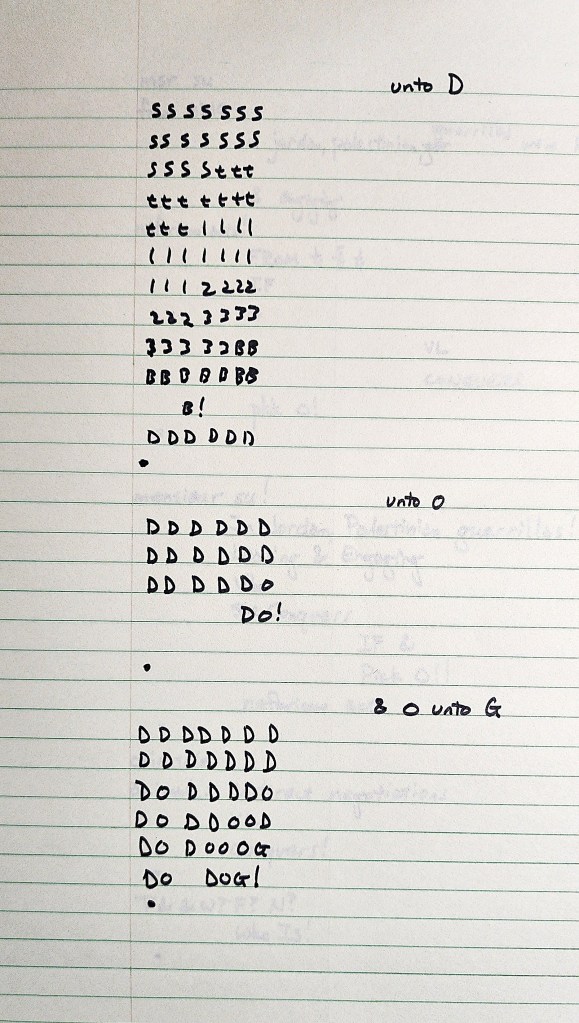
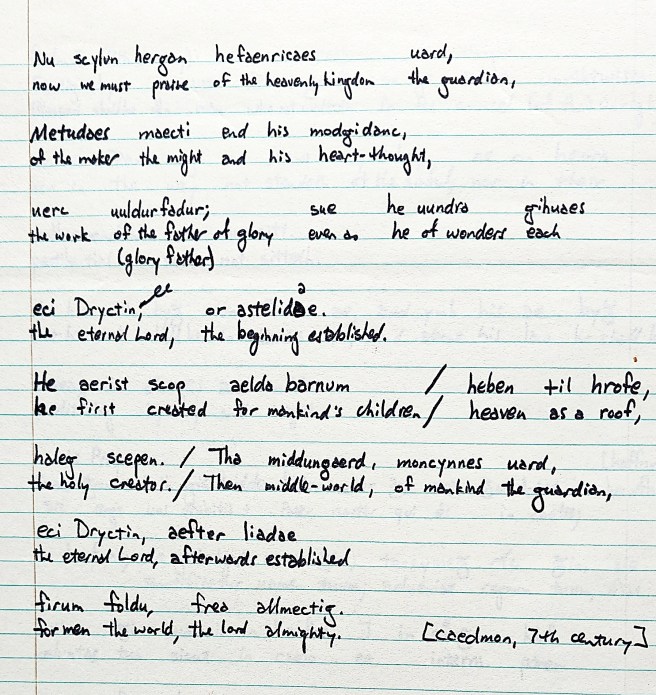
English once had more figures in the alphabet. Here are some that have been lost.
~*~
Introduced to Shayna. The encounter, and the trips to Rochester that followed, have been extrapolated into Pit-a-Pat High Jinks and its predecessors, Hippie Drum and Hippie Love. Note that I’m now dating my entries, and in the manner of Gary Snyder.
At the farm: Andy, “really together at 27,” also a “skin man … does it hold her together?” Was born the same day as Shayna. Story of a suicide attempt – slashed neck – he lends much, if he has it. He attended Corning Community College in ’67 and dated the redhaired Maria who had thrown me for a loop: said she used to be super straight, had dogs in her apartment, and her rug was soaked in dog piss, smelled awful. In retrospect? Bullet, dodged it.
See I also had a mishap on the Vestal Parkway that tore a chrome strip off my Buick.
Andy found Shayna’s glasses (sunglasses?), gave them to Hana. Where are they now?
Riding as passenger on his motorcycle, 70 mph: fucking scary, “You were really nervous.” Yeah. My eyes also teared up, I wasn’t comfortable, thrown forward, then back. Kept leaning against the turn. Got hit by a bug. Yet later, had to admit some really excited energy.
Annie at the farm: “Don’t let him live here! He’s a narc!” Fuck her.
With the old circle, a newbie was quite jittery and chattery. I asked Molly if I used to be like that, ‘Fraid so, said she.
Jack needs $70 by Monday, my share of the rent.
Final page has a phone number and address, “a fine place.”
Shayna’s second-floor apartment? Yup.
[Incinerated]
~*~
From Spiralbound Hippies, with commentary from now.
Here’s a collection of captivating money quips, should you want to showcase your success and financial flair. Better yet, as I suggest in the Talking Money category at my Chicken Farmer blog, use these and others you come across as prompts for personal examination and study-group discussion. They’re more loaded than you likely expect.
Money can’t buy happiness, but it can buy freedom.
The best investment you can make is in yourself.
Money isn’t everything, but it sure does help.
The only way to have more is to make more.
Money makes the world go round.
The key to success is financial intelligence. (And what, dare we ask, is success?)
Making money is hard work, but it’s worth it.
Focus on making money and the money will follow.
The more you learn, the more you earn.
Wealth isn’t measured by money, but by the impact you make.
Judith seemed very happy to see me today. Very warm, smiling, affectionate but once her eyes tightened, like those in Children of the Damned, her voice turned shrill, terrifying. So strange, she.
I’m smiling easier, more naturally than back in January. Am more on personal salvation than on social action as I was a year ago.
Want someone but see how birdy the girls I’ve met are: seek strength/entertainment for their man.
Marj’s sister Hana talks-talks-talks, of her problems, her shrink, anything and nothing, she won’t shut up. She runs to new things, won’t finish. [And yet, I must confess decades later, I really desired to fuck her. Jail bait notwithstanding.]
My first trip into Susquehanna PA.
Marj’s stuff litters the kitchen: typewriter, textbooks, notebooks; sink filled with dishes from Monday, at the least
Ran into Judith on my way to swim (which then didn’t happen). Did take her through the car wash, “I haven’t had so much fun in years,” and then to Ross Park, where the animals looked shaggy, sad, bored – awaiting children. Repeated the Susquehanna route, with the barren tree hillsides resembling female pheasants. The river was sparkling turquoise aflame.
Judith insisted on picking ferns, “I’m such a naturalist. They look so sick with these spoors.” And she nearly fell in the river.
Back at my apartment, she climbed into my bed. Skin feels so nice, and sex on a friendship-only basis isn’t so bad – not enough, but better than none.
Running into Judith on campus again, she’s tense. Wants to get involved with Carl. That’s her trip. Read Springhill Mine Disaster, which Judith dislikes. She’s really afraid to feel, keeps cutting me off. Bad noos!
~*~
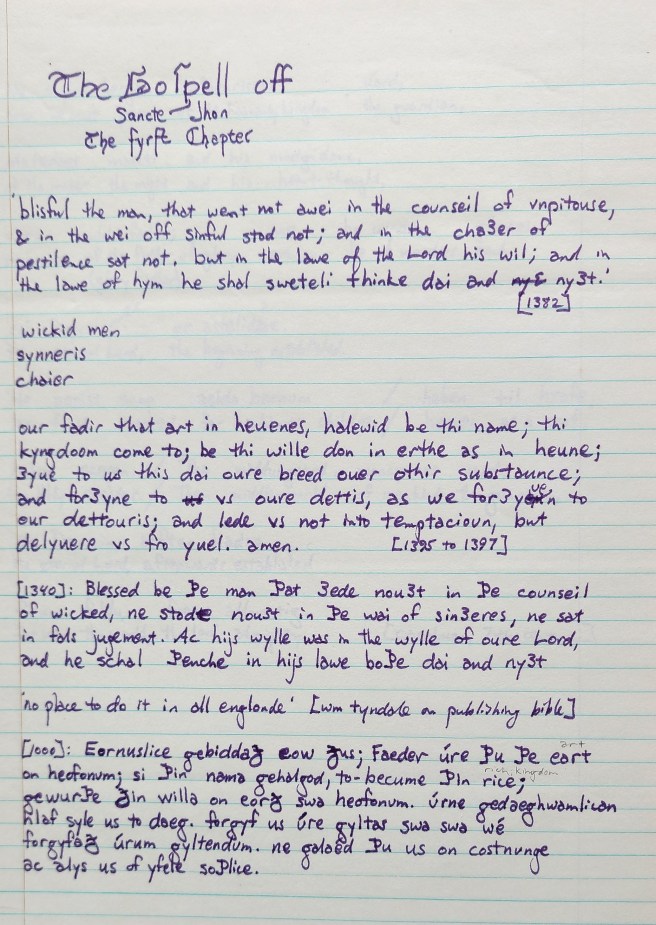
I was investigating some pretty arcane sides of English language and literature:
~*~
With another Tuesday off, I stayed up till 1:30 or 2 – reading Snyder. Very peaceful, like nights at IU.
Picked up a hitchhiker, it was Judith, so crunched uptight. [Am surprised she would stick her thumb out, big city girl that she was.]
This reaction of not writing: a reaction to five years of primarily writing?
Swam a length in butterfly, a must stroke now: great for back muscles and arms.
T.J. said I’m an ascetic. At first, it pissed me, but as his sister insisted, it’s an honor.
Feeling much better, free from hassles, but still miss a woman.
But then Hana showed up, yakking about her neuroses but doing nothing …
Leaving lights on and cleaning up nothing. Small pride?
Ajax got a job at the Chinese restaurant.
Molly/Polly/and him: talky, talky.
Hana, Marj’s sister, wants to know if I’m keeping the apartment over the summer, she’s hoping to stay but drives me up the wall. “Yesterday was the first time in three days I’d been outdoors,” “What was the weather like?,” “I dunno.” She’s like a three-year-old, needs to be led by the hand; offered to help me take the garbage down but left it at the first landing. Makes messes, doesn’t clean up. Flipped out because this guy she liked danced with every girl at the party but her.
She enjoys the sick little girl role. The simplest yoga poses are beyond her concentration.
Esperanza was really beautiful and sexy at the Latino concert, but she and Len are arguing too much.
Somewhere by now, Polly had remarked on how schizoid my life was, torn between the demands of journalism and what she thought should be grad-school for me. I was living as a grad student, essentially, hanging out on campus and among a college crowd.
[Incinerated]
~*~
From Spiralbound Hippies, with commentary from now.
St. Pat’s Day, everybody in Binghamton turns Celtic. Just look at the high school marching band.
Pebble’s staying: too many dishes pile up, and trashy living room
After I went to bed, Pebble and Marj began whispering in the living room, just outside my door. Pebble’s so loud anyway, and then they started giggling and I heard cloth rustling, snaps, and a zipper, followed by heavy breathing, oohs, and aahs. When I awoke, they were sleeping in Marj’s room.
Pebble’s stuff is strewn all over the place, and the dishes are piling up very high. They have been leaving them for me.
~*~
As for my typing, a la Kerouac, on long strips of teletype paper, which I had in abundance from the newsroom. It served me for both correspondence and my own drafts at literature.
~*~
Last day of winter: 2 inches new snow.
First day of spring: sunny and warm.
Getting my knee to touch the ground, closer to lotus. My body is a joy; it does some things I want now, like playing, standing on one foot and “flying.” My balance is improving. This trip started out on a downer.
~*~
From Spiralbound Hippies, with commentary from now.
By this point, I was getting addicted to the weekly hatha yoga sessions and had even visited Swami’s ashram in the Poconos. I’ll save those details for a more focused presentation later. Or you can read my novel, Yoga Bootcamp.
For now, here are some more mundane activities and thoughts from that period.
~*~
From Borges’ “Anxieties”: “Now that I have the secret, I could explain it a hundred different and even contradictory ways … Compared to it, science – our science – seems not so much more than a trifle … The secret, I should tell you, is not as valuable as the steps that brought me to it. Those steps have to be taken, not told.”
In my readings of the Inca: “In 440 years we have failed to eliminate the savage in music of language: Spanish remains the secondary tongue: the West has been defeated: the flute solo sounds strangely like jazz or Xanakis: there is hope for u.”
[Esperanza was originally from Ecuador!]
~*~
Headline writer
Poet of gossip
[Robert Katzman]
~*~
Meditation revelation: I was trained and conditioned to be a technician: me, the artist, a technician! Frightening thought! A technician knows the surface, not the heart or subjective substance
Swami: “Do not do the exercises on your own. You destroy your cells, they don’t have time to regenerate. Once a week will be much stronger.”
Two I may do, though:
Contemplate a candle flame.
Prepare for lotus.
~*~
Snow follows me wherever I go these days: here in the Poconos, also Staten and Long islands trips.
~*~
Surprised to get a letter from Fay and wrote a reply. Noted mine “sound manic but it’s not. How does one write about happiness? Or yoga, the Protestant atheist discovering God within himself, and Spinoza and a Quaker?” The latter item comes out of the blue, considering how little I knew of Friends. Once again …
Also wrote to Nicki.
Blue jeans, desert boots.
And Betty Ann said something like, “Hey, that’s a tough outfit you’re wearing,” and I answered, “Yeah,” She’s been mostly pouting, probably because I haven’t asked her out yet. She was dressing in a brown bibbed pantsuit.
With all the yoga, am going through such mind changes, perhaps the biggest in my life.
~*~
From Spiralbound Hippies, with commentary from now.




 Jnana's Red Barn