NAMING THE CHANGES

My fondness for mountain laurel goes back to my days of living in the ashram in the Pocono Mountains of Pennsylvania. There, the undergrowth of the forest was filled with these blossoms in season.

Over the years, my own spiritual practices have undergone many changes. Even in a tradition like the one I’ve embraced, seemingly free from the annual routines of a liturgical calendar or outward emblems, there appear cyclical changes mirroring those of the seasons. Cycles, too, like those of progressing from childhood and parenthood into retirement or release. In Salem Quarterly Meeting in Ohio, the session each Fifth Month meant rhubarb in the applesauce. See it as sacrificial and special.

There are times of struggle, doubt, and distrust. Times of whirlwind passion and excitement. Times of discovery. Times of drought or deep winter, relying on what’s brought out of storage. Times of renewal and recharge.

This has manifested as periods where I’ve been able to dedicate significant time to meditation, solitude, travel in ministry, prayer, Bible study, research into history and theology, organizational service, teaching, correspondence, or writing, as well as to regular disciplines such as fasting or physical spiritual exercise (the hatha yoga sessions or even wilderness hiking). Emphatically, however, one would predominate while others would likely be absent or greatly diminished. In addition, they would be strongly impacted by the events of my daily life itself – whether I was single, married, divorced, or “in relationship,” my hours and nature of employment, my friendships and faith community, my driving patterns through the week.

The result of all of this would be a crazy-quilt tapestry or a ricochet trajectory if it weren’t for a spiraling within it. That is, over the years, various periods and interests begin to overlap one another, creating a kind of harmony or accumulated depth. My asparagus bed in New Hampshire has roots in my experience of asparagus along irrigation canal banks in Far West desert three decades earlier. A dog sitting through Quaker meeting here is a reminder of dogs sitting through predawn meditation sessions in the Pocono Mountains, or of the cats aligned on the scaffolding outside the windows, as if they, too, were deep in concentrated worship. I read a particular Psalm and see the passage taking twists I hadn’t perceived earlier.

In my own life, my childhood was filled with natural science, hiking, and camping, each with its mystical visions and moments. Adolescence led into politics, classical music, opera, and writing complicated by unrequited sexual yearning. Without romantic companionship, a Lone Ranger journey. Rejection of existing creed while ensconced in church office was followed by flight into atheism and hippie excess landing, inexplicably, in a yoga ashram with its Hatha exercises and sustained meditation. From there, into Quaker practice, though of the ABC – or “anything but Christ” variety. The ashram lessons were applied here, in circles of deepening prayer life. By steps, I moved toward Christocentric and Plain speech, and an especially faith fervent language. Among the Wilburite Friends as well as Mennonites, especially, I came to wrestle within Scripture while similtaneously undergoing repeated Dark Night journeys and questioning. Turning to therapy, I wondered if anyone could come along with me through all of this. By now I was no longer meditating to get high, or transcend, but rather to center down to the Seed. Here, with all of its committee work, I was engaged in a religion that combines mystical experience with social witness and activism. In a nutshell, then.

Each swirl also stirs up something from before. What failed in earlier marriage or relationships reappears. What has been left unfinished is not left entirely behind. What has been shredded remains to be woven. I heard this opera in its entirety a hundred times. Have I ever heard this note before?

I moved from the Midwest to the East Coast and back before heading on to the Pacific Northwest in what seemed an epiphany but instead shattered amid volcanic eruption and devastation. I left the wilderness for another kind of wilderness, back across the Midwest to the East Coast. The pendulum, as they say. Here, I now see life as both linear and circular – that is, spiraling. The spirit requires flesh, or is it that flesh requires spirit? Seasons include times that are full or overflowing, and times that are barren or dry. I now welcome the questioning that is not hostile is both essential and healthy.

My first spring in the orchard, I expected all of the trees to blossom simultaneously. They don’t. The apricots and cherry petals give way to plums, pears, and peaches. The apple blooms arrive last, when others are already gone.

Experiencing a new place through a full year or repeated years provides a much different understanding than a tourist gets – even one who spends several months there. Relocating requires a year-and-a-half to gain familiarity with the new surroundings – to get beyond the obvious, to establish friendships, to be oriented with the elements one finds essential or special. A favorite restaurant, a woodland pathway or place to swim, a boutique or gallery.

There are seasons for a person of faith, from winter to spring elation and then into fullness, dryness, struggle, or disillusionment. To harvest, perchance. Marriage? Family? Children? Extended into joy, compassion, humility, appreciation – one begins observing and naming.

The turning point in my own journey came when I accepted a new name.
HOW HUMBLING

Even though I’ve never asked previous clerks how they experienced sitting at the head of an institution founded in the 1660s, I found it humbling. The mere thought of superintending the construction of our present meetinghouse (1768) is overwhelming, as is the faithfulness that led the congregation through the Revolutionary and Civil wars. To think of the succession of mighty Quakers who came here in traveling ministry reflects the history of the movement itself, beginning with Elizabeth Hooton, who first nurtured George Fox in the emerging faith. Dover Friends sat down to worship originally in homes and barns, then in our first two meetinghouses, and finally in the room we know so well.

Visit historic Plimoth Plantation, and you get a taste of what Dover must have been like – already four years old at the time those enactors portray. It’s probably not that different from what the first Friends encountered just 3½ decades later when they stirred up what would become our Meeting. Just think of the differences in dialects and vocabulary. (Plimouth, to represent a population of slightly more than a hundred people, employs seventeen dialects, moderating them enough to make them understandable to modern visitors; Dover was likely no less divergent.) From all the evidence of smoke-filled houses, bitter winters, mosquito-infested summers, this must have been a rough-and-tumble community where Friends required generations to evolve into the sedate image we often treasure.

There aren’t many places in the United States having organizations with such long histories. We know only a portion of ours. Even so, we’ve been entrusted with this legacy, and to fulfill it and pass it on. How humbling, indeed.

MYSTERY SOLVED?

While Dover Friends (Quakers) proclaim that we worship in our third meetinghouse, erected in 1768, our history of the previous two structures becomes a bit foggy. Even so, ours is the oldest house of worship in use in the city.

In his authoritative New England Quaker Meetinghouses (Friends United Press, 2001), Silas Weeks mentions that our first house of worship was built about 1680 on Dover Neck, just south of the present St. Thomas Aquinas High School. Correcting an earlier version of the relocation of the structure to Maine, he writes that in 1769 “the 1680 house from Dover Neck was taken apart and re-erected in Eliot at the corner of what are now State and River Roads. There is a bronze plaque marking the site …” (Alas, there goes the tale of its being skidded by oxen across a frozen Piscataqua River. Taken apart and put on a boat now seems more likely.)

Apparently, when our current house was built, we had no need for the smaller structure. I suspect that until our current meetinghouse was available, Dover Friends met for worship in the two smaller structures and gathered together for business sessions.

The disposition of the second house, though, had eluded his investigation. It had stood at what Silas “believed to be the present corner of Locust and Silver Streets,” but there was no indication it had been incorporated in later buildings on the site.

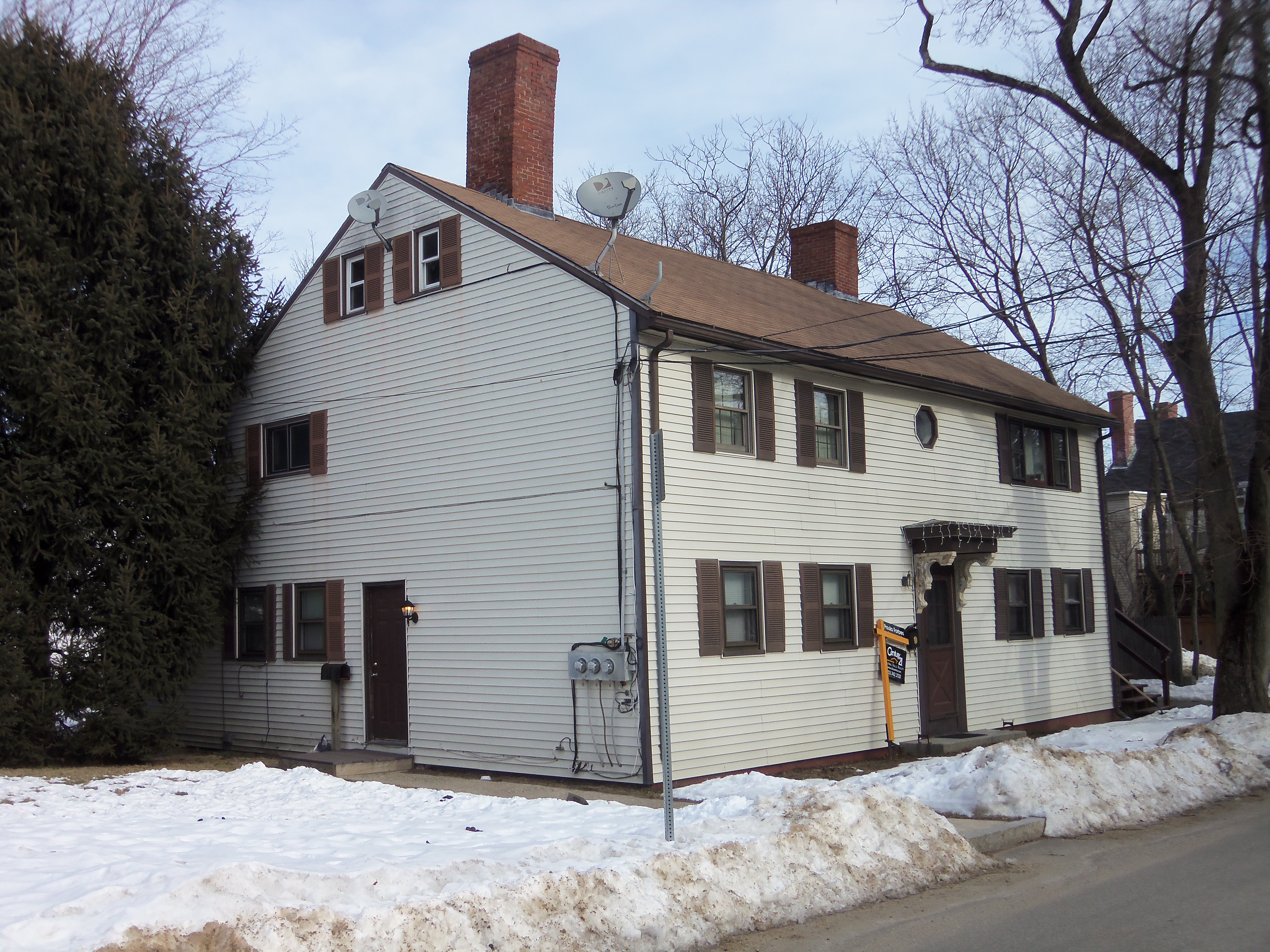
A publication from the Dover Chamber of Commerce, however, may have the answer. Dover’s Heritage Trails, a guide to historic walking tours through the city, notes this at 3-5 Spring Street: “This old dwelling was Dover’s second Quaker Meeting House, built originally at the corner of Silver and Locust Streets and moved to this location in 1728, before Spring Street existed.”

Silas reported “The second was erected in 1712 on land belonging to Ebenezer Varney. The deed, transferred to Friends in 1735, described the site …” in ways that support the Silver and Locust location. My guess is that the structure was moved in 1828, since the Chamber pamphlet mentions that neighboring houses were built in 1810 and 1811.

The building has no doubt changed a lot, inside and out, since it was erected three centuries ago -- including the addition of chimneys. But the shape is right for a Friends meetinghouse.
The building has no doubt changed a lot, inside and out, since it was erected three centuries ago — including the addition of chimneys. But the shape is right for a Friends meetinghouse.

As they say, the plot thickens. And to think, the answer to our search may wind up just a bit more than a block up the street from where we gather.

BECOMING A CHARACTER

Everyone where she was from said simply, “Oh, that Anna! She’s a character!” But they’d never say why.

I met her long after she’d moved east, and sensed in her a deep spiritual presence.

Still, when it came to opening her memorial service, I couldn’t refrain from mentioning her identity as a character. What emerged in the next hour was quite a lesson.

Afterward, as I drove home from New Jersey, I embraced this mandate: we have the first 40 years of our lives to get our act together – and the next 40 to become a character. If we can. If we’re worthy.

SEASONS OF THE SPIRIT

To perceive a spiritual journey as Seasons of the Spirit acknowledges how much of it is out of our own hands, like the weather. We yield to the Spirit and are guided by it, to the extent we are faithful. “Which Spirit is thee speaking of?” I hear echoing, a memory of elder Mary Hawkins of rural Ohio before she counseled me of other spirits, such as anger and jealousy and so on. For the record, then, this is what I now call the Spirit of Christ – specifically, the Light and Life addressed in the opening chapter of the Gospel of John. You may define your encounters as you may. My interest here is with an experienced connection with the Divine and a heightened awareness of its manifestations among us.

While everyone talks about the weather, few openly discuss religion. Too often, those who do raise the subject seem unwilling to listen, at least openly, and their arguments are cast along the lines of dogma or creed. Again, my focus is not on what we have been taught about faith, but what we can say about its workings in our own lives. When we can get past the formulaic responses, a discussion of religious experience allows us to search some of the deepest desires and fears of human existence. It can also unleash extraordinary social reform, as we might see looking through history, or be constrained to do the precise opposite.

 *   *   *

To speak of Spirit in this manner requires us to search for the ways it becomes embodied in our lives and our world. That is, how it takes flesh. What is abstract reveals itself in concrete decisions and actions, as well as thoughts and emotions.

A LIVELY CAST

One of our favorite TV comedies has been Little Mosque on the Prairie, a Canadian series about a small, struggling Muslim community the fictional prairie town of Mercy, Saskatchewan. I’ll let those of you in other faith traditions weigh in on the parallels, but I suspect you’ll find each of the show’s characters already existing in your own congregation.

You’ll also see many of the same dividing lines and tensions. Traditionalists versus modernists, for instance, or those bred to the faith versus converts. There are even the basic questions of identity and self-identity or motivation and discipline.

As I look at my own Quaker circles, I sometimes see a line between those drawn to the hour of worship itself and those drawn to the peace-and-justice witness, such as gender and racial equality, global non-violence and fair trade, prison reform, environmental concerns, and the like. Sometimes the difference shows up most sharply in the announcements that come at the end of our period of silence – those who want to leave quietly, savoring the calm, and those who instead urge us to attend all kinds of lectures, discussions, demonstrations, fundraisers, and other gatherings in the coming weeks.

Sometimes the lines even cross.

THERE’S A REASON IT’S CALLED WORK

Perfection: the goal. The end of craft. The essence, completely uncovered. Yet writing is never perfect. Can never be. Not even in its own era, its own place, its own vernacular. So we’re working within a field of potentialities, choosing one aspect over another. Liquids at play. The words themselves will change over time. Energy fields. Northern lights. Sunsets. The mind and flesh, mixing.

Consider a square grid sheet neatly intersected, and then place yourself at the center, where the four quadrants intersect. Take the horizontal line and name it for one continuum, say “highly emotional” at one end and “completely rational” at the other. Now take the vertical line and apply another continuum, say “public” at one end and “private” at the other. As if we could actually measure any such qualities and then scale them on the grid. (We could even consider this as a color field, with white/black as one dimension and red/green or blue/orange as the other.) We could even consider this as a kind of Chinese checkerboard, but stepping outward. The point is, you have to move: to stay at the center produces a muddy gray: nothing unique emerges. The fulcrum remains static and lifeless. As one proceeds away from the center, a kind of balloon or blob may appear on the grid: you’re working somewhere between selflessly emotional and rational, for instance. Or maybe it’s highly focused. In an art – and possibly other areas of life – I see the goal being to move out to an arc from the ends of the horizontal and vertical axis lines – somewhere along an optimal and growing frontier of two qualities. Beyond that, however, destruction awaits. An orchestral conductor, for instance, can emphasize a work’s inner rhythms or its singing lines – or, more likely, arrive at some combination – while counterpoising them with architectural structure or emotional outpouring. The choices determine whether the result is an orthodox repetition of familiar security or an insightful and exciting (and even disturbing) revelation.

So there’s the question of when to stop, on a given piece. When we’ve depleted ourselves. Or when we’ve moved on. Or when it’s more or less accomplished what we set out to do – the less ambitious works having more prospects for success than do those that attempt to soar closest to the sun. Or when the piece moves off into the marketplace, one way or another. Or when we die or grow infirm. Or when we realize we’ve completely missed the mark.

My focus here is primarily on poetry and fiction, although the concepts can be readily expanded outward through all of the arts and probably into a number of other fields as well.

WHAT SILENCE? WHERE?

Yes, we’re called a silent meeting. But there’s silence and, well, then there’s silence. As nuns would tell parochial school students at the beginning of chapel, “Quaker meeting has begun, no more talking or chewing gum.” Who knows where that originated, much less why certain people – such as the priest – might be considered exempt. Let me declare, I know of no authentic silence. Nowhere on this planet! (Outer space, maybe? Deafness?) Even when we have no spoken messages arising in our worship, we still have the pulses of breathing, to say nothing of the clock, with its measure annoying some and reassuring others. Waves of restlessness, late arrivals, and traffic and sirens along Central Avenue, too. In summer, birds and crickets. Maybe a bagpiper at the edge of the cemetery. In winter, the furnace kicking on, children murmuring, a cough or sneeze. A coat crackling as it’s taken off or put back on.

There’s even silent noise arising in stray thoughts. Imagined lists of things to do. Recollections of things done in the previous week or decades earlier. News reports echoing through our minds. Sometimes, rain. Or simple wind. Maybe “stilled” is a more accurate description than “silent” or even “unprogrammed.”

Yes, I’ve heard stories of city dwellers who come to the countryside and are soon troubled by its relative quiet. I have to chuckle, realizing how much they miss. I think of a meeting for worship one May morning along Broadway in upper Manhattan, when I heard little else outside the room but birdsong, countered a week later in rural Ohio by loud farm tractors and semi-trailer rigs. Remember, too, a few Mays before that, when the kids came into the meeting room, saying that the boom heard a little earlier was Mount St. Helens exploding. Their classroom faced the west and the volcano eighty miles away, with its inky squall line soon blotting out the noontime sun.

What we have, of course, is a practice of acute listening, capable of detecting far-off explosions as well as the motions of the heart. What we enter is not silence exactly but something I often find more akin to swimming underwater. Something that can be calming, peaceful, refreshing, renewing, good – as in good to eat, too. Filling. “Has thou been fruitful?” as they used to say.

My description of what we have is QUIETIST worship, rather than “silent” or “unprogrammed.” Hushed, still, clearing, typically peaceful, not showy, and unobtrusive being a few of its earmarks. Though this hardly covers the experience, either.

While Quakers traditionally did not hire preachers, they did recognize individuals who had abilities as lay ministers and others with the spiritual gifts of elders (that is, bishops, within the congregation) and still others whose skills might help the members in their everyday struggles. When Meeting gathered for worship, these “weighty Quakes” would sit at the front of the room, in what we know as the “facing benches.” Somehow, their presence still lingers in the room, sweet as it is.

NOT QUITE SILENT

We speak of silent Quaker worship, though it’s not exactly silent. If I refer to it as meditation, or even group meditation, others may quibble. Let me explain.

First, within the gathered silence of traditional Quaker worship, someone may begin to speak or, more rarely, sing or pray. It’s a response we call vocal ministry, and it’s usually brief. Ideally, it’s a prophetic response, a Spirit-led message that takes the assembled body deeper into the mystery. At others times, the message is not in the stream of the day’s worship, and the sounds can disrupt that flow. In larger or more established meetings, including Dover, the individual rises from his or her seat before speaking; in smaller circles, the Friend may remain seated.

Second, the understanding of meditation, especially from Asian religious tradition, has it being an intensely personal practice. In one branch of Zen Buddhism, for instance, the sitters face the wall and away from the middle of the room. Typically, any physical movement is prohibited, and the practitioner’s focus is increasingly inward, leaving the physical surroundings behind. While Quaker worship demands a similar personal engagement, which we call centering, there is an expectation that it will open into a group experience involving everyone in the room, even if not one word is spoken. Not everyone centers through meditation, as such – some may sit with an open book, others may simply drop into deep reflection; some may sit with their eyes closed tight, while others gaze softly across the room. Whatever the individual approach, the result is Quaker meeting.

Actually, this blending of inward and outward might not be all that far removed from some of the Asian disciplines. There, the period of group meditation itself may run between twenty and thirty minutes, and be followed by scripture reading, chanting, or a lecture from the teacher. In Quaker practice, the first half-hour often – but not always – remains silent, with vocal messages appearing in the second half of the hour.

Still, with or without any words uttered, it’s group meditation, in my book.

I love the simple elegance of old Quaker meetinghouses.
Touches of good design, reflecting care, without ostentation.
How beautiful the wood itself can be, left unimpeded.
Elements we see echoed in the most exemplary architecture of our own era.

ON TURNING SIXTY … FIVE!

The milestone demands some acknowledgement, or at least a hard assessment of my life to date. To be honest, when I graduated from college, I hardly expected to survive past my mid-thirties, and the way things were going, maybe I wasn’t far off the mark. On the other hand, I never anticipated the turns this journey has taken.

For one thing, I rarely thought of journalism as my lifetime career, but rather as a steppingstone to something else. While the field could be exciting at times, getting caught up in the management side of the business took a toll, and the more recent downward spiral of the professional publishing industry in general is downright frightening.

I had envisioned myself either returning to my hometown and writing for a newspaper that no longer exists, or else working in the heart of a large metropolis with its range of concerts, galleries, lectures, and theater, possibly after going back for a law degree. Of course, neither way opened, but the ashram route did. And I, who started adulthood somewhere between agnostic and logical positivist, was now on a spiritual pathway that would lead me to Quaker practice.

As I look back on my adult life, the only thing that has made sense has been this spiritual evolution. Each of the geographic moves, ostensibly in pursuit of a career, actually introduced the next step in an expanding faith and practice. Now my generation is having to move into places once filled by the “mighty old oaks” who came before us – the most troubling aspect being that we are, all these years later, still the younger members of Meeting or, for that matter, much of literature and the fine arts.

The craft of writing has itself has taken its own curious twists within this; while the poetry and fiction have often arisen in the discipline of keeping my skills sharp in the face of the daily grind, and thus have often veered toward the “experimental” side of literature, they’ve also served as a tool for investigating the unfolding experience – something quite different from trying to “create” a poem or story. Examining a situation honestly and directly, rather than trying to be ironic, cute, entertaining, or ideologically correct, is one of the consequences; on the other hand, you’re constantly measured against some standard of innovation. It ain’t easy, balancing the two.

Nevertheless, I’ll confess to a lot of remaining frustration. All of the unfinished work before me, for instance, or the difficulty in achieving successful book-length publication, despite having more than a thousand poems and short stories published in literary journals, at this point, on five continents. On a more personal level, I could look at all of the social skills to be fostered, to say nothing of a round of grandparenting, should that happen.

Even so, as I told my wife a few months back, I have nearly everything I’ve wanted, though it resembles none of what I imagined. The crux here is in being receptive and grateful, which proves surprisingly elusive when we’re in the middle of the usual swirl.

*   *   *

This is something I wrote for myself at sixty. And here it is, with a few tweaks, five years later. Just as applicable.