Sometimes a little curiosity falls into place

You know, you drive past a thousand times and finally decide to explore a side street.

That’s what happened in Dover when I had a half-hour to spare before my presentation at the public library.

Upper Factory Road off Tollend was the excursion in question, and I was curious to see if I could actually get a glimpse of Kimball Falls in the Cochecho River through somebody’s back yard.

Yeah, suburban-style sprawl.
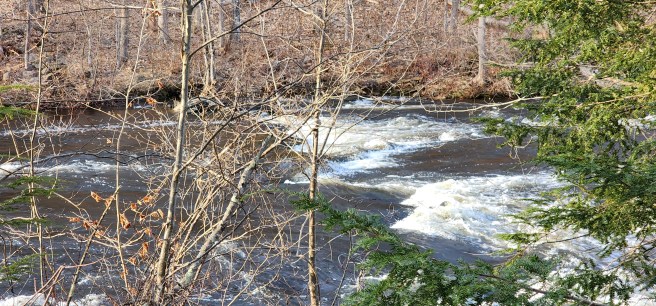
What first appeared was this falls, or rapids, at the foot of the trail. It’s the fourth of six falls as the river runs through Dover, though some of them are more accurately rapids. (I’m guessing there’s a nuance of meaning I hadn’t gotten previously – a waterfall seems to be a more clearly defined kind of “falls,” in contrast to fast-running streams like Jones Falls and Gunpowder Falls in Maryland as well as the Salmon Falls River abutting Dover.)

This one would have been the site of the Dover Cotton Factory, which bought the land before 1820, erected a dam, mills, and housing, and sold it in 1830, when the operation moved downstream to the first falls, now the heart of downtown.

Whittier Falls, which are discussed in my book Quaking Dover, were the second set going upstream.

To my surprise, Upper Factory Road actually leads to a small trail down to the water, along with a twist along the riverbank to a definite waterfall. Alas, that part was too wet to use at the time, but it is on my list for a future trip.
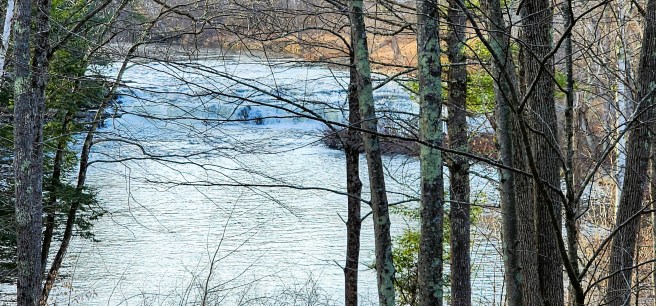
Upstream I could see an actual waterfall, where water pours vertically from a lip into a pool
The water level was up, thanks to recent rain and melting.

Checking the aerial map when I got home, I realized I had frequently passed the falls on the community trail on the other side of the river, but the path had veered too far inland for a direct view. But you can definitely hear them, as I recall.

It’s rather surprising how much you can find in what’s essentially your own back yard when you look. Or, perhaps more accurately, know what you’re looking for. I lived in Dover 21 years and found this 2½ years after I left.

By the way, there’s no Lower Factory Road.

What is it that makes a waterfall so appealing?

Lest we Friends be too proud

From Bowen Alpern’s book, Godless for God’s Sake:

“Much of what we tend to regard as the achievement of Friends as a whole was, in fact, the work of individual Friends, or small groups of Friends, often in the face of opposition or neglect of their monthly meetings. (One of the most positive – if often tedious – aspects of Quaker culture may be its capacity to produce or attract individuals who are willing to stand up to it).”


No index and no footnotes

November is the month many amateur writers set out to draft a full novel within 30 days.

My book Quaking Dover is nonfiction, but with eight published novels, I can still sympathize.

I should have been suspicious when this book seemed to write itself, producing what one beta reader then sensed as not just stream-of-consciousness but a mind-dump.

Ouch!

Revising it, aiming at a more consistent, creative non-fiction tone, was much more torturous and required much more time and attention than I can calculate. Still, I have to admit the result feels satisfying. Just don’t make me do it again.

As a history book, it wound up with no index and no footnotes but instead focused on a community of people over time.

Well, the ebook edition can be easily searched for items. Not so with the paperback.

As for footnotes? Much of my research in the Covid outbreak was conducted online, not exactly a permanent source of information.

The effort did push me far beyond my journalism discipline, pushing me into the story as an active observer, not that I was comfortable with that.

But it seems to work, all the same.

Looking for God in the details

The architect Ludwig Mies van der Rohe is often credited as the origin of the quip, “God is in the details,” but the phrase actually goes back much earlier.

Still, however tedious but essential, details do extend to the minutia of building and sustaining a marriage, a family, and a wider community. You can also apply it to any number of other things, including business, sports, the fine arts, politics.

In researching Quaking Dover, I am left with many gaps in the records of Friends’ godly endeavors. When, for example, did Dover Friends cease to run their own schools?

In addition, in writing a history, the details can drive one mad.

May I suggest the devil’s at work there, too?

My genealogical research experience was a plus

In my mid-30s, a decade after I started worshiping in the Society of Friends, I heard that my great-grandfather had been a Quaker who moved from North Carolina to Ohio after the Civil War.

I’d no clue and was shell-shocked, in a good way.

That soon got me into genealogical research with another, older, cousin, which in turn led me to others through correspondence. Many of the results can be found on my Orphan George blog.

Central to that research were Quaker Meeting minutes and learning to interpret those records. For family data, they can provide some of the best information before the census of 1850, the first to name everyone in a family, along with ages and some other facts.

Serving as clerk of Meeting and in other roles also deepened my understanding of the faith and practice.

While I gained some skill navigating this field, other researchers specialized in public records, such as wills, tax filings, and property maps.

Admittedly, working as a census taker in 2020, I did develop a sympathy for lapses and errors in the federal population documents.

When it came to researching Quaking Dover, I found myself returning to others’ genealogical summaries, where one version differed from another, as well as other records. I knew to treat what I saw there as tenuous but still helpful.

Somehow, though, it felt familiar.

Looking for witches among the Quakers

One of the first things the Puritan authorities examined for after arresting women preaching the Quaker message in America was physical proof of their being witches.

I have no idea about the specifics – and am not sure I want to know. Still, their obsession with the naked bodies strikes me as creepy, even pornographic.

After publishing my book Quaking Dover, the thought struck me that the Puritans must have seen Quaker worship as some kind of séance. Not that we were trying to communicate with the dead, but rather be open to the presence of the Holy Spirit, or Christ.

Of course, that Holy Spirit was translated at the time as Holy Ghost. Yipes! Sounds like Halloween, no?

From my perspective, Ghost is way too limiting for that Spirit, especially when Christ is seen along the lines of Logos in Greek philosophy.

It’s far more revolutionary and liberating than you’d think. One way builds religion as a kind of legal system with punishments and rewards. The other builds it as a set of relationships.

Now, to stock up for those little trick-or-treaters who will be knocking on our door. I promise not to put religious tracts in their bags, tempting as the opportunity might be.


There’s much more to Salem than witch hysteria

Through much of the colonial era, Salem was one of America’s ten biggest cities. In addition, it was closer than Boston to Dover, and like Dover it was settled by West Country English fishermen before the Puritan migration flooded into New England.

Salem’s first Quakers suffered some of the most intense persecution for their faith found anywhere, and they were instrumental in bringing that faith to Dover.

What I didn’t realize was that Salem was long the only Quaker Meeting in the Massachusetts Bay colony. The other early Meetings in today’s Massachusetts were actually in the Plymouth colony.

Details on Salem Meeting’s existence were scarce until I was pointed to Carla Gardina Pestana’s Quakers and Baptists in Colonial Massachusetts.

Her study breaks off before the Salem Meeting shifts to Lynn, where it was once the largest or second largest Friends congregation in New England. And then that, too, faded from sight early in the 20th century.

Pestana’s sensitive telling of Friends through the period includes her sense of Quakers as family oriented, communal, even what she calls tribal. I would still like to see the story of what happened to Salem Friends in the industrial era, but she provided consolation for my own conclusions in Quaking Dover.

As for Salem, its unique Peabody-Essex Museum ranks in many categories in the top ten art institutions in America. It’s definitely one of our favorite destinations. Its grounds even include a reproduction of Salem’s first Quaker meetinghouse, built about the same time as Dover’s.

Various lifestyles I’ve lived

Maybe it’s a good thing we didn’t have selfies through most of it. Most of those shots would have no doubt been embarrassing now.

So here’s how my life’s shaken out in terms of lifestyles.

  1. Straight ‘50s middle class: Growing up in the Midwest.
  2. Hippie: From college to Upstate New York and various moves thereafter, including my first marriage to an emerging visual artist. Well, this does fuel my novels Daffodil Uprising, Pit-a-Pat High Jinks, and Subway Visions.
  3. Monastic: The rogue yoga ashram in the Pocono mountains. See my novel Yoga Bootcamp.
  4. Ascetic: In many ways, this was still hippie as I lived in a loft in a small downtown in a place resembling what I’ve called Prairie Depot.
  5. And back-to-the earth: The next move was a return to my college, this time as a research associate position before leaping on to the interior Pacific Northwest, one with my personal life filled with growth as a published poet, a shift to Quaker spiritual practice, and immersion in backwoods and wilderness wonder. These inspire my novels Nearly Canaan and The Secret Side of Jaya.
  6. William Morris: Steel mill region in what one called the Near East, aka the Rust Belt. Included a divorce and rebound. Hometown News arises in that experience.
  7. Nearly Plain Quaker slash Muppie: The Mennonite Urban Professionals I was hanging out with in Baltimore were the less expensive version of Yuppies. Living in a federal-style brick rowhouse in the Bolton Hill neighborhood was the culmination of my big-city dreams. During the week, I was often on the road with a company car and expense account. This was a rich mix for me, a time of much personal growth, ending in a self-gifted sabbatical year hunkered down in a suburb in which I drafted early versions of much of my fiction.
  8. Yuppieville on the Hill: Relocating to New Hampshire, I wound up living in a complex where I rented a small townhouse. Back in the working ranks rather than management, I was freed from long unpaid overtime hours and the neckties and suits of my earlier professional situations. Contradancing, especially, steeped me in Boston, an hour to the south, while I immersed my personal writing in poetry circles. My love life had many ups and downs.
  9. City farmer: Remarriage prompted my move to the New Hampshire Seacoast, where we bought an old house within easy walking distance of downtown and the Quaker Meeting. That “farmer” label actually befits my spouse, the avid gardener. The property also had the small carriage house you know as my Red Barn. Retirement included serious choral singer and daily swimmer roles.
  10. Island author: We needed to downsize, which led to the remote fishing village with a lively arts scene you’ve been reading about here.

As if his Merrymount antics weren’t enough

Other than the broken wedding engagement, I’ve seen no hints at Thomas Morton’s sexual orientation, as if such distinctions were even worthy of notice back then in colonial New England. But, as far as I’ve found, he never did wed.

Beyond that, I’m left feeling the Puritans were afraid the Quakers would lead to something similar to Morton’s scandalous presence a few decades earlier.

His Merrymount settlement was, I’m convinced, a significant moment in early New England history that few people know about, one sharply at odds with the resulting Puritan image. It was, you know, a kind of hippie commune with friendly relationships with the Natives. Not that Friends would have engaged in dancing, much less doffing their clothes, around a maypole. As well as perhaps many of the other things that cause a lot of people to congregate on Salem, Massachusetts, this time of the year.

Let’s just say it heightened the tensions.

If you don’t know about Merrymount, my book Quaking Dover offers an introduction.


Can it really be a whole year since the book appeared?

Have to admit it’s been an exciting, though not exactly lucrative, past 12 months since Quaking Dover appeared in print. The 255-page volume is quite different from my earlier publications. It’s history, rather than a novel or poetry, and its tone and outlook pushed my journalism training in new ways. I’ve even come to see this as my major creative nonfiction opus.

Reader reaction has been enthusiastic, and the book’s perspective has challenged the conventional take on New England history and its impact on the rest of America.

Friends Journal magazine called it an “eminently well-argued and documented account,“ while others declared it “a rich feast of a book” or said “It’s like you’re speaking right to me! It’s not like a history at all!” or simply “enjoyed your conversational writing style.”

Unlike my novels, its publication led to a festive book-release party in the Dover Quaker meetinghouse, followed by other events – some of them with unique PowerPoint visuals – in Dover, New Hampshire; Haverhill and Cape Cod, Massachusetts; and Eastport and Pembroke, Maine. Ten in all, and all well received. Didn’t get to do that with the novels. I’ve even had strangers stop me in the street to tell me how much they like my reading. And creating the presentations and accompanying illustrations has been fun in a whole new way for me.

One thing that’s impressed me is the way this has connected with people. It’s about places they live in or have visited, about families and communities they know, about values they share. It’s more concrete than fiction but no less personal.

Overall, it’s sold close to the U.S. average of 200 copies a year. Considering that the book is, at its core, the story of a small congregation in a small city in a small state, I’ll take that as a good start.