GLEANING THE MEMORIES

As I said at the time …

From those last surviving aunts, piece together what you can from what memories, photos, and documents you can collect. Maternal sides, especially, can fade from sight, even within the recent past. These personal histories can be far more revealing than those of public figures we usually hear. Especially important is recording the negative findings, as well as the positive.

Look, too, for medical markers. The depression, for example, could arise in genetics or social patterning. For what it’s worth, I suspect there’s a strand of it in my Dunker ancestry. The Hodgson/Hodson/Hodgin males, meanwhile, seem to die largely of heart diseases, probably a consequence of a high cholesterol North Carolina-style diet.

The past lives on, one way or another. It helps to discern its presence in defining your own values and actions.

UNTANGLING THE ROOTS AND THEIR RICHES

As I said at the time …

Your memories of your father’s side of your family are vital. His parting ways, in effect, holds G-d to account for its half of the Covenant in the face of the pogrom.

Fair enough. And it’s a history that must never be forgotten.

After Dad’s funeral, I spent a lot of time in a similar project with his “baby sister” and one of their first cousins as a consequence of a mention, “You know your grandpa’s slogan was ‘Dayton’s Leading Republican Plumber.’ It was on all of his advertising and even the trucks.” I didn’t remember that, but added to what she saw as my grandparents’ hypocrisy, along with their entire church circle, I had something to start with; even though I’d spent a lot of time with them, I never really felt I knew them – it was mostly through my mother’s rather resentful eyes. Up to this point, my genealogy research had leapt over them to get to the roots they rejected. Now there’s (one more) book-length manuscript, probably my one with the most commercial potential, at that. One of the things that intrigues me is the number of times each of us remembers an event or issue differently, or not at all. My advice? Rather than aiming for consistency in the narrative, embrace the variations. Thicken the plot and the possibilities. You’ll rarely know for certain, anyway. Sometimes more details make everything more mysterious. For instance, my aunt finally found the picture of all the trucks and sent me a copy. There was no slogan, though I do have a greeting card where he includes it. Come to think of it, this would have been Grandpa and Grandma’s anniversary – yes, they were married on Lincoln’s birthday, in Uncle Leroy and Aunt Anna’s parlor (I have the photo). Talk about Republican?

At the other end of the string, I found someone online whose explanations took my Hodgson line back across northern Ireland to a still-remote corner of northwest England around 1530. More writing to clean up and eventually submit!

Considering that growing up, I had really no sense of roots or cultural identity, and only much later discovered how much of my ancestry had been in radical religious practices – Quaker and Dunker (a.k.a., German Baptist Brethren and then Church of the Brethren) – has been a real mind-blower. Even though all of my dad’s lines were here before the American Revolution, most of them were pacifists, meaning there are only two ancestors whose actions would allow my sister to join the DAR, if she desired (fortunately, the answer’s no). On Mom’s side, though, there was an aunt who wanted to join, but the lines all get too blurry going across Kentucky – where a number of them were slave-owners, nasty and small-mined people, from the fragments I see.

Obviously, Dad’s side, up to his parents, is what I identify with and cherish. When you speak of the difficulty most people have with understanding the matter of continuing to be Jewish while being, as the term goes, nonobservant, I can point to similar strands on both the Quaker and Dunker sides – essentially, a culture rather than the faith. In the genealogy and broader history, I’ve been interested in seeing what values an individual keeps or discards after leaving the practice, especially across generations. By the time I reached college, I was essentially agnostic or logical positivist, yet I knew, in my bones, I could not fight in Vietnam – this, without any outward religious support and even though my father had served in World War II. Knowing its depth in my ancestry would have been very comforting and strengthening.

HARD-HEADED RESOLVE IN THIS MATTER OF DIVERSITY

As I said at the time …

May I plead for some hard-headed Friends in our midst? We’ve been blessed with many compassionate, sensitive, open-hearted individuals. (Not that we wouldn’t welcome many, many more to join in our circle.) But in our emotions and good intentions, we can also be easily swept up in more than we can handle as a faith community.

There are many reasons to value the Friend who asks the hard or even embarrassing question in the midst of our business discussions, even if we find ourselves momentarily annoyed. The one who keeps asking, How will we pay for this? Who will do it? What are the long-term consequences? Where’s the documentation? Sometimes it’s someone who sees needed repairs and sets about getting them done. The legal issues and nagging details, too. Often, it seems like throwing a wet blanket over our enthusiasm, but I’d rather have that happen before we set out on a venture than have us break down in discouragement when unexpected difficulties arise once the project is in motion or we find we lack the time and commitment to follow through.

For all of our talk of diversity, we do tend to be largely a self-selected group – like attracted to like – and this can leave us with some large gaps in our skills and outlooks. Any auto mechanics or accountants, for instance? Or, as the French novelist Andre Gide once asked, Where are the shoemakers and cobblers in the Society of Friends these days? Which is another way of saying, the people who help us keep our feet on the ground when we’re caught up in the Spirit.

A ROCK AND THE RIPPLE

Looking back on the passing of Silas (all those years ago, now) also stirs an acknowledgment of a major transition in our Meeting, something that had been in process over recent years as he retreated from the active business of our fellowship, all the while remaining a guiding spirit. Now came the finality and the reality. What’s become apparent in our recollections is that despite our emphasis on equality and the avoidance of hierarchy, some Friends are more dedicated, committed, active, forceful (fill in your own words) in their service than are others. This is a statement of fact, not a value judgment. The two decades I knew Silas, after all, came in his retirement years – which were focused fully on his passionate causes.

Maybe we were also admitting we had no one stepping into his shoes. And maybe, to some extent, that’s a good thing – he was, let’s face it, a character all his own. On the other hand, a lot of tasks in Meeting are left unfilled, to our own loss. How we would address these in the coming years was yet to be revealed.

By coincidence, we had a message a few weeks earlier about the absence of guru-style teachers among Friends. Even so, as I wrote, we encounter a string of teachers in our Quaker practice, each one a unique presence. Among them, we would have to count Silas. A Boston Globe at the time carried a story of another, by then in a nursing home in Washington state, and a violin that he’d begun making in prison during World War II, finally completed by his grandson and a friend. As I started to retell this story of someone I’d last seen more than a quarter-century previously, my younger daughter interrupted me to say she’d heard the report on public radio. With all of these overlapping circles, it can be a small world, indeed, and sometimes rather timeless. Maybe our harmony, too, will be heard, well beyond our imagining.

What I feel now is gratitude for each one in our fellowship, and the gifts we bring together. Wherever we are going in the coming years is not entirely in our own hands, but an opportunity for a revelation in faith. Maybe our being here, itself, was not entirely in our own hands, either. That, coupled with a wondering about our ripples and how far they might carry.

~*~

A wonderful documentary with Silas is now available as an online video. Just click here.

REMEMBERING SILAS

Sometimes an image says everything. I remember sitting on the green at Bowdoin College one afternoon during Yearly Meeting sessions and looking out to see a line of boys marching along the far sidewalk. Four or five, maybe six of them, ages somewhere between eight and 12, and determined with a destination. In tow, perhaps twice their height, was another, hunched forward in his gait, a man obviously grinning to be part of such a mystery – Silas Weeks, of course. Who knows what they had to reveal to him? Only that it must have been important – very important, in ways that remain veiled or part of that precise moment.

The fact that they were leading him, rather than the other way around, says a great deal about trust and openness, in both directions. Even the role of affirmation. Everything so natural and rare.

Silas was one of those “old Quakes” who had managed to become A Character, in the best sense of the meaning. He was already well into retirement by the time I relocated to New Hampshire, and remained a force in Dover Meeting for much of the next two decades, despite his growing deafness. He was one of the handful of Friends who reopened the meetinghouse to weekly worship in the 1950s, after its use had become irregular for several decades, and he faithfully served it in many capacities, including clerk, over the years. That’s not to say he couldn’t be stubborn or cranky, but he did manage to get Friends moving on a project. Thus, his passing at 94, though not unexpectedly, brought a deep sense of loss to the meeting.

“Silas tells funny jokes,” is what Eli Abbott, 13, remembered.

Silas stories were bountiful, within and without the meeting, and there’s no way I could begin to tell them all.

When majoring in community development at the University of New Hampshire, however, one of our friends had Silas for her academic advisor. She remembers being honored to be part of a group of students invited to a social gathering out at the farm, until he announced on their arrival that it was time for potato planting – and then pointed to the spades. For them, it was an awkward situation where nobody could say no freely. The next semester brought another invitation, this time accompanied by the revelation that it was now harvest time for the spuds.

Apparently, there was no ill will. After learning that they shared the same birthday, however many years apart, these two begin meeting for a dinner each year to celebrate together – not always on the exact day, but as close as they could manage – a tradition that spanned three decades. And she still keeps a garden, in response to his lessons.

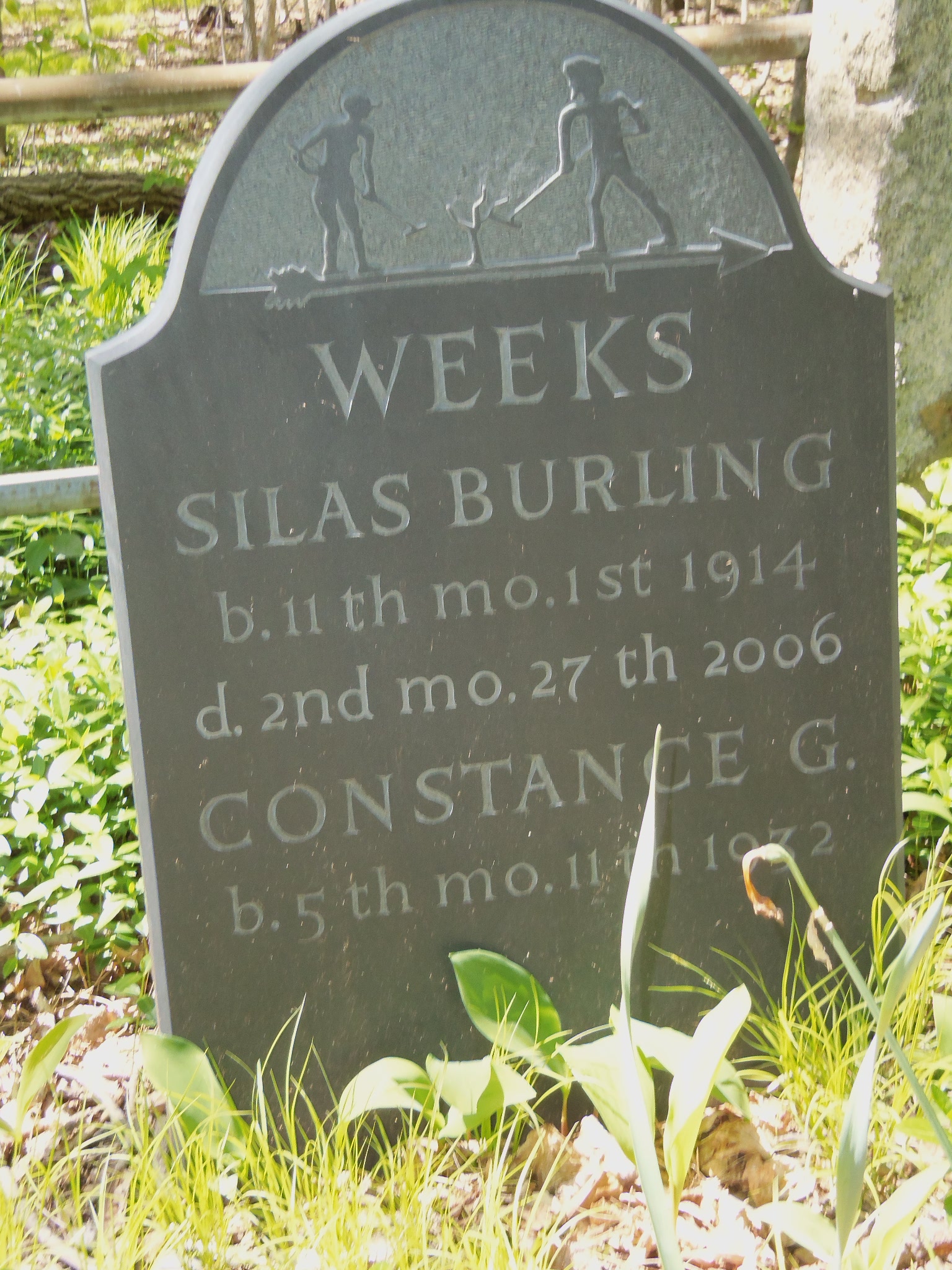
He chose to be buried in an existing burial plot on the farm, rather than in the meeting's cemetery. The engraving atop his stone is one designed as their emblem.
He chose to be buried in an existing burial plot on the farm, rather than in the meeting’s cemetery. The engraving atop his stone is one designed as their emblem.

Kodak9 033

LABORING TOGETHER

In his book of essays, Life Work, Donald Hall divides our labors as jobs, chores, and work. Jobs, of course, are done for income; chores, the things that must be done to keep a household running, are gratis; but work, he says, is done out of passion, and if we’re really lucky, it even pays our bills. In other words, work energizes us.

Another poet, Gary Snyder, uses the term, The Real Work, which is also the title for a book of his own essays and interviews. There, he argues that real work is a matter of attention and focus, as well as finding our unique place in the universe of the moment.

From the Shakers’ “hands for work, hearts for God” practice, I would add that real work is not rushed, but rather proceeds at a sensible pace, without too much concern for “productivity”; real work includes times for reflection and play. Otherwise, you’d never conceive and create things like a circular saw or clothespin. And, increasingly, such work is rarely found in the workplace. (Job-place?)

From a conference representing three different strands of Quakerism, a statement from one of the Evangelical Friends has stayed with me. She differentiated between “church work” and “God’s work.” One, she explained, was agreeing to teach First-Day School because an adult body was needed; the other was a response to something deeper and fully engaging. In Hall’s view, one was a chore, while the other was work.

Nominations time will approach all too shortly. Yes, our pool of available bodies is shrinking and aging. Still, I’ll ask that you search your heart for the ways you might respond to God’s work in our midst. (As clerk, I was more and more amazed by the range of skills needed to keep this building and its activities running!) Look especially at the little ways this might play into your own larger Life Work – and for ways we might engage playfulness into our labors, transforming chores into the real work.

I’ve spoken of what I call the parable of the geese – the image of our clerks, rotating in the lead so that none get exhausted. My turn, your turn, his turn, her turn. And to think, the birds fly almost as fast as cars on the freeway. Maybe it’s another image of the perfect Meeting. In one of the first quarterly meetings I clerked, as I looked out from small table at the high bench in the Henniker meetinghouse, I thought, Look at all those former clerks! It was my turn, and I felt comforted to know I could trust their guidance.

So who’s leading the geese? And how do they decide in their lineup? I can’t decide if they’re barking or laughing as they fly, but they sure sound like they’re having fun – coming or going.
QUERIES IN THE SOCIAL HOUR

Some of the most profound and lasting messages I’ve received among Friends have come outside of the Meeting for Worship – and often as questions. It may surprise many of you to learn that in my first years with Quakers, I was generally pretty hostile to anything smacking of Christianity. And yet seeds were planted. I recall, for instance, Norris Wentworth’s observation while giving me a lift in his car – something to the effect that because America has an underlying Christian mindset, Eastern religions would have trouble taking root here.

Or “What do you think of Jesus?” during my clearness session for membership in what turns out to be one of the most universalist meetings in America. (Our preparative meeting was about 150 miles away in the desert of Washington state.) Followed by a remark to me, “I fear that we’re losing our Christian connection.”

A few years later: “What do you think of the Bible?” as an elderly Wilburite Friend in Whittier, Iowa, drilled her eyes in my direction. I doubt my analogy of a sharpening-stone wheel satisfied her.

Or, a year or two later: “And just what spirit was thee speaking of?” Mary Hawkins, an elder at Middleton Meeting in Ohio, before adding. “there are many spirits – anger, envy …” Since then, I have since been careful to say, Holy Spirit or Spirit of Christ.

The most influential Friend, though, was Myrtle Bailey, a recorded minister at Winona, Ohio. I’ve been thinking a lot lately about her asking me what I considered the perfect meeting, and my response, which seemed to surprise both of us. Rather than looking at meeting as the experience of worship, I looked at it as a community – a woodpile, in fact. We need good pieces of seasoned wood, as well as kindling; but also green wood, to begin seasoning. Here at Dover, we seem to be falling behind on the green wood supply. Which leads us to the next question.

A STRANGER AT THE DOOR

No Friends Meeting is ever the same – whether with the same body of people, in the same location, or while visiting around the world. This awareness casts a new light on the concept of expectant worship, in that you never know exactly what to predict, other than the possibility of being blessed by something wondrous and remarkable.

Traveling among different strands of Friends expands that concept.

In one pastoral Meeting, for instance, I encountered “silent singing” – no, they did sing from a hymnal, but the room was awfully quiet. Maybe all of their best voices were away in Philadelphia that weekend.

In one Evangelical Friends Meeting, as the pastor told me the following week, the Holy Spirit had been so powerful he had to put his sermon aside; I’m sure he wasn’t expecting that!

Or I was introduced to karaoke, of a contemporary Christian vein, in a midweek Meeting in central Pennsylvania. Who’d a’thunk.

So what do you say, greeting the stranger at our meetinghouse door, ready to sample Quaker worship for the first time? This is what not to expect?

“Maybe we’ll have a rare, totally silent worship,” seems to be as good as any. You never know.

SNOBBERY, ALL THE SAME

To see the old meetinghouse at China, Maine, as it’s been turned into a Friends Camp arts studio (a messy one, at that) is a pointed symbol of the tensions many of us encounter as we attempt to live out our faith – and not just on the cultural front. (For the record, I am, after all, a published poet and novelist, a professional journalist, an avid contradancer, gallery-goer, foreign film buff, occasional violinist and harmony singer, and a lover of opera and classical music – all of which can raise eyebrows in various spiritual circles, and most of which would have been forbidden in traditional Quaker discipline – all this even before we turn to the struggles of the workplace, families, neighbors, or politics. Call me a snob, if you will.) The fact remains that the Society of Friends today is filled with many artists pursuing every imaginable medium. Dover Meeting is not alone in its range of talent.

A while back, I spoke of practice as something that’s ongoing and never finished, in contrast, say, to a performance or even a rehearsal. Practice as something done more for its own exploration and pursuit of a discipline than for any finished product. Practice as being part of a bigger encounter: the practice of prayer, practice of poetry, practicing musical scales, play practice, football practice, even medical practice. Something done with care, and if freedom follows in critical situations, as we often hear in interviews after a Patriots’ game, then all the better. Weeding and composting, I suppose, are part of the practice of gardening, apart from any harvest.

When I think about qualities that mark Quaker artists, I would tentatively suggest: placing the ongoing work ahead of themselves; “cool” rather than “hot”; a sense of experience and discovery rather than make-believe or escape; honesty rather than pretense; wonder rather than irony; humility rather than egotism or arrogance; candor rather than flamboyance; a preference for simplicity over complexity; directness rather than confusion; economy rather than extravagance; calmness rather than shrillness; curiosity and listening rather than dogma or bombast.

We might also turn the old Quaker views toward a critique of today’s cult of celebrities (almost universally entertainment/professional sports figures) and their exorbitant incomes – a situation that I believe accompanies a lessening of power within our communities. To that we could add the ways the arts are often used as a secular religion to sanctify public occasions. As for the Oscars?

But maybe that’s just another part of our unfolding spiritual awareness.

OH, THE SONG OF THE WEARY

At our yearly meeting sessions each summer, one night features an all-ages coffee house organized by the teens. It’s a great release for the adults, who have been hunkered down in joint business agendas that often run three hours at a shot. Still, in a week filled with those plus organized discussions and workshops, committee reports and tables, social issues documentaries, casual conversations, and much more, the live amateur entertainment can be a bit much, no matter how excellent many of the acts are.

So it was for me one year when I decided to skip the event – perhaps even go to bed early for a switch.

As I wandered down a hallway, I came across a half-dozen or so Friends gathered around an upright piano and singing four-part music. Great! I jumped right in and was delighted when we turned to a Stephen Foster piece that’s also in the repertoire of my choir. We were just getting it down for ourselves when the announcement came: “You’re on in five!”

What?

My plans had just changed.

So there we were, all adults, lining up for the stage, marching up, finding our places in a semi-circle facing the audience, and being introduced by an enthusiastic high school senior. What was supposed to be “the Hard-Timers,” after the piece we were to sing, came out of her mouth as “the Old-Timers.” Instead of being offended, though, I was grateful it hadn’t come out “the Alzheimers.” Ahem.

If you’re not yet there, be warned: This getting older does have a lot of unanticipated turns. Don’t you forget it. And don’t forget to smile.