Meet a Quaker

You never know what we'll churn up in cleaning a stall

In his “Note on the Religious Tendencies” published by Liberation magazine in 1959, the Zen Buddhist and poet Gary Snyder remarked, “The statement common in some circles, ‘All religions lead to the same goal,’ is the result of fantastically sloppy thinking and no practice.” His very next sentence is equally startling. “It is good to remember that all religions are nine-tenths fraud and are responsible for numerous social evils.”
Well, the essay is largely a defense of the beat generation, and he was an American studying in monasteries in Kyoto. I wonder if he’d admit today how much social progress and learning have come about through religion, too. That could make for an illuminating debate.
I did hear him once mention that on the Buddhist spectrum, Zen starts at one extreme and Tibetan tradition at the other, but that as followers of each advance in their practice – as he said this, his outstretched arms began to sweep over this head – they eventually approach and then cross places. Just as his arms were doing. Go far enough, of course, and each would land where the other one had set forth.
Without going into detail, I find a lot in common there when it comes to Quakers and Eastern Orthodox on the Christian spectrum.
The one is plain, even austere, and very much centered in the present. The other is visually and tactily rich, accompanied by an accentuated awareness of mortality and death.
As regular readers of this blog are aware, I am a Quaker who’s been fascinated lately with Greek Orthodox life. It doesn’t all spring from questions arising as I drafted and revised my novel What’s Left, either. Besides, Cassia’s family wasn’t all that observant of their native faith, even if members were toying with the Tibetan Buddhism her father practiced.
Admittedly, few Americans know much about either Quakers or Orthodox Christians, despite their impact on the larger society. Ditto for Buddhism.
Today is an especially important day for the Orthodox.
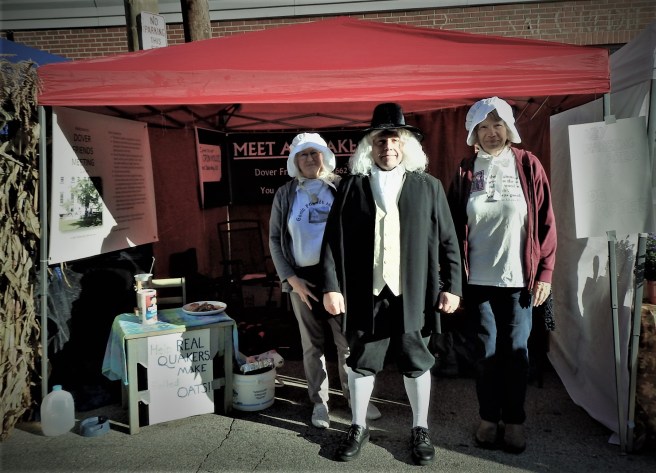
As Quakers, we’re not confined to a liturgical calendar or its requirements. Even so, through much of our history, members of the Society of Friends lived within the limitations of strict discipline, which included plain dress like the Amish and plain speech of the “thee” and “thou” sort.
These have greatly loosened up over the past century, which is not to say we don’t live out a distinct set of values – we’re just more flexible or forgiving. Non-violence and pacifism, equality, simplicity, social justice, and truthfulness remain forefront in our daily lives. Few Friends I know smoke, and in our circles, I suspect the majority now drive Priuses as a consequence of faith. Many, but by no means all, participate in vigils or social witness demonstrations.
But being Quaker doesn’t preclude us from what Douglas Steere coined “mutual irradiation,” acknowledging that we can learn from others’ religious practices and experiences and encourage them in their own. It’s not the same as a lowest-common-denominator ecumenism, but rather a willingness to be inspired and enlightened by our differences. It’s something I’ve been enjoying among the Greek-Orthodox where I live, and found with Mennonites and Brethren earlier. It’s also a principal reason I participate in the Dover Area Religious Leaders’ Association and our joint services.
Of course, remarrying has changed some of my perspectives. With children, especially, there was no way of downplaying Christmas, not in contemporary American society. (Historically, Friends were among those who considered it a pagan import.) I’ve previously posted about the revolutionary ways observing Advent has helped me cope with the commercial assault of that holiday.
~*~
Eliminating a liturgical calendar also meant we also didn’t observe Easter. (Every day was to be holy.) And without Christmas or Easter, there would be no Advent or Lent.
Leap ahead.
There’s no way to totally ignore these, not when no longer live in close communities of our own and are often the only Quaker in our workplace. On top of that, many of us come from other faith traditions and carry within us many of those teachings and traditions, one way or another.
~*~
All of this leads up to to a desire in our household to use Advent and Lent as times of renewal and rededication. We try to do a special reading together, at the least, and usually give up alcohol.
For the record, by the late 19th century, most Quakers had banned alcohol altogether – it’s not uncommon to meet Friends who have never had a drink in their life. On the other hand, when I admitted to enjoying a glass of beer or wine, one old Friend replied, “Jnana, in thy occupation, we’d be surprised if thee didn’t.” Remember, I was a newspaper editor.
So, here we are in what the Eastern Orthodox call Great Lent, and I’m surviving without my daily martini or a glass of wine with dinner. Abstaining reminds me of just how habitual these things become. Besides, I believe saying “no” for a season can be strengthen one’s willpower for other decisions, too.
~*~
One year, my wife and I went largely vegan for Advent. She had reviewed all of the Eastern Orthodox dietary rules for that observance and concluded they were essentially vegan with the additional elimination of olive oil and alcohol. Oh, and when she concluded that since olive oil would have been the only oil in the eastern Mediterrean, she extended the ban to all cooking oils.
It was a tough period, as I posted at the time. She did come up with some marvelous dishes all the same, but rather than being freed from considerations of food, she was spending more time trying to find ways to manage.
This year, for the period of Great Lent, we’re taking a slightly different approach. Remember, we’re not confined to the ancient regulations, we’re doing this voluntarily. (And, as I’ve learned, the Orthodox rules are only suggested, not required, of the faithful.) What we’re doing is inspired by food guru Mark Bittman’s book Eat Vegan Before 6:00. In short, we have more options when it comes to the evening meal – especially, as we’re applying this, on the weekends.
Since I’m already trying to observe a Healthy Heart diet, I’m not seeing a lot of change. The biggest challenge has involved my morning coffee, which is already down to a single cup a day, thanks to another medical restriction.
No, alas, there are no wonder substitutes for dairy.
Homemade almond milk comes closest – we find much of the commercial variety to be vile. But almonds are comparatively expensive, and soaking the nuts and grinding and straining take time.
Oat milk, made from oatmeal, starts cooking in hot liquid, leaving an unpleasant layer of sludge in the bottom of the mug.
Coconut milk tastes like coconut, which I find disconcerting.
Black coffee seems harsh on an empty stomach – a sliver of lemon helps a little, somehow.
~*~
So I’m counting the days till Easter – the Orthodox version, which comes at the end of Passover, a full week later than the Western celebration.
Many Americans participate in a congregation close to their homes – a neighborhood church, as it’s often called.
For others, though, the decision is more selective and may require travel to gather for worship, communal action, and other events.
Frequently, these members define their personal identity strongly by these religious circles – I certainly do as a Quaker. Still others, like Jews or Greeks, find their identity further enhanced by the use of a foreign language, such as Hebrew or Greek, in worship and possibly also at home, as well as unique holidays on dates the wider public doesn’t celebrate.
I am fascinated by the intensity of this identification for some people or its relative weakness in others. I rarely hear individuals define themselves as, say, Methodist or Presbyterian or even Baptist with the sense of intense core identity I hear in Quaker, Greek, Mennonite, or even “nonobservant Jew.”
Think about the Amish, with their German dialect accompanied by distinctive dress and horse-and-carriage transportation. Or Ultra-Orthodox Jews who also observe the dress restrictions and likely add Yiddish to the mix.
Let’s assume we’ll find similar patterns in new ethnic populations appearing in the nation – Islam, especially. Anyone else feeling some empathy?
What’s your experience of religion and personal identity?
From our perch today, it’s hard to believe that a Broadway musical like “South Pacific” could have been a bold statement on behalf of racial tolerance a half century ago.
I’m encouraged, of course, to see a Quaker connection.
First, even though the novelist James A. Michener, whose book was the basis of the show, had served in the U.S. Navy during World War II, he was raised by a Quaker adoptive mother and attended Quaker-affiliated Swarthmore College. In other words, he had been exposed to both pacifist and racial equality values.
Second, as Vanity Fair writer Todd S. Purdom notes in “The Road to Bali-hai,” is that librettist Oscar Hammerstein’s wife’s niece Jennifer attended the George School, another Quaker institution, one where Michener also taught briefly. The Hammersteins’ own son Jimmy also went there, as did a young family friend named and future Broadway great Stephen Sondheim. (And to think how vigorously earlier Quakers denounced theater as vain entertainment!)
Purdom’s article contains another telling point. The hit song “I’m Gonna Wash that Man Right Out of My Hair” was originally a flop. In the preview performances before the Broadway opening, director and co-author Josh Logan was perplexed to see it wasn’t connecting until he realized that star Mary Martin had the women in the audience so abuzz about whether she was actually washing her hair onstage that nobody ever heard the lyrics themselves. He fixed that by having her belt out the first stanza before working her hair.
I wonder about how many other small changes in any art form spell the difference between boffo hit and mundane shelving.
A similar tweak in “Wonderful Guy” changed the song to a soliloquy with the word “you” substituted for “they.” As Logan recalled, “That night they tore the house apart.”
As I was saying about small changes or a simple touch? Never underestimate the importance of revisions in art. Or maybe life itself.
~*~
Michener, by the way, wrote of his experience on the Electoral College elections with the telling title on his political science volume, Presidential Lottery: The Reckless Gamble on Our Electoral System.
He was so prescient there.
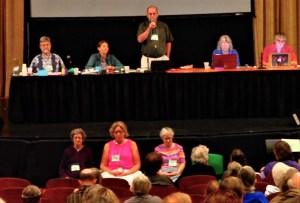
In Quaker organizational structure, the ultimate decision-making body is the Yearly Meeting – so named because of its annual sessions. While the central event is the convocation, the organization itself (also called the Yearly Meeting) has ongoing activities and committee meetings throughout the year. One of the purposes of the gathering is simply to coordinate and nurture these missions.
Unlike some denominations, we have no central headquarters. Our Yearly Meetings are rather distributed across the country and the globe, and these bodies work together through cooperative affiliations, shared projects, communication, and inter-visitation.
My local Friends Meeting is part of New England Yearly Meeting of Friends, the oldest such body in the world. In fact, when more than 800 people – representatives, their spouses, and children – assemble next month on the Castleton University campus in Vermont, it will be our 358th gathering. (Until 1905, we met in Newport, Rhode Island. Since then, we’ve moved around New England.)
Here are some reasons I attend, whenever possible.
~*~
Is there a similar assembly – maybe a camp? – that you like to attend for similar reasons? What is it? And why?
~*~

Continuing the poetry parade, see what’s new at THISTLE/FLINCH.
YES, EVERYBODY TALKS about the weather. I’m no exception, and I usually enjoy the exchange. But I also listen with a grain of salt. To take a longer view and talk about the seasons, however, is another matter – one heightened in recent years by concerns about climatic upheaval and global warming. Living as I have in various locales in a band across the northern half of the United States, I’ve come to appreciate a wide seasonal ebb and flow. Deep snowfall and subzero spells, crackling and booming thunderstorms, an extended spring – I’m not one for the monotonous sunshine of Florida or southern California. I want to be jolted and moved, with all the accompanying influence on my emotions and thinking. There are seasons for curling up late at night with a book; others for reading on the beach or under the trees. Times for shoveling snow or cross-country skiing; times for raking leaves and mulching. Each new place has meant adjusting my expectations and observing fine differences from what I had previously encountered. All this, before dealing directly with the variations from one year to another within a specific place.
Over the years, the repetition adds up to knowledge and expectation. As the winter solstice observations of Christmas and New Year’s, there’s anticipation before ordering garden seeds in January and bringing the grow lights up from the cellar so you may start the seedlings. Having the cross country boots and skis ready. Keeping an eye on the pussy willows, to collect their sprigs. Planting, harvesting, cooking, sharing, and preserving. There’s the anticipation of the sequence of flowers or garden produce, each to be savored in its moment. From asparagus, snow peas, and strawberries through to potatoes, garlic, and leaks. From snow lilies, forsythia, and crocus through to asters and Jerusalem artichokes. Ordering firewood early, so it will season properly. Calling the chimney sweep and annual furnace checkup. Making room in the compost bins for October leaves. Trimming the hedges. And that’s just from a homeowner’s and urban gardener’s perspective. Normally, I wouldn’t be writing in July – my attic workspace simply becomes too stuffy, but this year’s an exception. There are other fronts. We’ve brewed ales in late autumn and lagers in deep winter, to take advantage of the favored requirements of each yeast. There’s also the seasonal flow of paying taxes and insurance, registering the car, taking a vacation, enjoying holidays. We also see academic years, baseball and football seasons, opera and symphony seasons, television seasons. There are many more, of course, as you start looking.
The challenge comes in not falling behind, but to instead preparing for the next stage. Here come the tomatoes, here comes the sweet corn. Pace yourself for the playoffs. Budget accordingly.
gratitude
for minutia and large
flowing creation
and homing
family, mystery within walls
around our bedding
wealth beyond cash
and clutter
overabundance of opportunities
to engage
any strength generously
distinguishing between gifts
and hard-earned wealth
and everything seized from others
remembering greed
bondage and
warfare
gluttony all entangle
lust
yet if we love liberally
this sojourn
exposing each deception
in relentless light
reunion . reconciliation
uttered utterly
forgives . accepts
corrects . and gives again
Poem copyright 2016 by Jnana Hodson
To see the full set, click here.
I used to get quite annoyed at those at the ashram who were so deeply into the astrology, into charting every minuscule bit of mathematics (and do they ever get into the calculations! hour after hour). And the following is all very tentative, superficial scratching especially when the serious astrologer is looking over our shoulders. But then they look to see what seems to fit and what doesn’t from their findings.
The idea of celestial influences on our lives can be seen in as a dimension of Seasons of Spirit. Sometimes conditions are more favorable than others. Sometimes things go more smoothly than others. The Biblical counsel, however, is to stay faithful in one’s practice. Make no excuses. Be ready.
Those of a more scientific bent can point instead to the precision of celestial calculations. The annual sequence of heavenly turning, the appearance of various meteor showers (with their own unpredictable volume and visibility), is complicated by the individual calculations for moons and planets.
From either perspective, we watch. Two or three planets approach in the evening sky, moving through the night, to reenact an ancient mythological tale.
~*~
For more Seasons of the Spirit, click here.
In the early days of Friends, they’d often greet each other with the question, “How does Truth prosper among you?” Not “How are you doing?” or even “Good morning.”
Strikes modern ears as puzzling, even problematic, beginning with that verb prosper, which we tend to consider along financial terms rather than thrive or even proliferate. Equally unfamiliar is the idea of Truth being active – alive – rather than static and unchanging.
To further thicken the plot, consider their linkage of Truth and Christ, so the question also asks, “How is Christ alive among you?”
How would you answer that!
~*~
For more along these lines, take a look at Religion Turned Upside Down.