By the end of ’68, the counterculture phenomenon was metastasizing from San Francisco’s Haight-Ashbury and nearby Berkeley into pockets across most of the country and even Europe. As August of ’69 proved, it was sufficiently established in the East to draw together the unanticipated throng at Woodstock.
Much of the transplanted activity existed at the fringes of college campuses, as I experienced in Bloomington, Indiana, and later Binghamton, New York. For me, growing up in Ohio, I would have rather attended hip, beat Antioch in Yellow Springs, but the finances were way out of our consideration. So a state school was my destination, and at the time, Indiana as an out-of-state student was nearly as reasonable as in-state for me in Ohio. And a bit later, to my surprise, how yesterday Antioch began to appear once I was near the East Coast.
The searing experiences shape what I describe in Daffodil Uprising and then Pit-a-Pat High Jinks. And as I continue to repeat, hippies came in all varieties – and still do. There was no standard-issue, card-carrying member, but each was one to some degree or another. Nobody completely fit the hippie image.
As someone who became addicted at the onset of adolescence to classical, opera, and folk music, I was already passionate about an alternative to commercial entertainment, which was what rock at the time really was. I was one who lamented deeply when Bob Dylan went electric. Sold out, so it seemed. I had the long hair and blue jeans and bell bottoms. I was against the war, tried a few hallucinations, loved sex when I could get it, which wasn’t often.
And then I encountered yoga, which led me to give up meat, alcohol and drugs, and sex for the life I detail in Yoga Bootcamp – and yet, curiously, this was when I felt the most hippie in all of my awareness.
In the Society of Friends, or Quakers, testimony and witness are synonyms. It’s what one does in one’s life, not what one says about the nature of faith or social stances. Here are some ways we practice this:
Open, Spirit-led worship. Traditionally, sitting together in silence, but many Friends today do have pastors and hymns within a loosely structured worship program.
Peace. It includes pacifism and non-violence, extending to speech.
Honesty. No oaths, which can lead to a double-standard of truthfulness.
Integrity. This means doing what we say.
No creeds or dogma. We speak from our own hearts and experience. We do, however, recognize doctrine (meaning sound teaching) as useful.
Queries. Use of questions and deep listening to guide actions and faith, rather than barking orders.
Equality and social justice. (You don’t have to be a protester, though, to be a member.)
No gambling. And no getting something for nothing, especially at another’s expense.
No voting to arrive at decisions. (Voting in public elections, however, is strongly encouraged.)
Simplicity. It’s more complicated than you’d think.
One test of a poem (for me, at least) is based on the qualities of good vocal ministry arising in the traditional quiet worship of Quakers: incantatory language and prophetic whirlwind. Unlike “slow prose” as a kind of sermon.
In vocal ministry, how often the message comes from within our current conflict or personal struggle!
Yes, we wrestle with God.
Poems and prayers you feel in your hands more than bounce around ‘tween your ears.
Let me express my own everlasting gratitude for Glenn Thompson and his eye for talent, in my case after my letter to the editor and then his offer of an internship, later followed by a full summer. In a seemingly casual interview, he urged me to keep a personal journal, which I actually have. And then came the job offer. Without him (and so many others), my life would have taken a different direction. Gee, indirectly he even led to my first lover. (Look for Mitch in Daffodil Uprising, who’d been a copy boy I met thanks to Glenn’s support. Mitch was the catalyst to the crucial introduction. That dimension, in itself, could be a novel.)
Glenn was the editor-in-chief of the morning newspaper in Dayton, Ohio, and in his own way, a visionary. Behind the scenes, he even brought together the first university I attended, Wright State. And also, through him, I became a professional journalist, even while still in college. Another long story.
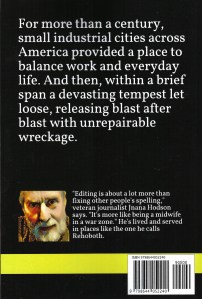
The paperback cover …
And he asked questions no one had prodded me with before. How would I change the world? What issues could I raise and address? At first, I was speechless. We were so green, and within a year, everything would look different. The biggest item on the agenda was the Establishment, not even its war in ‘Nam. Civil rights issues were a distant second.
The next summer I was a hundred miles up the road from Woodstock, working for a publisher who totally ignored me and editors who kept their heads down. But a new direction was taking shape for me.
Alas, as I’m also seeing, mine are steps youth today cannot follow. The pathways simply no longer exist, to the larger society’s impoverishment.
As I describe in my novel Hometown News, American journalism has long been based on a precarious business model. News itself is a byproduct of trying to attract customers for advertisers, and many publishers considered news gathering mostly as a costly nuisance. Successful newspapers were defined mostly by their obscene profits, and the pay levels for reporters and editors were often at the bottom of pay scales for professionals. As a priest reminded me before my first marriage, we might as well have been bound by vows of poverty. Oh, yes, and some of the highest quality papers – the kind I aspired to – were fighting for their very survival. We can now add to the toll of the role of the Internet.
So it’s all in flux now.
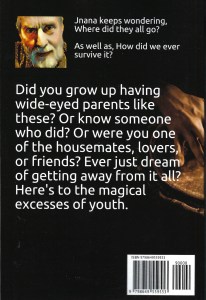
… and the back cover.
Still, newspapers show up in the majority of my novels, though in Nearly Canaan the field turned from journalism into non-profit organizations where the long, odd hours, public service, and stress nevertheless remained.
As I look back on my own years of being on the management track in a shrinking business, I see how I started out a hot-shot who thought the New York Herald Tribune in its last years was the best newspaper ever – led by an editor who later admitted in a letter to me he seemed to have become a specialist in trying to recover dying papers. Even then, I would have loved to have worked for him.
Despite my own honors, I had some crucial near misses. For one, I wound up in the final 24 for a dozen summer internships at the Washington Post but failed to make the final cut. The next summer, the Wall Street Journal was laying off staff rather than hiring, so their interest evaporated. Ten years later, something similar happened with timing for a high-level spot at the Detroit Free Press. And so my career veered away from the big cities where I had dreamed of living and from the big time, maybe for the best for me personally and ultimately professionally.
Somehow, this also has me thinking back to the lost hippie wannabes at the corner of Third and Main in Dayton during the summer of ’68. Theirs was a story I had hoped to write, but I couldn’t ask the right questions, I was too green myself. But, more honestly, maybe I just wasn’t cold-hearted enough to cut through to the real hurt and relate it without concern for the consequences.
When the Quaker movement swept through the English-speaking world and a bit more in the mid-1600s, it saw itself as primitive Christianity restored from before the time apostasy set upon the church – that is, sometime before the Nicene Council of 325 CE.
In theory, nothing could have been simpler or more welcoming than what they presented, an alternative Christianity for all, though in practice what emerged was often more difficult than many could follow, even before the disciplined rules of conduct set in.
I could lay out many of the obstacles to continuing the faith over the generations, even admitting that I wouldn’t have survived the lifestyle restrictions during much of that time, but more recently I’ve been seeing the most insidious impact was in the curtailment of emotion.
Yes, Friends were often seen as gentle and kind, but it came at a price. The Quaker culture that evolved, quite simply, suppressed any expression of anger – which was usually seen as leading to violence, which Friends abhorred – but only in recent decades has there been an acknowledgment that emotions don’t go away, and suppressing the expression of one curtails an open experience of the others. Burying anger, in fact, festers as depression, which can be glimpsed in the memorial minutes of many of the “weighty Quakes” of the past.
While moderation in daily life and meekness were encouraged, they could be performed thoughtfully or habitually without being deeply felt.
I’ve heard instances of old Friends’ reluctance to show emotion.
Greeting a son returned from wartime service with a handshake rather than a hug, for instance. My own family, several generations removed from its Quaker and Dunker (Brethren) roots, was similarly restrained. And, as has been said, the Hodsons didn’t know how to have fun. (When students at one Quaker school asked to have a fun activity, the elders had to withdraw to ponder the peculiar request and then came back with a proposal to paint a widow’s barn. An old Brethren, asked what he did for fun as a child, was perplexed by the very notion and finally replied he guessed it was bringing the cows in each evening.)
Then there’s the sly comment that passed among young Friends in the 1970s, asking if we knew why the old Quakers were so opposed to handholding. The answer? It might lead to premarital intercourse, not meaning sex but rather conversation.
There are also stories, usually told within families, of the individual who would never, ever, express anger only to have an offense fester, leading to deeply hurtful reactions in convolutions much later. You can guess, the baffling ex-mother-in-law, after the divorce, that sort of thing.
Not all birthright Friends, I should add, are so conflicted. Many I’ve known have been among the most loving individuals in my acquaintance.
But in looking at the decline of the faith over its history, I feel an awareness of the psychological undertow needs to be acknowledged, especially as we face the future.
Religion, as I see it, always has work to do to bring each person to a fuller experience of life.
I wish there were a better label than “hippie” to apply to the counterculture explosion that swept the world in the late ’60s and early ’70s. Contrary to popular assumptions, there was no standard-issue hippie, male or female. Not everyone did pot or ventured into acid and beyond, nor did everyone participate in a protest march or have long hair or have sex every night or at least on the weekend. We all came in various degrees of separation from general society yet, somehow, we also recognized a kinship with each other.
The paperback cover …
“Are you sure you were a hippie,” my wife sometimes asks. So what if I didn’t like rock? Many of my friends had been at Woodstock just down the highway from the milieu I describe in Pit-a-Pat High Jinks. No, we didn’t recite a credo, you dig what I mean?
The only other flash in history I can see similar to this was the mid-1600s in England, with its World Turned Upside Down before the restoration of the monarchy – stresses that would fester until the American Revolution a century later. What we shared was a vision of a more just, equal, and caring society. We didn’t have standard-issue, card-carrying members. Alas, we didn’t have elders or cohesive discipline, either. And the breakdown that followed can’t be blamed entirely on a youth movement crossing over into the dreaded age 30. (Oh, how I’d love to be back there, if only I wouldn’t have to figure out how to survive in the current economy.)
Tom Wolfe, author of “The Electric Kool-Aid Acid Test,” pointedly asked why there wasn’t the big hippie novel, overlooking a few notable entries like Gurney Norman’s “Divine Right’s Trip.” The problem, as I see it, is that the scope of the events was too big and too fuzzy to be encapsulated in a single volume. You had the activist side, from civil rights and draft resistance to pacifism, feminism, and the environment, for starters. Add to that sexual revolution. And then drug use, abuse, and visions, as well as new spiritual teachings and practices. All before we even get to the music and its scene. How could you possibly wrap all of that, plus more, into a single volume?
… and the back cover.
Believe me, I’ve tried with my own Daffodil Uprising and its companion “Pit-a-Pat High Jinks.” Hate to admit there’s so much more that could be added to the, uh, pot. Make that “pan.”
By the way, I think there are worthy nominations in each of the subcategories I’ve just mentioned. I’d love to hear more.
Frankly, I think we, as a nation, have been in a state of denial about the era, with its tension between the war in ‘Nam and the Establishment supporting it, on one side, and the opposition on multiple grounds, on the other. Those rifts in the soul of the nation have never been adequately examined and addressed from either side, much less healed. We could start with the MIA-POW myth, for one, or the ways we might have failed to answer our kids’ questions about pot use, for another. They are definitely exploding in our face now.
Meanwhile, Cassia, in What’s Left, has come along to try to make her own way out of the debris.
And so I humbly or brashly offer my own novels for discussion.
Admittedly, it’s hard to generalize. And not everyone agrees we’re even Christian, though our historic roots certainly are. In addition, for some of these, it’s more a matter of degree in comparison to some other faith traditions.
With that, let me suggest that those of us in the Society of Friends (Quakers) are distinguished by our:
Open worship conducive to reflection or even meditation, at least for some part of the service. This is best seen in the traditional hour of silent Meeting.
Personal direct experience of the Divine, rather than what I’ll call speculative theology.
Queries to guide personal daily practice and awareness rather than recitation of dogma or creed.
Emphasis on what we do in all facets of our lives rather than on what we believe or are supposed to believe.
Metaphor rather than law as the language of our faith.
Corporate decision-making. No vote. (This could lead to a whole other Tendrils entry!)
No outward sacraments. Baptism is of the Holy Spirit, not water.
Shared discipleship. We learn to listen to each other openly, sometimes even as “listening in tongues.”
Pacifism and non-violence as essential tenants of faithfulness. Here, we unite with Mennonites, Amish, and Brethren as historic peace denominations, though Quakers are more likely to take public action.
We find our name appropriated by whole lines of products we don’t make, starting with Quaker Oats. What other denomination is so, uh, honored, apart from some later applications of Amish in recent years? Seriously!
Writing has been a means for me to investigate the question, “Who am I,” and of recollecting fragments, especially those that might eventually coalesce into a larger perspective. Unlike many adults, I have few vivid childhood memories, but what I am piecing together is often troubling. I grew up in Ohio in a mainstream Protestant tradition, became an Eagle scout, loved chemistry, hiked and camped, that sort of thing. I can blame becoming a hippie on my first lover, and thank her, too, for pointing my life in an unanticipated direction even after she flew ever so far away.
In the years since, I’ve followed a zigzag journey that’s been rich in many ways excepting money. Let’s just say it’s been off-beat.
Now retired from a career in daily newspaper journalism, I’ve married for the second time, live in a historic mill town in the seacoast region of New Hampshire, and am an active Quaker. It’s a full plate. What I didn’t expect was how much of my own “contemporary” fiction is now history – so much has changed so quickly in my own lifetime.
It’s hardly the end of the story, though. Not if we can help it.


 Jnana's Red Barn