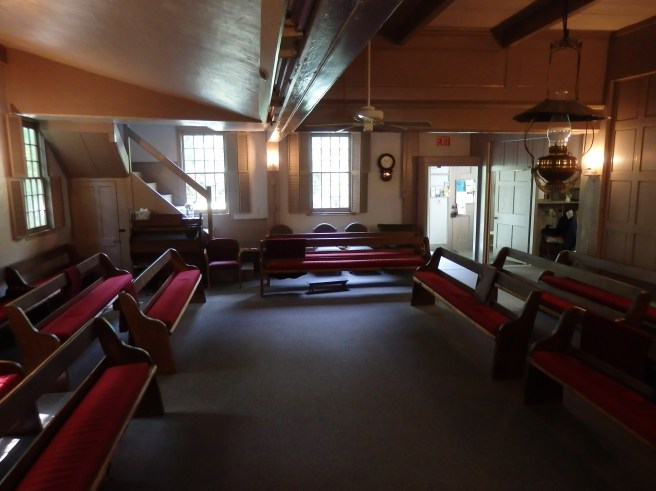
Way back before the Zoom camera appeared.
You never know what we'll churn up in cleaning a stall
Way back before the Zoom camera appeared.
About halfway back in my life, I found myself among Plain-dressing rural Christians. Some of them were also Plain Quakers who retained the “thee” and “thou” speech of Friends’ tradition. My bff of the time was one of them.
Plain dress, should you ask, is what the Amish wear, as well as old-order Mennonites, Brethren, and some other strands, in their own subtle distinctions.
There were reasons I didn’t go all the way, but I did acquire some items, including broadfall pants that have no zipper or belt loops. They were surprisingly comfortable and very well made, in America, no less. After 35 years or so, my denim and blue corduroy pairs are finally showing some wear. I have no idea how many regular brand-name blue jeans these have outlived, but now it’s time to order more of the Plain style.
For many folks, that means Gohn Bros. in Middlebury, Indiana, whose no-nonsense, illustration-free catalog can be downloaded online or ordered by phone or mail. The owners of the store, we should note, aren’t Amish, though they’ve served that demographic for generations. I’ve heard of other faithful buyers who found the store through the Whole Earth pages of hippie lore. Maybe this post will add to it.
I am happy to see that the small-town emporium survives. A few minor changes appear in the options as enhancements rather than copouts. For instance, I can now substitute belt loops for the suspender buttons or opt for gray or black denim rather than blue. My, my.
Here I am, actively paring down my possessions, trying to use up what’s already on my hangers and in my dresser drawers, yet I’m feeling tempted to order a few new shirts, maybe a dress coat, too.
Don’t worry, it’s not Armani. Instead, these selections are much more everyday practical me. Just think, too, they’ll always be in timeless style.
One of the many surprises I encountered in researching my book Quaking Dover was the fact that the Puritan authorities in Boston were ready for revolution from the git-go, way before Paul Revere.
I’d like to see more of their history presented from that riotous side.
There were the cannons they set up on Boston Harbor in 1634 to fire on Royal Navy vessels, should they come to follow up on the king’s voiding their charter. As things developed, Charlie the First got distracted from his problems over here and thus those volleys were never fired.
For another example, we can look to the coins John Hull produced from 1652 plus others for the next 30 years, even though the new king, Chuck Two, soon declared the practice treasonous.
Yes, treason. Off with your head or mere imprisonment in the Tower of London, that sort of thing.

Leap ahead, I’m wondering how he would have handled credit cards and their depths of debt and to me, at least, usurious rates.
Looking at some of those figures today, is anyone ready to say “Off with their heads?”
Maybe ancient history isn’t so far back there after all.
On top of it, the colonists had no representation in Parliament. That had to chafe on their identity as Englishmen through and through.
That was compounded by the costs London imposed on the Americans in defending themselves from the attacks by the French and their Native allies in the decades of warfare prompted by petty European royal succession and alliances. The New Englanders were definitely on their own.
A big question is what made the ruling Virginia Cavaliers turn from Loyalist to revolutionaries? Plus, why did it take so long?

There were no banks and you couldn’t write checks.
Were dried fish and lumber so valuable in Britain and the Continent that you could still make a fat profit shipping them across the ocean? Furs, I can understand, as well as the hunger for gold and silver, which may have fueled speculators who were inevitably disappointed. Plus fish, likely dried.
As for paying your workers? A daily portion of rum or the like was apparently often part of the deal.
By the way, Quakers were in the forefront of developing banks and insurance and even packet shipping in time.
The early colonies had layers of ownership, starting with those demanding annual quitrents for the land you would clear and build on or have “purchased” with any improvements. Then there were the chartered investors, like Lord Saye and Sele and Lord Brooke in New Hampshire’s case, who somehow expected to make a profit overseeing the place. They still had obligations to other investors, like the Council for New England. I’m really unclear how all of that worked in practice or what they got from “selling” their charter to Massachusetts.
The best I can come up with is that it was a kind of private enterprise tax, though I’m not sure what was offered in return. Like Mafia “protection” or layers of graft?
And that’s even before getting to England’s heavy mercantile system that hampered American entrepreneurial opportunities. The colonists were expected to provide raw materials for manufacture in England before being sold at hefty markups in the New World, too.
How did the colonists ever thrive, all their hard work aside?
I’m thinking it’s almost as vaporous as bitcoins.
Yeah, I know about the adage, “Write about what you know,” but I’ve come to see that advice needs to be balanced by “write about what you want to know.”
What we might call a creative tension. If you’re a writer, I hope that helps.
My latest book, which started out as a humble and brief profile of Dover’s Quaker Meeting but turned into a contrarian New England history, could be presented as one example.
I mean, Dover is still seen as a shadow to neighboring Portsmouth, which is much smaller and more uppity. Get real!
Back to the book at hand and the research that’s gone into it. Here are some things that surprised me.
Order your copy of Quaking Dover at your favorite bookstore. Or request it at your public library.
As a commercial book venture, my Dover history would be considered marginal at best.
Quite simply, short of a breakout, it targets a tiny audience.
The city itself is small – a population of slightly more than 30,000. And while the surrounding area runs around a half-million, that’s still small by book publishing markers.
Additionally, my work focuses on the city’s second-oldest congregation, an even tinier potential readership. While that element opens another market of fellow Quakers around the globe, it’s still small.
As for history buffs? They have their niches.
At the outset, at least, any for-profit book publisher would see this as a high-risk, losing bet.
I am, of course, hoping Dover’s 400th anniversary this year will give it a bounce.
And, as a microcosm of a snarky, contrarian New England history, Quaking Dover just might entertain a wider reception.
I mean, how many people do you think would have been interested in covered bridges in Madison County, Iowa?
~*~
One commercial publisher specializing in local histories did take a look but quickly backed off. The editor didn’t like the first-person voice of my book, for starters, and got spooked by the fact this volume hadn’t been vetted by religious authorities.
A few others were simply looking for an author-subsidized co-publishing deal.
That returned me to the self-publishing world I found in ebooks and then, for paper editions, at Amazon’s Kindle Direct Publishing.
As much as I like ebooks, for reasons I’ve previously discussed here at the Barn, I very much felt this was one that needed to be available primarily in a hands-on physical book form.
While Amazon has no upfront costs for an author in its print-on-demand paperbacks, physical bookstores refuse to carry them because they would have to buy the volumes at retail and then add a markup to the price to cover their own costs. They rightly complain it puts them in an unfair position.
But then came the announcement that my ebook flagship, Smashwords.com, was merging with Draft2Digital, which specializes in producing print-on-demand. Both companies have arrangements with distributors and retailers, and both offer their services to writers for free.
The arrangement also gives me more flexibility in marketing and special sales opportunities.
In short, count me in. I’m truly proud of the result.

Although he is best known for his persecution of the three Quaker women missionaries and his mock war game that captured hundreds of Natives, which led in time to the devastating attacks on Cochecho Village and Oyster River as well as decades of violence ending in 1763 with the French and Indian War, Major Richard Waldron (or Walderne, in its alternative spelling) could easily be the subject of a fat biography of his own, if a very resourceful historian would rise to the challenge.
His influence and power ranged far beyond his mills at the great falls of the Cochecho River. He was Speaker of the Massachusetts General Court, or Assembly, for multiple terms and even owned a substantial house in Boston. His ships ranged the seas, where two of his children died doing commerce. And there are good reasons I call him a perfect villain in my book Quaking Dover.
Through him, though, I sense that Dover had some solid connections with the powers in Boston, rather than existing just an outpost on the frontier. It alters my perception of sparsely settled colonial New England.
Just how did he amass so much wealth, especially? Were his leadership skills mostly along the lines of a bully or did he have some sophisticated means of influence?
It’s fair to ask if anyone else cast such a long shadow over New Hampshire’s course or how he would stack up in comparison to better known Boston figures.
Let me be clearer, he could be the subject of a hot book or movie or maybe a mini-series.
My first-ever Zoom presentation is now available for streaming, thanks to the Whittier Birthplace Museum. The presentation on January 26, “Starting with a marriage certificate: Why Whittier was no stranger to Dover,” focused on the famed poet and abolitionist’s many connections to, well, my new book Quaking Dover.
For the full YouTube event, do take a look here.
John Greenleaf Whittier is hardly the central theme in the book, but for me, developing the topic for this show, along with the accompanying PowerPoint slideshow, another personal first, was fun.

If you’re a regular here at the Barn, you know I do lag behind on the tech front. One step at a time, right?
I didn’t expect an unusually itchy nose and scratchy throat resulting from our dry indoor air. So much for my up-in-the-corner-of-the-screen stage presence.
On top of that, with the PowerPoint up in front in me, I couldn’t see who was attending. Oh, well, I had my hands full anyway.
Earlier, behind the scenes, there was concern about a possible power outage on my end as unusually warm temperatures dropped below freezing amid heavy rain. We did have a contingency plan, just in case.
I’m so glad we didn’t need it.
Readers of my new book are telling me how shocking they find the Puritans’ cruel persecution of the up-and-coming Quaker faith. That reaction is quickly followed with their disgust that the Puritans came to the New World for religious freedom but then refused it to others.
What we need to acknowledge, though, is how deeply our outlook is engrained with an expectation of freedom of speech and religion, something that would have been foreign to mindsets back in the 1600s. There, religion and politics were one, as in a one-party state. In England in the early 1600s, the king had the state church, what we know as Anglican or Episcopal, well under his thumb, while the Puritans had Parliament and its armies. It was a volatile mix, even before we get to New England, where my book is set.
I should emphasize that for us, as modern Americans, it’s all too easy to condemn Puritans as backwater bigots, when in fact they were radical progressives on many fronts. They were decidedly anti-monarchy and proto-democracy, and advanced a less feudal, more equitable economy and society. They championed education and literacy for men and women alike and founded Harvard College within their first six years in New England despite deep divisions within their attempt to establish a godly Utopia. Boston was even prepared to fire cannons at Royal Navy ships in the mid-1630s, had they arrived to revoke the colony’s charter, which the Puritans had obtained from the king in an end-run around the man who was responsible for New England’s development – Sir Ferdinando Gorges, the father of Maine and first cohead of New Hampshire, as you’ll find in my book. He definitely would have torpedoed their application. (Whew! The amassing details do thicken the plot, hard as they become to follow.) A Puritan wife could actually divorce her husband if he failed to fulfill her. And they loved their beer.
In other words, Puritans weren’t nearly as awful as we want to portray them today, even if they do come across as villains in my book, Quaking Dover.
Since its release, I’ve been coming to believe the Quakers pressed the Puritans simply for not going far enough in their reforms and intended Utopia. Historian Carla Gardina Pestana, in her wonderful “Quakers and Baptists in Colonial Massachusetts,” even came to the conclusion that the Quakers (or Friends, as we more often refer to ourselves) went out of their way to provoke the Puritan authorities. Ouch, I’m thinking that’s true.
More recently, in revisiting Kenneth Carroll’s book “Quakerism on the Eastern Shore,” meaning Maryland, I felt affirmed by his statement, “Quakerism was, in some ways, an extreme form of Puritanism,” followed by, “It is not surprising, therefore, to discover that Quakerism, in its opening days in Maryland, reached into the centers of Puritanism … for a great number of its converts.”
Well, that latter point was surprising to me. I do see Friends blending Mennonite strands via the English General Baptists into what emerged.
~*~
While my book is focuses on New Hampshire and its adjacent provinces, I’m finding that religious restraints in the southern American English colonies of the time were far harsher than those in New England. For instance, a provocative essay by Marilynne Robinson, “One Manner of Law, the Religious Origins of American Liberalism” in the November Harper’s Magazine, notes that the under the repressive laws in Virginia the penalty for missing church services three times or speaking ill of the king was death, along with the harshest penalties for minor infractions of other laws. She adds there was no mention of trial or appeal and much of what we consider Common Law was nebulous. The Carolinas were just as extreme.
Carroll, for his part, finds that in contrast to New England’s persecution of Quakers, “there may be a skeleton in the closet of the southern colonies also.” He remarks, “The intense persecution experienced by Friends in Virginia soon drove many of them into Maryland,” followed by a series of drastic laws that even kept Quakers from being allowed to enter the colony. “There was to be no challenge to the Established Church as the one religious institution in Virginia,” something that excluded Puritans, Presbyterians, Baptists, Quakers, and Roman Catholics alike. Carroll then states, “The full nature and extent of persecution suffered by Quakers in Virginia is not known. … We do know that William Cole, of Maryland, and George Wilson, of England, were imprisoned in a ‘nasty stinking, dirty’ dungeon in Jamestown where Wilson was whipped and heavily chained so that ‘his flesh rotted from his bones and he died.’” A number of Indian converts to Quaker faith may have also been sentenced to death because of their conversions. And Maryland for a while also imposed harsh persecution, including the banishment and whipping of Quaker “vagabonds” from constable to constable through the colony.
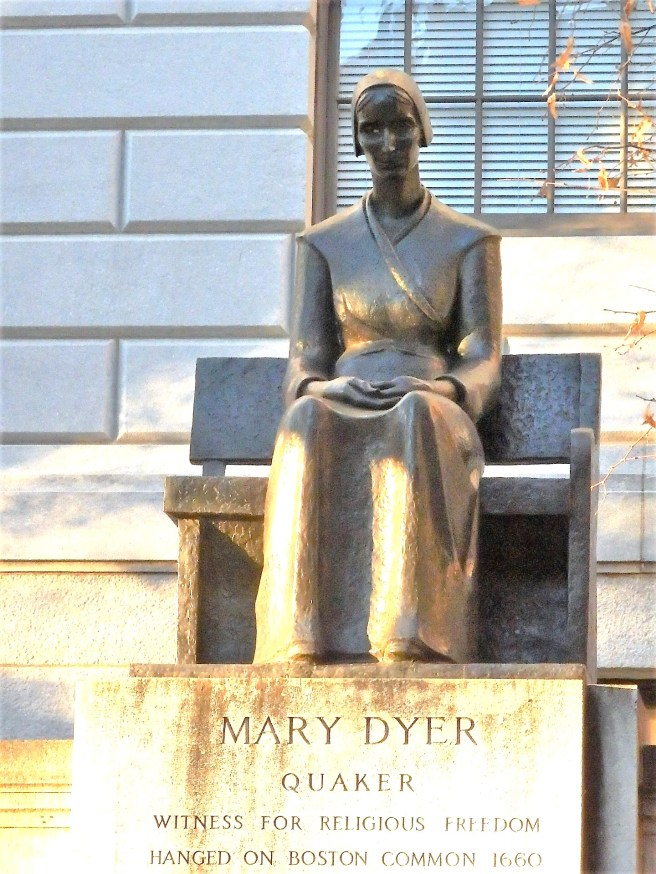
Among those in the South who had visited Dover were William Robinson, before his execution in Boston, and Alice Ambrose and Mary Tompkins, once they left the north.
~*~
To see how this played out in Dover, please turn to my book, Quaking Dover.
I, for one, would definitely like to see a fuller understanding of how religious liberty came about in the Southern colonies and also a presentation of how Puritans in New England evolved to emerge, in one strand, as Unitarians.

