One of the many surprises I encountered in researching my book Quaking Dover was the fact that the Puritan authorities in Boston were ready for revolution from the git-go, way before Paul Revere.
I’d like to see more of their history presented from that riotous side.
There were the cannons they set up on Boston Harbor in 1634 to fire on Royal Navy vessels, should they come to follow up on the king’s voiding their charter. As things developed, Charlie the First got distracted from his problems over here and thus those volleys were never fired.
For another example, we can look to the coins John Hull produced from 1652 plus others for the next 30 years, even though the new king, Chuck Two, soon declared the practice treasonous.
Yes, treason. Off with your head or mere imprisonment in the Tower of London, that sort of thing.
Leap ahead, I’m wondering how he would have handled credit cards and their depths of debt and to me, at least, usurious rates.
Looking at some of those figures today, is anyone ready to say “Off with their heads?”
Maybe ancient history isn’t so far back there after all.
On top of it, the colonists had no representation in Parliament. That had to chafe on their identity as Englishmen through and through.
That was compounded by the costs London imposed on the Americans in defending themselves from the attacks by the French and their Native allies in the decades of warfare prompted by petty European royal succession and alliances. The New Englanders were definitely on their own.
A big question is what made the ruling Virginia Cavaliers turn from Loyalist to revolutionaries? Plus, why did it take so long?
Readers of my new book are telling me how shocking they find the Puritans’ cruel persecution of the up-and-coming Quaker faith. That reaction is quickly followed with their disgust that the Puritans came to the New World for religious freedom but then refused it to others.
What we need to acknowledge, though, is how deeply our outlook is engrained with an expectation of freedom of speech and religion, something that would have been foreign to mindsets back in the 1600s. There, religion and politics were one, as in a one-party state. In England in the early 1600s, the king had the state church, what we know as Anglican or Episcopal, well under his thumb, while the Puritans had Parliament and its armies. It was a volatile mix, even before we get to New England, where my book is set.
I should emphasize that for us, as modern Americans, it’s all too easy to condemn Puritans as backwater bigots, when in fact they were radical progressives on many fronts. They were decidedly anti-monarchy and proto-democracy, and advanced a less feudal, more equitable economy and society. They championed education and literacy for men and women alike and founded Harvard College within their first six years in New England despite deep divisions within their attempt to establish a godly Utopia. Boston was even prepared to fire cannons at Royal Navy ships in the mid-1630s, had they arrived to revoke the colony’s charter, which the Puritans had obtained from the king in an end-run around the man who was responsible for New England’s development – Sir Ferdinando Gorges, the father of Maine and first cohead of New Hampshire, as you’ll find in my book. He definitely would have torpedoed their application. (Whew! The amassing details do thicken the plot, hard as they become to follow.) A Puritan wife could actually divorce her husband if he failed to fulfill her. And they loved their beer.
In other words, Puritans weren’t nearly as awful as we want to portray them today, even if they do come across as villains in my book, Quaking Dover.
Since its release, I’ve been coming to believe the Quakers pressed the Puritans simply for not going far enough in their reforms and intended Utopia. Historian Carla Gardina Pestana, in her wonderful “Quakers and Baptists in Colonial Massachusetts,” even came to the conclusion that the Quakers (or Friends, as we more often refer to ourselves) went out of their way to provoke the Puritan authorities. Ouch, I’m thinking that’s true.
More recently, in revisiting Kenneth Carroll’s book “Quakerism on the Eastern Shore,” meaning Maryland, I felt affirmed by his statement, “Quakerism was, in some ways, an extreme form of Puritanism,” followed by, “It is not surprising, therefore, to discover that Quakerism, in its opening days in Maryland, reached into the centers of Puritanism … for a great number of its converts.”
Well, that latter point was surprising to me. I do see Friends blending Mennonite strands via the English General Baptists into what emerged.
~*~
While my book is focuses on New Hampshire and its adjacent provinces, I’m finding that religious restraints in the southern American English colonies of the time were far harsher than those in New England. For instance, a provocative essay by Marilynne Robinson, “One Manner of Law, the Religious Origins of American Liberalism” in the November Harper’s Magazine, notes that the under the repressive laws in Virginia the penalty for missing church services three times or speaking ill of the king was death, along with the harshest penalties for minor infractions of other laws. She adds there was no mention of trial or appeal and much of what we consider Common Law was nebulous. The Carolinas were just as extreme.
Carroll, for his part, finds that in contrast to New England’s persecution of Quakers, “there may be a skeleton in the closet of the southern colonies also.” He remarks, “The intense persecution experienced by Friends in Virginia soon drove many of them into Maryland,” followed by a series of drastic laws that even kept Quakers from being allowed to enter the colony. “There was to be no challenge to the Established Church as the one religious institution in Virginia,” something that excluded Puritans, Presbyterians, Baptists, Quakers, and Roman Catholics alike. Carroll then states, “The full nature and extent of persecution suffered by Quakers in Virginia is not known. … We do know that William Cole, of Maryland, and George Wilson, of England, were imprisoned in a ‘nasty stinking, dirty’ dungeon in Jamestown where Wilson was whipped and heavily chained so that ‘his flesh rotted from his bones and he died.’” A number of Indian converts to Quaker faith may have also been sentenced to death because of their conversions. And Maryland for a while also imposed harsh persecution, including the banishment and whipping of Quaker “vagabonds” from constable to constable through the colony.
Among those in the South who had visited Dover were William Robinson, before his execution in Boston, and Alice Ambrose and Mary Tompkins, once they left the north.
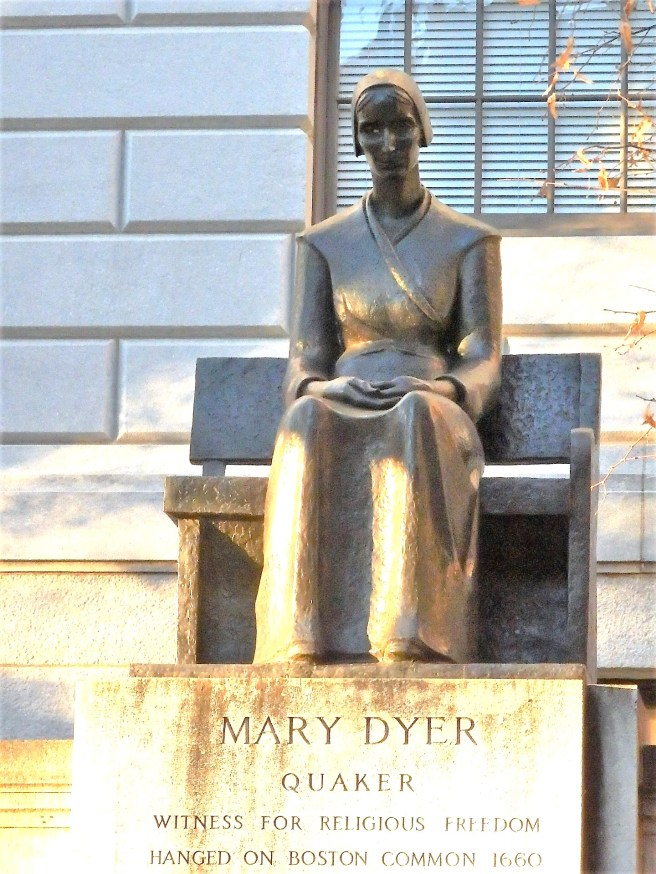
This statue by Sylvia Shaw Judson sits in front of the Massachusetts statehouse, with copies in Philadelphia and Richmond, Indiana. Mary Dyer was one of four Quaker missionaries hanged in Boston because of their faith. She’s the only one who hadn’t visited Dover, New Hampshire, although the site of the gallows later became known as Dover Street. As a fine point, she didn’t offer her life for religious freedom but rather as a sacrifice to a Truth she espoused.
~*~
To see how this played out in Dover, please turn to my book, Quaking Dover.
I, for one, would definitely like to see a fuller understanding of how religious liberty came about in the Southern colonies and also a presentation of how Puritans in New England evolved to emerge, in one strand, as Unitarians.
Is it just me but are power outages becoming more common, more widespread, more severe?
That would fit the forecast of climatic instability, otherwise known as global warming, which is no longer undeniable.
Remember the scoffers who first decried the prophets as ridiculous, denied the causes, spent millions to ensure their profits, and ultimately said there’s nothing we can do about it, contrary to what those insightful prophets had warned?
I’m looking for a better option than paying for a propane-powered generator that further lines the pockets of a source of the problem. Got it?
Who says you had to conform growing up? Here are some people who made America the land of the free, not that I agree with all of them. Still, it really does come down to language and how we use it. Especially when religion and politics are mixed in.
Samuel Gorton. Just plain onery in early New England.
Roger Williams. Leading to a progressive movement then known as Baptists.
Anne Hutchinson. Pointing the way to New England Quakers.
John Woolman. A Quaker who worked ardently against slavery and other economic perils.
Henry David Thoreau. It’s a Unitarian thing, ultimately.
William Miller. The foremost of the voices that would become the Seventh-day Adventist church. Ellen G. White emerged as an essential proponent in its development as it organized in Battle Creek, Michigan, and then Takoma Park, Maryland.
Joseph Smith. You know, the Mormons. Along with Brigham Young and Utah.
Dorothy Day. Catholic Workers, a truly radical movement.
Martin Luther King Jr. Civil rights and much more.
Bayard Rustin. Gay Black Quaker ahead of his time on many fronts.
In looking at the categories I’ve used since launching this blog a decade ago, I feel I should explain why I’ve resisted adding to them.
I simply wanted to retain some kind of focus on what I’d envisioned as a merry-go-round. Yes, the categories were the selected horses to ride.
Think of “American Affairs,” largely inspired by an academic department that Indiana University and Yale and a few others launched in the mid-‘60s to encapsulate a multicultural investigation of current affairs. I nearly embraced it as my own major, the way some Blacks turned to Swahili.
Hey, I had a girlfriend who saw that regarding her own eldest brother. Back off, please, and let’s get back to subject.
What I’ve found in practice here at the Red Barn is that my Am Affairs specific pigeonhole has increasingly probed local public states, especially in Dover, New Hampshire, and more recently, Eastport in Way Downeast Maine.
Or, as the adage goes, all politics are local. (Should that be “is”?)
The writer Tom Wolfe was someone I had thought followed this American Affairs college degree path, but I find myself mistaken, at least as far as academia goes. Still, I would list him as an inspiration here, just shorn of the heap of superlative adjectives, expletives, and adverbs.
But our localities do get lost in the national mass-media mindset, to the impoverishment of us all.
Or, as the French said, “Vive la difference!”
Actually, as I’m realizing, that also applies to my latest book, Quaking Dover.