Along with the emergence of a personal voice and style

Preparing my collections of poetry for release, as well as the shorter chapbooks appearing at my Thistle Finch editions blog, has been eye-opening, especially after spending so much time concentrating on the novels.

A lot has changed in my half-century at this. At first glance, my work has seemed to shoot off in every direction. But then, in spite of that, commonalities appear. Some of them, to some extent, apply to both the prose and poetry.

Despite all of the changes in my life and the differing approaches of my writing that accompanied that, I believe some underlying qualities run through my output.

Here goes, mostly from notes to self from way back and up:

  • No tolerance for fluff. Anti-romantic. Playful twists are another matter.
  • My quest for accuracy has invoked sharp focus – despite the blur and whirl of my own life.
  • I’ve relied on flashes, gathering. Like snowfall, curiously. A burst of storm, however brief or long the season.
  • Surrealism & absurdity can be more accurate than what’s seen on the surface.
  • Jagged and leaping make sparks, akin to my Kinisi here at the Barn.
  • As for what makes my work unique? What makes me unique? (My niche?)
  • In much of my writing, I’ve mapped organic geo-history, the overlapping energies of a locale and its spirit(s), as truthfully as I can, however fragmentary the result. Personal relationships, including marriage, hover within these landscapes, even as their own physical places as well as spiritual, influencing and influenced by the larger ecosystem. I try to comprehend this within a concern for the larger, more timeless harmony (Logos).
  • My investigation of invisible vibrations of specific landscapes has led me to cherish alternative cultures that embody healing energies – Native practices, Amish, Mennonite, Quaker, and so on – in contrast to our increasingly rootless, violent, unstable society at large.
  • An awareness of the wonder of the universe and an appreciation for our own unique places within it. Out of that, roots, a radiance of peace, and the sustaining nurture of a community of kindred souls.
  • Mine is a unique, distinctive name reflecting my originality (or eccentricities) in bridging many diverse currents. My writings, as I see them, are tightly compressed, radiating clarity, and highly polished with a raw edge.
  • What’s my trademark, my signature touch?
  • Starting with poetry:
  • Distillation. Compression. Radiance.
  • Lean and polished lines.
  • An aversion to formal forms.
  • A rejection of poetry as a hidden code requiring an interpreter.
  • A preference for allowing the images and details to speak for themselves.
  • Delight in allowing the individual reader’s interpretation to unfold on its own.
  • The land and the girl / spiritual landscape / the girl in a spiritual landscape. Somehow, they overlap.
  • An unexpected snap in each line. (Thus, lines long enough for something to happen.)
  • Silences as positive openings.
  • Writing as a means of discovery and deepened memory, more than to embellish or escape.
  • As a journalist, my touchstones have been Accurate, Informative, Useful, and Entertaining. I wonder how those apply to poetry, too.
  • To honor life and its wellspring.
  • Writing as an act of gratitude and humility.
  • To be audacious without subterfuge or scrabble or sleight-of-hand.
  • To be enterprising without deception.
  • To be daring without falsification / ruse / trickery or bombast.
  • Much of my writing emerges as an attempt to record and investigate the Hidden Way as it has opened and shaped my life. Often unconventional, prompting experimental inquiry, this unfolding has led me to its ancient roots and traditions, which in turn provoke contemporary responses.

And the fiction? You can add:

  • That aversion to formula or genre, especially when it comes to marketing.
  • A preference for allowing the images and details to speak for themselves.
  • I write to discover, and to remember, more than to embellish or escape.
  • As a newspaper editor, I have often found daily journalism to be better written than many of the novels and other books that crossed my desk.
  • An awareness of the artifice of linear, rational exposition and development. How do we get beyond that?
  • Deep Image is not confined to poetry.
  • Life as an experiment. So much variability with the basic laws and given conditions.
  • I’ve relied on flashes, gathering. Like snowfall, curiously. A burst of storm, however brief or long the season. Or even confetti or a ticker-tape parade.
  • I’ve preferred discovery to fabrication. Accuracy to cleverness. Mandala engagement over private code. What is brought forth in each individual reflecting on the icon, from deep personal experience, rather than the artifact itself.

Well, that’s how I’ve defined my efforts over time. Sometimes the results do startle me, all these years later. And some of my results come closer to my ideals than others, not that I’ll fault those, either.

~*~

You can my works in the digital platform of your choice at Smashwords, the Apple Store, Barnes & Noble’s Nook, Scribd, Sony’s Kobo, and other fine ebook retailers. Or you can ask your local library to obtain them.


Not every lover finds roses comforting

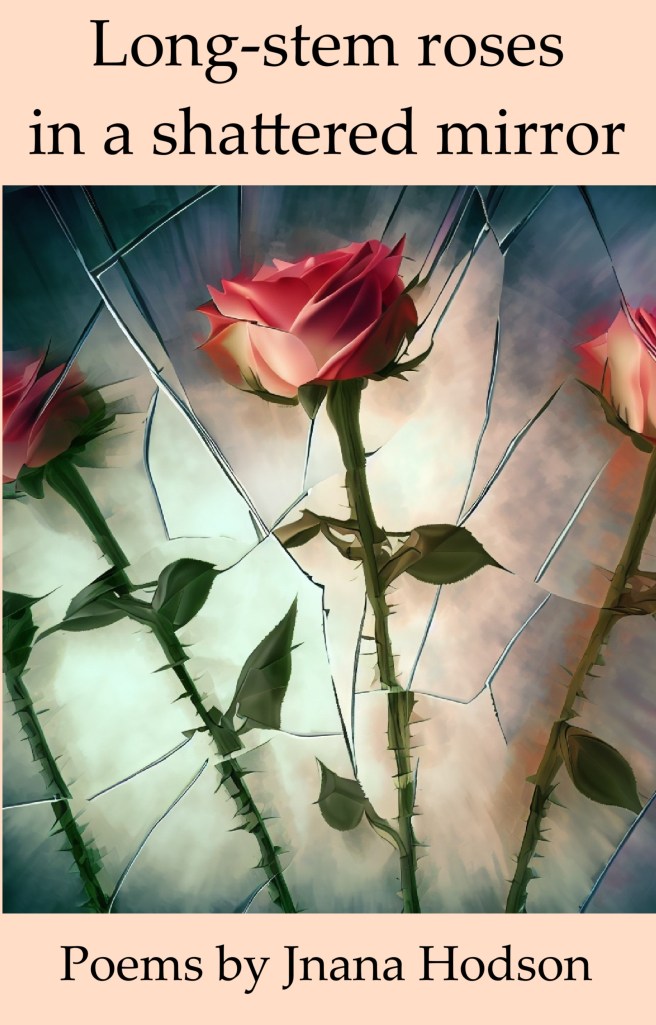
In support of that statement, let me offer Long-Stem Roses in a Shattered Mirror, my collection of poems released to the public today.

Think what happens when a hot relationship goes belly up and everything you trusted turns painful.

These poems arise in a brutally honest reevaluation of those interactions, as one of the lovers insisted on at the time, as well as the larger hopes and desires.

Many of the poems appeared in small-press literary magazines around the globe, but this is their first outing complete.

I have come a long, long way since, perhaps because of lessons I learned in these earlier relationships.  The poems remain intense, vivid, and powerfully moving, even at my age.

For my series of passionate roses, check out my collection in the digital platform of your choice at Smashwords.com and its affiliated online retailers. Or ask your public library to obtain it.


Hello, readers!

I’m excited to announce that my lineup of ebooks is available as part of a promotion on Smashwords for the month of July as part of their Annual Summer/Winter Sale. This is a chance to get my novels, poetry collections, and Quaker volumes, along with volumes from many other indy authors, at a discount so you can get right to reading. Some of mine are even free, as you’ll see.

The sale begins today, so save the link:
https://www.smashwords.com/shelves/promos/

Please share this promo with friends and family. You can even forward the news to the avid readers in your life.

Thank you for your help and support.

And happy summer reading!

Anyone else taking notes in an art gallery or museum?

I’m not sure when the practice started in my own life, but somewhere it did.

Typically, in a first visit to an art museum, I’ll move along quickly to get a sense of the fuller collection. In the returns, however, I’ve become more inclined to sit down in front of a particular piece or even a full wall or room and then more fully immerse myself in particular pieces, usually while the rest of our party roves on. Yes, I’m with notebook in hand.

Those scribblings have led to poems, especially those in which Norman Rockwell and Gertrude Stein appear commenting, somewhat like poet Lew Welch’s Buddhist Red Monk who kept popping up at the bottom of the page. I’m not quite sure how they showed up, either, but there they are, as you’ll find in recent entries at my Thistle Finch editions blog.

Let me repeat that I’m generally averse to poems about poetry or celebrating poets or that somehow place artists of any stripe above the rest of humanity, ditto that for movie stars or professional athletes or billionaires or politicians. We do need our heroes, but I’m convinced that it’s healthy to keep their human frailties and shortcomings in perspective.

In that regard, I do believe we artists need to keep our vision beyond our studio door. Anything less strikes me as incest, even for an interdisciplinary addict like me. It’s why I refuse to respond to political pollsters. Go ask somebody on the street, OK?

Still, I made the central character in my Freakin’ Free Spirits novels a photographer. Even having him make a living by working at a newspaper was skirting my taboos.

~*~

The term “ekphrasis” defines poems that describe visual artworks though it can be applied more broadly. Sometimes the results are admirable, as exemplified in music by Gunther Schuller’s “Seven Studies on Themes of Paul Klee” or Modest Mussorgsky’s “Pictures at an Exhibition.”

~*~

Lately, I’ve become quite fond of the Alex Katz galleries at Colby College, not just because he almost collected a painting by my first wife. Rather, I sense something in the plainness of his depicted figures and where I’d like my own work to head. It’s stripping something down to essentials.

We’ll see.

~*~

For Rockwell and Stein, take a look at at Thistle Finch editions. For Freakin’ Free Spirits, look for the four novels in the digital platform of your choice at Smashwords, the Apple Store, Barnes & Noble’s Nook, Scribd, Sony’s Kobo, and other fine ebook retailers. They novels are also available in paper and Kindle at Amazon, or you can ask your local library to obtain them.

Working ‘in series’ came as a big breakthrough

One of the artistic ideals in my life originated in the fantastic illustrations by Inuit craftsmen as they expressed the world they inhabit. Perhaps you’ve seen some of their calendars exhibiting owls, seals, the sun itself, and the like.

As I was told by the couple who introduced me to the Inuit works, an artist in the tradition does a subject just once, at least in the position or perspective that results. A bear, for instance, might be shown standing, but only once. If a bruin shows up again, it would be fishing or lumbering along or maybe paired. Each appearance, though, must be unique. There were still plenty of ducks, geese, walruses, whales, and other Inuit – hunters, mothers, and children – remaining for close examination, even in their Arctic environment.

The husband who told me this, let me add, was a coauthor of the Alaska constitution who had some acquaintance with the ecosystem. He had grown up at its southern edge, northern Washington state.

After more than two decades with that as a guideline, I faced a conundrum as I tried to assemble my own poems for submission as a competition for a chapbook – a booklet, essentially. A book needs to flow from start and middle to an end with some sense of continuity. My one offering that had that, American Olympus, had a received a provisional acceptance from a prominent press that later rescinded, claiming a cut in their grant funding. And my other pieces hopped, skipped, and jumped from one setting to another – if only I had been able to remain in one setting long enough for continuity in their completion.

Beyond that, my own life had moved on, providing me a lode of new material to draw upon. That’s when I turned to the idea of theme and variations, a major element of the classical music I so love and also big in jazz as improvisation. What hit me, especially, was Ted Brautigan’s sonnets from the ‘60s. They were essentially three poems, reworked over and over, into a full and very stunning collection.

I took that as my springboard into two intense weeks – while working fulltime as a newspaper editor – of reworking raw notes of loved desire that had incinerated into what you can read as Braided Double-Cross – a set that was rejected by the jurors in a competition based in its principal subject’s hometown. Maybe it was too intense. The poems are searing.

The night I finished drafting the 60 poems, I should note, I went out to dinner and have no idea how much I tipped the server. I was thoroughly exhausted, not just emotionally. Not that I remember of the meal I devoured.

Love really can be such a bitch. At least it still is with me, no matter how much she wonders why I still worship the one who continues in my life.

~*~

For now, let’s turn to the question of what makes a poetry collection “hang together”? In contrast to an assembly from my “best work,” however sporadic.

For perspective, also consider my aversion to series in fiction, where I’ve seen too many series as the same book done over and over with a few tweaks, even if that has led to way too many bestsellers. Yet I’ve gone back to my novels and reworked them to create linkage from one to the next, at least in two separate series. What I think now separates mine from most series is that none of my novels is a carbon copy of any of the others. Mine do, in contrast, represent a sequencing of growth from one to the other. In that way, they create one longer epic rather than imitative episodes like a TV sitcom.

Still, what is it that draws you back to a particular author, book after book?

~*~

I think now of the observation that an author’s next book springs from what was left unsaid in the volume published just before it. That point resonates and returns us to the question of how does an author know when a work’s finished.

Regardless, I’ve definitely done much more in the vein of “series” since completing the first.

~*~

You can find Braided Double-Cross and more in the digital platform of your choice at Smashwords, the Apple Store, Barnes & Noble’s Nook, Scribd, Sony’s Kobo, and other fine ebook retailers. You can also ask your public library to obtain it.

Embracing my sunny side

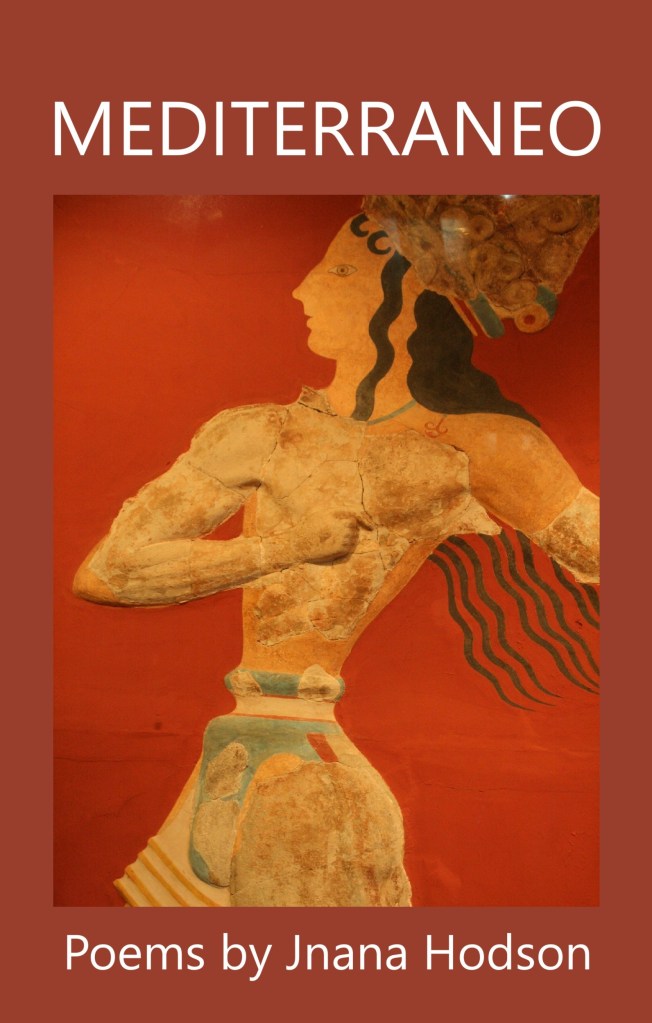
Let’s celebrate the publication of my poetry ebook Mediterraneo this week.

As a series of poems, this book was a turning point for me. My earlier poetry had been mostly of the nature or love genres.

Here I focused on Western culture itself, through places around the Mediterranean Sea. It was someplace I’ve never visited, though it’s had a huge impact on my artistic and spiritual outlook. What I have known comes through artworks, literature, philosophy, operas, insights from my daughter and wife’s travels and those of my goddaughter and friends and even Greek Orthodox dancing and liturgy as well as ancient Hebrew scriptures. Put them all in the mixer, then, and see what we can distill.

It’s quite distinct from my ultimate roots in the British Isles and Germany.

When I created these poems, I had not yet relocated to a remote fishing village on an island in Maine after 20 years in the Seacoast region of New Hampshire. The climate is colder than the Mediterranean’s, for certain, but the light of the sun does reflect off the sea and back into the sky, magnifying the luminance in a way that attracts artists, as it does in many of the locations in this homage to the cradle of notable classic faiths, cultures, and cuisines. I do miss Greek dancing and related dining. The ability to see whales from shore or deer in my small-city yard do offset that.

The Mediterranean is much larger than I had supposed. It would reach from nearly one end of the United States to the other, yet also spans so much more diversity.

While I’ve never been to the Mediterranean, much less Egypt, and never out of the country, for that matter, excepting pockets of Canada, all the same, I’ve flown places in my imagining, and some convey some underlying kinship.

Barcelona is one of those. Seemingly far out of my northern nature, this Latin complex of sensuality, color, and Roman Catholic devotion also harbors a stubborn independence, under its ostensible domination by others. Spanish, but not Spanish. Catholic, and yet in a historic realm of heretical lay movements. A passion for the musical dramas of Wagner, accompanied by industry.

Perhaps my genetic line does run, as a marker suggests, from northern England to the border of Spain. Uncork a red wine, then, and sit in my Smoking Garden on a summer late afternoon. Muse on a line from on friend or other while listening to an opera broadcast.

Consider Pharaoh’s descent, the ways the culture of ancient Egypt anchors one corner of the Mediterranean. Was there another anything like it, in its mindset or visual conception?

Or the pervasive smell of camels with their wave-like gait as they nearly sail from the southern shore of the Mediterranean and on deep into the interior of north Africa. In many ways, it’s their land more than man’s.

Or the continuing influence of Greece and its blinding sunlight, scented with lavender and sage, spills over the the culture we inhabit, sometimes with an air of longing

So much ancient history is filled with brutality and revenge, lusts and conquests. Especially, we would venture, around the Mediterranean and its sea.

The Italian Renaissance, with its lush reds and golden adornments, leaves its mark on the imagination. What would Europe be without it?

As for Minotaur in the Ring, with strokes of Picasso, don’t overlook Barcelona, the fifth most populous metropolitan area in the European Union. Some say the port city was founded by Hercules, which would fit its fierce spirit. It even lives its own language, despite Spanish rule. And then there’s its unique style.

They’re all energies in these poems.

You can obtain the collection in the ebook platform of your choice at Smashwords.com and its affiliated digital bookstore retailers.

The hardest prompt: a love letter

You’d think these would be the easiest, most natural thing on earth, except that they usually wind up being 99 percent cliché and hot air.

Besides, how many times and ways can you express the dirty stuff, if you dare?

(And be prepared to back it all up in person.)

Really!

In addition, the audience of one can be the world’s most demanding, no matter how fond of you they are.

Even more difficult, add to the assignment something I heard a writing prof say, quoting another one: Never revise a love letter.

Nope, let it gush forth.

~*~

For further humiliation, there was an instance when I was living in the ashram and writing a reply to a beloved’s epistle when several of my fellow yogi residents came up and grabbed my effort, grimaced, and declared, “If I received that, it would be the end of the relationship.”

Those girls were so full of helpful insights, as you’ll find in my novel Yoga Bootcamp.

~*~

Well, I’ve never been good at pickup lines, either.

~*~

About a dozen years ago, I had a spree in the loft of our old barn when I went through the remaining letters to me from girlfriends and lovers over the years.

Earlier ones had been helpful when I was drafting my novels Daffodil Uprising and Nearly Canaan. What jumped out at me in this round was their underlying unhappiness apart from me. It didn’t make for a good give-and-take in a relationship. No wonder things didn’t work out in the long run.

The time for the ritual burning was way overdue. It took longer than I would have guessed.

~*~

More recently I came across some surviving letters written on computer, some of them that were then sent by the postal service and others that went by email.

The ones I wrote now embarrass me. As for theirs? A gentleman won’t say, though they reflect a long search for a fitting relationship that never panned out, like panning for gold. My, all the hours I spent writing those and reading the responses!

Once more, though, a purge is overdue.

We could get into a discussion regarding the intimacy of handwritten letters versus legibly typed ones, though that’s largely moot now that the exchanges have shifted to emails and cell phone texts. That topic deserves its own conversation. For now, let me say that the playful back-and-forth with my now wife via America Online when we were getting to know each other is woven into my Prelude & Fugues poems available at Thistle Finch editions.

~*~

Back to the advice about never revising a love letter. I find it useful as an ideal for other kinds of personal writing, too. Just let it pour out, best as you can. Not that it usually proves so easy.

Yeah, yeah, I fall back heavily on the revise-revise-revise emphasis elsewhere, along with the adage, “Talent goes into the first draft; genius comes in the revisions.”

Still, some of those love letters gave rise to the poems in my collections Braided Double-Cross, Blue Rock, and Long-Stem Roses in a Shattered Mirror (upcoming).
Let me add to that the only time – well, just about – that I face the dreaded writer’s block is when having to come up with something spiffy on, say, a get-well card. Like the ones they used to pass around the office. I know of a truly major writer who agrees with me there. Maybe sympathy cards are even worse. You can’t go with “Miss you” there, and nearly everything else is so trite.

~*~

One final concern I’ll raise while we’re circling around the topic involves what would we say to each other now, all these years later. At one time, I tried to find out, thanks to Facebook. It wasn’t encouraging. Some who had been hot on my end barely remembered me.

And while I had tried to be conscious of their objections or potential feelings of hurt in reading the fictional accounts of our lives, I finally had to realize they never read what I had written after our breakups or differing directions.

Ouch! Most of them I missed more than they did of me.

Sound familiar?

~*~

You can find Braided Double-Cross in the digital platform of your choice at Smashwords, the Apple Store, Barnes & Noble’s Nook, Scribd, Sony’s Kobo, and other fine ebook retailers. You can also ask your local library to obtain it.

For better or for verse, here are more lodes I’ve also mined  

By the standards of many, I’ve been a prolific poet, though if you consider that just one new poem a week would come to more than three thousand now.

Sounds about right, even with the arduous revisions they underwent, pressing the original inspiration into something quite different, always in an “experimental” rather than traditional vein. Add in all the hours of submitting the results to journals and small press openings, and all the rejection slips that followed, it was an obsessive amount of time – I had been warned that even “successful” poets averaged 20 rejections for every published poem. And beyond that, simply preparing a “clean” page for those submissions back in the days of typewriters pressed the limits of patience.

Still, poetry could be done in shorter spurts than fiction in my free days and nights while I was engaged working fulltime in a newsroom. As a minus, it did divert my attention from the local news scene and related gossip, but it did sharpen my editing and writing skills, both of which chafed at the limitations of newspaper style.

Many of my early poems sprang from my journals, something that changed over the years, especially as I got into Deep Image and related techniques. While more than a thousand of my poems were published in journals around the globe, book-length collections remained elusive. Now, however, some are available as ebooks, allowing you a chance to sample my evolution over six decades.

Here’s a lineup:

American Olympus: This longpoem is also a mythopoem set in a single week of camping on the Olympic Peninsula of Washington state. The book came close to being published by a prestigious letterpress imprint but fate intervened, sending me spiraling back eastward. Many other nature and landscape poems reflecting my experiences from one end of the continent to the other and back in my early adult years await full collection. Please stay tuned for future appearances of those works.

The volume has a new cover, one that’s a departure from my usual design style. I do find the leap rather exciting, and suitably unconventional.

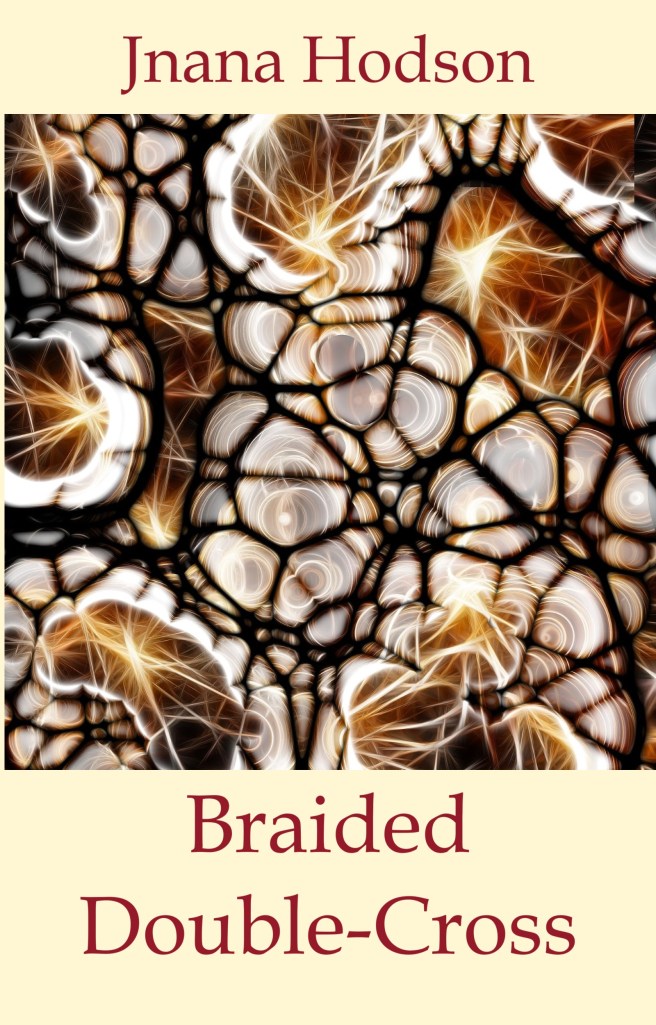
Braided Double-Cross: Intense attraction, sexual ecstasy, and long-term dreams ignite this set of contemporary American love sonnets that reflect the conflicting emotions and unspoken expectations that surface in the eruption of breakdown and breakup. The set, my first run of poems composed as a series, explores passions that sugarcoat realities and betrayals. Sometimes something so truly hot leaves a lover branded for life.

Blue Rock: Continuing in the conflicted passions line, these poems reflect attraction, romance, and the aftermath in today’s society. Just groove to their beat.

Trumpet of the Coming Storm: Admittedly polemic, these are brimming with buried anger erupting at last. Sometimes you just can’t ignore politics, even in a historical perspective.

Hamlet, a Village of Gargoyles: This playful investigation of human identities alternates between gossipy and confessional, set within the context of close community. The collection now hits me as somehow prescient, considering that I’m now living in a real village with characters I hadn’t considered. The tone is contemporary with nods to Shakespeare and Chaucer.

Ebook formatting does limit the visual array of what you would otherwise find on a defined page of paper, but it does make my daring work available inexpensively around the world. I can live with that and so can you, especially if you’re reading on a smart phone.

I promise, there will be more.

You can find these in the digital platform of your choice at Smashwords, the Apple Store, Barnes & Noble’s Nook, Scribd, Sony’s Kobo, and other fine ebook retailers. Or you can ask your local library to obtain them.

Acid test poet: Ted Berrigan (1934-1983)

Encountering a trio of his Sonnets in an issue of the Paris Review my senior year of college blew me away. First, by the fact that their iambic pentameter had been cut into lacy fragments but also that the remaining threads were made more powerful and light-filled as a result. Or, “oh, for the loving” (expletive), as he wrote. These were more like the collages of Robert Rauschenberg than the corseted stanzas of Shakespeare.

The fuller set, published in 1964, advanced the impact, especially in seeing how the collection came together as a series of essentially three poems that kept getting reassembled in new ways. Variations on a theme, as it were.

These were unmistakably urban, cigarette smoky, and not so secretly drug-infused.

They inspired my own set of American sonnets, The Braided Double-Cross.

As a reader, they also point me toward John Berryman and John Ashbery.

I love his definition of a poem as a miniature wind-up toy.