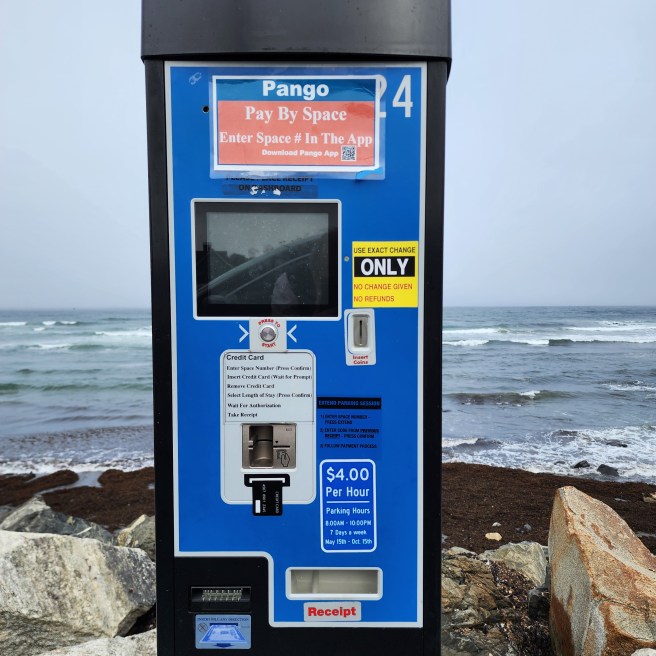
Gone are the days of paying with quarters, especially not now that the hourly rate has gone up to $4. We have many memories of the Long Sands stretch of York Beach, Maine.
On our end of the state, the ocean parking is commonly free but the water’s too cold for swimming. Alas.
In the renovation, we had periods were seemingly nothing was happening but then, BLAM!, things suddenly moved on all fronts.
This was especially true when we were at the mercy of other tradesmen and their schedules – plumbers, high on the list.
One of those involved the crew that would do the sprayed foam insulation on the front half upstairs. We decided to go with a different company than the one that had done the back, in part because the new one got back to us with a bid promptly, unlike the other. Not only that, they could get to work for us sooner than later.
That did put some pressure on Adam to get the electrical wiring and outlets in the framing before the crew showed up, so it was crunch time there.
But then the electrical panel in the basement blew out.
We were without power going into the weekend. And without heat.
Adam did have an amazing storage battery that we plugged the refrigerator into while he patched the old system.
As he said, the only thing holding the panel together was rust and spider webs.
This came only months after he had rewired the pretty much the whole house, everything but the panel and circuit-breaker box. They were scheduled for later.
And then, the whole town lost power for a few hours, all just before the weekend and the foam-spray guys on Monday.
As a further complication, we had to be out of the house for 24-hours after the foam application. We got a two-night reservation near West Quoddy State Park, in a delightful cabin overlooking Lubec Channel and all the way up to a corner of Eastport. We were so close to home and yet a world away.
The bad news came when we determined the extent of damage done by the power surge. Four of our surge protectors were fried, as was the outlet to our washer (for a while, we thought it was gone), and then a unit in our furnace was also kaput – requiring a night call for service.
It was quite a whirlwind for us.
That sprayed-in foam insulation also covers the wiring. It’s amazing.
We still needed a new electrical panel and, while they were at it, a new circuit-breaker box, too. Adam called in some allies to tackle that, and they got to us quicker than usual. The problem was getting the electric company to come promptly to cut off the power to the house and restore it.
Whew, it did happen, though the utility forgot to include a ladder with the first truck it sent out.
~*~
Perhaps this is the time to explain why we passed on the Generac backup when we moved to town. You might get a charge out of this.
Most of us, at least in the industrialized world, take reliable electrical wiring for granted. An old house, especially if you’re updating it, can remind you otherwise.
I’ve already mentioned the hot topic that Maine is prone to widespread electrical power outages. The state does have some arcane accounting details that likely abate the problem, but I’ll spare you the common rants about our utility companies and their higher-than-average rates.
One upshot is that many houses around here have emergency generators emplaced to kick in at the outbreak of an outage. Sometimes we hear that before we realize our lights and other conveniences are out.
We nearly got one ourselves, despite the high price. The tripping point turned out to be where to put the unit itself, its concrete pad etc., but especially the propane tank – a much bigger one than we thought necessary. The only viable site in our yard was in the heart of our best full sunlight, a spot we deemed more valuable as a future garden bed.
That didn’t rule out a smaller portable Honda generator in the future, though it wouldn’t go into service automatically and requires attention for the duration of an outage.
Better yet, the portable battery Adam lent us looked like the ideal solution for us, especially after we found one on sale.
We’re thinking between that and our wood stove we can ride out the typical outage.
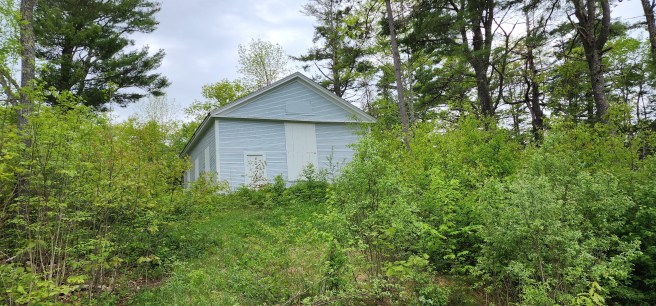
The former home of Methodist Episcopal congregation in Edmunds, Maine, once looked out over the Lower Bridge across the Dennys River. The bridge disappeared after U.S. 1 was routed a quarter-mile to the east. The church, meanwhile, is being encroached by forest, a reminder of a more populous and more prosperous time. Its square belfry is long gone.
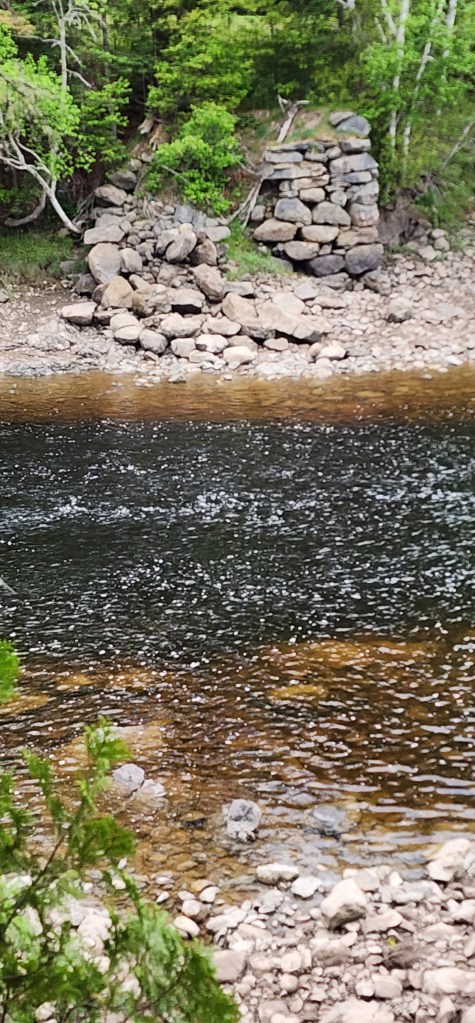
Below, remaining stone abutment of the bridge is seen on the Dennysville side of the river at low tide.
A state ferry conveys autos and passengers along the Fox Islands Thoroughfare as it links North Haven Island and the mainland on one of three daily runs. This shot was taken aboard the historic schooner Louis R. French last summer.
For more schooner sailing experiences, take a look at my Under Sail photo album at Thistle Finch editions.
Now, to update you on much of the demolition and rebuilding that transpired while we engaged in uncovering the history of our old house. Or as I can now say with confidence, our historic house. I do hope you enjoyed reading those findings.
While I’m confident we do not have ghosts in our crannies, unlike some of our neighbors in theirs, I can say that after learning of the families who previously resided here, I am conscious of the earlier residents’ imprints. Our is not just any old house, then, but a manifestation of Eastport itself. I do wonder how the parade of earlier inhabitants would react to what we’re doing to the home. The few still living whom I’ve spoken with have been encouraging. And Anna M. Baskerville is, I hope, smiling over all of it.
My biggest lesson to date is that ours is an ongoing project, a work-in-progress, far from finished much less ever perfect. Still, we keep trying to come a bit closer to that ideal.
~*~
As we entered 2024, we still had the front half of the upstairs to rip away and enlarge.
The biggest hurdle was already behind us — the insertion of the ridgepole the length of the roof and the four supporting columns. It was needed to hold up the old front rafters until they were replaced, and needed afterward, as well. The new front rafters would connect to it.
This round promised to be a piece of cake in comparison to what came before. There would be no plumbing to contend with.
We now knew how the roofing would come off, as well as the way that removing the knee walls would extend the wall of the new dustpan dormer out further than the two small dormers that were becoming history. Also, the color of the new metal roofing was already decided.
We even knew the brand and style of the windows.
If only it went that easily.
~*~
We anticipated resuming full-force in the spring, but it was closer to the beginning of summer. Our contractor had a few earlier commitments to follow up on, for one thing, and then rainy weather forecasts set us back, for another, as well as health issues for our hardworking contractor.
And then those little dormers turned out to be far more complicated than expected. When they were added, apparently sometime after 1850, the rafters above them were simply severed, with no structural support. Adam was appalled. What were they thinking? How did it ever hold up, especially once a slate roof was added?
Weather didn’t cooperate, either. And then when all the debris would have been generated, we couldn’t get a dumpster – turns out they get booked out a year ahead around here for the town’s big Fourth of July festivities. Who’d a thunk?
And there were other delays.
Our plumber, for one, wound up on a big project out in Indiana and then another in Seattle. He promised to be back.
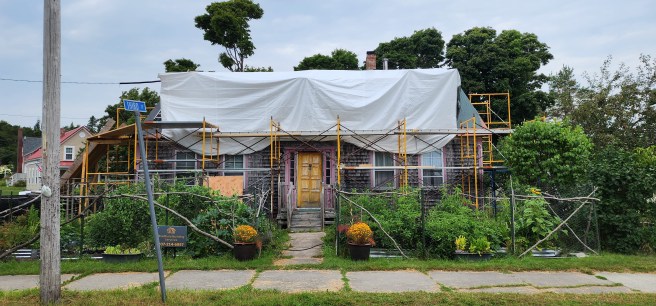
Some people thought we staged this as a theatrical statement, but the big tarp was a desperation replacement for several smaller ones – and it, too, got torn up in some fierce weather. We had some water “raining” in the two front parlors, despite the best efforts otherwise.
The roofing, eaves, window framing, new electrical lines, and spray-foam insulation all took time.
And there was the delay when the electrical panel in the cellar blew out and had to be replaced, along with the circuit-breaker box.
The upshot was that the front upstairs wasn’t buttoned up until Halloween, a bit over a year after we set forth, and then interior framed and drywalled finished just before Christmas.
Many people told us that was moving quickly by Eastport standards.
Uh-huh.
It has been an adventure, one that fluctuates wildly between elation and despair.
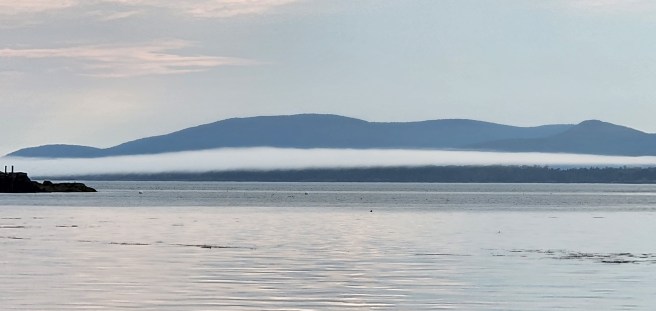
Here I am at the keyboard while overlooking Lubec Channel from a rented cabin at West Quoddy Station, a former U.S. Coast Guard lifesaving post. We needed to vacate our home for two days during its renovation, and we settled on this, still in sight of Eastport on the water to the north and yet a world away.

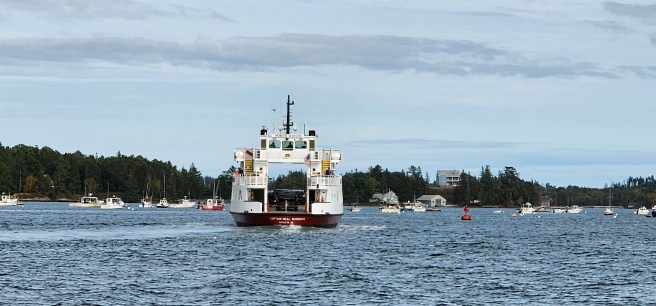 A state ferry conveys autos and passengers along the Fox Islands Thoroughfare as it links North Haven Island and the mainland on one of three daily runs. This shot was taken aboard the historic schooner Louis R. French last summer.


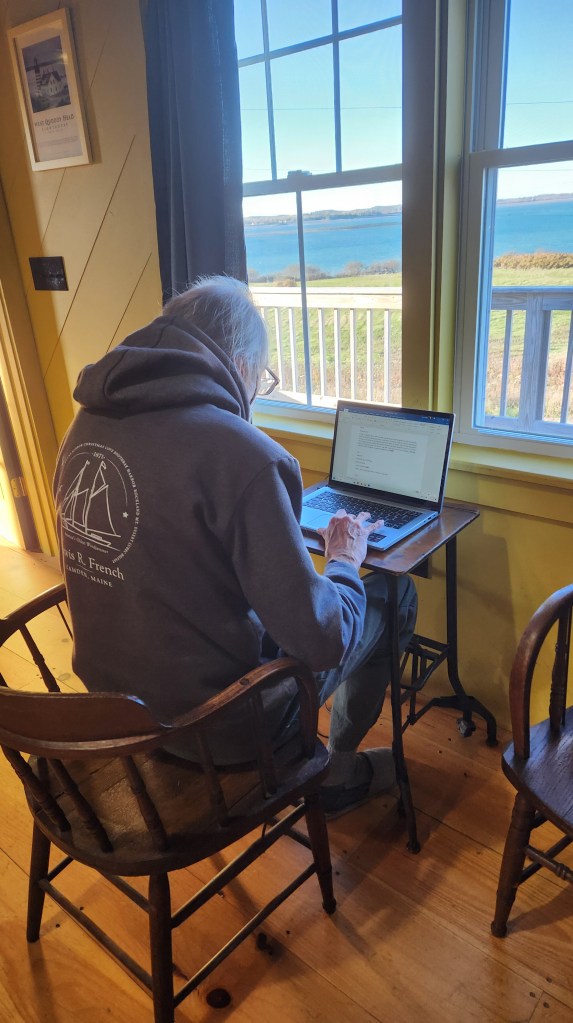 Here I am at the keyboard while overlooking Lubec Channel from a rented cabin at West Quoddy Station, a former U.S. Coast Guard lifesaving post. We needed to vacate our home for two days during its renovation, and we settled on this, still in sight of Eastport on the water to the north and yet a world away.
 As seen from a cruise aboard the historic schooner Louis R. French on Penobscot Bay last summer.
 Jnana's Red Barn