And there’s more than sea glass, too.
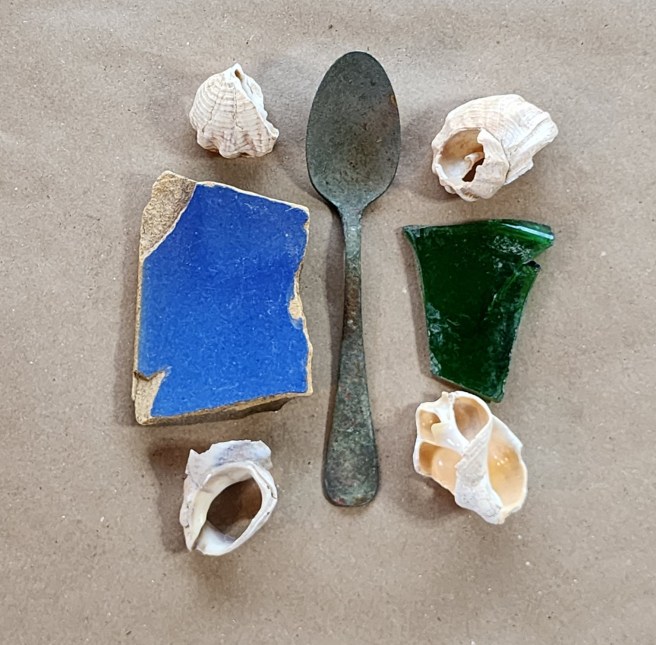
Sometimes it’s fun to play with what you tote home, creating whimsical designs like the ones you’ll find in the Shore Things free photo album at my Thistle Finch blog.
You never know what we'll churn up in cleaning a stall
And there’s more than sea glass, too.
Sometimes it’s fun to play with what you tote home, creating whimsical designs like the ones you’ll find in the Shore Things free photo album at my Thistle Finch blog.

Many cruise ships to Rockland, Maine, are too big for the harbor itself. Instead, they drop anchor just beyond and ferry their passengers to the town.
This is how it looked from the historic schooner Louis R. French last summer.
For more schooner experiences, take a look at my Under Sail photo album at Thistle Finch editions.

Another consideration I haven’t mentioned was the upstairs flooring.
As much as we would have liked polished hardwood, our budget called for something more affordable.
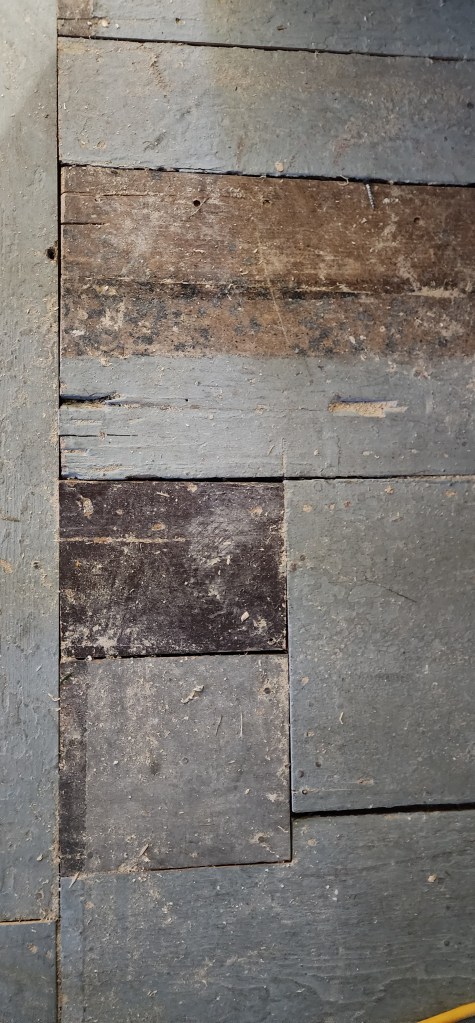
The existing flooring was more piecemeal, with unevenness and knots. It did speak of the rustic origins of the house and its historic character. Our contractor mentioned some flooring that would match it, and we were onboard. (Sorry for the pun.)
Refinishing those planks might have looked historically charming, though they were never great to begin with. Instead, we salvaged what we could and added fresh to continue.
The next question was how to treat it. Apart from two rooms and a hallway of vinyl flooring downstairs, the existing flooring, upstairs and down, had been painted a light blue that easily flaked. Could it be sanded and refinished in a natural finish? Did we have time to undertake that? Otherwise, what color of paint could we agree on, at least for the bedrooms? The bathroom and laundry room might be a different matter requiring something more waterproof.
I had hoped to decide on a paint color extending across all of the upstairs. Mine was the minority vote.
That left me facing a decision for my room. Please stay tuned.

Just down the road from the birthplace of the U.S. Navy, the decommissioned Bucks Harbor Naval Radar station has an otherworldly presence, as if everyone had been taken away to another planet in the middle of the night.

Pleasure boats are everywhere in Camden Harbor at the height of summer. It’s iconic Maine, after all. This detail was noted aboard the historic schooner Louis R. French last summer as we set out for five days of prime sailing.
For more schooner sailing experiences, take a look at my Under Sail photo album at Thistle Finch editions.
People looked skeptical when they heard that we were living in the house during all of the renovation.
It’s not like our budget had enough of an edge for us to lease quarters elsewhere. Were we just more daring or more tolerant than others?
A key to the project turned out to be the translucent plastic “door” created at the top of the stairwell at the beginning of the work, the one with the zipper. It reduced the amount of dust that escaped from the construction and also kept much of our heat down on the first floor.
The sound of that zipper became a fact of life for us. All three zippers we had over the course of the project.
~*~
What awaited us on the other side of that veil went through a progression.
At first it faced a crowded set of shelves set in under the sloping roof, along with sliding doors to two makeshift closets and a narrow hallway running to each side.
After that came the demolition that revealed charred rafters and sheathing.
We briefly had a stretch of open sky followed by the raised roof and then the framing for the bathroom and laundry room.
What caught us by surprise, though, was the blank wall when the sheetrock went up. The stairs didn’t lead straight to another door. What would we put there? A large painting? A bookcase? A settee?
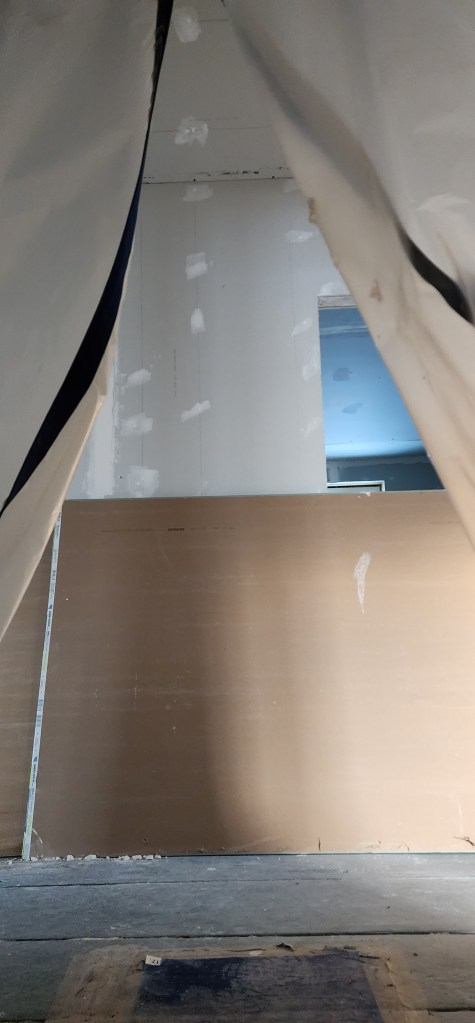
One of the coconspirators in our planning insisted on having a wide hallway, or perhaps more accurately, a landing – 6-by-16 feet, it turns out – conjoining the doors for the four bedrooms, the bathroom, and the laundry room. As a practical matter, this would make moving large items much easier, but aesthetically, the space feels wonderful, especially when we decided to keep the ceiling there running all the way to the crown of the house rather than having a low flat one.
No photo would get you a sense of that.
~*~
Somehow, Adam managed to keep the stairwell in place through all of the demolition and rebuilding. It did have that hand-cut oak lathing that predated 1830, for one thing, and the period molding.
For months, it stood like a dark ark at the center of all the action.
Once the new upstairs walls and details were in place, he turned to repairing the stressed stairwell walls and ceiling. One alteration we had envisioned was an interior window for natural light from the bedroom nook. Minor touch, but satisfying. Alas, one that was cut, in part for budget considerations.
We also gained storage space above in a kind of mini-attic accessed from a bedroom. It’s perfect for seasonal decorations that are needed just once a year. Easter, Halloween, Christmas, mostly.
~*~
As I had to confess by this point, the project was much more complicated than I had expected. I could now see why one contractor had just wanted to gut everything from the get-go, while another wanted to rip the top off and replace it with a gambrel roof. But I’m confident neither of those routes would have led to what’s emerged.

Officially, Treat Island is part of the city of Eastport, Maine, and once had its own thriving fishing village, school, and post office.
Today, though, nobody lives there. Instead, it’s one of the many preservations of the state’s coastline now held by the Maine Coastal Heritage Trust.
At low tide, it’s connected by a rocky breakwater to Dudley Island, which is officially in the town of Lubec.
The only way to get there, do note, is by water.
To take a quick tour upon landing, including its 7,000 feet of shoreline at the mouth of Cobscook Bay, check out the free photo album at my Thistle Finch blog.
 On a clear day, the North Atlantic turns this incredible blue color.
This was seen aboard the historic schooner Louis R. French last summer while plying Maine’s Penobscot Bay.
For more schooner sailing experiences, take a look at my Under Sail photo album at Thistle Finch editions. You won’t get wet.
A full Cape is a classic American design with some good traffic flow downstairs, but it has drawbacks on the second floor, where rooms can feel cramped by low ceilings and be too hot in summer and too cold in winter. Our house was no exception, something we hope we’ve rectified.
In maxing the ceiling heights by following the new roofline, we gained both headroom and air circulation. That move also adds character to each of the resulting rooms, making them something more than rectangular boxes with holes punched in them for windows and doors. (See the ongoing argument in previous posts.)
The sprayed insulation also enhances year-‘round comfort by reducing radiant summer sun impact as well as invasive winter cold.
In addition, the setting of the windows in all four bedrooms provides cross-ventilation, as needed, and the casement windows in the two smaller rooms reduces any draft entry. Each bedroom has windows on two walls, not just one.

We’re especially happy with the resulting four bedrooms, what I was tempted to call “staterooms,” as they are on a ship. There, the chambers follow the contours of the hull and deck overhead, and ours do something similar.
The front two also have a commanding view of Friar Roads, the channel between us and Campobello Island, Canada, while another looks out on a street of a distinctly New England fishing village nature. The fourth looks into trees and the village, giving it a sense of being a treehouse. Rather heavenly, as I’m finding.
For now, I’ll turn your attention to the front two, which overlook Eastport’s principal north-south street, not that it has heavy traffic. Remember, our fair city doesn’t even have a stoplight. Not one.
The front two bedrooms have the quirk of a panel that follows the original roofline before the dustpan dormer kicks in. This results in a small cubby space that creates a small storage cabinet in one bedroom but is left free to run to the floor in the second.
The main differences between the two bedrooms springs from working around the existing stairwell. Our historic stairwell, definitely pre-1830, from the hand-cut oak lathing.
If you divide those two rooms apart by drawing a line halfway between the north and south exterior walls, you’d see that the north bedroom would have been smaller than the south room because it had to accommodate the stairwell. What it gained in the renovation, though, was a charming nook between the stairwell and the outside wall. The space between the stairwell and wall had been a mystery, a wasted space where we thought we might find any buried skeletons in the house. Alas, only dust and spiders.

The nook, as we discovered, had to stretch a bit beyond that halfway line north-south, because the room’s window was centered there (above the front entry door). Our solution was to have that extension be matched by a closet running along the stairwell in the south bedroom.
The nook does make for a nice, slightly secluded study with that stunning view, especially around dawn and sunset.
Let me remind you that all of that distance to the exterior wall was space added during the renovation.
~*~
As we approached the time for priming and painting the upstairs, we had to admit we had more than 3,000 square feet of drywall to cover with primer and paint, even before considering the flooring. More decisions! As well as delays.
There, I settled on a brilliant white for my walls and ceiling and what Sherwin-Williams called Smoky Blue for the floor.
~*~
The cathedral ceilings not only enhanced our celebration of the natural light in our house, they also gave us something we didn’t anticipate: loud rain on the now metal roof, something we usually find comforting, so far. Not that everyone would.
But these rooms are also free of any rolling you’d endure on a ship.
Everybody’s mostly happy with the resulting twists. Remember, nothing in life is perfect, no matter how hard we try.
 Jnana's Red Barn