Restoring a one-of-a-kind Civil War mural

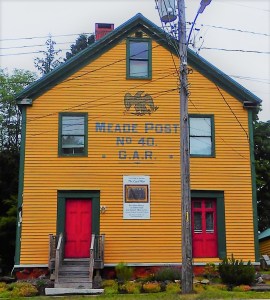
Now owned by the Tides Institute and Museum of Art, the post is being renovated to include a significant Civil War-era collection and display.

Eastport’s Civil War veterans had good reason for naming their Grand Army of the Republic post after Major General George G. Meade. Not only had he commanded the successful Union troops at the Battle of Gettysburg, he was stationed in Eastport after war to curb the Fenian Rebellion, an Irish liberation attempt that had organized in the United States and conducted raids in neighboring Canada.

During his time in Eastport, he caught pneumonia and nearly died, and some residents got to know him first-hand. One – the wife of the owner of the house where he was staying – complained bitterly for years afterward about his poor aim in spitting tobacco juice all over her home. Let’s hope he was better with a firearm.

The local post wasn’t the only one named in his honor, by the way, and the organization itself became a powerful force within the Republican Party, helping to elect at least four its members to the White House and pressing for progressive legislation.

In 1881, the local post took over a two-story frame structure at 6 Green Street as its meeting hall. As its membership – limited to Union veterans of the Civil War – died off, the building passed to the local Veterans of Foreign Wars for its post. The building next door included a bowling alley, roller skating rink, and dance hall all fondly recalled by youths of the time.
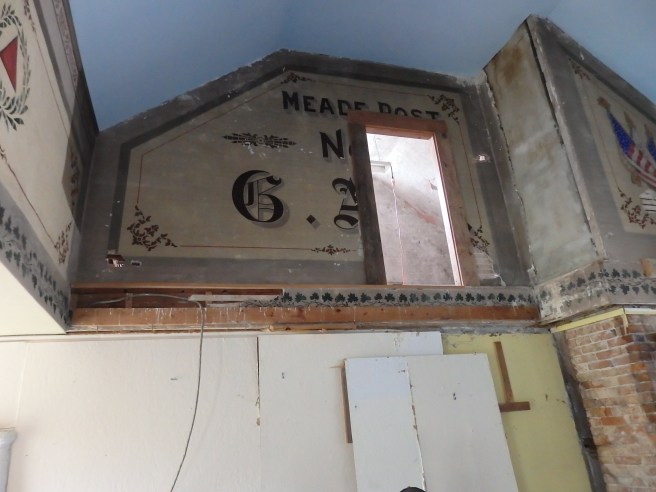
Nobody knew these were overhead.

The murals and ceiling were long hidden by a dropped ceiling and rediscovered only shortly before 2014, when the building was gifted to the Tides Institute and Museum of Art.
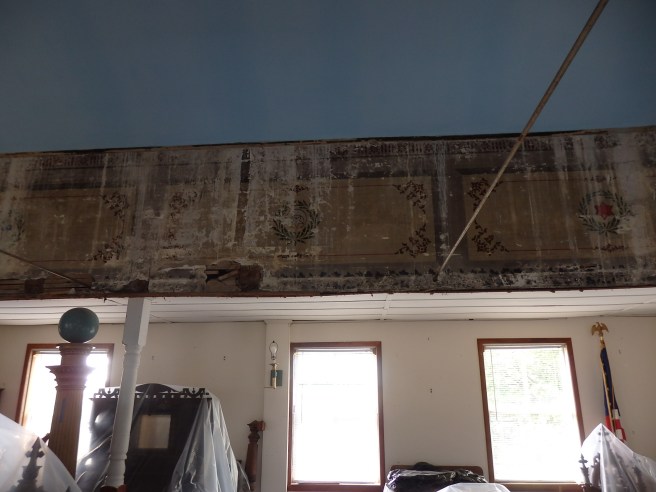
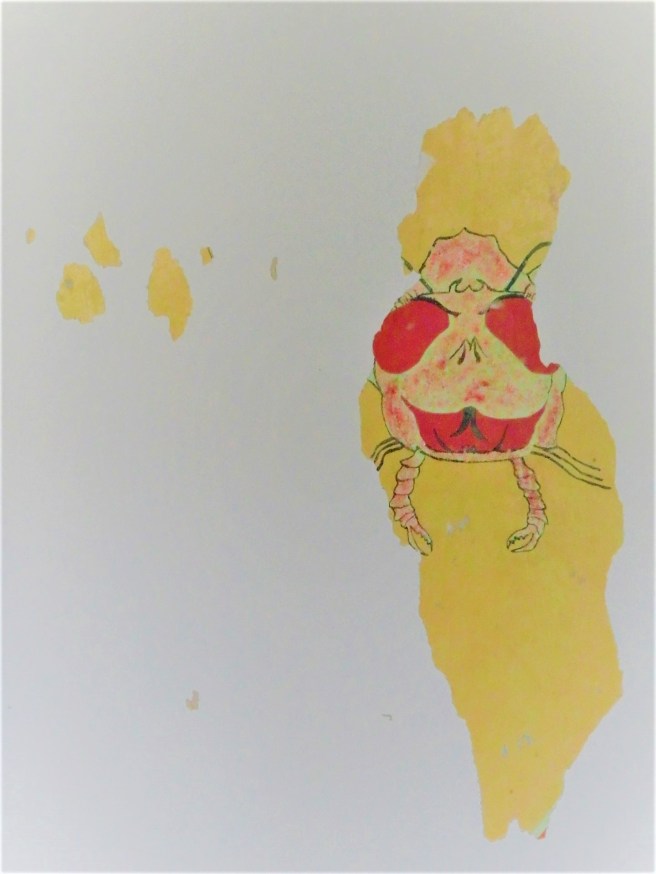
The mural runs the length of the roughly 40-by-25-foot room and includes images of eight Army corps badges.

Tony Castro of New Gloucester, Maine, has been renovating the murals. Despite severe water damage, they may be the only surviving interior of their kind in the state.
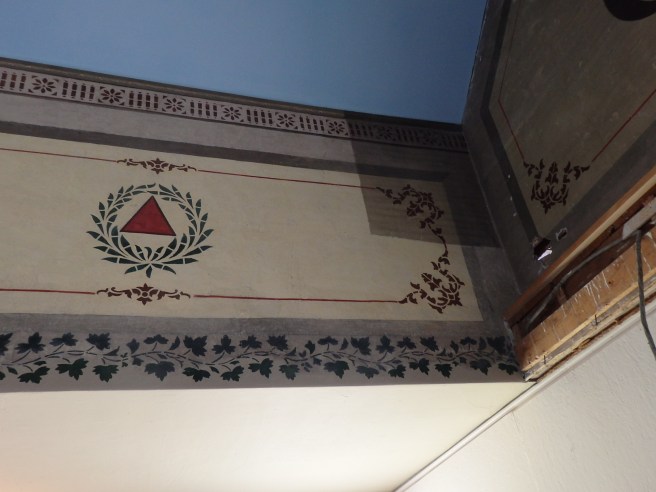
The patch at upper right shows how this section looked before its restoration.

The Tides Institute has also been gifted with important Civil War artifacts and documents, which may be displayed as the museum adds gallery space.
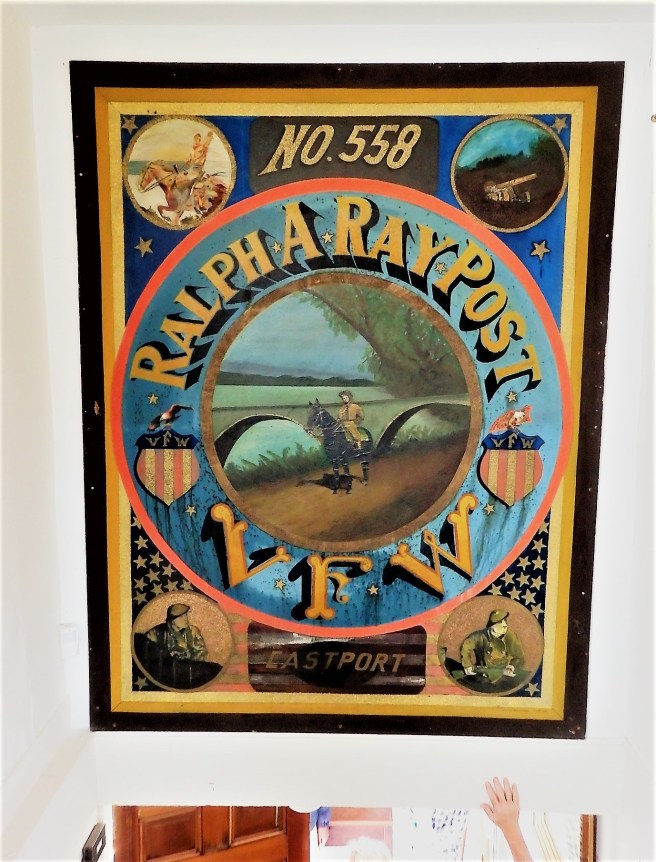
A sign from the hall’s later use as a Veterans of Foreign Wars post.

Come on down to where the town really connects

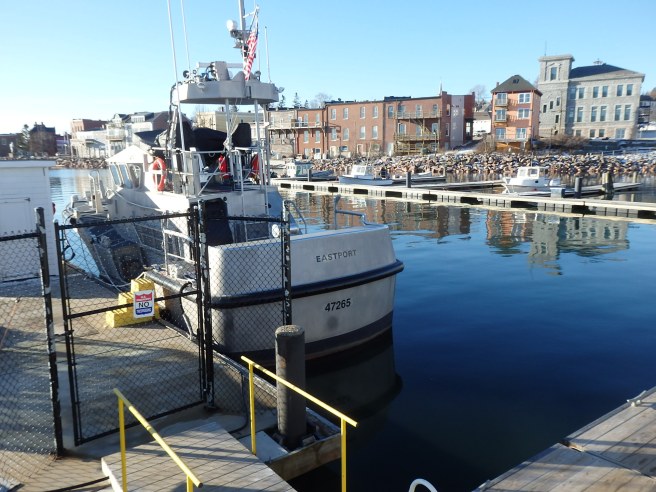
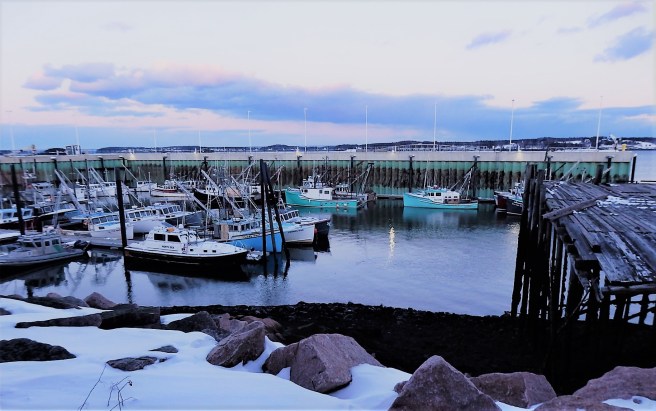
Locally, it’s known as the Breakwater, rather than the town pier or wharf or dock or safe harbor. And it’s the heart of Eastport, the centerpiece and focal point, as well as the home of the commercial fishing fleet and U.S. Coast Guard station.

It’s snuggled up right next to our small, struggling, and potentially quaint downtown. Here’s how it looks from the walkway this time of year.

It even broke down and collapsed in the winter of 2014, taking a few fishing boats with it.

Rebuilding was another matter. Officially, it reopened in September 2017, though details may have been completed later. The versions differ, up to “two winters before last.”

Eastport has the deepest natural harbor in the continental United States and is said to have rivaled New York’s in shipping at one point. I’ve seen photos of a cruise ship tied up here, and it truly overwhelmed the dock and town in its size.

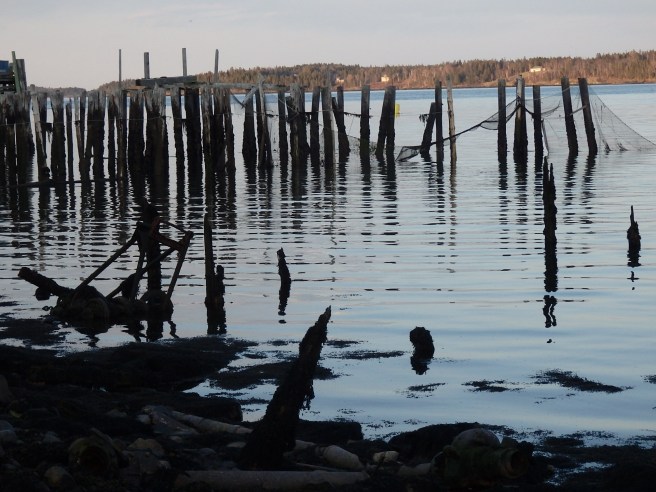
The waterfront has – and had – other piers, with pilings that can still be seen – the old vaudevillian appearing steamship dock, for one, or the more recently gone Northeast Marina and Fuel Depot, as prominent examples. And, yes, definitely, what was once the world’s largest sardine cannery, as well as a solitary brick shell from the era still standing over the water with some folks hoping for a redevelopment before it caves in.

Significantly, there is the Cargo Terminal, our industrial shipping complex at Estes Head just around the bend. It has both high security and tractor-trailer traffic, so you don’t stroll around there.

Still, the breakwater at the end of Sullivan Street beckons us, even with its seemingly perilous heights above the water at low tide.

And here’s how downtown looks from the Breakwater.

On relating to some special place you’ve explored in depth 

Tourists may get a taste of a distinctive natural wonder in a particular landscape during their brief stay, usually in prime season, but it’s not the same as dwelling there through an entire year. A winter night or storm, for example, is a much different cosmos than a summer day.

I’ve been fortunate to have experienced some remarkable destinations through all their varying weather, thanks to my career moves, but never to the degree of living largely alone, as Henry David Thoreau did at Walden Pond or Henry Beston along the dunes on Cape Cod.

I’ve come to know both places firsthand over the rotating years, and so reading the two classic books that emerged from them evoked personal awareness of scenes that likely struck the general reader as exotic or even confounding. I never would have appreciated them the same way had I still been in the Midwest or Pacific Northwest, for certain. Quite simply, the encounters provided a stronger foundation for revelation of so much I had missed.

One of the fringe benefits of my second marriage was that my stepdaughters’ Grandpa Jim lived in Wellfleet on the Lower Cape, or what Beston more clearly calls the Outer Cape. (Understand that the Upper Cape is south of the Lower Cape, much the way Downeast Maine is really up the coast. Welcome to New England.) So we got to visit throughout the year, making me a big advocate of visiting popular travel sites in the shoulder season. There’s no way to describe walking several miles along the surf below the bluffs and having the expanse totally to myself – in perfect weather the week after the normally crowded Labor Day.

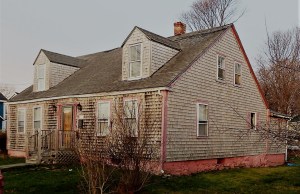
There’s a reason it’s called a Cape, or more technically, a full Cape. Here’s how ours in Eastport looks before the renovations begin. It was likely built more than a dozen years before Henry David Thoreau retreated to Walden Pond.

My wife used to gaze on the few remaining gray cabins atop the bluffs and voice a dream of living in one of them – the National Parks Service has been removing them piecemeal – noting that you wouldn’t want to have anything there you wouldn’t mind losing to a hurricane or nor’easter.

Beston’s 1928 The Outermost House tells of spending a year in just such a house only one town south of Grandpa Jim’s, and so I could envision and even smell much of what he describes.

At first, I was put off by the feathery, slightly Victorian language, as well as the affectatious British spellings rather than American, but once Beston presented some sharp, detailed observations of wave and wind motion and sound, I was captivated. His examination of waterfowl and other birds, especially, is admirable, but the range of shore and sea life he portrays is also encyclopedic.

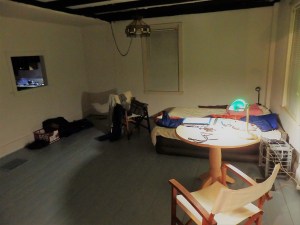
Here are my luxury accommodations the first months in town. I essentially lived in two rooms, spilling over into two more.

He writes from a time when the Cape still retained an older character that was being overlapped by newer ways that included telephones and flashlights, both unlike today’s suburban feel, and his book is credited with inspiring the creation of the Cape Cod National Seashore to protect the wildlife and geology he treasured – as many of us do today, thanks to the protections.

My reading came a few months after moving into my own equivalent of Beston’s cabin, albeit it much further up the coast and in a fishing village – still in view of the ocean.

You’ll be hearing a great deal about it through the coming year.

Are there books you’ve especially enjoyed because they’re rooted in places you know?

Our glorious dawn is much more than just sunrise

Except on overcast or stormy mornings, the early light of day in Eastport is amazing. Campobello Island in Canada blocks the first rays of the rising sun from striking us directly. Instead, the beam is deflected from the ocean into the air to become an ethereal rosy radiance, sometimes against a dark bank of clouds hovering off over the neighboring Fundy islands. And then, with that doubly-illuminated sky mirrored in the two-mile-wide channel separating Eastport from Campobello, the overhead color spreads out below as well.

Often, this scene is accompanied by the faint puttering of commercial fishing boats venturing out from the port.

When the sun itself finally swells into view, the blaze is nearly blinding, winter or summer.

Note to self: Keep sunglasses at hand.

Why L.L. Bean started making all those kayaks, canoes, and duck boots

Maine is bigger than you’d think, and half of it is still unpopulated.

In fact, the easternmost county in the USA is more than twice the size of Rhode Island or New York’s Long Island – or, if you prefer, bigger than the two of them put together. And it’s merely half of Downeast Maine, with Hancock County comprising most of the western flank.

Washington County, aka “Sunrise County,” has a population of only 32,000 – about the size of Juneau or Fairbanks, Alaska, or Dover, New Hampshire, my home of the previous 21 years. You know, the one I repeatedly referred to as a small city. My, how my perspective’s changing!

Most Downeast folks live near the rugged coastline, with the largest municipality in Washington County being Calais, the connection to mainland Canada, followed by Machias-East Machias, Eastport, Lubec, and Jonesport.

The four largest public high schools have about a hundred graduates a year – combined.

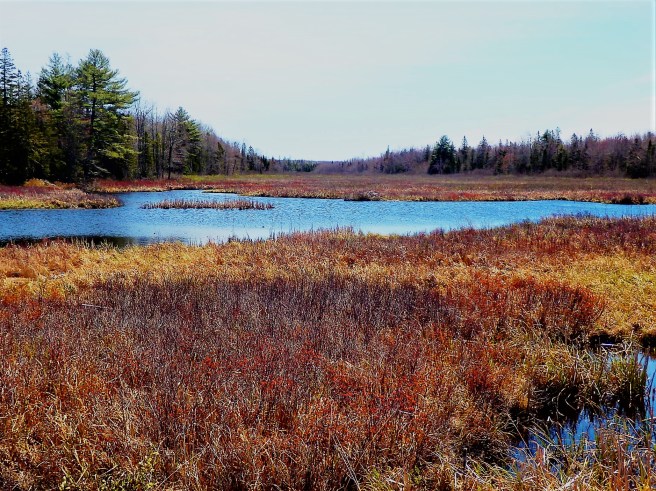
One of the many streams and wetlands.

There are many reasons Downeast reminds me of the Far West, though it’s generally much wetter. In fact, 21 percent of the county is covered with water, much of it as big ponds running along the valleys between the low-elevation mountains. Many of these often island-specked bodies extend two to five miles in length and at least a mile across. And that’s before getting to the bogs and fens or wild rivers and tide meadows or marshes and swamps or prolific beaver ponds. The technical definitions vary, depending perhaps on how wet your shoes get. Quibble as folks might, the northern half of the county seems to be more lakes and wetlands than solid ground. I’m not sure if the Atlantic bays and coves even count in this tally. Quite simply, we’re surrounded by a lot of liquid, so watch where you step.

Lake Meddybemps

What also strikes me is how little development rings the shoreline of the lakes. Many have only a few “camps,” as we New Englanders call the cabins, trailers, or cottages and their docks, with the remainder in full, unspoiled forest. Make a bid, if you must.

It does make for a lot of unspoiled tranquility, for those who are so inclined, if you can deal with black flies and mosquitos. Moose often come as a bonus.

Often you’ll even see a beaver lodge.