Or about 4½ pounds, purchased from a dragger docked at the Breakwater pier, where the crew of three was busy shucking the morsels from their shells. After dining on these two days straight last Christmas, we agreed we have a new holiday tradition. Unlike ones you would purchase at a market, these have no water added, and that means you can get a lovely sear when sauteing them in a bit of olive oil and butter. Do I need to add they taste heavenly?
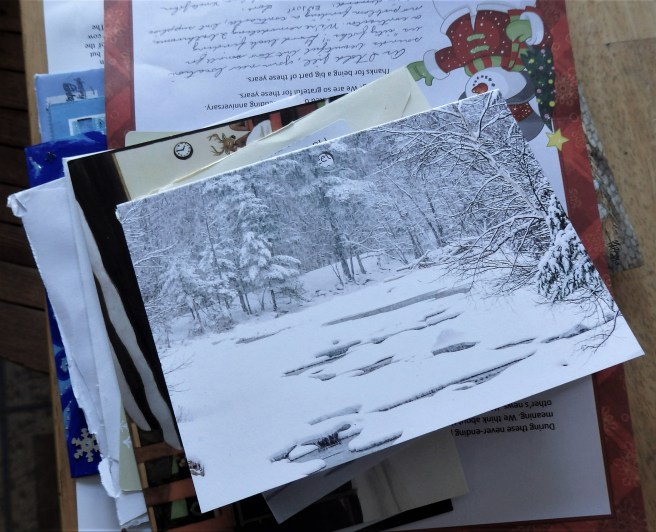
Those (real, postal carrier delivered) cards and letters are a fading tradition, but some of us cling on. Hearing on paper from old friends and some special family members each year is quite different, and warmer, than anything we’d receive online.
Even if it is from the governor or our U.S. senator. In a small state, we’ve usually met them face-to-face.
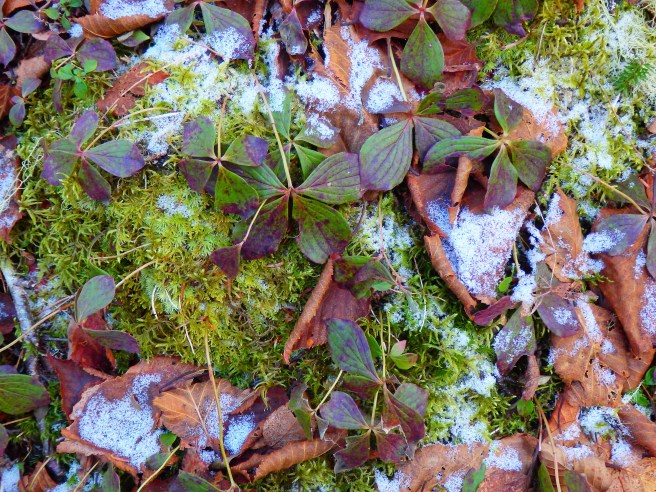
We’ve become fond of this groundcover along many of our trails, with its white blossoms in the spring and red berries well into summer. Here the foliage is fringed with red, set here against moss and a touch of snow in a stretch of what may be a peat bog.
Quoddy Head State Park, Maine
For the record, Cornus canadensis is also known as Canadian dwarf cornel, quatre-temps, even crackerberry,
Have to admit “New Brunswick” sounds more exotic than simply “Canada.” Most Americans know where Canada is, after all, but have to think twice when the province is mentioned.
The deep channel between Eastport and Campobello Island, New Brunswick, is called Friars Road, named for a rock formation dubbed the Old Friar. It stands at the foot of the bluff that’s part of the international park honoring Franklin Roosevelt’s former summer estate.
Equally exotic for this Ohio boy is living on one of the Fundy Bay islands, even if we don’t have to take a ferry to get to or from the mainland.
If I’m counting right in the satellite images, mine is one of the one hundred most easternmost houses in the continental U.S. It’s likely I’m even the most easternmost Quaker in the country.
Was this once part of a sardine cannery? Or the steamship terminal? Yes, that’s more of Campobello Island, New Brunswick, on the other shore.
Been here two years now, too, and it’s still amazing me.
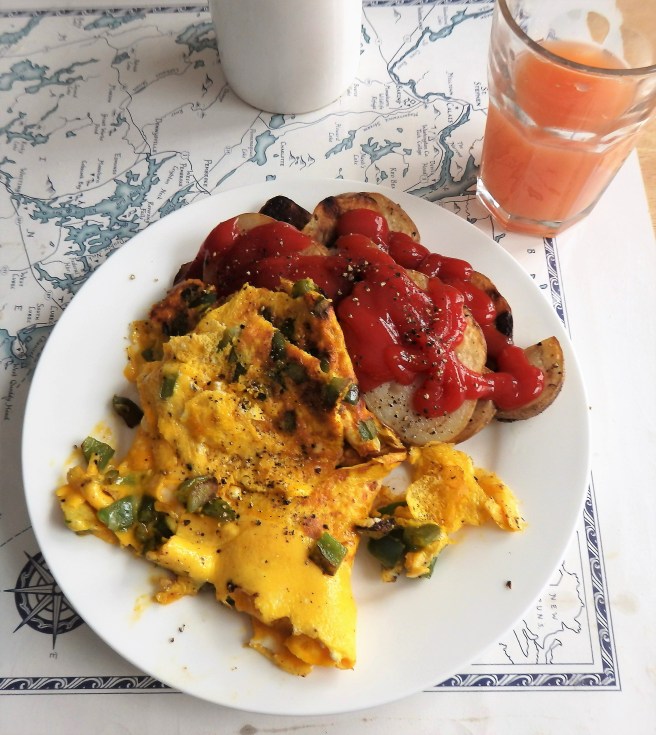
A cheese, green pepper, and mushroom omelet using eggs from our next-door neighbor’s hens is served with home fries made of potatoes I purchased in Aroostook County. Notice there’s no need for ham or bacon. I do love grapefruit juice, by the way. Brunch like this remains a favorite Saturday tradition for me.
My eating habits were one of the places my residency at the ashram changed my life (see my novel Yoga Bootcamp for a taste of the experience).
The lacto-vegetarian cuisine was one, leading to three extended periods “on the outside” when I continued it. Even when I haven’t, the amount of meat in my menus has remained much less than many Americans’. I rarely use bacon, for instance, and when I do, it’s likely to be as a garnish, say on a spinach salad. Hamburger is more likely to be in a meatball or meatloaf rather than in a bun.
Gravy, curiously, has become more heavenly than ever as an extension of the rue family.
And lamb, a recent addition, is simply glorious, especially grilled.
Grilling, I should add, is something I’ve come to treasure through my wife and the space we dubbed the Smoking Garden. There’s no substitute, as far as I can tell, and it makes for some great social gatherings.
What I gained through the ashram was a delight in vegetables and fruits, especially in season, as well as dried beans, nuts, and mushrooms.
The other lasting change was in my dining habits.
Our first food of the day came after morning meditation, community scripture reading, and perhaps physical exercise, and then it was light food – coffee and toast, maybe with yogurt or fruit, and that after we’d already been up three hours. The real meals were a late brunch or early lunch, around 11, and an evening meal around 4 or a little later.
I’ve continued a similar schedule, foodwise. Well, my caffeine intake is down, per doctor’s orders, but what I have is top-notch. Quality over quantity, right? When I was working the “vampire shift,” till midnight or so, the hours were adjusted accordingly, often with a melty cheese sandwich before bed or a martini. (Alcohol was strictly forbidden on the yoga diet.)
In retirement, I find myself often down to one major meal of the day, and holding steady.





 Jnana's Red Barn