
At low tide, the remains of the four-masted ship are fully exposed. Built in Shackford Cove, she had returned for maintenance when she caught fire and sank.

Here’s another perspective.
You never know what we'll churn up in cleaning a stall
At low tide, the remains of the four-masted ship are fully exposed. Built in Shackford Cove, she had returned for maintenance when she caught fire and sank.
Here’s another perspective.
There was a seasonal correspondence with the renovation project and the winter season.
In a clime like ours, weeks pass when everything outdoors seems dead. Outside our vision, though, things are preparing for rebirth. Maple sap starts running, for instance, as the syrup makers know. And then the first flowers pop up.
Something similar was happening with the house work.
I mentioned the wiring. Here’s another look as it developed.
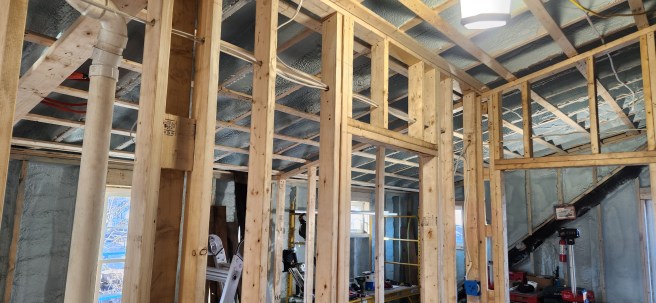
And then the plumbing.
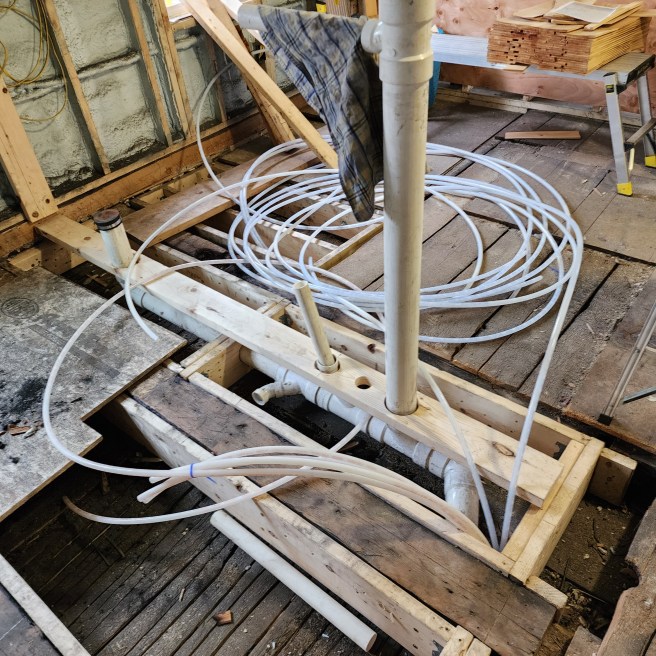
Selecting the toilet, tub, shower, and so on took more time than anticipated, especially when two separate trips to Bangor – a full day each – turned up nothing at Lowe’s, Home Depot, or Frank W. Webb.

I am looking forward to finally being able to take a bath without feeling like a pretzel. It’s been four years, in fact.
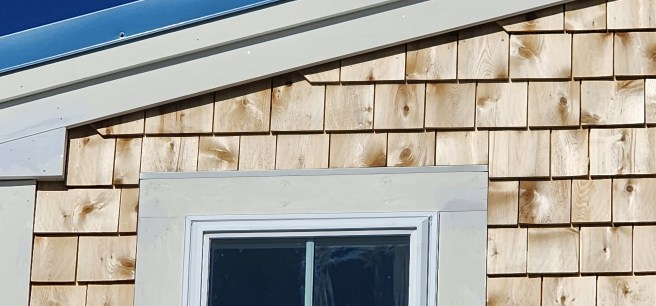
Visible progress was even appearing on the new exterior on the gable ends.
And the dividing walls along the center started coming down.
Do I sound impatient?

Yes, spring is finally breaking out around here. Whiting, Maine.
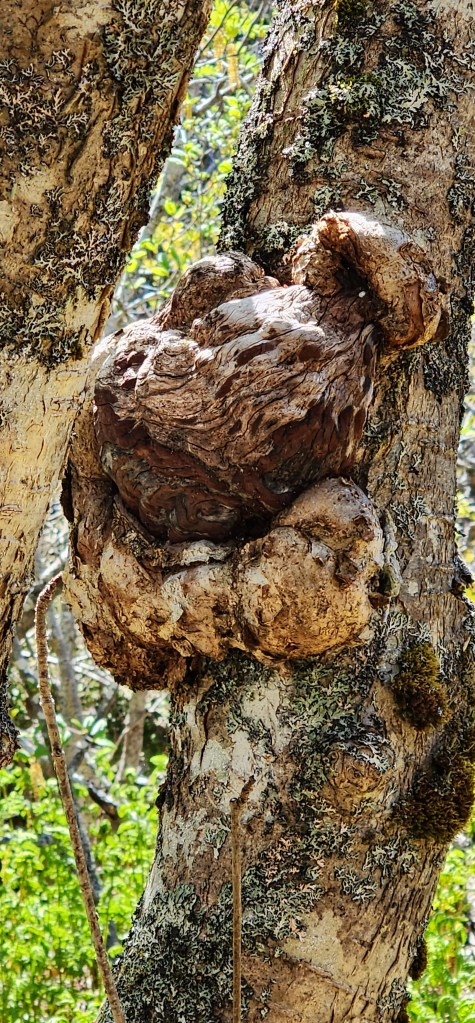
Gnarled trunk on a trail at West Quoddy looks like a living gargoyle.

At the lower fish ladder.

Sometimes food is even better the second or even third time around. In this case, Brussels sprouts with homemade croutons and grated cheese form a main luncheon course.


Those are salmon pen farms, should you be interested.

And that’s the point, in Cobscook Bay.
The new year introduced what seemed like slow-motion forever, a superficially sluggish pace that lasted all winter.
The reality was that there were a lot more parts and details to attend to in a project like this than met the eye. As for patience? It’s a skill, as I’m observing.
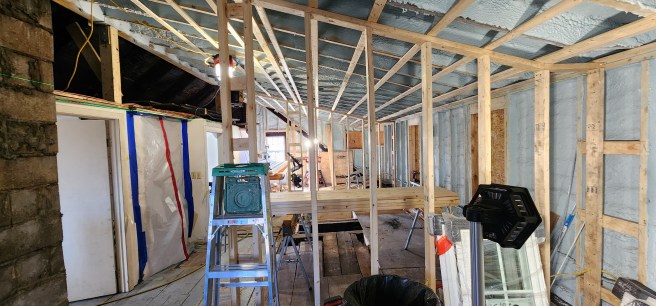
Cutting the openings in the exterior for the new windows and then framing them inside and out was one example. One step required each window to be perfectly leveled and then sealed into place. It wasn’t nearly as smooth-going as you’d imagine. And that was even before Adam uncovered the rot under the north gable window. One more delay for repair.
I have to admit the varied sizes I’d chosen and their emerging views did give me a sense of confirmation and satisfaction, as did looking at the scope of the full back half of the upstairs.

Pulling up flooring to permit rough fitting for the piping in the bathroom and adjoining laundry room was another example, one we’ll cover in an upcoming post.
An unexpected discovery was a spider’s nest of tangled electrical wires, itself a violation of building code, but something that then led to the shock that none of our “modern” wiring on the first floor was grounded. Among other problems. Addressing that situation detoured Adam for more than a week, but it included a redesign of the wiring in the cellar, too.
That project was on our longer agenda, but it wasn’t something to ignore. I am delighted that we can now plug in three-prong wires without having to resort to those crazy converters for the two-prong sockets. As it turned out, none of our surge protectors would have worked when plugged into the old system.
It’s a huge relief knowing that’s all in our past now.
You’ve already seen photos of the knob-and-tube lines we found in the rafters. Some of those then led back to outlets on the first floor – connected by nothing more than stripping the main line and taping over the new wrapping. We already knew from experience that most of the first floor, plus the cellar lights, were on one circuit. Running the bread toaster and another energy hog could easily overload that, sending me flashlight in hand to reset the circuit-breaker in the cellar.
Our carpenter also found a junction box set in the upstairs floor – another violation of today’s building codes.
And here I’d been concerned about our lack of three-prong grounded outlets? Oy vey.
Of course, we’re looking to correct all that. My, are we.

Framing for the two bedrooms and the bathroom and laundry room also took time and care, as did the strapping for the drywall on the ceiling to come. For now, there were the electrical lines, outlets, and switches to install, once the holes were routed in the future walls.

Outdoors, the back half of the house was surrounded by scaffolding. Although the first cedar shakes were applied to the new exterior early on, continuing was a random activity based on fair weather. The exterior work had to do more with flashing and the underside of the roof overhang. More details, as you’ll see in coming posts.
How much would have to be more or less finished before tackling the front half of the upstairs? Instead, we were trying to find crannies downstairs to move our possessions still parked overhead, but Adam also needed more workspace. It was amazing how many tools and related equipment he had there. Even his construction lighting was impressive, before we considered the permanent fixtures.
If I was looking for a halfway point, I was sensing the path ahead was more complicated. We still had plans for downstairs, too, if any of our nest egg remained.
Welcome to our learning curve and money jitters.
~*~
One thing we were discovering was that there are far more parts to house than you’d imagine.
All along, we kept hearing mysterious pounding and shaking overhead, the whine of power saws and the thumping of an air compressor, along with falling timber or worse. I learned not to anticipate taking a nap during what other’s consider normal working hours.

Cedar in Whiting, Maine
 Jnana's Red Barn