SINGING WHERE WE LIVE

Like all of the arts, poetry has a long tradition of speaking for the marginalized and disenfranchised. Just look at a lot of the Psalms (even those attributed to David the King!) or Isaiah, for starters. That, as well as the court poets throughout antiquity. Or Wallace Stevens, the insurance executive. We sing where we live.

As for the review, remember: being a writer requires a thick skin when it comes to criticism – and, as Gertie Stein said, every writer wants to be told how good he is, how good he is, how good he is. Now, let’s look at the depth of this “criticism”: adjectives like dumbest, dumb, dumb … how many times? To say “I didn’t like this” is not criticism, O Wondrous Publisher, but the lowest form of consumerism.

Much of the most powerful art we find unlikable in our initial encounters – only through repeated exposure and exploration do we finally begin to see it open in its fullness and awe, and to appreciate its scope. (Not that everything that’s unlikable is great art, or even art, mind you – just that candy in and of itself can leave one seriously malnourished.) So don’t invite this cad to the opera, Shakespeare or Shaw, the symphony, art museum, jazz, a wine-tasting or brewpub, wilderness camping/backpacking, or your next edition. I once counseled a photographer I know in the Pacific Northwest to go beyond the obvious, superficial beauty there and to instead capture the real nature of the landscape.

Last time we talked, he said his work had taken on a breathtaking intensity, but that none of the galleries would touch it – because they didn’t believe it was real! It isn’t what the owners and collectors think they see in the outdoors – it’s the reality, in its naked majesty, instead. That’s what art is about! Or should be.

Or, as Gary Snyder once argued, all poetry is nature poetry – even if the closest the poet comes to nature is his old lady’s queynt.

Another thing to remember when it comes to publishing: not everyone will like everything. Back when Doonesbury was the “hot” comic strip, one newspaper was astonished to find in a survey that the strip was both its most popular – and the most hated! Please the latter subscribers and you might not be selling copies to the former; but please the former, and the latter will still be onboard, to get whatever it is that they like. Or. if a restaurant removed every item that any of its clientele found objectionable, there would be no menu. Even McDonald’s has detractors.

Of course you’re going to tinker with each edition! Every poem is different, too – or should be. (I could name some writers who are repeating the same formula they struck upon ten or twenty years ago, but that’s not for me – Eskimo artists, I’ve heard, will do a subject only once and then move on to another. Good model, methinks, although the “once” might mean a work within a series of sixty to a hundred poems – kind of like a novel, I guess.)

Maybe you’ll even have a stretch where the personal life and upheaval and discovery and adventures quiet down, and you feel it’s time to do a mostly-poetry issue – go for that, too!

Right now, what’s singing where I live is the mockingbird. Ever so gloriously, with a song that’s rarely the same.

NOTTINGHAM SQUARE

The monument to the Revolutionary War soldier in Nottingham Square marks the town's fervent participation in the struggle for freedom. Gunpowder seized from the raid on Fort William and Mary was stored in homes facing the square, and months later, when cannon fire from the Battle at Bunker Hill in Boston was heard, the militia mustered on the square to begin its 50-mile march to join in the combat. The rural town boasts of having several generals among its residents.
The monument to the Revolutionary War soldier in Nottingham Square marks the town’s fervent participation in the struggle for freedom. Gunpowder seized from the raid on Fort William and Mary was stored in homes facing the square, and months later, when cannon fire from the Battle at Bunker Hill in Boston was heard, the militia mustered on the square to begin its 50-mile march to join in the combat. The rural town boasts of having several generals among its residents.

ALL THOSE TRAINS

With the exception of a small spur to our south, all of the railroad traffic to and from Maine goes within a few blocks of our house.

The first year or so we were here, our youngest complained of the noise through the night – turns out it was gravel and sand headed to Boston for the Big Dig construction. At least that’s died down.

During the day, though, we have the Amtrak Downeaster’s five runs south, to Boston, and back, to Brunswick, Maine, plus the usual freight traffic.

But is it healthy to have so much dependent on such a tiny point of transit? At least as a point of homeland security, I’d argue not.

WIND BLADE

100_8492

Several months ago, while driving on Interstate 95 to Boston, a remarkable view caught my eye. Headed in the opposite direction was a very long trailer, one at least three times longer than the usual tractor-trailer rigs. A few miles down the road, I glimpsed another. And then a third.

They were blades for wind-powered electrical generators being erected atop several ridges in Maine. Perhaps you’ve read some of the controversies erupting over proposals to build these “wind farms” in suitable locations across the country. But this was the first time I got an inkling to the size of each tower.

Earlier this month I came across two similar propellers, this time settled in a parking lot, no doubt waiting for a few more to join in a caravan. Even before being erected on a summit, they’re an amazing sight. Somehow, the gleaming sun on the metal reminds me of watching whales lolling in the ocean. Whales, you may recall, were the source of the oil used to illumine many homes in early America. They were another source of energy from New England.

100_8486

100_8490

MYSTERY SOLVED?

While Dover Friends (Quakers) proclaim that we worship in our third meetinghouse, erected in 1768, our history of the previous two structures becomes a bit foggy. Even so, ours is the oldest house of worship in use in the city.

In his authoritative New England Quaker Meetinghouses (Friends United Press, 2001), Silas Weeks mentions that our first house of worship was built about 1680 on Dover Neck, just south of the present St. Thomas Aquinas High School. Correcting an earlier version of the relocation of the structure to Maine, he writes that in 1769 “the 1680 house from Dover Neck was taken apart and re-erected in Eliot at the corner of what are now State and River Roads. There is a bronze plaque marking the site …” (Alas, there goes the tale of its being skidded by oxen across a frozen Piscataqua River. Taken apart and put on a boat now seems more likely.)

Apparently, when our current house was built, we had no need for the smaller structure. I suspect that until our current meetinghouse was available, Dover Friends met for worship in the two smaller structures and gathered together for business sessions.

The disposition of the second house, though, had eluded his investigation. It had stood at what Silas “believed to be the present corner of Locust and Silver Streets,” but there was no indication it had been incorporated in later buildings on the site.

A publication from the Dover Chamber of Commerce, however, may have the answer. Dover’s Heritage Trails, a guide to historic walking tours through the city, notes this at 3-5 Spring Street: “This old dwelling was Dover’s second Quaker Meeting House, built originally at the corner of Silver and Locust Streets and moved to this location in 1728, before Spring Street existed.”

Silas reported “The second was erected in 1712 on land belonging to Ebenezer Varney. The deed, transferred to Friends in 1735, described the site …” in ways that support the Silver and Locust location. My guess is that the structure was moved in 1828, since the Chamber pamphlet mentions that neighboring houses were built in 1810 and 1811.

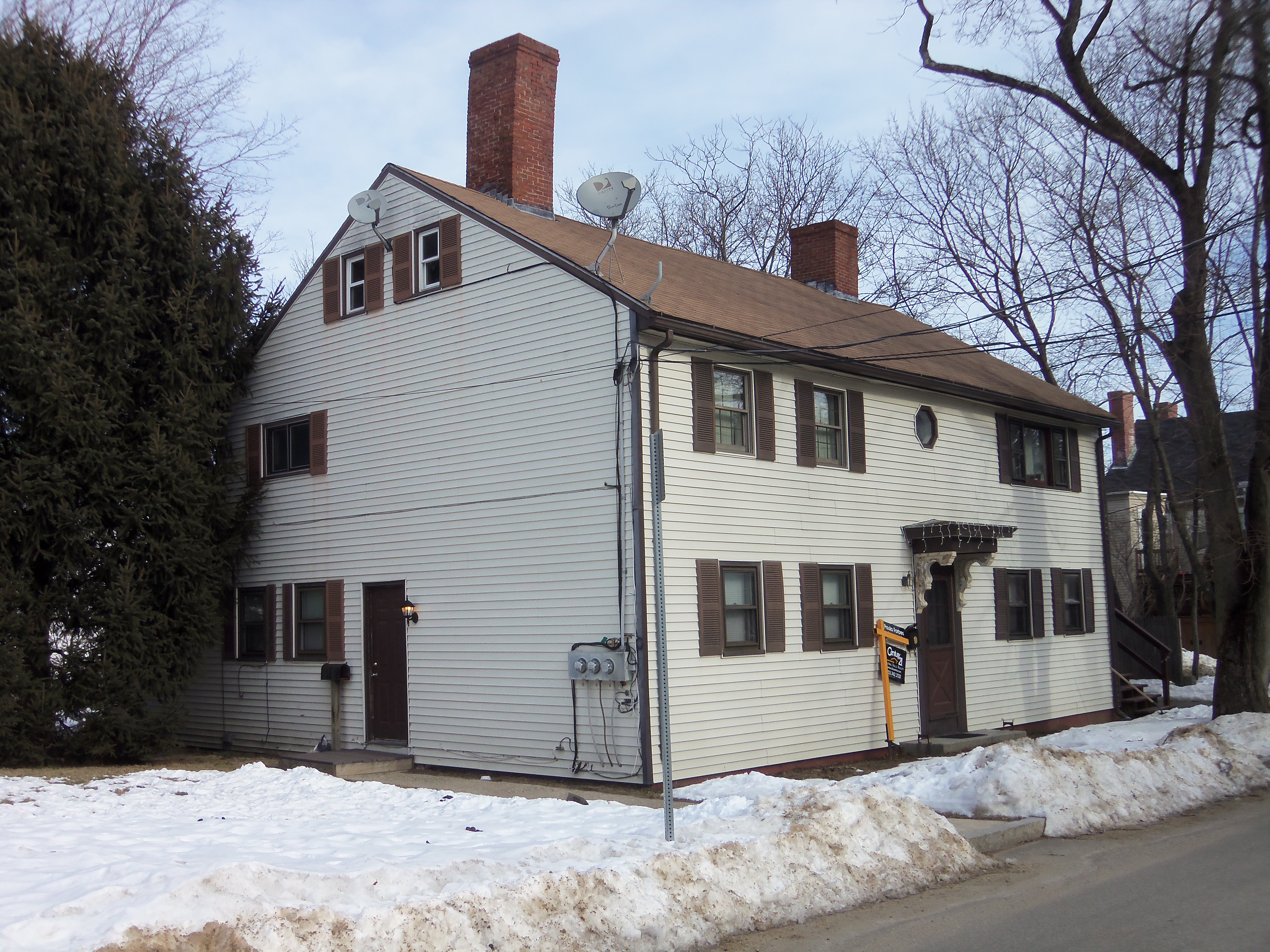
The building has no doubt changed a lot, inside and out, since it was erected three centuries ago -- including the addition of chimneys. But the shape is right for a Friends meetinghouse.
The building has no doubt changed a lot, inside and out, since it was erected three centuries ago — including the addition of chimneys. But the shape is right for a Friends meetinghouse.

As they say, the plot thickens. And to think, the answer to our search may wind up just a bit more than a block up the street from where we gather.

ALL HAIL THE DETERMINED GARDENER

Although I do my share of the weeding and much of the spading, I’m not the gardener. My wife is the one who studies the varieties of plants, selects and orders, fusses and sows, evaluates soil and sunlight, while I’m more likely to mow, do the composting, construct the raised beds, and transport ferns, Quaker ladies, and ox-eye daisies from the wild. In recent years, our elder daughter has taken delight in getting seedlings started and transplanted, especially, as well as making jams from the fruit we harvest. (The younger one could care less.)

While my dad, mainly, raised vegetables and tomatoes behind the garage when I was growing up, and my mother fussed over flowers that generally failed, and despite my later experiences living on a hippie farm and then the ashram as well as my first wife’s efforts in Ohio, Indiana, and the fertile desert country of Washington state, my perspectives on gardening center on Rachel and her world. Everything before was simply preparation. Little did I suspect, when we set out to buy a house as part of our marriage, how much she was calculating garden opportunities; many of the urban New England properties, surprisingly, have little usable space for raising plants. Only after bidding successfully on the house we now inhabit did we learn that it included not just a small but manageable strip beside the driveway but a half-lot on the other side of the house, as well – the side we’ve come to call the swamp.

But that’s the beginning of another story.

POINT OF REVOLUTION

A lighthouse has stood at this site along Portsmouth Harbor since 1771, where fortifications were first erected in 1632. The long dark stonework along the water was part of Fort Constitution. Historically, it was the site of Fort William and Mary, the first armed skirmish of the American Revolution.

This year’s Patriots’ Day comes next Monday, a holiday in Massachusetts and several other states to commemorate the April 9, 1775, Battles of Lexington and Concord that inaugurated the American Revolutionary War. These days it’s also the occasion of the 117th annual running of the Boston Marathon as well as a late-morning Red Sox game at Fenway.

New Hampshire, on the other hand, traditionally marked the event obliquely, with its own Fast Day the following week, ostensibly originating in 1680 and officially abolished in 1991. We got Fast Day as a holiday free from the office, but the only way we knew when it would fall in a particular year was by paying attention to the Marathon — and we’d get the following Monday off.

While Patriots’ Day marks the historic “Shot Heard Around the World,” the actual first armed skirmish happened months earlier at Fort William and Mary along the Piscataqua River in New Hampshire. On the evening of December 13, 1774, Paul Revere rode north from Boston with reports of the latest British actions, especially in Rhode Island. The news sufficiently angered 400 Sons of Liberty led by John Langdon to march on the fort, one of several protecting the mouth of Portsmouth Harbor, and raid it, carting off 98 barrels of gunpowder, roughly five tons. The next night, a small party headed by John Sullivan carried off 16 pieces of small cannon and military stores.

These supplies were then distributed to hiding spots, including the cellars of Boston churches and at least one New Hampshire home, before being used in the Battle of Bunker Hill on June 17 the next year.

Known as the Powder Major's House because of the gunpowder secreted in its cellar after the attack on Fort William and Mary, the residence of Major John Demeritt in Madbury likely originated around 1723 as the wing now attached to the larger Colonial home.
Known as the Powder Major’s House because of the gunpowder secreted in its cellar after the attack on Fort William and Mary, the residence of Major John Demeritt in Madbury likely originated around 1723 as the wing now attached to the larger Colonial home.

MUG, MORE THAN A CUP

Seems I’ve always been a coffee lover, as far back as those “coffee milks” our Gran used to serve my sister and me on Sunday afternoons. Maybe that’s why I still prefer mine café au lait – half milk heated with a liberal dose of sugar or sweetener.

For decades now, my days have begun with a round of hot coffee, often abed – yes, how blessed I was after remarrying, when my wife would appear with the perfect mug when I needed to awaken. And how much I lament how that ceased, in part because the office rejuggled my schedule, meaning she never knew quite when I would be rousing.

For someone in a faith tradition that eschews rituals, I have to admit where they really appear – and be willing to acknowledge anything that’s an addiction, as well. (Remind me to take a coffee fast in the next year, OK?) Yes, maybe the editors of one poetry journal had it right when they admitted they were devotees of the Goddess Caffeina. (Oh, she has temples everywhere.)

More recently I’ve begun to question whether it’s really the coffee itself I like. That is, I can drink it black. And, yes, I also demand dark coffee – the darker, the better. I even like Starbucks, though that has nothing to do with my years in the Nevergreen State. (Remember, I lived in the desert side of Washington state.) No, I realize when the mug’s turned cold, my beverage tastes a lot like the cartons of chocolate milk we used to purchase in the elementary school vending machine – the ones that cost us a nickel. So maybe it’s that chocolate underpinning that grabs me.

Is it possible that even at six-foot-two, the chocolate stunted my growth? We can’t blame the coffee, now, can we?

ON THE PICKET LINE

As I said at the time, carrying a picket sign, after all those years as a professional journalist, crossed a barrier. We don’t take sides, in public, so what does one do in a labor impasse? I realized this is what my younger stepdaughter, the political activist, called a “viz,” for visibility event, and that we could add more posters to our sticks, to create a “totem pole.” I also recalled a Friend, speaking of driving along and seeing a vigil and then stopping and opening his car trunk for the sign he always carries, just so he’d always be ready to join in anywhere. There was something liberating in this, even if it was an “informational picket” rather than a straight-out strike line.

Now, having retired from the profession, I sense another opening. A return to an earlier calling. My entering journalism, as a public witness and service, is restored to its original prompting of advocacy and reform, before it was confined by corporate media – the very bottom-line organizations right-wing critics overlook when they accuse “liberal media” of, well, reporting both sides. Maybe I’ll become a Quaker agitator, after all. (As the retiree activist, I might say: Thank you, Megan. And Iris. Especially.)