OCCASION OF CELEBRATION

As I posted in a poem back in April, spotting a hummingbird is an occasion of celebration. They’re so tiny and so fast you’re likely to dismiss one as a dragonfly or as some other large, speedy insect if you’re not paying attention. Sometimes you notice more the irregular angles of their zig-zag flight, the motions no other flyer can manage, rather than the bird itself, and then you start observing closely. And sometimes you just happen to look out when one’s hovering nearby, say at the blooming azalea in front of the bay window.

I hadn’t seen any this year until a few weeks ago, when I glimpsed out from our kitchen and noticed one working its way through our stand of burgundy-color bee balm. I called for my wife to come look, but by the time she came over, it had vanished behind the asparagus, and that was it. You have to be quick. And now those blossoms are gone by.

I’d also remarked that we hadn’t seen all that many goldfinches this summer. Sometimes we seem to have thousands, but these things can go in cycles, so I just figured it was an off year.

And then, late yesterday afternoon, I sat down in the far corner of our yard simply to enjoy a cold beer and regard our garden and house from that perspective. Since this is also the glorious time of year I consider high summer, what I viewed was a culmination of so much that had been building up. Everything was quite green and lush, of course, and the garden was punctuated by the red of tomatoes, the yellows of squashes and peppers, and the incredible purples of eggplants, even before I got to the flowers. As I settled in, after admitting to myself the grass needs to be mowed again, I realized this was dinner rush hour for the birds. Who knows why, but they do seem to eat in spurts, at least when it comes to populating our feeders. And here they were, far more than I could count (after all, they’re constantly flitting from one place to another). Not only that, but many of them were goldfinches, perhaps attracted by our sunflowers that have finally started blooming. Mourning doves landed in the grapevine and wild-rose covered branches of the black walnut tree before looping down to the ground under the main feeder, littered with birdseed as it is. Along the tree I could see just the gray flickers of squirrel tails as they raided the ripe nuts from the branches. In short, it was lovely. And the grass seemed to be just the right depth for many of the smaller birds to go grubbing.

That’s when I caught the distinctive flight of the hummingbird, which then did something I’d never before seen: it actually landed on one of those branches, where it quickly became a camouflaged bump on the distant limb. Soon there were two, and I don’t ever remember seeing two at once. (Well, maybe once in Maine, at a friends’ feeder outside their kitchen slider door?) Still, a first, as far as our yard and garden go.

Minutes later, I spotted one working its way through the zinnias about a dozen feet from me. How meticulously it hovering above a single flower and vacuumed each petal. Next thing I knew, it was gone and then one followed by a second came shooting inches past my head, even as I ducked instinctively. Well, that was the second … and third … time in my life I’ve had to dodge that bullet! They certainly seemed to having fun, as birds and bees are said to do.

It’s been said that meditation may have originated in the art of hunting. That is, in learning to sit very still for extended periods of time and just let the wildlife come to you, if you’re worthy. So I sat very still, the way I would in Quaker meeting for worship or in a half-lotus position on my meditation cushion. Over time, I saw at least four hummingbirds working their way around the yard, swooping from the trees to the Joe Pye weeds, the sunflowers, the zinnias and cosmos, and somewhere behind me, before landing repeatedly in the trees.

All of what was happening could be considered as an epiphany, those special moments when the Holy One appears or becomes manifest in an individual’s life. No, I’m not suggesting that the hummingbirds are divine or even angelic, but this was clearly a reminder of the times and ways we are blessed. You can’t just go looking for it and expect it to happen. You can only be receptive and grateful when it does. You also have to know what you’re seeing and be able to name it, knowing how rare and wonderful it is. Along with the simple pleasures of having everything momentarily perfect. Isn’t that a definition of miracle?

Soon, of course, the hummingbird sightings became fewer and fewer. The ones in the yard were probably already migrating from further north and bulking up for their long flight in a few weeks across the Gulf of Mexico. Their season here is nearly over. The finches, meanwhile, will be around longer before donning their gray traveling cloaks, as one friend says, and then heading south.

On our part, all this was soon followed by our own time for dinner with its fresh sweetcorn, tomatoes, and basil eaten al fresco in the golden rays of the setting sun.

What was I saying about an occasion of celebration? Indeed.

SMOKING GARDEN

At night these strands twinkle.

I’ve mentioned the space we whimsically call the Smoking Garden – the funky patio, as it were, beside the barn.

It’s great for late afternoon and evening dining all summer, or parties ringed by Tiki torches, though it’s been a while.

Even so, here it is.

BIRDS AS BYSTANDERS

A ring of blue jays is sounding an alarm somewhere close by. Who knows what it is this time.

So I stop typing, get up to look out the window, just in case they’re in view. What I see instead is a grandstand of smaller birds – sparrows, juncos, chickadees – all sitting contentedly on branches and facing the action.

Here we have it: the idle curiosity of us all.

KEEP AN EYE FOR THE TIDE

Just about every time we take I-95 south to Boston, a particular experience comes to my mind while crossing the Merrimack River. I look out from the bridge, hoping to see whether the tide’s in or out.

But that’s not how it was when I first moved to New England.

On one warm evening, while driving with a girlfriend along the river just beyond the bend we can see from the bridge, I found a place to pull over. The water was low, with many steppingstones exposed. We couldn’t resist walking way out from shore and back again, but when we turned around, all of the stones where we’d been were now submerged.

It was a close call. As I now know.

THE PERSONAL STAMP

Until landing here, I’d never given much thought to selecting a garden plot. Flat, well-drained sunny soil was a given. Crops could be put out in easily marked rows. The Midwestern loam or Pacific Northwest’s volcanic ash-enriched ground demanded little, other than perhaps a bit of fertilizer boost. What came with our house and its small barn, however, were another matter – one abetted by a decade of deferred maintenance. On the driveway side, hedges had grown to overhang what’s now a kitchen garden and the ground was overrun by invasive ivy. Behind the house, one lilac bush stood nearly three-stories tall. Large limbs rubbed against the barn and blocked the pathway. Three garage-size brush piles soon emerged in the swamp, awaiting a fire department burn permit. It becomes a long history. What I was quickly introduced to is what my wife calls “dead dirt,” almost as hard as asphalt (plucking the stealth maples often required pliers), and then squirrels, especially as they dug up daffodil bulbs they had no intention of eating.

The process of restoring soil is another labor, one that becomes evident years later when the stealth maples slip from the earth, offering no resistance, a result of mulching, pruning, appropriate groundcover taking hold, and composting. In short, the improvement reflects a larger repetition of annual cycles of practice.

Moreover, I’d not appreciated the extent to which actions by earlier residents now shaped what we would build on. For starters, the siting of the house, barn, and driveway likely took advantage of drainage. Later, the construction of a gravel patio in shade on the western side of the barn – screened by a row of lilacs – has become so integral I cannot envision another use for the space, which we call the Smoking Garden, with the panels beside it that we filled with ferns, which have proved more difficult to establish than one might imagine. With two “springs” at the top of the swamp (we argue whether the pipes that feed them come from neighbors’ sump pumps or some other source), the seasonal flow of water becomes even more problematic. Combined with variations in sunlight levels and the soil itself – part of the yard remain quite hard, including asphalt fill – to see what grows well, and where, is eye-opening. For instance, our first season, we planted six pussy willow sprigs. One quickly croaked, followed by another. A third has barely grown over the next decade. Two others have shown moderate growth. The sixth, by the more active “spring,” however, has flourished and been the source of a handful of others planted close by.  The asparagus bed, meanwhile, was built atop an earlier raised bed at the top of the yard. And so on.

What has evolved is something that reflects our own style – more natural than formal, low-maintenance or at least relatively low-cost, and often eclectic. Our little city farm hardly provides enough to sustain us, but it does offer a taste of the changing seasons in all of the amazement that truly fresh produce delivers, as well as celebrating the unfolding of the year itself. This is far from the mossy Zen gardens I thought I would have desired, places I now perceive as expensive to build and maintain, or even from orderly, rectangular beds of rational efficiency. I love sitting beside the berm, in the far corner along the street, sipping coffee or wine – or, especially, in the Smoking Garden as late afternoon slips into night, with our torches blazing and clear lights strung overhead twinkling.

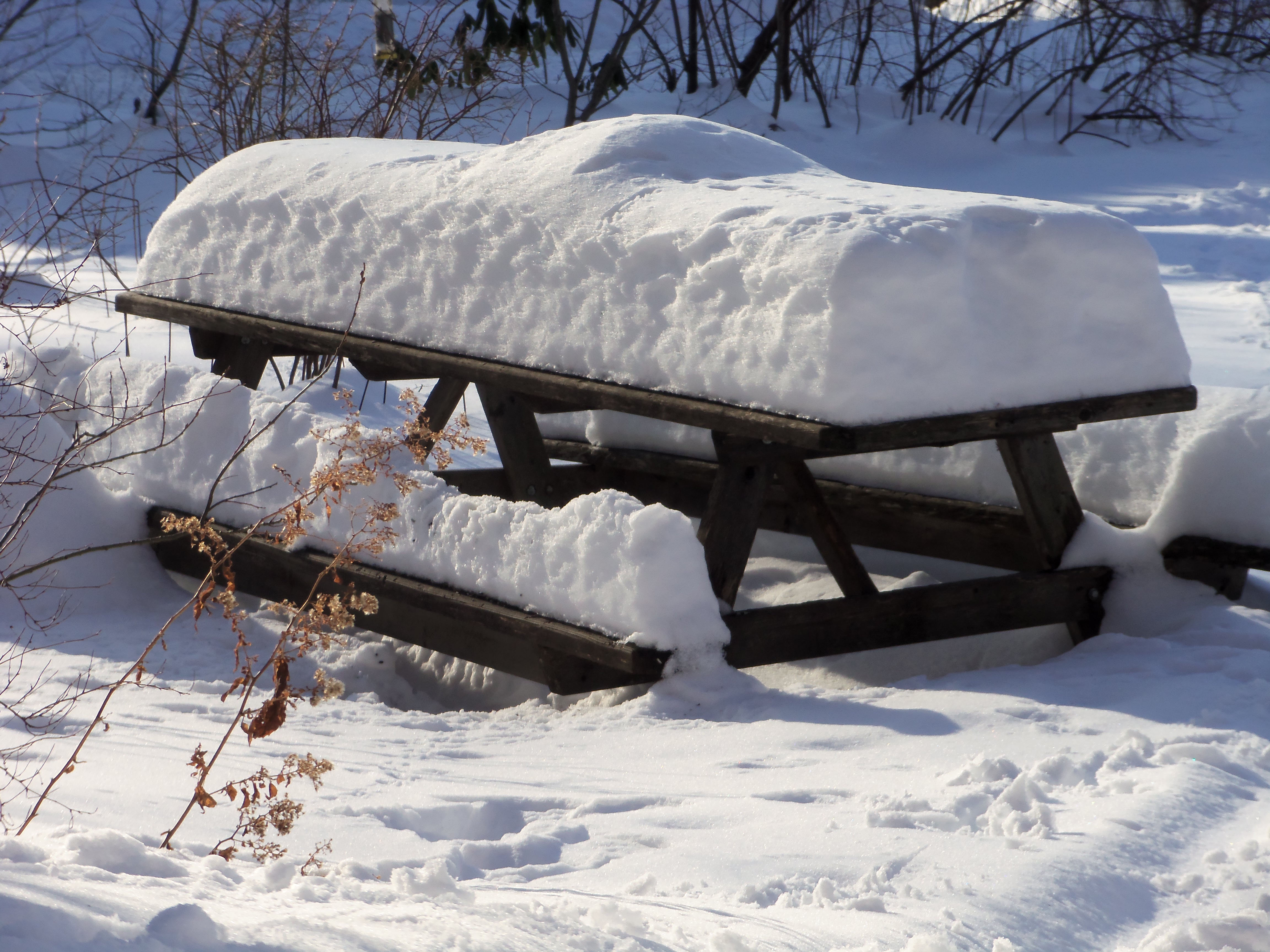
I love, too, gazing at the gardens when they’re buried in three feet of snow, appearing so pure and mysterious. They are both all potential and memory of the previous year – the hummingbirds and finches, butterflies and lady bugs.

WIND BLADE

100_8492

Several months ago, while driving on Interstate 95 to Boston, a remarkable view caught my eye. Headed in the opposite direction was a very long trailer, one at least three times longer than the usual tractor-trailer rigs. A few miles down the road, I glimpsed another. And then a third.

They were blades for wind-powered electrical generators being erected atop several ridges in Maine. Perhaps you’ve read some of the controversies erupting over proposals to build these “wind farms” in suitable locations across the country. But this was the first time I got an inkling to the size of each tower.

Earlier this month I came across two similar propellers, this time settled in a parking lot, no doubt waiting for a few more to join in a caravan. Even before being erected on a summit, they’re an amazing sight. Somehow, the gleaming sun on the metal reminds me of watching whales lolling in the ocean. Whales, you may recall, were the source of the oil used to illumine many homes in early America. They were another source of energy from New England.

100_8486

100_8490

LION’S TOOTH SALAD

Maybe it was simply a day of firsts.

As I was lunching al fresco for the first time this year, having savored our first asparagus of the season (which I’d sautéed with minced garlic leaf in olive oil and then fried two eggs atop the mixture), I realized I was still hungry. So glancing up, I noticed a sprout of dandelion, got up, plucked a leaf, brought it to the table, wiped it in some of the remaining egg yolk, and … it was good. It was very good. Somehow, the yolk overcame whatever bitterness I expected at the end of the bite.

So I harvested the remainder of that cluster (which also doubled as weeding, let’s be candid), went indoors to rinse it and fry another egg to serve with it, covered the resulting salad with salt and coarse-ground fresh pepper … and it was still good. Very good.

So for dinner, another round, this time with a fresh mustard vinaigrette my wife had just made … and it was still good. Very good.

Maybe I’m hooked. Yes, we’ve read some fine food writers who’ve extolled their pleasure in fresh dandelion every spring, before the leaves turn too bitter and too tough. Until now, though, our dandelions were treasured only by our pet rabbits.

Not anymore. Another first.

Now, to see how it works blanched. Or maybe as a spinach substitute, say in a Florentine-style dish.

Not that I have any intention of turning the Red Barn into a food blog. Oh, no. I know my limitations.