FROM SHAMANS AND NICE GUYS TO THE LEFT HAND OF GOD

With the annual Christmas shutdown, I thought my reading drive had also collapsed; seemed during the first two months of 2007 I wasn’t getting any traction, either. Only when I sat down to update the list did I realize I’d got up through quite a number here, and there may have been more. So to continuing this month’s survey of Books Read, here are a few more entries:

  • Jeremy Narby and Franics Huxley, eds: Shamans Through Time: 500 Years on the Path to Knowledge. Anthology of selected excerpts of field observations of “magic men and women … with the power to summon spirits.” Ranges from hostile writings by missionaries to anthropologists who submit to healing sessions, and from Siberia to South America and Africa variations. Includes mention of the dark side of the practice, too.
  • Paul Coughlin: No More Christian Nice Guy. Argument for a masculinity that has boldness in the face of fear – one that confronts prevalent assumptions in society at large, protects the weak, and upholds Christian values in the home and the workplace.
  • Stephen L. Carter: Integrity. This legal scholar of ethics presses the case that integrity is more than simple honesty. Rather, it is a matter of actions based on deep reflection, which also demands listening to perspectives other than one’s own. The crux of integrity, he says, is the willing of good rather than the willing of evil.
  • Geri Doran: Resin (poems). “We rowed all night in the river of God, / singing kyrie, kyrie.”
  • Sascha Feinstein: Misterioso (poems). Pieces rooted in and flowing through jazz.
  • Toni Tost: Invisible Bride (prose poems). “My friends are wheels turning away from themselves.”
  • David R. Montgomery: King of Fish: The Thousand-Year Run of Salmon. A geologist examines the pressures on salmon, both in historic preservation efforts in Scotland, England, and continental Europe as well as those in New England, and in the Pacific Northwest today. Includes consideration of the dynamics of rivers and they ways various varieties of salmon have adapted to the specifics.
  • Michael Lerner: The Left Hand of God: Taking Back Our Country From the Religious Right. A social activist rabbi argues that in removing religious values from public discourse, the left has left a vacuum for the political right to exploit. Rather than being value-free, the result has been value-less positions by the left – and the left is perceived as spineless and without beliefs. Lerner has some good insights on the American workplace and the tension people feel, blaming themselves for unhappiness in their employment while applying value systems that are diametrically opposed to their religious faith. Much of this volume is quite painful to read, addressing public issues in full candor and complicity.

100_6795

OF THE GRAVE AND BEES TO PERFUME AND HOLLYWOOD

Continuing this month’s survey of Books Read, here are a few more entries:

  • Graham Montague: The Stillness of the Grave and the Quickening of the Spirit. Pamphlet by a contemporary British Friend, suggested by Patrick Burns. I love the use of Walt Whitman’s description of attending his first Quaker meeting and sensing the worshipers were as still as the grave — followed by insights of dying to the world around us momentarily and resurrection.
  • Matthue Roth: Never Mind the Goldbergs. Flippant fiction as late-night fun for this reader. One of my favorite teen-angst novels, it has some marvelous insights into religious identity as well as some scathing portraits of Hollywood values and practice.
  • Holley Bishop: Robbing the Bees: A Biography of Honey, the Sweet Liquid Gold That Seduced the World. Although the author spends much of her time following a commercial beekeeper in Florida, she does present a range of fascinating detail on the care of honeybees through history, the evolution of commercial hives, and the place of honey and beeswax over the centuries. A book to stand alongside, Cod, Salt, Cotton, and other basic commodities. Includes recipes.
  • Mandy Aftel: Essence and Alchemy: A Book of Perfume. A beautifully designed and produced book (North Point Press) exploring the history, artistry, psychology, and ingredients of perfume. But do I want all of those recipes?

100_6951

FROM THE WEATHER TO SUICIDE OR EVOLUTION

Continuing this month’s survey of Books Read, here are a few more entries:

  • Dave Thurlow and C. Ralph Adler, eds: Soul of the Sky Exploring the Human Side of the Weather. A Mount Washington Observatory publication presenting literary writing about weather.
  • Milan Kundera: The Art of the Novel. Seven essays in “a practitioner’s confession.” From a peculiar Central European perspective, he admittedly stands at odds, as he points out, with contemporary French fiction. After a first read, I find it difficult to place my work in relation to what he argues, except to acknowledge the ways my work does what only a novel can do. On the other hand, I like work that conveys solid reporting as well – history, geography, geology, theology, and the like – something Kundera clearly disdains, except in a most generalized or abstracted manner.
  • Albert Huffstickler: Poetry Motel memorial edition (No. 32). Work that stays too close to daily journaling for my taste. I’ve seen other pieces by him that seemed to take flight.
  • Maxine Kumin: Jack and Other New Poems. This volume doesn’t go far beyond observations of a New England horse farmer, of the genteel sort.
  • Jeff Clark: Music and Suicide (poems). A controversial and often sophomoric collection (from the Academy of American Poets), yet parts of it catch fire – get the juices going. Coming after Kumin, this is poetry.
  • Patricia Fargnoli: Duties of the Spirit (poems). Centering on a quotation from Thornton Wilder, Fargnoli argues for the duties of joy and serenity – all too easy, methinks, for an old lady living in rustic retirement. These are all pale garden pieces, of the white linen sort – dirty fingernails being for the hired help. Righteous anger, like the social justice verses of Isaiah, are also duties of the spirit – where the red blood flows through muscle.
  • Ntozake Shange: The Sweet Breath of Life. A marvelous collection of poems written in reflection to inner-city photographs by the Kamoinge Inc. collective (and edited by Frank Stewart). An incredible match-up.
  • Jon Tolaas: Evolution and Suicide. A thin freebie, this work turns into a fascinating consideration of the meaning of consciousness itself, using Darwin and Freud as its starting points, pro and con. At the core, perhaps, is the insight that the central question is not, What is the meaning of life, but rather: What have you done (are you doing) with your life.

100_6791

FROM MATING AND DATING TO THE GREAT NORTH WOODS

Continuing this month’s survey of Books Read, here are a few more entries from my scroll as I kept it:

  • Andrea Orr: Meeting, Mating (and Cheating) Sex, Love, and the New World of Online Dating. One journalist’s argument that matchmaking is what kept Internet companies afloat during the dot-com bust. Also interesting vignettes of the changing nature of courtship in America.
  • Nathan Graziano: Frostbite. Fine short stories in a Bukowski vein, set mostly north of Concord. Pessimistic, young adult outlook. Is title a pun on Robert Frost, for a Granite State writer?
  • Ray Blackston: A Delirious Summer. Frothy romantic comedy set in South Carolina. But ultimately sexless enough for Southern Baptist readership.
  • W.D. Wetherell, ed: This American River Five Centuries of Writing About the Connecticut. Good way to begin thinking more pointedly about living in northern New England, where I’ve now been nearly two decades. (Compare what I’ve done here so far to my reading about the Pacific Northwest back in the 70s and my Olympic Peninsula longpoem.) From where I live and work, the Connecticut seems to be the backdoor of the house, with my orientation toward Boston and Maine. Yet it also leads up to the crown of New Hampshire, which I need to explore sometime.
  • W.D. Wetherell: North of Now. Some personal thoughts about living in Lyme and the changing character of rural New Hampshire.
  • Simon Ortiz: Out There Somewhere. Poems and journal entries by a major Native American writer. Found the paperback in Kettering, Ohio, and shared portions on the Northwest Airlines flight from Detroit to Manchester with a lovely Sioux across the aisle. Still, the collection comes as something of a disappointment: I expect work of the level of the piece Rachel had for class discussion.
  • Iris Moulton: A Thin Time. First volume by a young Utah poet who seems to be instrumental in a revival in Salt Lake City.
  • Stephen Gorman: Northeastern Wilds. Full-color photos with essays exploring the Great North Woods sweeping from the Adirondacks eastward across Maine. Suspect I’ve seen many of these in Sierra Club calendars, and the writing often seems pitched to glossy magazines, with three or four not quite continuous sections pieced together to create a single chapter. Annoying, saved mostly by some decent reference material. An Appalachian Mountain Club volume.

100_6768

FROM BIRDING BY EAR TO GROWING OLDER, WITH OR WITHOUT CHOPSTICKS

Continuing this month’s survey of Books Read, here are a few more entries:

  • Peterson Field Guides: Birding by Ear (booklet and audio tapes). Tweet! (OK, I still can’t identify most birds by their singing. Maybe I just don’t know the words?)
  • Stephan Yafa: Big Cotton. Exploration of the impact of another major commodity on world economies and politics. In line with Salt, Cod, Honey, even the fur and tusks that Farley Mowett has pursued.
  • E. Digby Baltzell: Puritan Boston and Quaker Philadelphia. A disturbing comparison of the legacy of two Colonial cities founded on faith. Baltzell’s reliance on High Society and family dynasties gives the work its own twist, so that families that moved away from either city vanish from sight, no matter their continuing contributions to society. Still, many of his conclusions are also disturbing, especially from a Friends’ perspective.
  • Henry David Thoreau: A Week on the Concord and Merrimack Rivers. A surprising amount of bad poetry here, as well as very little observation of what’s right before him. I find myself dismissing Thoreau as a suburban naturalist, more an antecedent to Kerouac than, say, Snyder.
  • Tom Montag: Kissing Poetry’s Sister. Includes looks at creative nonfiction as a genre. He’s another middle-aged poet who has continued to write in relative obscurity while being employed in non-teaching positions.
  • Elizabeth Lyon: The Sell Your Novel Toolkit. Had this one sitting on my shelf all along, thinking it was another self-marketing guide for once the work was published. Instead, it turns out to have in-depth sections on query letters, synopsis/outline presentations, landing an agent, and the like. As a result, I have reworked all of my materials for the three novels I’m pitching – even renaming two of them. Now, let’s see if it does the trick.
  • Victoria Abbott Riccard: Untangling Chopsticks. A young woman from New England moves to Kyoto to master the cooking and presentation of food that accompanies tea-ceremony. Along the way, she becomes adept in a culture where she would always be an outsider, even after a lifetime. Includes recipes.
  • Tom Plummer: Second Wind, Variations on a Theme of Growing Older. Pleasant essays more appropriate to newspaper or magazine columns, by an understated Mormon.

100_6790

JUST FOR ADDED KICKS

Admittedly, we live in an area that gives meteorologists headaches. It’s one of those where several major weather systems collide. Not quite as bad as where I once lived in Upstate New York and we sometimes wound up with four completely different forecasts for the day’s four editions of the paper as the day wore on. But here, one winter, when one of the local websites had its own retired Air Force meteorologist providing early morning reports, he did note an ongoing line running from Concord, New Hampshire, to Portland, Maine, and remarked that if it shifted slightly north or south, so would the weather, depending which side you were on. That line held on most of the winter.

In the past week, we’ve just come through two “weather events” that provide some amusement in the iffiness of science department, even if it has meant more than 20 inches of snowfall to dig out. In the last one, the projected amounts of snowfall kept changing, sometimes with hourly revisions, or so it seemed, going from one to two inches and settling on two to four, at one service, to three to six at NOAA. We wound up with over eight. So they missed, one of them (the one that’s usually somewhat hysterical in its warnings) off 75 to 88 percent.

In the storm before that, I’m glad I decided to back out of plans to head to Boston for a working session with Friends. The heavier-than-expected snowfall was a mess, and I never would have made it there in time.

Now we’re looking at another weekend, one with a gathering halfway across the state tomorrow night, and the other Sunday morning, the one we rescheduled in Boston. And I have no way of knowing what to expect, other than it might be messy.

Without getting into the percent chances of precipitation but sticking only to the forecast, here are the options:

  • Saturday overcast, Sunday ice pellets, Monday rain.
  • Tomorrow wintry mix, tomorrow night and Saturday rain/snow, Saturday night and Sunday freezing rain continuing Sunday night, Monday rain/snow.
  • Tomorrow a few afternoon showers, Saturday cloudy, Sunday rain, Monday cloudy.

So Sunday’s the only day they agree on, and even that could be simple rain or really messy?

I guess if I had to choose one, it would be the third option, especially since Sunday has only the warmer rain. Or maybe, if I look around more, I might even find a fourth choice I like better.

Or should I just check my horoscope for a clearer idea, instead?

DREAMING OF A WHAT?

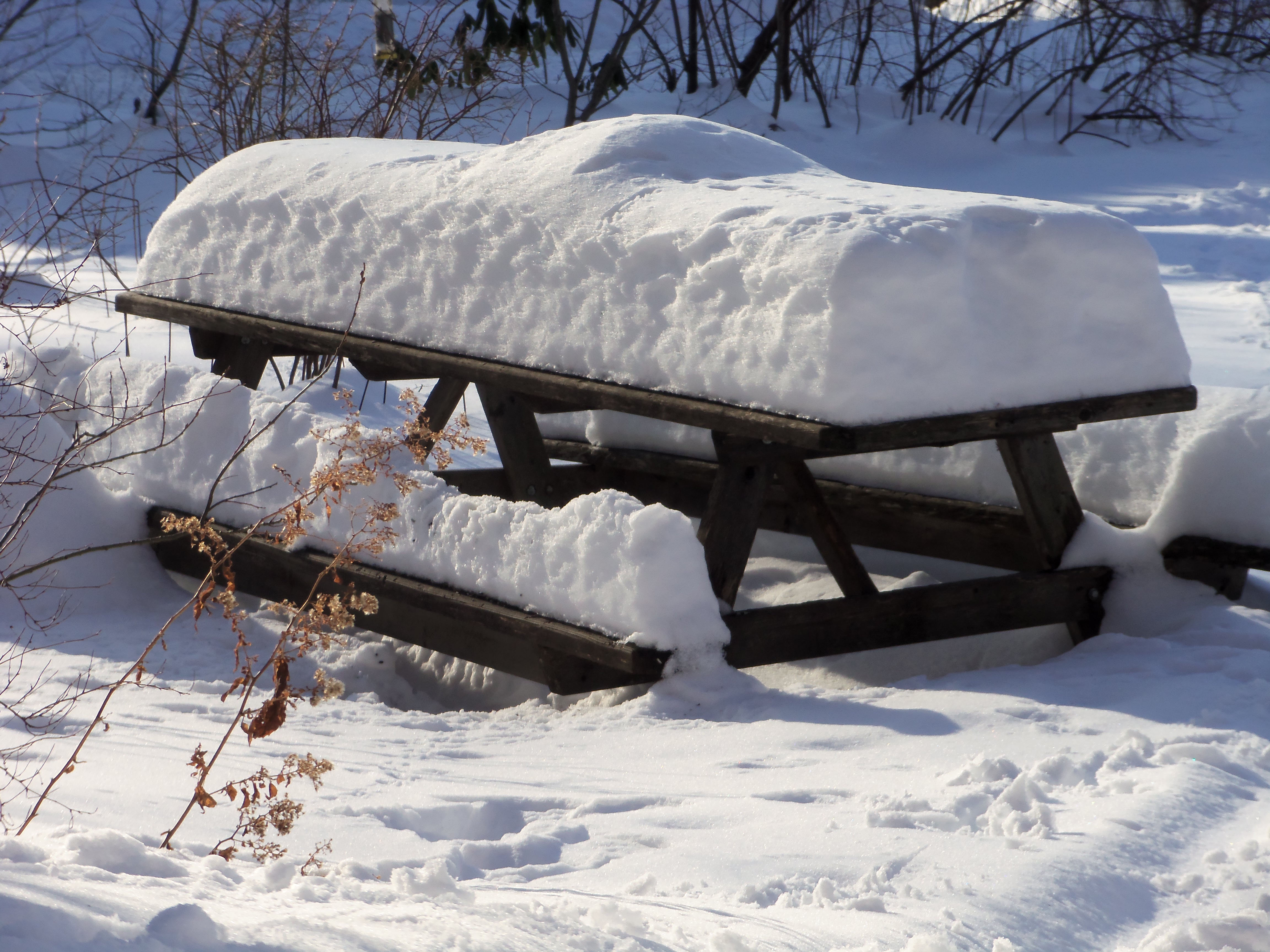
Golly, it really is too early in the season for this much snow. I spent much of yesterday digging out from a foot or so of the stuff, our first real round as we plunge into another winter, even though it’s officially still autumn and we’ve had a blanket of white on the ground for a week now.

It’s also too early to be this cold, considering the minus-2 Fahrenheit forecast for tonight. That should seal in the snow cover, for sure.

My wife is no doubt anticipating sending me outside with a guest or two to harvest Brussels sprouts in a little over a week, when it comes time to prepare for our traditional Yule feast. Looks like once again we’ll be using an ax to break the icy covering and a shovel to locate the greens. I’ve previously posted about the way frost gives the sprouts and kale a wonderful sweetness, but the snowpack always thickens the plot. She finds it highly amusing, watching from the kitchen window.

Meanwhile, as I shoveled yesterday, I kept remembering that since this is just the start, it would be wise to make an extra effort to leave room for the next storm … or three or four or … Thus, don’t leave the pile at the end of the driveway so tall you can’t see oncoming traffic, be sure to push the icy wall along the driveway back so you won’t have to throw the next round higher than your shoulders, keep as much on the side away from the foundation so it won’t drain into the cellar, … Yes, there’s a long list, based on long experience living here.

Then I remembered something else. Last month, I finally got the bindings on my cross-country skis fixed – and new boots to go with them. Sure looks like a good day to go outside and try them out in a loop around the yard. Hope I keep my balance. Here we go, even before the latest forecast: With Christmas really just around the corner, we’re expecting another inch or two tomorrow.

Whee!

SOARING AND SWIRLING

In mid-March, the buzzards return, soon followed by hawks.

“Buzzards,” as one acquaintance long ago explained, “is what cowboys call turkey vultures.”

But buzzard is so much more fun to say, fast or slow.

Yes, a few linger around here all winter, along with a number of hawks. But one day, looking up, you realize the balance has changed.

They’ve mostly headed for Florida again. Along with the rest of the “snow birds.”