Thunder pealed again, and everybody packed up. Outside, Roddy and Erik danced in the eerie dusk. A soft drumming in trees sounded like drizzle, but instead of water, powder fell. Everyone appeared amazed, even elated. Weren’t we fortunate to have a volcano blow up in our face! Then Jaya recalled history: “Oh, Pompeii! Will guides conduct tours here, showing the world exactly how we victims perished? Is this the way our world will end?” Something gripped her, insisting they get home or die in the effort. She dragged Erik, protesting, to the car and raced through the grit. Autos in front of them were invisible, even their taillights, until Jaya was almost atop them. The ink blot overhead closed in on the far horizon, sealing off the last natural light. Plunging through this tar-paper snowfall on a route they knew so well, Jaya recalled the many times she had joked about being able to drive it blindfolded.
~*~
To learn more about my novel, go to my page at Smashwords.com.
Looked up as I drove by a big green lawn the other day and saw it was dotted with pink. A bright pink unlike any flowers we grow in these parts.
Then I smiled, realized the house had just been flocked – there was even a note stuck on a stick.
In a flash, even at a distance (this was the kind of place that has a small pond between the house and the highway), I sensed the two dozen flamingos were all uniform, likely brand-new, unlike the motley band we “quarantined” for our own use all too many years ago now. Why, ours even multiplied in the course of their service – some of the dads were making new ones from plywood, rather than plastic.
Flocked, you ask? Oh, I was sure I’d told that story, somewhere.
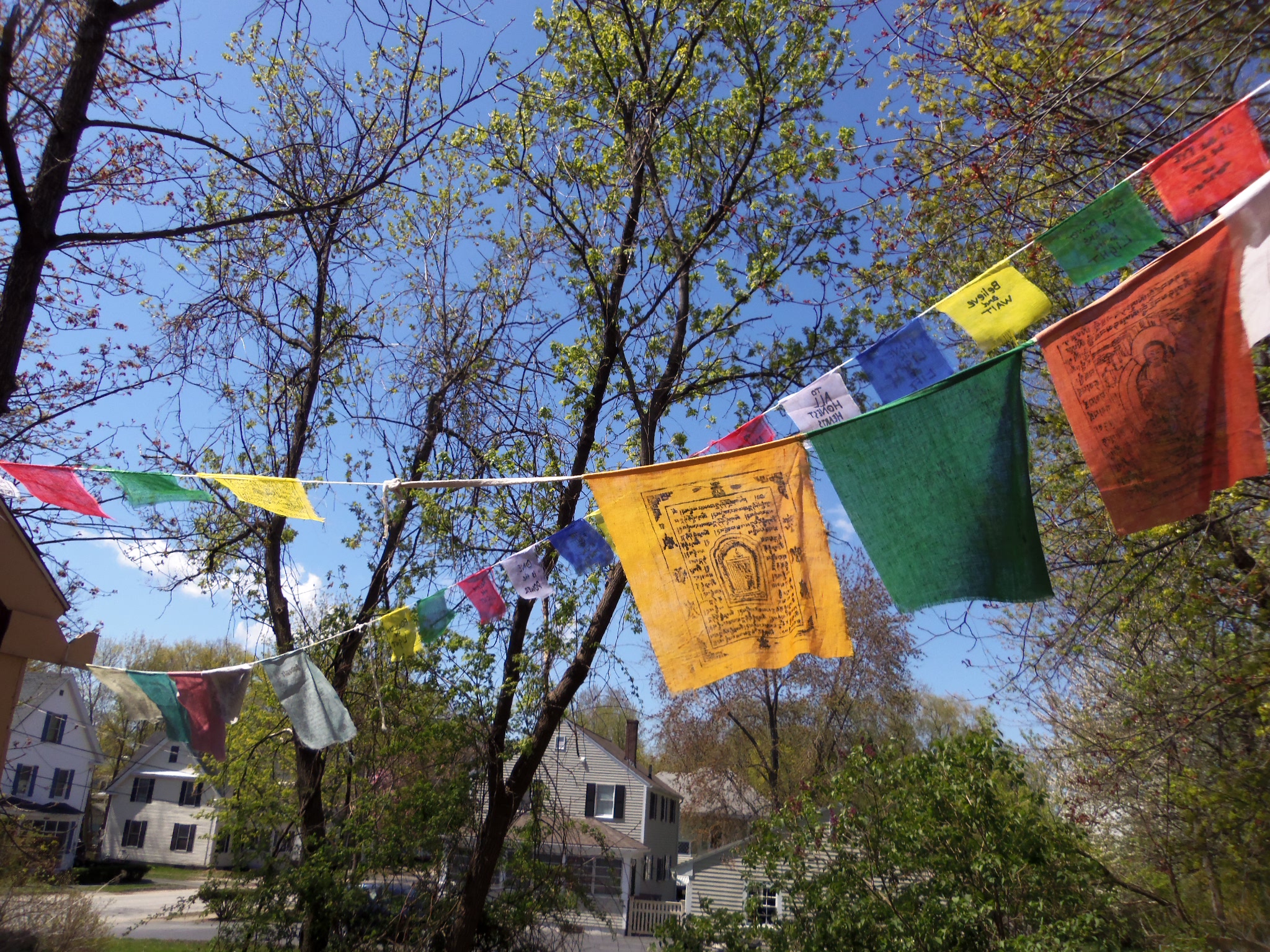
Each spring, new flags join the line in our yard. The second strand, at the rear, has quotations from James Nayler, a powerful minister in the early Quaker movement.
The Apostle Paul has urged Christians to pray without ceasing.
I view Tibetan prayer flags rising in the breeze as joyous reminders my heart can do likewise.
Seeing a yuppie neighbor tackle another home project was always amusing. You could tell by the shiny new brand-name tools in the driveway. Always the he-man approved brands, at that. All for a 15-minute or half-hour job.
What a contrast to the beat-up weapons used by the professionals I knew! Or even the more skilled neighbors.
Pay attention and you can find a lot of good stuff at yard sales, including aluminum ladders and fold-down sawhorses.
But sometimes, it just pays to pay more for quality. My favorite garden spade demonstrates this perfectly. Purchased at a local greenhouse-and-nursery, the metal from the tines extends up and around the shaft, rather than being jammed into its end. There’s no separation while forking, unlike the cheaper models, the ones we still have but rarely use. No, those are just too frustrating. I’m sticking with my better designed favorite.
Here’s my favorite. The forks are cast as a single piece with the sleeve that fits over the handle.In the less expensive model, the forks are jammed straight into the handle. Over time, however, they pull out while you’re using them, leaving you frustrated and saying things you shouldn’t.
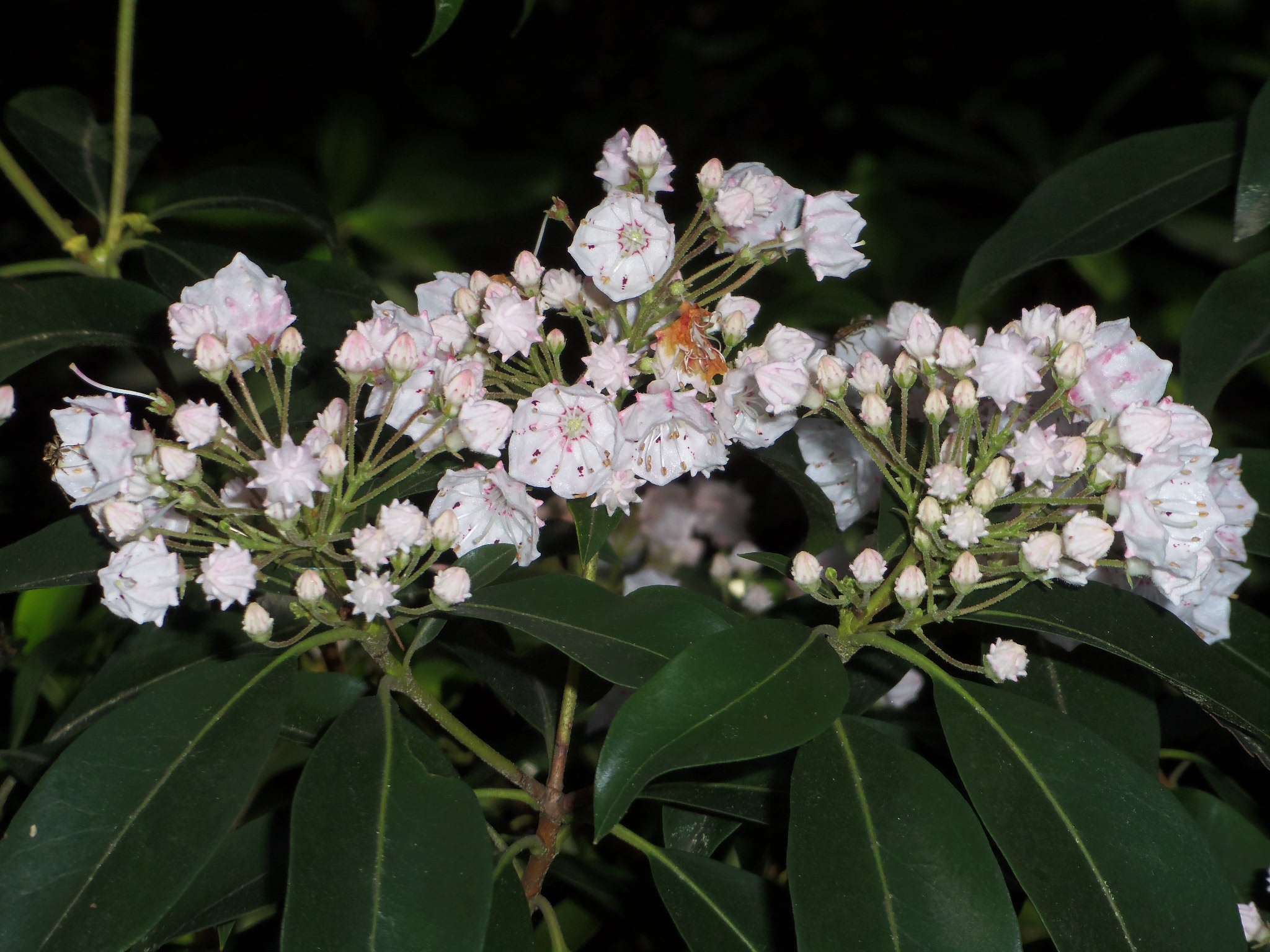
Mountain laurel have taken hold in our Quaker burial ground. Now, if I could only get them to do likewise in our yard.
My fondness for mountain laurel springs from my days in the ashram in the Poconos. Those tiny white clusters like origami that open into tiny teacups are, I was told, the state flower of Pennsylvania, and protected by state law.
My fondness for rhododendron goes back even further, to backpacking a section of the Appalachian Trail as an 11-year-old Boy Scout and coming upon Roan High Knob in full bloom in North Carolina.
Joe Pye weed is something I’ve learned to appreciate here, after we bought our annuals at the Conservation District sale.
Add that, as it thrives, to our azaleas.
Rhododendron and mountain laurel line the lane under tall pine in our undisturbed Friends burial ground.
On a May night five years ago, while driving home from the office, I did something I’d never before done: braked to keep from hitting an owl. Actually, I began braking because of a gray flutter in the foliage on the right side of the road – a deer, perhaps, or moose, because of the shoulder-height of the movement and color. Instead, the owl flew out over the road and continued for a hundred feet or more up Route 155 as I followed, before turning to perch in a tree, where I caught a glimpse of its shape.
Several weeks earlier, in the same stretch of roadway, I saw a smaller owl (or so I’d say) dart across the road, above the pavement by a dozen feet.
Earlier that week, I had two glorious commutes via the Mountain Route. The first, clear sky – brilliant green pointillism set off by sunlight and blue. Two days later, drizzle and fog – quite moody, especially with a matching live broadcast performance of Ravel by the Formosa Quartet, one that looked mostly, as it were, into the soft shadows rather than the usual sunlight. (Renoir, more than Monet or Serrat.)
How easily such glories can be lost in the memory. How wonderful, to revisit them.
OK, the title’s a cross between the classic “Eat your greens,” as grandmothers used to advise, and the once ubiquitous “Eat your Wheaties,” as the Cheerios folks used to advertise. But this time of year, I’m doing something that gives me a sense of being simultaneously virtuous and hedonistic.
Here’s what you do. Pick the dandelions before they blossom, hopefully uprooting them while you’re at it, and then wash the early greens before the plants turn altogether bitter. (Toss the roots aside; that’s the weeding part of the equation.) You then use the tiny leaves as the basis for salads or, I suppose, anything Florentine. Yes, food writer Angelo Pelegrini (a decade before Julia Child) was right in his praises: dandelion greens in season can be glorious. If you like spinach, you’ll understand.
We’ve been delighting on them both as cold salads and as quickly blanched greens, especially with hard-boiled eggs and/or thick, crisp bacon on top. A fried egg works nicely, too, with its runny yolk. Top your dish with grated cheese if you want. Salt and pepper to taste. Can anything be simpler?
And that’s as close as you’re going to get to a recipe on this blog. I’ll let others point to the fancier variations. For that matter, they can even match it with the right wine … or beer.
I’d thrown the kids off the PC, where they were watching an episode of The Simpsons, only to find out it was actually an assignment for the older one’s upper-level college course, the Sociology of Humor. [No joking.] And then I got around to some poetry submissions, including an acceptance or two.
Glad you like the work I sent. The elk poems arise out of the four years I spent in the desert of Washington state, bordering the “dry side” of the Cascade Range. They’re part of a series, most of which has already appeared in journals. I’m not a hunter, but living as I have most of my adult life in places near forest (even my time in Indiana and Iowa), I’ve had to acknowledge the existence of hunting as a fact of life – and the ways ancient hunting, with its religious/spiritual dimensions (the discipline of meditation, for instance, arises from waiting for the game), contrasts with modern “harvesting.” Even so, some editors have rejected the work out of hand – maybe they thought I’m a NRA member (quite the opposite, in reality – no guns for me).
Among the poems I’ve written are “After the Fact,” which comes out of Native American lore. It turns out that Gary Snyder also has a piece drawing on the same myth – “This Poem Is for Bear” – which acknowledges the aspect of the girl’s disrespecting the bruin before the abduction. I found another piece along this line of my work, “If a Man Goes Mad,” which works along a similar grain.
Finally, as I look back on the period, I reopen a longpoem, my American Olympus, based on a one-week camping trip with a now ex-wife and a former girlfriend who was visiting (who would have guessed they’d actually enjoy each other’s company). As it turns out, I still hear from the ex-girlfriend.
Typically, when you first enter a forest, you see very few animals. Maybe a squirrel or two in the shadows, and then flitting birds. It’s mosquitoes or other insects, mostly. You might as well be looking for fish. Even in a desert, where the range is wide open, this happens. Pay attention, though, and they appear, albeit largely second-hand – a snap or cracking branch, the cry of a blue jay or crow, the high-pitched exuberance of peepers in spring, the work of beavers, a feather on the trail, a tuft of fur caught in a snag, the small tunnel opening of a den, a pile of bone, a curl of snakeskin. Tracks and scats, especially. To say nothing of roadkill, along the highway.
Thus it was in my initial forays into the high country west of Yakima, where I was puzzled by deer-like pellets and tracks everywhere in the undergrowth. In time, I learned how widespread elk had become again, after being decimated a century earlier – and how crucial hunting and fishing organizations were to the conservation efforts. Although I neither hunt nor fish, I came to respect those who do so with a sense of humility and admiration. At the office, especially, Jim Gosney and Wayne Klingle told of intimate encounters in the field, while others, speaking of the occasions when they’d eaten the meat, could have been describing a sacramental meal. Heard their derision and disgust, too, regarding others who come only for slaughter. Heard, too, that the best places to observe elk were at the back of the Rez, south of town – an area off-limits to all but tribal members and their guests.
That understanding was only a small step from timeless Amerindian lore, the insights and practices arising where survival or death hung in the balance. Even before my move west, I had begun running across these stories, however haphazardly; by now, the Native American myths directly touched me in ways I found more compelling than the Greek, Roman, and Norse mythologies that fill so much of our literature. More pressing, in fact, than the Hindu and Buddhist stories I’d devoured before heading west. “If a Man Goes Wild” and “True Practice” both draw on this trove, even if some poetic license is applied; besides, the stories themselves no doubt become varied as they pass from one locality and time to another. Here, though, the animals are no longer inferior creatures but can speak and interact in an equality with humans.
From this perspective, whether we’re considering elk, moose, or bear, the reappearance of large wildlife expresses not only a healthy forest or range, but a healthy society as well. I cannot think of elk without also thinking of what’s been lost and is being lost from the North American continent. Recently, returning to my native Ohio in winter, I looked across the shorn corn and soybean fields and realized how impossible it is to imagine the endless forest my ancestors entered, when elk and wolves and Indians were still present – nor the ecological catastrophes that followed in their first years after.
For me, elk are an emblem of what I learned living in the foothills of central Washington state. Here, then, are moments when the intimacy resumes, one way or another. Elk matter, indeed.
The elk farm in Lee offers me reminders of the wilds of the Cascade Range in Washington state, especially.
The title, drawn from a line in Galway Kinnell’s “Tillamook Journal,” brings to my mind the corkscrew motion of seasons, memories, and time itself across the sequence of landscapes where I’ve dwelled.
My poems arising in this vein rarely stray far from northern woods. Or from the woodpile or fire, even in summer, no matter how unacknowledged their presence.
Nor do the poems in this range stray far from crickets, whose fiddling is akin to rubbing sticks together to create a fire. Where I live, their night rasping intensifies in early autumn, as though defying the growing chill and approaching, decisive frost. In a sense, there’s an inverse relationship between the mating songs of birds, so rampant around dawn in mid- to late spring, and the cricket activity. In the end, their music goes where the smoke goes. For now. Before starting over.
 ~*~
~*~




 Jnana's Red Barn