NIGHT WATCH

1

between sunset and sunrise
the ocean returns to desolate obsidian

of her dark depths
in the character

at best, stars above
strand of shoreline, depending

maybe the moon
with her sea-legs

or repeated slapping

2

breakers arrive as a single point of reflected white
opening out evenly in a line on either side

a lip, sometimes to one side only
rarely claiming, “I love you”

sheets of gleaming water shift on the sand
or everything way out, obscured
in fog

scolding
pipers scurry about
on their stilt-legs

at highest tide, pebbles sound of boiling

with all the sunburned drunks long asleep
or the party, behind glass or on the deck
a cigarette meanders somewhere to my left
though I catch no shards of conversation

3

if only the beach were not broken
by rocky fingers and cliffs

unseen ledges and outcroppings

or overwhelmed in abrupt tempests

the night voyageur might sail dependably
by the compass

but vessels and their crews
mostly go down along coastline
blindly

mistranslating, the whole sense stymied
by a single word, a puzzle, upturned wind

4

count the seconds, then, in the flashing
points
matched to the chart

one red-lighted buoy
white caps below

Whaleback just clearing the hilltop

a large, well-lighted ship near the Shoals
waiting for high tide to enter Portsmouth

or on a very clear night, way off
Thacher Island, Cape Ann, Gloucester

how is it the Boon flare jumps about
three spots, playing the length of shrouded rock island?

of the available beacons
the closest, curiously, appears only a muffle

in the call of the underside
“come to me”

mournful bell or horn
and strobe light

restless, relentless
rhythm, however unpredictable
retreats, advances
restores, destroys
cleanses

5

I cannot imagine rowing ten miles to an island
at midnight

after an evening in town

but they did
for a drink or conversation
so they said

Poem copyright 2016 by Jnana Hodson
To see the full set of seacoast poems,
click here.

STAY FOR THE SERVICE

I’m invited to photograph an Indian funeral for a 109-year-old woman. It’s a traditional affair, with a Pendleton trapper’s blanket on a casket lowered by hand. Even so, young punks surround me: “Don’t you think you’re crazy,” they ask, implying?

I look around for Kokopelli, who might intercede on my behalf. He’s nowhere in sight.

Later, with a Styrofoam cross and dozens of American flags, the casket rides the back of a pickup, viewed by faces in Cool-Ray sunglasses — ancient traditions side-by-side with the cheapest, most honky-tonk trinkets of the New American Way.

I wasn’t permitted to enter the house, either.

For more insights from the American Far West and Kokopelli, click here.

INVITATION TO FLIGHT

On one of my solitary walks with Kokopelli, I admire the fullness of purple-tipped grasses along the canal bank. Some offer bunched, short seeds in clusters. Others have long-shafted seeds in plumes. Or oblong, spiked seeds suspended like bells. “There must be a thousand golden variations,” I tell him. Oats. Wheat. Barley. Bread and beer. Silk-enshrouded ears of corn for sweet butter. Fat tender steaks. Sour whiskey mash. Like some people I knew. The many named needles and strands of whips and brushes reach skyward, flaying the wind, inviting birds to flight.

For more insights from the American Far West and Kokopelli, click here.

RETURN

1

slowly approaching a line
that grows from the edge of the sea
and then spreads at the harbor mouth

slowly, details emerge
and at last, some recognition
in what’s become familiar

home, or at least neighborhood
extending

attuned here, more than elsewhere

the awareness, something all your own
has happened with this place
but not knowing precisely when

in the tide
returning

2

introductions, by degrees
lapping and receding

even in six hours

Plum Island with Eric, Bill
and the baby, “Why don’t we leave our towels
down there?” rather than the crest of the dune

“you’ll see”
once the surf bubbled inches
from our possessions

or high tide covering the jetty
that shaded the sailboat venturing out

or entering a ferry on one deck
and exiting
on the return, from another

or weather

on a carefully selected
Sunday picnic, and air
optimal for swimming at the sandbar
only to have the Coast Guard
pull up in an inflatable raft with a bullhorn
“Out of the water! A storm’s coming!”
while the sky’s still cloudless but
before we reach shelter two hundred
feet away, the sun’s gone and a deluge opens

with or without hail

or the mid-afternoon ferry
through twenty-foot swells
and returning at sunset
on calm water

not that we’re friends
or have much of what you’d call
a relationship

3

miles inland, closer to the house
detecting high tide in marshes and rivers
or its absence

salt hay in cow milk

Poem copyright 2016 by Jnana Hodson
To see the full set of seacoast poems,
click here.

ANCIENT VIBRATIONS

Instead, I looked in another direction and discovered that the Yakama people once occupied 17,000 square miles and had three distinct language stocks. So, even back then one tongue was insufficient to articulate the vibrations of this place, even as an open desert. To try relating the qualities of a simple thing, a pane of hundred-year-old glass, perhaps; the interaction of clouds and sun, alkali and volcanic ash is far more complex. You start by learning the names of flora and fauna. Watch, listen, wait. I open a window and consider the current research, which places the first people here about 14,000 years before my arrival. These nomads made tools from bone and mineral. Hunted large and small game. Fished salmon. Collected river mussels. Gathered wild food plants. Given a guide and sufficient time, maybe I could learn to do these things. (Don’t look at me, Kokopelli shrugs. I’m not from around here.) Maybe I shouldn’t feel so strange about being here, either, even though such long perspective makes me feel incredibly insignificant. The Anglo civilization embodied here is only veneer concealing much deeper systems. The ancient climate was cooler and moister. The land was dotted by many lakes and small streams. Grasslands scattered with pine stands and willow flourished where there’s only sagebrush now. Food sources included bison, antelope, deer, foxes, muskrats, rabbits, ducks and geese (their eggs, too), and turtles.

I want to leap through time to join them, dressing the hides of their game, or making rattles and tools. These people used red and yellow pigments, and valued birds for their feathers as well as their flesh — cormorants, geese, condors, turkey vultures, and eagles all had clothing functions. Maybe I need some ceremonial garb. (Come, now! Kokopelli is hooting with laughter. He loves to taunt and mock me.) Tiny bone needles were used as far back as 10,000 years. I have enough trouble with steel needles today. So what do I make of their earliest burials, cremations that send the body back into spirit?

It’s obvious my own difficulties won’t end overnight.

This is a time of sparrows.

For more insights from the American Far West and Kokopelli, click here.

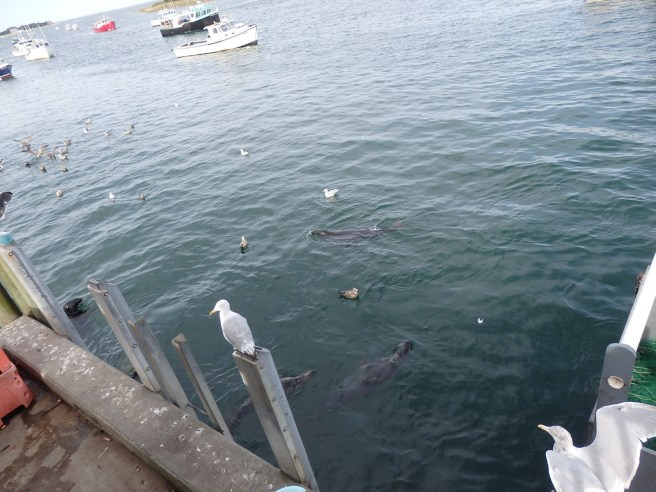
GRAY SEAL PARADISE

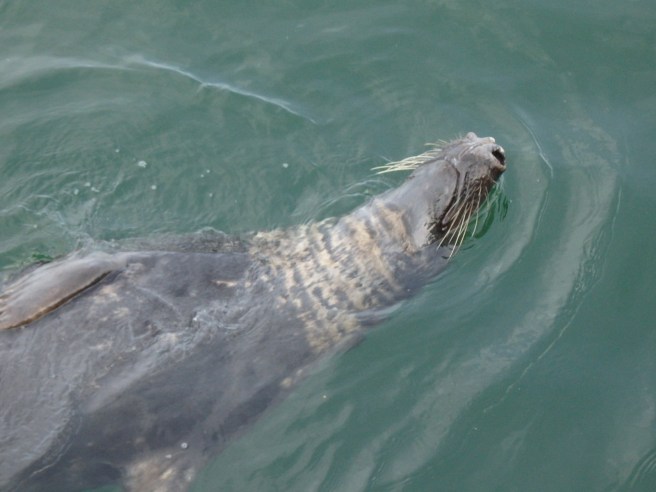
They seem to enjoy the backstroke. So do I.

The deck of the Chatham Fish Pier is ideal for viewing gray seals in motion.

The town at the elbow of Cape Cod also includes Monomoy Island, an 8-mile-long sand spit that is home to thousands of the seals, as well as great white sharks feeding on them in recent years.

Seeing four at once is common here. Another had just dived where the gulls now flock.


AS FOR WOLF

A wolf is powerful because it eats powerful food, Kokopelli warns me.

As for the girl-chasing man who’s always hungry, it’s “hair-pie,” he grins.

Although I’ve never hunted, I see points at which ancient traditions lurk within modern religious practices. Meditation, high among them, has roots in hunting and gathering. Then, too, there’s the role organized sportsmen have performed in restoring populations of wildlife, and you can learn much from hunters eminently adept at reading animals’ ways in the field. Keep an eye open.

Natures change slowly. The hunt on land and the water has barely begun.

There’s great game beyond food. Much of it, Kokopelli sings, runs through your brain.

For more insights from the American Far West and Kokopelli, click here.

ESTABLISHING DIRECTION

1

light in shimmering bronze
illuminates maritime charts and sails
unfurling with desires, an escape
in the apex of broad wakes

who you think you are
doesn’t matter
when the tide turns

a band from the North Star
turns toward harbor –
glints of affirmation or rebuke from a stranger –
ruffles bells and rigging

identities don’t matter
when the wind turns

off we go, then, and this time
this world or this way and then another

2

 five seals, headed north

their heads sparkling with stars
disappearing quickly

the austerity of beach swept clear

Poem copyright 2016 by Jnana Hodson
To see the full set of seacoast poems,
click here.

HUNTING IN THE OLD DAYS

True hunters in this country live on what they track, Kokopelli explains.

Articulating this precinct means drawing on three language stocks: Sahaptian, spoken by Klickitat, Yakama, Kittitas, Wanapam, Palus, Nez Pierce, Cayuse, and Umatilla; Salishan, by Wenatchi and Columbia; and Chinook, by Clackamas and Wishram.

Nine thousand years ago the climate resembled today’s. Around seven thousand years ago, Mount Mazama lost its head and Crater Lake emerged. Did the ash fall reduce the game? Kokopelli assumes so. About that time, Olivella shell beads show up in archeological sites, revealing coastal trade, in addition to a new kind of projectile point. About 6,500 years ago the roost became drier and warmer. Rivers ran significantly lower. Adz blades of nephrite and serpentine, about 4,500 years ago, permitted heavy woodworking and expose trade relations with what is now British Columbia. “That’s when I got this pipe,” Kokopelli says, allowing me to stroke the instrument. As winter temperatures became warmer, sizable winter villages gathered in river valleys for fuel, fresh drinking water, and greater protection from bitter winds. Such clustering required food storage capabilities and also permitted greater social and ceremonial activity, perhaps a result of more efficient food gathering. Most likely this involved salmon fishing, properly dried and preserved, caught in great numbers; fish traps and weirs were much more efficient than spears, lines, dip nets, or bows and arrows.

From this came pit houses, some of them earth-covered for insulation, others covered with mats and grass or brush. The mats swelled and froze in winter to keep wind and rain out; as spring temperatures rose, thawing provided ventilation. Such housing required well-drained soil, such as that of desert.

The tipi was introduced much later, from the Great Plains.

A-frame mat houses developed from the pit design. Their emergence especially reflected the introduction of horse culture, which added to trade possibilities and also brought saddles, bridles, quirts, dress, and ornamentation such as feathered headdresses, but above all else, ideas about tribal organization. Appaloosa were on the way. Whalebone clubs, as well as fishing nets and harpoons, were acquired through expanded trade networks.

Horses allowed more food to be brought back from summer sojourns in the mountains. Soon bowl-shaped mortars and elongated pestles were used to prepare food. “Let me tell you about real progress,” Kokopelli insists.

Each local group assumed stewardship over the economic resources of its locale. Leadership arose out of respect, not law. Ritual purification occurred in sweat houses. Three-day workouts weren’t uncommon. I wonder whether voters and candidates alike should do the same before Election Day. There is, after all, a kinship to hunting and fishing.

Kokopelli agrees.

The major run of king salmon and oil-rich sock-eye salmon comes in late May or early June, when most of the year’s food supply is caught. The best spot for dip netting is where rivers bear down through narrow channels or over low falls. Wooden platforms tied precariously to basaltic cliffs hang over whirlpools and eddies. Such stations are inherited and highly prized. Permission must be sought before fishing there.

Fish head pulverized in a mortar, then carefully packed in baskets and stored for winter, provides a highly concentrated protein food. Even a few ounces serves as a full meal.

Bears caught in a dead-fall were hunted mostly for claws and teeth — ceremonial ornaments.

Wapatoo was a type of wild potato, perhaps like camas.

Cooperative hunting and salmon harvests were common. Women’s berry picking parties, too, even though some tribes were basically river folk. Excepting the Wishram band, the Yakamas believed in individual rights. They differed from coastal tribes, which possessed slaves who might fall to a cannibal ceremony.

Much the way rabbit skins are cut in a spiral to produce long strips, I keep learning. Once you acknowledge the importance of certain foods in a given turf, you discern zone-specific energies. In ecologically aware feasting, hamburger and hot dogs are thoroughly inappropriate for many reasons. They have no authentic geographic home.

For more insights from the American Far West and Kokopelli, click here.
CURRENT, CURLING

1

 prevalent, from the west
clear and cooler, from the north
rain on the way, from the south
tempest, from the east

reading the wind

in a flag
in smoke
in running clouds
or water in a clear thistle tube

2

listen, a storm approaches
through leaves and hills
the same sound as falling water

surf repeats its snare drumming
along the shoreline

matching a far-off airplane

all voice great power
resounding

in a stream
in the tide
in air
even in a light bulb

what’s present, now
within some great
motion

around each wing
the flow of thought
keeps running

3

ring around the moon
as a warning

listen, rainfall
will warm the ocean

and swimming is best
just after high tide

Poem copyright 2016 by Jnana Hodson
To see the full set of seacoast poems,
click here.